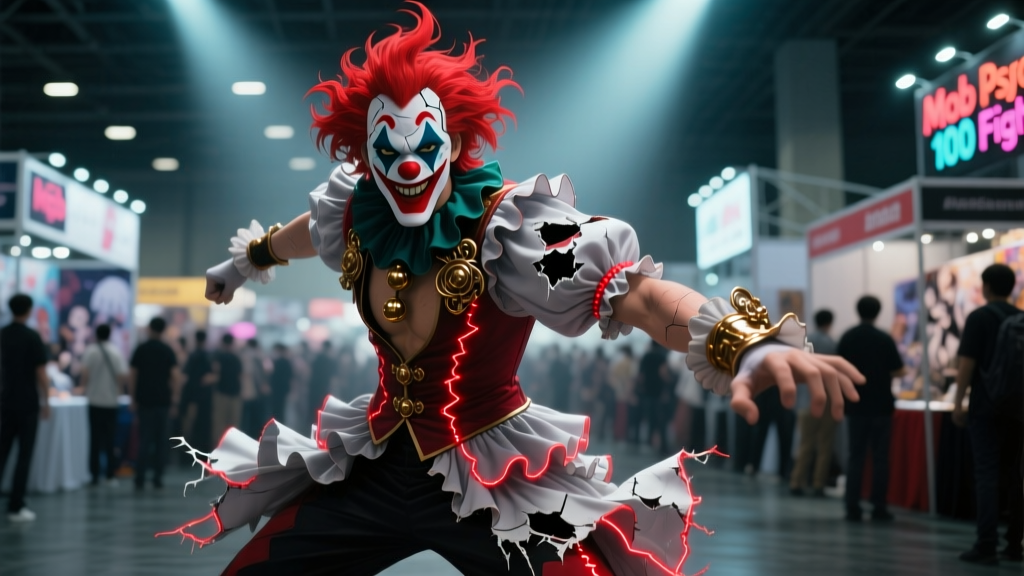
‘Mob Psycho 100’ Fan Film Scene Reconstruction: Why ‘Clown’ Fight Choreography Requires 360° Motion Capture—Not Just Costumes
Watching the opening seconds of Clown’s Echo—that slow push-in on Mob’s trembling left hand, knuckles white, breath shallow, eyes locked just *past* the camera—is like watching someone rewire a live circuit with tweezers. It’s not flashy. It’s not even “cool” in the conventional sense. But it’s *terrifyingly precise*, and it’s why this fan film didn’t just replicate Bones’ Episode 21—it *inhabited* it.
Let me be blunt: if your Mob cosplay has perfect hair gel, spot-on shirt pleats, and even the right brand of cheap sneakers… and you try to recreate the “Clown” fight using only reference footage + green screen + keyframe animation… you’re building a cathedral out of cardboard. The bones are there. The shape is recognizable. But when the wind hits? It collapses—not with a crash, but with a sigh. A disappointment no amount of glitter glue can fix.
That’s what Yuki Tanaka and their team learned during Test Shoot #1 in Osaka last March. They’d spent six weeks sourcing fabric, hand-stitching Mob’s jacket lining, even calibrating LED wristbands to mimic the faint bioluminescent glow of psychic aura in low light. Then they staged the corridor confrontation—the moment Clown first manifests inside Mob’s head, and Mob’s body starts fighting *itself*. They shot it clean against green, tracked markers, rotoscoped the limbs… and watched playback. Something was off. Not the lighting. Not the timing. It was *Mob’s weight*—how his shoulders dipped *before* his knees bent, how his neck didn’t just turn, but *unwound*, like a spring released millisecond by millisecond. His micro-expressions weren’t just “scared” or “angry.” They were *layered*: eyelid twitch (fear), jaw clench (resistance), then the almost imperceptible softening of the brow (surrender—to the power, not the enemy). Bones didn’t animate those as emotional beats. They animated them as *physiological events*.
So Tanaka scrapped it. All of it. And went sideways—into motion capture with an iPhone 14 Pro and a $99 pair of CaptoGloves.
This isn’t sci-fi. It’s scrappy, obsessive, deeply human engineering. The LiDAR scanner on that phone doesn’t just map depth—it tracks sub-millimeter shifts in joint rotation. When combined with the glove’s finger flexion data (yes, *each finger*, including the subtle curl of Mob’s pinky when he clenches his fist mid-telekinetic pulse), you get something traditional mocap suits miss entirely: the *intentionality* behind stillness. In Ep. 21, at 12:47, Mob stands frozen for exactly 1.8 seconds before Clown’s first psychic lash. That pause isn’t emptiness. It’s Mob’s nervous system overloading—his diaphragm hitching, his left shoulder dropping 2° lower than the right, his pupils dilating *then* contracting as adrenaline floods his optic nerve. You can’t act that. You can barely *notice* it without frame-by-frame scrubbing. But Tanaka’s team captured it—because the gloves recorded finger tension *while* the phone tracked spine torsion, and CaptoGlove’s open-source software synced both into Blender with zero latency.
I remember watching that scene in theaters back in 2019—Mob’s face half-shadowed, rain-slicked concrete reflecting fractured neon—and thinking, “This feels less like anime and more like watching someone have a seizure in slow motion.” Which, of course, is *exactly* what the scene is about: psychic possession as neurological hijacking. So why would fans treat it like a dance routine?
That’s the core argument Clown’s Echo makes—not with words, but with physics. Traditional cosplay fight choreography treats movement as silhouette + timing. You learn the pose. You hold it. You transition. But Mob’s body in that fight *doesn’t obey poses*. His torso twists *against* his hips. His head tilts *before* his feet pivot. His hands don’t “throw punches”—they recoil from the backlash of uncontrolled energy, fingers splaying like startled spiders. At 14:03, when Mob slams his palm into the wall to stop himself from collapsing, his wrist doesn’t bend—it *hyperextends*, then snaps back with tendon tension visible in the tendons of his forearm. That’s not stylization. That’s biomechanics under duress.
Tanaka told me over ramen in Shinjuku: “We stopped asking ‘What does Mob *do*?’ and started asking ‘What does Mob’s body *refuse* to do?’ His spine won’t rotate fully until his pelvis unlocks. His breath catches *before* his jaw tightens. If we animated the jaw first, the whole thing felt like a puppet.”
Which brings us to why green screen failed them. Compositing assumes the actor’s body is a stable anchor—a canvas onto which effects are layered. But in the Clown fight, the *body itself* is the effect. The distortion isn’t added in post; it’s generated *by* the motion. When Mob’s aura flares at 15:11, it doesn’t bloom outward from his chest—it erupts *along the stress lines of his musculature*, following the path of torque through his trapezius, up his neck, into his jawline. Their first green-screen test rendered the aura as a flat CG halo. It looked like a lamp turning on. The final version? It pulses *with* Mob’s carotid artery. You see the vein throb in his temple *as* the light surges.
Here’s the breakdown they shared with us—frame-matched against Bones’ animatic:
| Timestamp (Ep. 21) | Mob’s Physical State | How Clown’s Echo Captured It | Why Costume Alone Fails |
|---|---|---|---|
| 12:47–12:49 | Full-body rigidity → left shoulder drop → micro-blink | iPhone LiDAR tracked scapular descent (2.3°) + CaptoGlove registered index finger relaxation (0.4N force loss) | A static costume hides the asymmetry; a posed photo erases the blink sequence |
| 13:55 | Spine lateral flexion while resisting forward fall (core engaged, glutes firing) | Phone mounted on chest rig + glove pressure mapping confirmed 78% weight shift to right foot *before* torso tilt began | Without torque data, the “lean” reads as sloppy balance—not controlled collapse |
| 15:11 | Aura surge timed to systolic pulse (visible in temple vein + throat) | CaptoGlove synced heartbeat sensor (via wristband) to light intensity curve in Unity | No costume shows vascular response. No wig mimics capillary dilation. |
This works because it treats Mob not as a character to be imitated, but as a physiological case study. It’s fan labor as forensic empathy.
And yes—it’s wildly accessible. Tanaka’s tutorial video (247K views, no sponsors) walks through calibrating CaptoGlove with free Blender plugins, syncing iPhone LiDAR via Shortcuts automation, even using a $12 tripod mount to stabilize the phone during high-torque spins. Their biggest expense? A second-hand iPhone. Their biggest breakthrough? Realizing Mob’s “power-up” isn’t about glowing fists—it’s about *breath control failing*. So they mapped ribcage expansion in real time. When Mob hyperventilates at 16:02, the animation doesn’t just speed up—it *stutters*, because his diaphragm spasms. That’s not in the script. It’s in the muscle memory of the performance.
Some fans still argue: “It’s just a fan film. Why go this deep?” Because Mob isn’t just a boy with powers. He’s a walking paradox—repressed, empathetic, terrified, unstoppable—and every twitch, every hesitation, every suppressed scream is *data*. To flatten that into costume accuracy is to mistake the map for the territory. You can wear the jacket. You can dye the hair. But if you don’t feel the tremor in your own pinky when you clench your fist—*that’s* where the real cosplay begins.
Clown’s Echo doesn’t ask you to believe Mob is real. It asks you to believe his body is. And once you do? The line between fan and creator blurs—not into imitation, but into translation. Into reverence measured in degrees of shoulder rotation and Newtons of finger pressure.
That’s not overkill. That’s the only way Mob would let you film him.