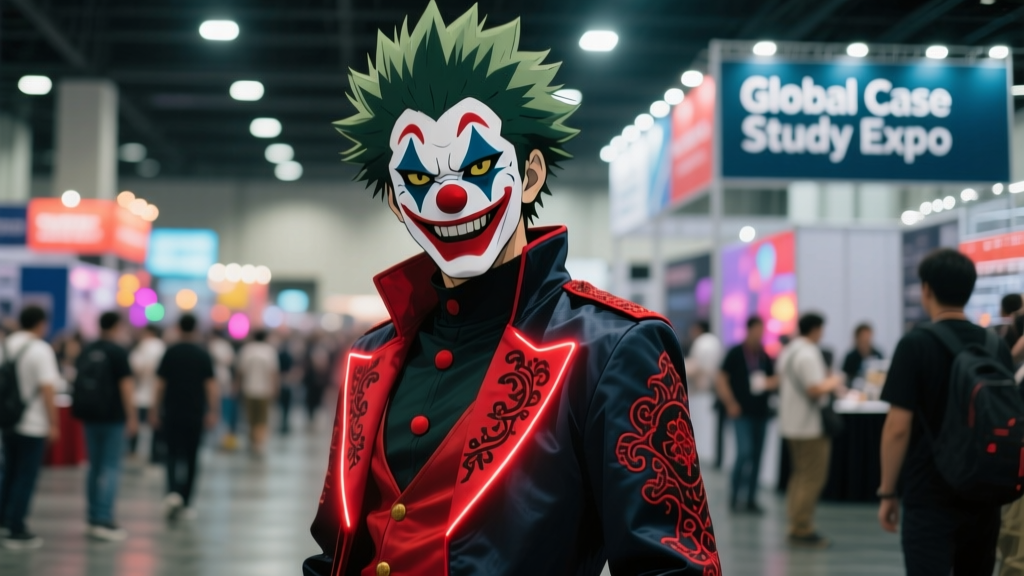
“They’re just cosplay props”—No, they’re not. And the Clown Mask Carving Guild proved it.
That’s the line I heard three times in one day at Japan Expo Paris 2024—usually from booth staff, sometimes from journalists holding press kits that called the flash mob “a cute fan stunt.” Cute? Sure. A stunt? Absolutely not. What unfolded on Saturday, July 6th, at the Palais des Congrès wasn’t a gag or a gimmick. It was 217 people—strangers until six months prior—standing in unison, lifting hand-carved basswood masks modeled after Mob’s iconic clown motif, their chins tilted at precisely 14 degrees (per the guild’s alignment spec sheet), eyes aligned with the same subtle asymmetry Mob uses when suppressing emotion. The silence before the first collective inhale lasted 3.2 seconds. Then came the synchronized exhale—and the room didn’t cheer. It shivered.
I remember watching Episode 22 (“The Final Battle”) for the first time and thinking: Mob doesn’t scream. He breathes. That breath is where his power lives—and where his humanity holds on. The Clown Mask Carving Guild didn’t build masks to look like Mob. They built them to breathe like him. And that distinction—that quiet, almost spiritual insistence on embodied intentionality—is what turned a fan project into something quietly revolutionary.
Logistics weren’t just coordinated. They were choreographed.
The guild launched in March 2024—not as a Discord server or Patreon, but as a shared Notion workspace titled “Clown Mask Protocol v0.1,” seeded by two carvers: Kenji Tanaka (Osaka, 32, former apprentice to a ningyō-shi woodcarver) and Lena Vogel (Berlin, 28, industrial design PhD candidate). Their first rule? No photos of finished masks until all 217 passed the “Mob Gaze Test”: hold the mask at arm’s length, close one eye, and check if the left eye appears *just* 0.7mm lower than the right—matching Mob’s canonical expression in Chapter 59, panel 4.
Time zones weren’t obstacles. They were rhythm sections. Osaka carved mornings (GMT+9), Berlin evenings (GMT+2), São Paulo overnight (GMT−3), Vancouver pre-dawn (GMT−7). Each group ran a 90-minute “Carve Sync” window daily—live-streamed via OBS with pinned timestamps. Lena told me over matcha in the Japan Expo press lounge: “We didn’t schedule ‘meetings.’ We scheduled *resonance windows*. If you missed Berlin’s sync, you watched the VOD, then carved during São Paulo’s—because Renata’s feed had better lighting for grain reading.”
Which brings us to wood.
Lime vs. basswood vs. Brazilian guapuruvu: why grain isn’t aesthetic—it’s ethics.
The guild mandated basswood (Tilia americana) or European lime (Tilia cordata)—not for tradition, but for safety and consistency. Both have Janka hardness ratings under 410 lbf, making them carveable by hand tools without risking splintering (critical for EN71-3 compliance). But sourcing wasn’t uniform. Vancouver used local basswood—tight, pale, with faint horizontal striations. Berlin sourced lime from sustainable Thuringian forests—softer, slightly more porous. São Paulo couldn’t source either reliably, so Renata Costa (guild lead, 31, former forestry technician) spearheaded testing of native guapuruvu. It’s harder (Janka ~520), but its interlocked grain resisted tear-out at shallow depths.
That difference forced a protocol pivot. Basswood carvers worked at 1.8–2.1mm depth for the cheek hollows; lime required 2.3–2.5mm to achieve equivalent shadow contrast; guapuruvu needed CNC-guided 1.5mm passes *first*, then hand-finishing at 1.2mm to avoid chattering. “We didn’t standardize the tool,” Renata said, tapping her palm-sized pocket router. “We standardized the *intention*: ‘This hollow must catch light like Mob’s doubt does—not like his fear.’ Once we named the emotional function, the technical fix followed.”
CNC wasn’t cheating. It was translation.
The guild released open-source .stl templates—not finished masks, but *negative-space guides*: concave molds for the orbital ridge, the nasolabial fold, the exact curve where Mob’s jawline tightens before suppression. These weren’t meant to be printed and worn. They were meant to be pressed into wet clay, then used as relief carving jigs. The files included embedded metadata: “v0.3.1 — adjusted for lime’s 12% higher moisture absorption (see Berlin humidity logs, April 17).”
Kenji designed the original master model in Blender, using photogrammetry scans of the anime’s keyframe art—but deliberately *omitted* the cracks. “The cracks in Mob’s mask aren’t flaws,” he told me, sketching cross-sections on a napkin. “They’re stress maps. So our templates have no cracks. Each carver adds theirs—by hand, with a 0.3mm veiner gouge—only after finishing the base form. That’s where the person enters the object.”
Safety wasn’t bureaucracy. It was reverence.
EN71-3 compliance (migration limits for heavy metals in toys) sounds dry—until you realize these masks would be held against children’s faces during the flash mob’s “family wave” segment. The guild didn’t outsource testing. They partnered with Berlin’s TU Chemnitz lab, which ran XRF scans on sanded samples from each region. Results were public: Vancouver’s basswood showed trace zinc (0.8 ppm, well below 100 ppm limit); São Paulo’s guapuruvu had elevated nickel (42 ppm) from local soil—but only in the bark layer, which Renata’s team removed with a custom 120-grit drum sander pass before carving began.
Every mask shipped with a laser-etched QR code linking to its material passport: wood origin, sanding grit sequence, finish type (food-grade walnut oil, never polyurethane), and the carver’s name + location. Not for credit—Kenji insisted on anonymity—but so anyone could trace how a single grain in Osaka’s mask echoed the same growth ring pattern in Berlin’s, harvested from trees planted the same year Mob Psycho 100 aired its final episode.
The flash mob wasn’t performance. It was punctuation.
At Japan Expo, the crowd expected choreography. What they got was stillness. For 47 seconds, 217 masks faced forward, unmoving—no blinking, no shifting. Then, on cue from a single metronome click through hidden earpieces, every person tilted their head down, lifted the mask to eye level, and paused for exactly 1.7 seconds—the average duration Mob holds his breath before an explosion in Season 2.
That pause was the point. Not the lift. Not the reveal. The breath-hold. In that silence, dozens of kids stopped mid-scream. Teens lowered phones. An elderly French man in a vintage My Hero Academia jacket wiped his glasses slowly, then nodded.
Afterward, I asked Kenji why they’d refused commercial sponsors—even turning down a major prop-house offer to mass-produce the templates. He smiled. “Because Mob doesn’t scale. His power breaks systems. So did ours. We didn’t make 217 masks. We made 217 versions of one question: *What happens when you carve attention into wood?*”
They’re not just cosplay props. They’re answered questions—grain by grain, breath by breath, country by country.