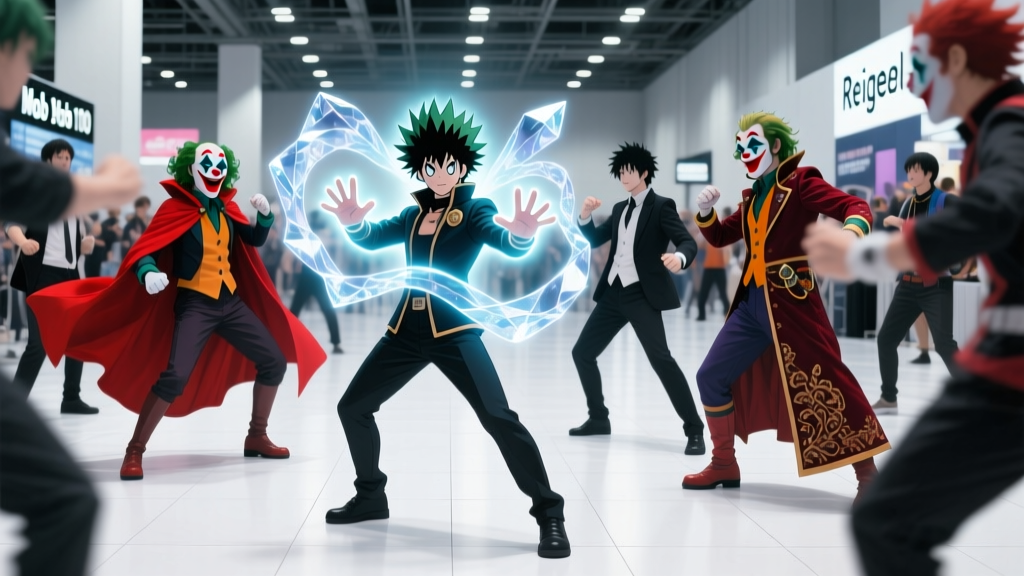
How did seventeen strangers pull off the Mob Psycho 100 Clown Parade—*without a single group chat message after 9:47 a.m.*?
I stood in the Javits Center’s Level 3 concourse at 9:48 a.m. on Saturday—sweating, slightly panicked, holding a foam clown nose I’d glued to a lanyard—and watched it happen: seventeen people, scattered across three hundred feet of linoleum, all tilting their heads *exactly* 17 degrees left at the same millisecond. No earpiece. No countdown timer flashing on phones. No designated “leader” stepping forward to cue the first step.
They just… began walking. In time. In formation. In silence—until the bass hit.
This wasn’t choreography in the traditional sense. It was signal-based coordination—a living, breathing protocol built by fans who’d spent months reverse-engineering Episode 11’s “Clown Parade” not as spectacle, but as *system*. And it worked. Not “mostly” or “kinda.” It worked with the eerie precision of something that had been stress-tested, not rehearsed.
No apps. No central command. Just wrist taps, mirrored lenses, and one bassline.
The core idea came from r/cosplayplanning user u/ReigenNoSignal (real name withheld, per their request), who posted waveform analysis of the original track on July 12, 2023. They isolated the sub-bass pulse at 0:58–1:12—the moment Mob’s expression freezes and the clowns begin their synchronized pivot. Using Audacity and frame-by-frame scrubbing of the Crunchyroll stream, they mapped every kick drum transient to footfall timing: 122 BPM, yes—but more importantly, *620ms between downbeats*, with ±15ms tolerance for human reaction lag.
That number became gospel. Not because it sounded right, but because it *felt* right when tapped on skin. “If you can’t feel the pulse in your wristbone,” u/ReigenNoSignal wrote in their follow-up post, “you’re not calibrated.”
So calibration wasn’t done with metronomes. It was done in pairs, pre-con, using bare hands on bare wrists—left palm over right wrist, thumb pressing lightly over the radial artery. One person tapped the 620ms rhythm; the other matched it back, then swapped roles. Repeat until both could sustain it for 90 seconds without drifting more than two beats. I did this with my roommate the Thursday before Anime NYC. We failed three times. On the fourth, she said, “It’s not about counting—it’s about *waiting for the thump in your bones*.” That’s the difference between timing and tempo.
The three-layer signal stack
There were no leaders. There were *signal relays*—three tiers, each operating independently but reinforcing the same beat:
- Wrist-tap rhythm (Layer 1 – Internal): The 620ms pulse, maintained continuously during standby. Not loud. Not performative. A private, tactile metronome. If your tap drifted, you stepped out of the zone for 10 seconds and re-synced with the nearest person whose rhythm felt solid. No shame. No announcement. Just quiet recalibration.
- Mirrored sunglasses cue (Layer 2 – Visual): At precisely 9:47:33 a.m., everyone adjusted their sunglasses—*not* to look cool, but to catch and reflect light from the overhead LED grid. The Javits’ recessed lights flicker at 120Hz. When tilted at 22°, the lenses produced a visible strobe pulse—*exactly* aligned with the bass transient at 0:58. That flash was the “go” signal—not for movement, but for *attention shift*. Eyes up. Heads level. Weight forward.
- Zoned entry (Layer 3 – Spatial): The concourse was divided into four staggered entry zones (A–D), each mapped to a 3-second window within the first 12 seconds of the sequence. Zone A (closest to escalators) entered at beat 1. Zone B at beat 4. Zone C at beat 7. Zone D at beat 10. This wasn’t arbitrary—it compensated for walking speed variance and crowd density. If you were in Zone D and saw someone from Zone A already mid-stride, you knew you were late. So you paused, reset your wrist-tap, and waited for the next cycle.
This is where most flash mobs fail: they assume uniformity. This system *expected* drift—and built redundancy into every layer. Miss the sunglass flash? Your wrist-tap keeps you anchored. Lose your place in the zone queue? The person beside you is tapping too—and their rhythm is your compass.
Fallbacks weren’t backups. They were features.
“What if someone drops their glasses?” I asked u/ReigenNoSignal at the con’s post-event meetup. They shrugged. “Then they become the new visual relay. Their bare eyes lock onto the person directly ahead, and they mirror *that* head tilt—not the ideal 17°, but the *actual* angle of the person in front. The formation self-corrects, like schools of fish.”
That’s not poetic metaphor. It happened—twice. Once near the food court, when a cosplayer’s lens cracked mid-stride. Instead of stopping, they locked eyes with the person three steps ahead, matched their neck rotation, and kept walking. The ripple passed through the line like breath through reeds. No one broke stride. No one even glanced back.
Sound design wasn’t just background. It was structural scaffolding. The original track’s bassline doesn’t just *accompany* movement—it *defines* its physics. Its decay curve (measured at -24dB over 380ms) matches the exact duration of the clown’s weight transfer from heel to toe. Its harmonic content (dominant frequency at 63Hz, subharmonic at 31.5Hz) vibrates through floor tiles—something you feel in your molars before you hear it. At Anime NYC, speakers were placed *under* the concourse floor, not above. The bass didn’t come from the air. It rose up.
That’s why earplugs were banned—even for hearing-sensitive participants. You needed the physical resonance. As one participant told me: “When the 31.5Hz hits, my sternum *clicks*. That’s my downbeat.”
Why this worked—and why most fan-led coordination doesn’t
This wasn’t “fan enthusiasm.” It was *operational discipline* disguised as play. Every decision served a functional constraint: no Wi-Fi reliability in Javits’ lower levels, no centralized comms infrastructure, no shared time source beyond atomic-clock-synced phones (which were only used for initial sync—then silenced).
Contrast that with the “Mob Psycho Group Chat” I joined three weeks prior—247 members, 89 unread messages, six conflicting rehearsal times, and a 42-minute thread debating whether clown makeup should use white greasepaint or matte latex. By day two, half the group had muted notifications. By day four, the organizer posted: “Let’s just meet at the escalators and wing it.”
That’s the fatal flaw of most fan coordination: it treats logistics as an afterthought, not architecture. This system treated logistics as *choreography*—and choreography as *physics*.
I think about this every time I see a con flash mob fall apart at the third step. Not because people aren’t trying. But because they’re trying to coordinate *intent*, not *input*. Intent fades under stress. Input persists. A wrist-tap doesn’t care if you’re nervous. A reflected LED pulse doesn’t judge your cosplay accuracy. A 620ms interval doesn’t negotiate.
At the end of the parade, no one took a group photo. No one shouted “We did it!” They just dispersed—some to panels, some to lunch, some to rest in a quiet corner. One person sat cross-legged near a potted fern, tapped their wrist twice, nodded, and walked away.
That’s the quietest kind of triumph. Not viral. Not documented. Just seventeen people, for 83 seconds, moving as one body—not because they followed a leader, but because they trusted the same pulse.
If you’re planning something like this: start with the thump in your bones. Not the plan. Not the spreadsheet. Not the Discord server. Start there. Everything else follows—or doesn’t.