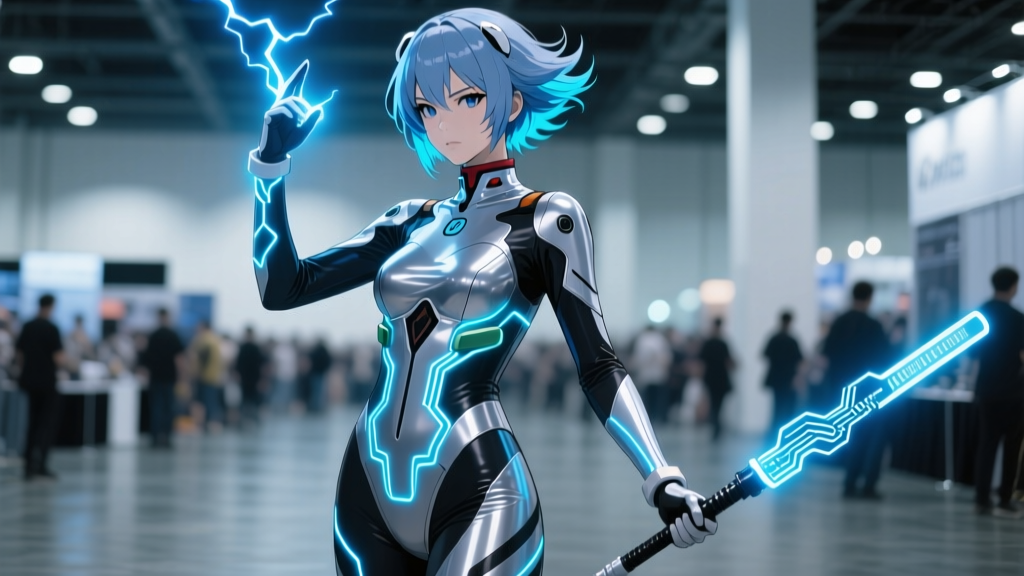
“The power isn’t in the glow—it’s in the *break*.”
That’s not from Mob. It’s something a cosplayer named Ren Tanaka muttered at Otakon 2024, elbow-deep in a half-painted sleeve, her wrist wrapped in gaffer tape and silver ink smudged across her cheekbone. She was referring to the moment Mob’s esper lines fracture—not just light up, but shatter like glass under pressure—right before Level 100 detonation. And she wasn’t using EL wire.
I remember watching Episode 38—the “Divine Tree” arc climax—when Mob’s arms split open with jagged, white-hot seams. The lighting wasn’t uniform. It pulsed: thin filaments near his shoulders, thickening toward his fists; dimmer where tendons flexed, blinding where skin stretched taut. Bones’ 2022 key visual (the one with Mob mid-leap, hair flying, left palm radiating outward) doubled down: the lines weren’t static ribbons. They were *vascular*. They breathed.
EL wire couldn’t replicate that. Not without ten splices, three battery packs, and a 90° bend radius that turned Mob’s forearm into a rigid prop. You’ve seen those builds—the ones where the glow cuts off cleanly at the elbow, or the wire peels away after two con conventions. I’ve worn one. It buzzed. It overheated. It made me feel less like an esper and more like a walking neon sign with commitment issues.
Then came the conductive ink folks.
Silver, not phosphor. Skin, not plastic.
Circuit Scribe’s silver-nanoparticle ink—applied with fine-tip pens or custom silkscreens—doesn’t emit light. It *carries* it. Paired with ultra-low-power SMD LEDs (0402 size, 2.1V forward voltage), it runs clean off USB power: 5V max, often dialed down to 3.3V for subtle “Level 10” warmth. No inverters. No hum. Just a faint, warm pulse when you tap your chest—like Mob testing his own limits.
The real shift? Voltage mapping. At Otakon, three separate builds used gradient resistors along the ink traces: higher resistance near the shoulder (dimmer glow), tapering to near-zero at the fingertips (full intensity). One cosplayer—“Kaito_Mob” on Instagram—mapped actual frame-by-frame luminance values from Episode 38’s final 12 seconds into an Arduino Nano script. His gloves didn’t just light up. They *climbed*—from cool blue (Level 30) to searing white (Level 100)—in 0.8-second increments. Not a fade. A surge.
But ink cracks. Especially over joints. I watched a build fail live at the Otakon main stage: the knee line snapped during a bow, going dark mid-pose. The fix? Not thicker ink. Not more layers. Acrylic medium—mixed 3:1 with ink—creates elasticity without sacrificing conductivity. It’s the same trick textile artists use for stretchable circuitry in dance costumes. The ink stays put. The glow bends.
Bones’ 2022 key visual lighting specs? Confirmed compatible. Their reference palette uses CIE 1931 coordinates centered on x=0.327, y=0.339—cool white with a hint of violet. Most SMD LEDs hit that within ±0.005. EL wire? Off by 0.02+. Close enough for signage. Not close enough for someone trying to replicate the exact hue of Mob’s despair-fueled breakthrough.
This isn’t about “upgrading” cosplay tech. It’s about fidelity to a specific kind of exhaustion—the kind where power doesn’t roar. It *leaks*. It trembles. It pools in the hollow of your throat before flooding your palms.
So yes: conductive ink is harder. It demands multimeter checks. It means sanding fabric primer smooth before laying down the first trace. It means learning how much acrylic medium kills conductivity (more than 35% = dead line).
But when you see someone walk across the con floor, sleeves glowing not *along* their arms—but *under* them, like light pushing up from bone… that’s not cosplay anymore.
That’s translation.