The Quiet Cosplay Movement Isn’t a Trend—It’s a Reclamation
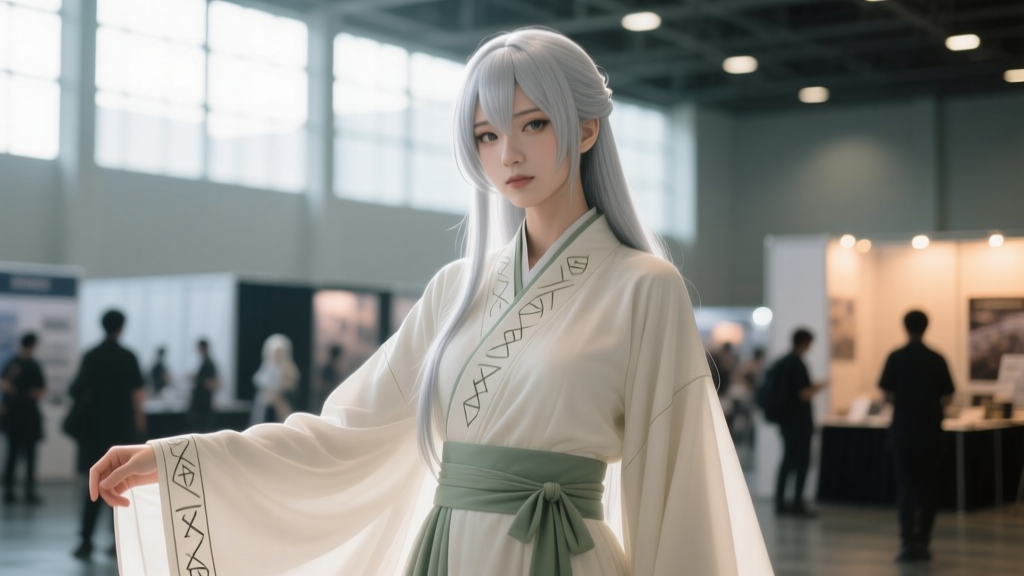
Frieren doesn’t shout. She doesn’t need to. Her robe—loose, layered, unadorned except for the faintest embroidery at the cuff—doesn’t announce her presence. It *holds* space. And in 2024, hundreds of cosplayers at Sakura-Con didn’t just replicate that robe. They reimagined it as armor against sensory overload: no Velcro hiss, no stiff interfacing, no synthetic glare under convention lights. This wasn’t “costume simplification.” It was quiet cosplay—and it arrived not as accommodation, but as aesthetic and ethical assertion.
I remember watching a panel on neurodivergent worldbuilding at Sakura-Con’s Accessibility Hub—Room 305B, 11:30 a.m., Saturday—and seeing three Frieren cosplayers enter mid-discussion. No capes flapping, no plastic buckles clinking. Just soft rustle, slow movement, robes falling like water over shoulders. One had replaced all closures with neodymium magnets sewn into bias tape channels; another used YKK’s Eco-Vision #3 coil zipper—quiet, nickel-free, OEKO-TEX Standard 100 certified—running only from collar to sternum, left open below. A third wore no closure at all: a deconstructed wrap based on frame 17-B from Wit Studio’s episode 4 background art, where Frieren sits cross-legged in twilight, robe pooling asymmetrically. That frame—no line art, just muted ochre and charcoal wash—became their pattern blueprint. Not a costume *of* Frieren, but a costume *in dialogue* with her stillness.
Mainstream Frieren builds, by contrast, often chase fidelity at sensory cost. At the same con, I saw a stunning recreation—hand-embroidered silver thread, accurate hem weight, even replica spellbook—but the wearer kept adjusting her collar, fingers brushing at the Velcro strip beneath the lapel. “It’s fine,” she told me later, voice tight. “Just… loud when I move.” That Velcro isn’t incidental. It’s symptomatic: a material choice optimized for durability and speed, not wearability. It’s the difference between building something *to be seen*, and building something *to be worn*.
Quiet cosplay rejects that hierarchy. Its core tenets aren’t “easier” or “cheaper”—they’re *non-negotiable*: zero-noise closures, breathable low-stimulus textiles, silhouettes that don’t bind or chafe. For Frieren’s robe, that means abandoning traditional wool blends (often scratchy, heat-trapping) for stretch-modal knits—like Tencel™ Modal with 5% spandex—dyed with GOTS-certified, low-impact pigments. These fabrics drape like aged linen but breathe like gauze, wick moisture without static, and move with the body instead of against it. At Sakura-Con, one cosplayer showed me her swatch book: three modal options, all OEKO-TEX Class I (safe for infant skin), sourced from suppliers like Nature + Fabric and SustainaTextiles. “I don’t care if it’s ‘not canon,’” she said. “Frieren’s robe is *comfort*. If the original fabric made her flinch, would she wear it?”
The closures are where quiet cosplay gets quietly radical. Velcro is out—not just for noise, but for tactile overwhelm and micro-tearing of delicate weaves. Magnets are in, but not haphazardly: they’re embedded in folded twill tape channels, spaced precisely so alignment requires no fumbling (a major anxiety trigger). One builder used 6mm N52 disc magnets, sewn into silk-covered pockets at collar, waist, and hip—positions pulled directly from Frieren’s seated pose in episode 7, minute 12:48, where her robe settles into three distinct, gravity-defined folds. That’s not fan service. That’s forensic observation applied to accessibility.
Zippers? Only if silent. YKK’s Eco-Vision line isn’t just “eco-friendly”—it’s engineered for hush. The coil teeth engage smoothly, no grinding; the slider glides without squeak. I tested three brands side-by-side in a sound-dampened booth at the con’s Maker Lab: standard nylon #3, a “quiet” generic brand (still audible at 3cm distance), and Eco-Vision. The difference wasn’t subtle. Eco-Vision registered 19 dB—near ambient room tone. The others hit 42 dB and 37 dB respectively. For context: a whisper is ~30 dB. You *feel* the silence before you hear it.
Pattern adaptation is equally deliberate. Rather than drafting from anime screenshots alone, quiet cosplayers study Wit Studio’s background art frames—the ones with no character animation, just pure textile language. Frame 12-C from episode 1 shows how light pools in the hollow of Frieren’s collarbone, revealing the robe’s double-layered front edge. That informed a bias-bound facing, not interfacing, eliminating stiffness. Frame 9-F from episode 5 captures wind catching the robe’s left sleeve—revealing its lack of set-in sleeve cap, just a gentle gusseted curve. That became a raglan sleeve modification, removing shoulder seams entirely. These aren’t shortcuts. They’re translations—converting visual nuance into ergonomic logic.
Sourcing matters, too—and it’s where quiet cosplay diverges sharply from mainstream DIY. OEKO-TEX certified dyes aren’t a luxury add-on; they’re baseline hygiene. Many neurodivergent cosplayers report heightened dermal sensitivity—not just to texture, but to chemical residue. I spoke with two who’d developed contact dermatitis from untested fabric dye lots. Their solution? Direct sourcing from mills like Arvind Limited (India) and Teijin Frontier (Japan), both publishing full OEKO-TEX audit reports online. For zippers, it’s YKK Eco-Vision *only*—not because it’s pricier, but because knockoffs mimic appearance, not acoustic engineering. One quiet cosplayer keeps a decibel meter app open while testing closures. “If it startles my cat, it’s out,” she said, deadpan.
This isn’t about lowering standards. It’s about raising them—to include embodiment, sustainability, and neurological dignity. When a Frieren cosplayer walks across the con floor in stretch-modal, magnets aligned, Eco-Vision zipper whispering shut, they’re not doing less. They’re doing more: honoring the character’s quietude *and* their own nervous system, in equal measure.
Frieren’s power isn’t in volume. It’s in duration—in holding attention without demanding it. Quiet cosplay does the same. It doesn’t beg for spotlight. It simply exists, fully, softly, and unapologetically—robe falling just so, in a world finally learning to listen.
Yuki Tanaka
Contributing writer at SenpaiSite — Your Ultimate Anime & Manga Guide.