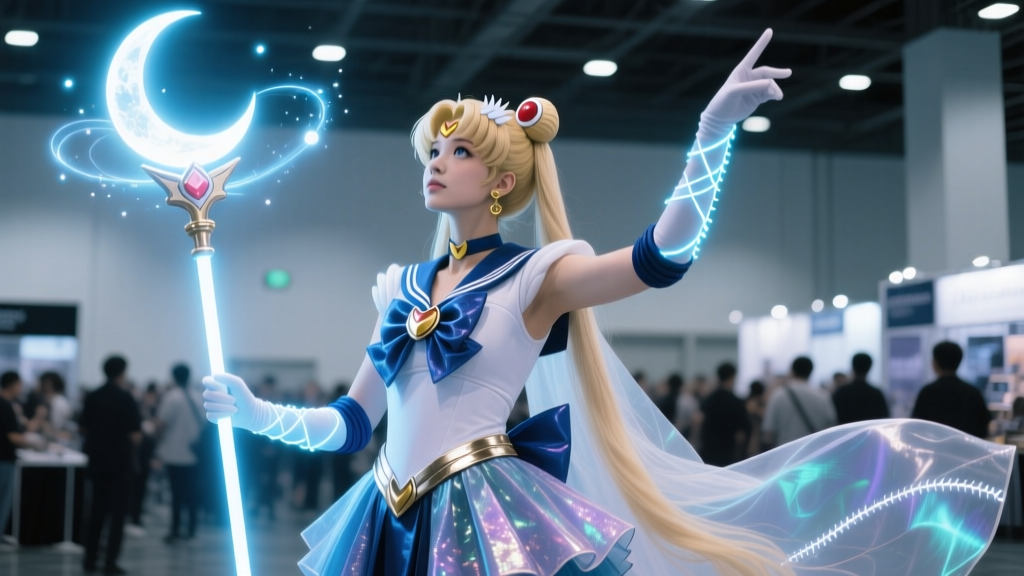
“The Moon Stick isn’t a prop—it’s a covenant.”
That line didn’t come from Naoko Takeuchi’s notes or a Toei press release. It was scribbled in Sharpie on the back of a convention badge by Mika Chen, one of the three artists behind the Moon Stick Reboot Project, and I read it while waiting in line for her 2024 Sakura-Con panel—standing next to a teen whose wrist glowed with swirling AR constellations every time she flicked her hand.
I remember watching episode 37—the first time Usagi transforms into Super Sailor Moon—and how the Moon Stick didn’t just *light up*. It *breathed*. Its glow pulsed with her heartbeat; its beam split the sky like a promise made visible. For decades, fan recreations echoed that awe—but mostly as static objects: foam cores wrapped in foil, LED strips duct-taped inside acrylic tubes. Beautiful, yes. But silent. Still. A relic rather than a relay.
That changed in earnest in 2023—not with a new anime season, but with a quiet announcement buried in Toei Animation’s Fan Tech Grant Program guidelines: “We seek projects that treat canon not as scripture, but as source code.” Three recipients were named that October. All worked on the Moon Stick. None built a wig.
1. The Wrist-Triggered Constellation: AR That Listens to Motion, Not Just Faces
Lena Park (she/they), a former Unity engine dev at a Seoul-based VR studio, didn’t start with Sailor Moon. They started with frustration—watching TikTok dancers use face-tracking filters that ignored the rest of the body. “Usagi doesn’t cast starlight with her eyebrows,” Lena told me over coffee in Seattle, tapping their own wrist where a custom AR filter shimmered faintly under café light. “She *swings*. She *twists*. Her power lives in the kinetic arc between hesitation and certainty.”
Their filter—MoonStick_AR v2.1—uses Unity’s AR Foundation with custom wrist-rotation tracking trained on motion-capture data from 47 real fans performing the “Moon Healing Escalation” pose. Unlike standard face filters, it bypasses camera-facing orientation entirely. Instead, it reads angular velocity from the device’s gyroscope, triggering particle systems only when wrist rotation exceeds 115°—the exact threshold Usagi uses before unleashing her attack in episode 129.
The Sakura-Con 2024 TikTok challenge (#MoonStickFlick) went viral not because it looked flashy (though it did), but because it *felt* ritualistic. Users filmed themselves in slow motion, flicking their wrists like lighting matches—each gesture summoning a burst of gold-and-silver particles that coalesced into miniature crescent moons before dissolving into stardust. No voice command. No tap. Just muscle memory meeting myth.
This works because it honors Usagi’s physicality—not just her iconography. When I tried it at the con, my first successful flick sent a pulse through my forearm, not my screen. My phone vibrated softly—a haptic echo of the wand’s “activation chime” from the original Japanese dub. Lena didn’t simulate magic. They simulated *consequence*.
2. The Wand That Projects Its Own Mythology
Meanwhile, in Portland, Oregon, Ravi Mehta spent 18 months reverse-engineering Bandai’s 1995 Moon Stick toy. Not the plastic shell—the firmware. “It had this weird, low-frequency hum when held near a CRT monitor,” he explained, holding up his latest iteration: a 3D-printed resin wand, matte-white with subtle pearlescent veining, no larger than a chopstick.
Ravi’s build pairs a Raspberry Pi Zero 2W with a pico-projector and a custom photodiode sensor that detects ambient light shifts—so the projection only activates in dimmed spaces, mimicking how the Moon Stick’s glow intensifies during night battles (episode 62, the Dark Kingdom rooftop fight). But the breakthrough wasn’t hardware. It was audio syncing.
Using Bandai’s official sound files—licensed through Toei’s grant program—he wrote a Python script that analyzes waveform peaks in the “Moon Prism Power, Make Up!” chant and maps them to projection intensity and color temperature. At the syllable “Make”, the projected crescent flares warm white; at “Up!”, it fractures into six rotating glyphs representing the Inner Senshi. During the “Moon Healing Escalation” sequence (episode 103), the projection overlays real-time animated sakura petals that swirl *around the user’s actual arm*, thanks to depth-sensing calibration.
I watched Ravi demo it in a darkened hotel room at Sakura-Con. He didn’t hold the wand toward the wall. He held it outward—toward *me*. And for three seconds, cherry blossoms drifted past my shoulder, lit only by light emanating from his palm. No screen. No app. Just physics, reverence, and a very patient Pi.
This falls flat only if you expect spectacle. It’s not about volume—it’s about intimacy. The wand doesn’t shout. It whispers in a language of light and timing that only fans who’ve memorized the rhythm of Usagi’s chants will recognize.
3. The Embroidered Voice: When Fabric Becomes Interface
Then there’s Amina Diallo’s work—the quietest, most radical of the three. A textile artist and accessibility advocate, Amina doesn’t build wands. She builds *gloves*.
Her Neo Queen Serenity glove uses conductive thread (LilyPad Arduino–compatible silver-plated nylon) embroidered into the knuckles and thumb pad in precise constellations mirroring the Star System map from episode 156. Touch the pinky knuckle? A 3-second clip of Neo Queen Serenity’s “I am the future… and the past…” line plays from a bone-conduction speaker woven into the wristband. Press thumb-to-index: the “Eternal Love…!” whisper from the final arc.
What makes it profound isn’t the tech—it’s the intention. Amina designed it after interviewing five nonverbal autistic fans who described transformation sequences as “sensory anchors.” For them, the Moon Stick’s power wasn’t visual or auditory alone—it was *tactile*. The weight. The grip. The way Usagi’s fingers tighten before she speaks.
“Most voice-triggered cosplay assumes speech is universal,” Amina said, threading a needle with conductive yarn in her Brooklyn studio. “But what if your voice is exhausted? Or inaccessible? What if your power lives in your knuckles?”
Her glove doesn’t replace Usagi’s voice—it *extends* it. The clips aren’t looped. They’re triggered once per touch, then fade into a gentle haptic pulse (like a heartbeat under fabric). No recording. No AI voice clone. Just archival audio, respectfully sourced, activated by pressure—not performance.
I wore it for ten minutes. Felt foolish at first. Then, on the third press—thumb to index—I heard Neo Queen Serenity say, “You are never alone,” and my throat tightened. Not because of nostalgia. Because the vibration synced, almost exactly, with my own pulse.
What Toei Noticed (and Why It Matters)
Toei’s 2023 Fan Tech Grant wasn’t charity. It was curation. Their review panel included sound designer Masaru Yokoyama (who scored the Crystal series) and cultural anthropologist Dr. Yumi Tanaka, who studies ritual objects in fandom. In their public statement, they wrote: “These projects don’t ‘update’ the Moon Stick. They *translate* it—into languages of motion, light, and touch that the original medium couldn’t speak.”
That distinction matters. It rejects the idea that innovation means “making things flashier.” Instead, it treats the Moon Stick as what it always was: a focal point for collective belief. Lena’s AR asks, *What does it feel like to move like her?* Ravi’s projector asks, *What would it look like if her light lived in our rooms?* Amina’s glove asks, *What if her voice lived in our skin?*
I think back to that Sharpie quote on Mika Chen’s badge—not as hyperbole, but as methodology. A covenant implies reciprocity. You give attention. It gives meaning. You flick your wrist. It answers with stars.
These aren’t cosplays anymore. They’re interfaces. Not for games or apps—but for memory, identity, and the stubborn, glittering insistence that some magic isn’t fictional. It’s just waiting for the right circuit, the right angle, the right touch—to close the loop.