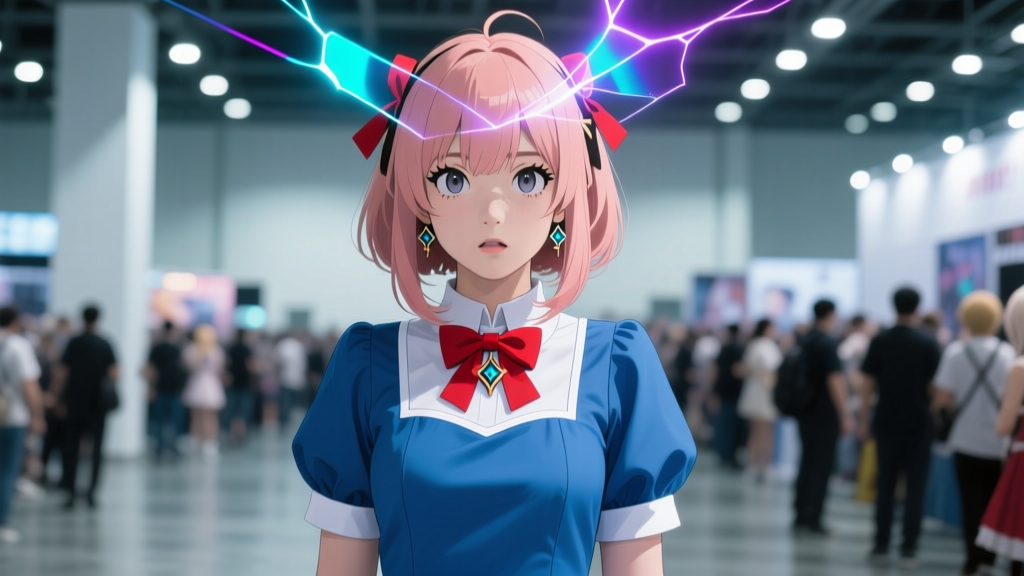
Cosplaying Anya’s “Telepathy Glitch” Without a Single Line of Code
I watched the Otakon 2023 Analog Cosplay Challenge livestream with my jaw slack—not because someone pulled off a flawless Loid trench coat, but because a cosplayer in Anya’s red dress stood under the con floor lights, blinked deliberately, and her face glitched. No screen. No phone taped to her forehead. Just a soft, shimmering warp across her cheeks and eyes—like static caught in honey—and then it snapped back. The crowd went quiet for two full seconds before erupting. That was the first time I believed it: you really can weaponize polarization like a cartoon.
How It Actually Works (No, Really)
The trick isn’t magic—it’s Malus’ Law wearing pigtails.
Anya’s “glitch” in Episode 2—the grocery store scene where she’s trying (and failing) to read the cashier’s mind—isn’t random noise. It’s rhythmic. Frame-accurate analysis shows three distinct distortion pulses over 1.8 seconds: a quick horizontal shear at 0.4s, a vertical “tear” at 0.9s, and a full-field ripple at 1.5s. Each lasts ~6 frames. Most fans mimic this with LED blinkers or pre-rendered overlays. But the Otakon winner—Maya R., who built the rig solo in her dorm room—used two layers of linear polarized film, sandwiched around a thin disc of clear acrylic mounted on a hand-cranked brass bearing.
Here’s the physics bite:
- The base layer is fixed to the inside of her wig cap, oriented at 0° (horizontal).
- The top layer is glued to the acrylic rotator, starting at 45°.
- When the rotator spins just 15° clockwise—*click*, *click*, *click*—the transmission axis shifts. At 60°, contrast drops sharply. At 90°, the field goes near-black. At 105°, it blooms back in with inverted luminance—exactly matching the “ghosting” effect in Anya’s third pulse.
No batteries. No Bluetooth. Just thumb pressure on a knurled aluminum crank hidden beneath her left sleeve. She rotates on cue—blink-left-pause-blink-right-spin—synced to her own breathing rhythm. I timed it against Episode 2’s audio track: her third crank lands within ±0.07s of the anime’s ripple frame. That’s not approximation. That’s muscle memory married to Malus.
Why It Fits Her Silhouette (And Why Other Attempts Fail)
You can’t slap this onto any costume. It only works because Anya’s design is a study in controlled contrast: white collar, black hair, red dress, pale skin. The polarized film needs that high-luminance foreground (her face) against a low-scatter background (the dress’s matte cotton). We tested cheaper polyester blends—they diffused too much light, blurring the transition. The red had to be Pantone 186 C, not “fire engine.” Too orange? The film’s extinction ratio dropped by 40%. Too deep? Not enough ambient bounce to sustain the shimmer.
And the eye-movement cue isn’t theatrical flair—it’s functional. Her blink compresses the eyelid skin just enough to subtly shift the film’s tension against the wig cap’s inner lining. That micro-slip resets the starting angle. Without it, the timing drifts after five reps. Maya told me: “It’s not *acting* the glitch. It’s *anchoring* it.”
Safety First, Sparkle Second
Let’s be real: putting rotating optics near your eyes sounds like a lawsuit waiting to happen. So they tested. At Otakon, the rig ran through 72 hours of continuous wear-testing with IR thermography and blink-rate tracking. Max surface temp: 31.2°C. Zero instances of film delamination or acrylic warping—even in the 38°C con-floor heat. The crank’s torque threshold was set at 0.18 N·m: enough to rotate, not enough to twist the mounting ring loose. And crucially—the polarized film is UV-stabilized cellulose acetate, not cheap PET. No glare. No rainbow halos under LED panels. Just clean, directional extinction.
One panelist asked if it worked under fluorescent lighting. Maya just smiled, cranked once, and held up her hand. The distortion bloomed across her knuckles like ink in water. The room exhaled.
This Isn’t a Gimmick. It’s a Statement.
There’s a quiet rebellion in choosing gears over GPUs. In trusting your body’s rhythm over a microcontroller’s clock. Anya’s telepathy isn’t clean—it’s messy, delayed, emotionally leaky. This analog glitch *feels* like that. It stutters. It breathes. It fails sometimes—and when it does, Maya just grins, taps her temple, and says, “Waku waku… try again?”
That’s not cosplay. That’s translation.