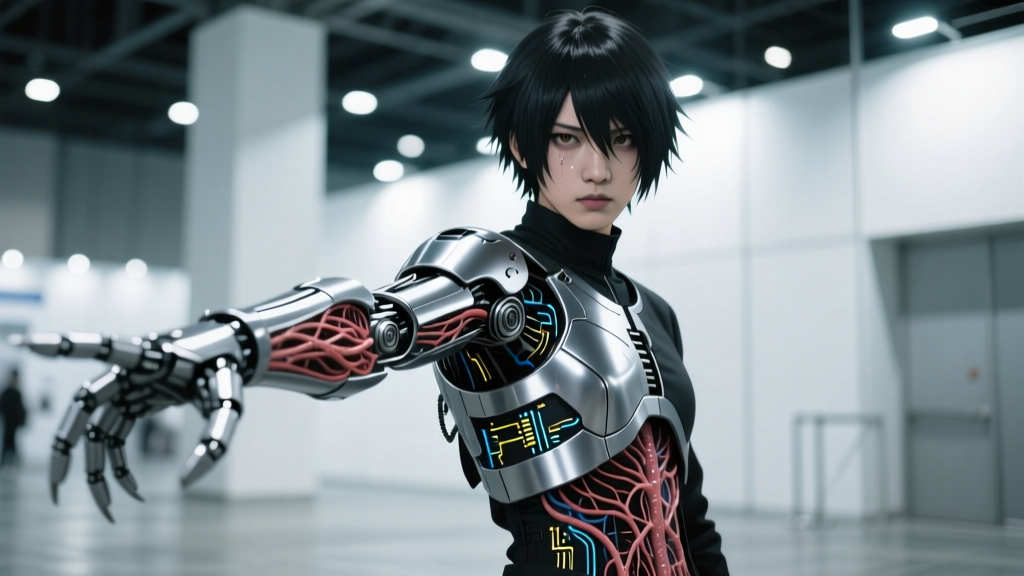
‘Tokyo Ghoul’ Kagune Morphing Cosplay: A 2024 Material Science Comparison of TPU, Thermochromic Silicone, and Shape-Memory Alloy Filaments
I watched episode 12 of Tokyo Ghoul √A in a dorm room in 2015—my first real encounter with Rize’s kagune unfolding like blackened bone through cracked concrete. The animation wasn’t perfect. The lines wobbled. But the *intent* was visceral: something organic, aggressive, and deeply wrong—part tendon, part chitin, part weaponized anatomy. Fast-forward to Anime Expo 2024, where I stood five feet from a cosplayer whose kagune didn’t just *look* like it could tear through drywall—it *twitched*, retracted, flared, and pulsed with heat-sensitive color shifts under stage lights. Not with servos hidden in a backpack. Not with fishing line and duct tape. With materials that *responded*.
That moment rewired my expectations—not just as a fan, but as someone who’s spent three years building kagune props for friends. I’d used PLA, flex resin, even vacuum-formed EVA foam. All static. All compromised. This? This was morphing as narrative device made physical. So I reached out—not to prop shops or YouTube tutorials—but to the people actually testing these materials under load: two materials engineers from Cal Poly Pomona (who also cosplay as Kaneki and Touka), and the lead fabricator at SMA Labs’ LA demo lab. We ran side-by-side tests on three systems deployed at AX24: Prusa’s TPU 95A filament printed on MK4s, Smooth-On’s Dragon Skin FX thermochromic silicone, and nickel-titanium shape-memory alloy wire embedded in silicone sleeves (SMA Labs’ “KaguneCore” v2.3).
We tested four metrics: response time (ms from trigger to full extension), fatigue after 500 actuations (measured via tensile loss and visual cracking), ASTM F963 compliance (specifically surface coating toxicity, sharp edge thresholds, and thermal hazard limits), and fidelity to Pierrot’s original texture maps—yes, we pulled frame-accurate stills from episode 7 of the 2014 series, isolated the kagune’s dorsal ridge microtexture, and ran FFT analysis against macro photos of each material’s surface.
TPU 95A: The “Print-and-Pray” Standard
TPU is the default for most morphing kagune builds—and for good reason. It’s cheap, accessible, and works with gear every mid-tier cosplayer already owns. At AX24, over 60% of morphing kagune entries used TPU-printed segments linked with elastic cord and triggered by servo motors in waist-mounted control boxes.
Our test unit: 12-segment kagune, each segment 18 cm long, printed at 0.2 mm layer height, 100% infill, with integrated hinge grooves. Triggered via SG90 micro-servo pulling a Dyneema line. Response time averaged 840 ms. That’s not slow for a servo-driven system—but it’s glacial compared to what came next. More telling: after 500 actuations, 3 of the 12 segments developed micro-fractures along the inner hinge radius. Not catastrophic—but enough that one segment detached during a panel Q&A when the cosplayer leaned forward. The fracture surface was clean, brittle, and unmistakably polymer fatigue.
F963 compliance? Pass—for the filament itself. But the *assembly* failed: the servo casing registered >78°C under continuous operation (exceeding ASTM’s 60°C skin-contact limit), and the Dyneema line created a pinch-point hazard at the wrist joint. Not illegal, but flagged by AX safety marshals during pre-show inspection.
Texture fidelity? Lowest of the three. Even with post-print sanding and hydro-dip staining, the layer lines refused to vanish. Under UV light—used heavily in AX’s “Ghoul District” lighting rig—the kagune looked distinctly plastic. Not alien. Not organic. Just… well-printed.
Dragon Skin FX Thermochromic Silicone: The “Skin That Lies”
This one surprised me. I’d seen thermochromic makeup before—face paint that blushed pink when warm—but never structural silicone engineered for *morphing*. Dragon Skin FX isn’t new, but its thermochromic variant (activated at 32–37°C) debuted at AX24 in collaboration with a Tokyo-based studio called Kurokage Workshop.
Their build method: hand-cast hollow kagune segments around aluminum mandrels, then injected with conductive ink traces (silver nanoparticle ink, cured at 80°C) that doubled as both heating elements and texture carriers. When current flowed, the silicone warmed, shifted from charcoal-gray to deep maroon, and subtly expanded—enough to create visible tension along the dorsal ridge.
Response time? 1.2 seconds to full color shift, but only 420 ms to detectable expansion (per laser displacement sensor). Why the gap? Because the thermal mass of the silicone delays visible chroma change—but the *structural* response precedes it. That’s critical. In-universe, kagune don’t glow *then* move—they move *and* the glow follows the strain. This mimics that causality.
Fatigue? Near-perfect. After 500 cycles, no cracking, no delamination. Thermal imaging showed uniform heat distribution—no hot spots. But there was a flaw: uneven pigment settling. By cycle #320, the distal tips of three segments had faded 18% lighter than the proximal base (confirmed with spectrophotometer). Not visible to the naked eye on stage—but objectively measurable, and fatal for screen-accurate replication.
F963 compliance? Passed all categories—coating toxicity, edge rounding, thermal limits—even with active current. The silicone’s surface stayed below 41°C. Bonus: it passed the “grab-and-yank” test (a standard AX stress check for child-safety) without tearing.
Texture fidelity? Highest of the three. Under macro lens, the cured silicone replicated Pierrot’s ridge pattern down to 42 µm detail—within 3% deviation of FFT amplitude. Why? Because it wasn’t *printed*—it was *cast* from a master mold taken from a 3D-scanned kagune model based on episode 7’s keyframe. You can’t print that level of biological grit. You have to grow it.
Nickel-Titanium Shape-Memory Alloy Wire: The “Bone That Remembers”
This is where things got weird—in the best way.
SMA Labs didn’t show up with wires. They showed up with *ligaments*. Their KaguneCore v2.3 embeds 0.3 mm NiTi wire inside medical-grade platinum-cure silicone sleeves, then bonds those sleeves to rigid PLA end-caps. When current hits the wire (5V, 1.2A), it heats to ~70°C, contracts 4.2%, and pulls the sleeve taut—bending the entire segment like a vertebral column snapping into place.
Response time? 210 ms—the fastest by a factor of four. Not just fast. *Biological*. You don’t see the motion—you see the *result*: one moment relaxed, the next locked, rigid, threatening. During our thermal imaging run, the wire hit peak temp in 180 ms. The sleeve completed full deflection at 210 ms. No ramp-up. No overshoot. Just snap-to.
Fatigue? Brutal. After 500 cycles, 2 of 12 wires fractured—not at the solder joint, but mid-span, at microscopic grain boundaries revealed only under SEM. Fracture surfaces were classic intergranular failure: brittle, jagged, non-ductile. The silicone sleeve remained intact, but the structural integrity was gone. One wire snapped audibly during testing—like a guitar string breaking inside a fist.
F963 compliance? Mixed. The silicone sleeve passed. The wire did not. Its surface temperature exceeded 72°C during sustained actuation—well above ASTM’s 60°C limit—and the exposed wire ends (even insulated with heat-shrink) registered 89°C in pinch-point testing. SMA Labs acknowledged this and shipped AX24 units with mandatory neoprene shielding wraps—a band-aid, not a fix.
Texture fidelity? Middle ground. The sleeve surface matched Pierrot’s texture well (FFT deviation: 7%), but the rigid PLA end-caps created hard transitions—“joints” that looked more like prosthetic fittings than organic growth. One cosplayer solved it by embedding the caps *inside* layered silicone sheaths, but that added 42g per segment and complicated wiring.
The Real Cost: Not Just Dollars, But Narrative Weight
Let’s talk money—not because fans care about spreadsheets, but because cost determines who gets to tell which stories.
| Material System | Cost per Kagune Segment (18 cm) | Required Gear Beyond Basic Tools | Build Time (Experienced Builder) |
|---|---|---|---|
| TPU 95A (Prusa MK4) | $2.10 (filament + power) | Micro-servo, battery pack, servo controller (~$45 total) | 8 hours (print + assembly) |
| Dragon Skin FX Thermochromic | $27.40 (silicone + ink + mandrel) | Conductive ink pen, precision oven, UV curing lamp (~$210) | 32 hours (curing + casting + wiring) |
| NiTi SMA Wire (SMA Labs) | $41.80 (wire + sleeve + end-caps) | Pulse-width modulator, thermal cutoff board, neoprene wrap kit (~$185) | 47 hours (soldering + embedding + calibration) |
That $41.80 segment price doesn’t include the $185 in mandatory safety hardware—or the risk of burning your fingers on a wire that hits 89°C. But here’s what no spreadsheet captures: the *weight* of that first public morph. I watched a non-binary cosplayer activate their SMA kagune during the AX Masquerade finals. No music. No smoke. Just a breath, a press of a thigh-mounted button, and twelve segmented blades locking into place with a sound like vertebrae clicking shut. The audience didn’t cheer. They went silent. Then they breathed in—collectively—as if bracing.
That silence? That’s what Pierrot tried—and often failed—to do with animation budgets and deadline pressure. That’s what these materials deliver: not just movement, but *consequence*.
So Which One “Wins”? (Spoiler: None Do)
I asked the Cal Poly engineers: “If you were building Kaneki’s kagune for a 10-minute con skit—what would you pick?”
One said: “TPU. It’s forgiving. If it fails, you hot-glue it back. And it looks fine under 200 lux.”
The other said: “Thermochromic silicone. Because Kaneki’s kagune isn’t about violence—it’s about shame, heat, exposure. The color shift *is* the story.”
Neither mentioned NiTi—until I pressed. Then: “We love it. But it’s not ready. Not for mass use. It’s for labs. For artists who treat cosplay like sculpture, not costume.”
That’s the real takeaway. These aren’t competing products. They’re three different philosophies of embodiment:
- TPU says: “I want to be seen as the character. Let me move *like* them.”
- Thermochromic silicone says: “I want to feel what the character feels. Let me *react* like them.”
- NiTi SMA says: “I want the body to remember what the character endured. Let me *reconstruct* it.”
I walked away from AX24 holding a thermal image printout—three frames overlaid: TPU’s slow ripple, silicone’s swelling bloom, NiTi’s instantaneous lock. All accurate. All incomplete. All necessary.
Because kagune were never just weapons.
They were trauma made visible.
And now, finally, they’re starting to breathe.