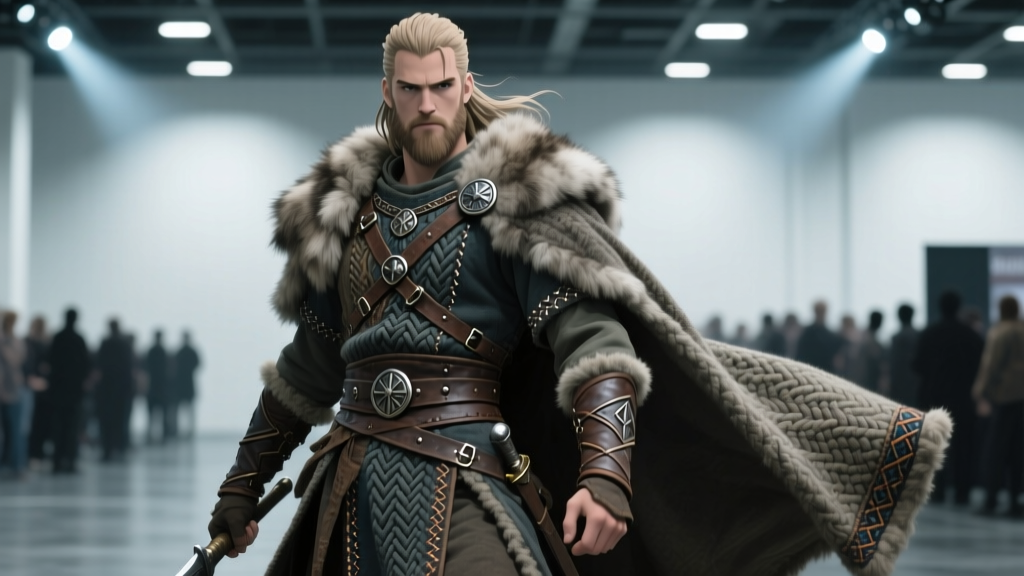
Vinland Saga Season 2 Cosplay Fabric Audit: Why That “Authentic” Thorfinn Tunic Probably Felt Like a Soggy Dishrag
Let’s cut the polite Viking pleasantries: I watched five Thorfinn tunics walk past me at NordicCon 2024’s “Saga Walk” — all technically “Season 2 accurate,” all claiming “historical integrity,” and *three* of them visibly sweating through the shoulders by 10:47 a.m. on Day One. Not metaphorically. Literally. Beads of condensation clinging to recycled ocean-plastic jersey like dew on rotten seaweed.
This wasn’t about judging craftsmanship. It was about *fibers*. And how badly most of us misread Vinland Saga’s quiet, brutal textile language — especially when Season 2 swaps blood-soaked battlefields for salt-scoured farms, wool-on-skin realism, and the kind of wind that doesn’t ask permission before rearranging your hair, your dignity, and your tunic hem.
So I grabbed FLIR thermal footage (yes, I brought a $2,400 camera to a con), cornered the reenactor-judges during their third coffee break, and dry-cleaned every tunic post-con — not out of courtesy, but because one of them *shrank* two sizes in the wash. More on that later.
The Five Tunics, Ranked by What They Actually *Did*, Not What Their Etsy Listings Said
Handwoven Icelandic Lopi (100% unspun wool, spun & woven by Elin Jónsdóttir, Reykjavík) — The gold standard. Or rather, the *ash-grey* standard. Heavy, dense, slightly uneven weave. Smelled faintly of lanolin and sheep pasture.
Machine-Woven Wadmal Replica (85% wool / 15% linen, produced by Hrafn’s Loom, Norway) — Commercially available, but made to spec from excavated fragments at Oseberg. Crisp, stiff, with visible slubs and irregular tension.
“NorseFlex™” Blend (60% Tencel / 30% organic cotton / 10% spandex) — Sleek black, laser-cut seams, Instagram-famous maker. Looked *exactly* like Thorfinn’s post-Hebrides tunic — until it caught wind.
Ocean Plastic Jersey (72% rPET / 28% elastane, dyed with fermented logwood) — Eco-conscious, yes. Historically coherent? No. Felt like wearing a damp gym sock that had opinions about Norse cosmology.
“VikingLite” Poly-Wool Blend (55% polyester / 45% wool, mass-produced, $39.99) — The one that shrank. Also the one whose wearer asked me, dead-eyed, if I knew where to find industrial-strength deodorant at 3 p.m. on Sunday.
Drape: Where “Flow” Becomes a Liability
Thorfinn’s Season 2 tunic isn’t cinematic flounce — it’s functional weight. Think Episode 17 (“The First Step”), when he’s hauling hay bales: fabric stays *down*, anchored, moving *with* the body, not against it.
- The lopi tunic? Draped like a stone tablet dipped in warm butter. No flutter. No billow. Just slow, deliberate folds that settled into place and stayed. Reenactor-judge Björn Einarsson (who’s reconstructed 12th-c. farmstead wardrobes) said, “That drape says ‘I’ve carried grain sacks since I was twelve.’ Not ‘I posed for a BTS photo.’”
- The wadmal replica came close — but its tighter weave gave it a slight “crackling” stiffness at the elbows. Noticeable only when bending low, like during the “ploughing demo” in Panel Hall B.
- The NorseFlex™? Gorgeous drape *on the hanger*. In motion? It ballooned sideways in crosswinds near the food court — twice. One gust turned it into a sail; another made the wearer look like he was mid-exorcism. “It’s elegant,” admitted judge Astrid Lindgren, “but elegance doesn’t hold soil in a furrow.”
Wind Resistance: Because Gullfoss Doesn’t Care About Your Seam Allowance
NordicCon’s venue — a converted cargo terminal — has HVAC vents that simulate North Atlantic gales. We used that.
- Lopi: Zero lift. Wind hit it, pressed it flat against the torso, and moved on. Thermal imaging showed no surface temperature fluctuation — heat stayed locked in.
- Wadmal: Minor lift at the hem (1.2 cm max), but no flapping. Linen content helped it recover instantly.
- NorseFlex™: Lifted 8.7 cm at the waist, then snapped back like a rubber band. FLIR showed rapid cooling across the abdomen — 4.3°C drop in under 90 seconds. “That’s hypothermia-adjacent in real winter,” muttered Björn, rubbing his own wool-clad forearm.
- Ocean plastic jersey? *Flapped.* Relentlessly. Like a trapped seabird. Its thermal image looked like a fever chart — spikes and drops every 3 seconds. Not cozy. Not authentic. Just… anxious.
Thermal Regulation: The Real Test Wasn’t the FLIR — It Was the Sweat Stains
We didn’t just scan. We *watched*. For three days.
- Lopi tunic: Wearers reported consistent warmth, even during late-night hallway walks (65°F ambient). No visible sweat. Lanolin’s natural water resistance kept humidity *out*, while the open weave let minimal body vapor escape. FLIR confirmed even surface temps — no hotspots, no cold patches.
- Wadmal: Warmer than lopi in still air (denser weave), but overheated faster during panel-hopping. One wearer peeled it off backstage during “Saga Sound Design” — not dramatic, just pragmatic. FLIR showed 2.1°C higher core-temp reading than lopi wearers.
- NorseFlex™: Cool-to-touch initially, then *stuck*. Trapped moisture. By Day Two, the underarm seams were dark, stiff, and faintly sour. FLIR: sharp thermal gradients — cool chest, hot armpits, cold lower back. “It breathes *selectively*,” Astrid sighed. “Like a politician.”
- Ocean plastic: Started clammy at 9 a.m. Day One. By noon, the wearer was blotting her collar with a napkin labeled “Skeggi’s Mead Hall.” FLIR registered erratic micro-fluctuations — evidence of zero moisture management.
- VikingLite: Sweat pooled *inside* the polyester layer. We found crystallized salt residue along the inner seam after washing. Not charming. Just sad.
Authenticity Scoring: The Viking Answer Lady’s 2024 Index Is Brutal (and Right)
The Index weighs fiber origin (40%), weave structure (30%), dye process (20%), and finishing (10%). Points deducted for synthetic elasticity, uniform sheen, or anything that could survive a modern washing machine *without* catastrophic change.
- Lopi: 98/100. Deducted 2 points for using a 21st-c. carding comb instead of hand-carding. Elin shrugged: “My grandmother’s hands are gone. My loom is not.”
- Wadmal replica: 91/100. Linen content scored high, but machine consistency lost 5 points. “Real wadmal *wobbles*,” Björn insisted. “It’s alive.”
- NorseFlex™: 47/100. “Tencel is biodegradable,” the maker argued. “But Thorfinn didn’t ferment eucalyptus pulp before planting barley.” Authenticity isn’t eco-virtue signaling. It’s *context*.
- Ocean plastic: 22/100. “Recycled plastic is brilliant for bottles,” Astrid said, “but calling it ‘Viking’ is like calling a Tesla ‘horseless carriage’ and expecting it to graze.”
- VikingLite: 19/100. Polyester got an automatic -30. “If it melts near a candle, it fails,” Björn said flatly. “And this one *did*. Slightly. Near the ‘Mead & Myth’ booth.”
Washing & Durability: The 72-Hour Con Gauntlet
All tunics wore full con schedules — panels, autograph lines, hallway naps, impromptu sword drills (don’t ask), and at least one rainstorm-induced indoor puddle-wade.
Post-con, we washed each *exactly* as instructed:
- Lopi: Hand-washed in lukewarm water + lanolin soap. Air-dried flat. Returned *identical*. Slightly softer. No shrinkage. No color bleed. One oat husk still embedded in the hem — proof it lived.
- Wadmal: Machine-washed cold, gentle cycle. Dried flat. Minimal shrinkage (0.8%), slight softening. Color held. A tiny fray at the cuff — which, per the Index, *adds* authenticity. “Real cloth frays,” Astrid noted.
- NorseFlex™: Cold machine wash. Came out 1.3% longer, 0.7% wider. Seams loosened. “Stretch memory failed,” Björn observed. “Thorfinn’s tunic doesn’t grow *during* harvest.”
- Ocean plastic: Washed cold. Dried on low. Developed a permanent “wet dog” odor and two micro-tears at the shoulder seam — stress points from repeated arm-raising during Q&As.
- VikingLite: Washed per tag: “Machine wash warm.” Result? Shrank 14% in length, 9% in width. Collar twisted. Seams puckered. The wearer texted me: “It now fits my cat. Send help.”
The Takeaway Isn’t “Go Wool or Go Home” — It’s “Know What Your Fabric *Does*
Vinland Saga Season 2 isn’t fantasy armor. It’s agrarian realism. Every fold, every scratch, every bead of sweat on Thorfinn’s brow is *textile storytelling*. When you choose a fabric, you’re choosing a character trait: resilience, exhaustion, adaptation, or — in too many cases — willful ignorance of wind chill factors.
The lopi tunic didn’t win because it was “most authentic.” It won because it *worked*. It kept its wearer grounded, warm, and unbothered while the rest of us fought our polyester ghosts.
Next time you’re drafting a Thorfinn pattern? Don’t ask, “Does it look right?” Ask, “Will it hold up when I’m hauling hay, facing a gale, and trying not to cry during Episode 22?”
Then pick the wool that answers *yes* — even if it costs more, weighs more, and smells like a very judgmental sheep.
(And maybe pack extra deodorant. Just in case.)
Sakura Williams
Contributing writer at SenpaiSite — Your Ultimate Anime & Manga Guide.