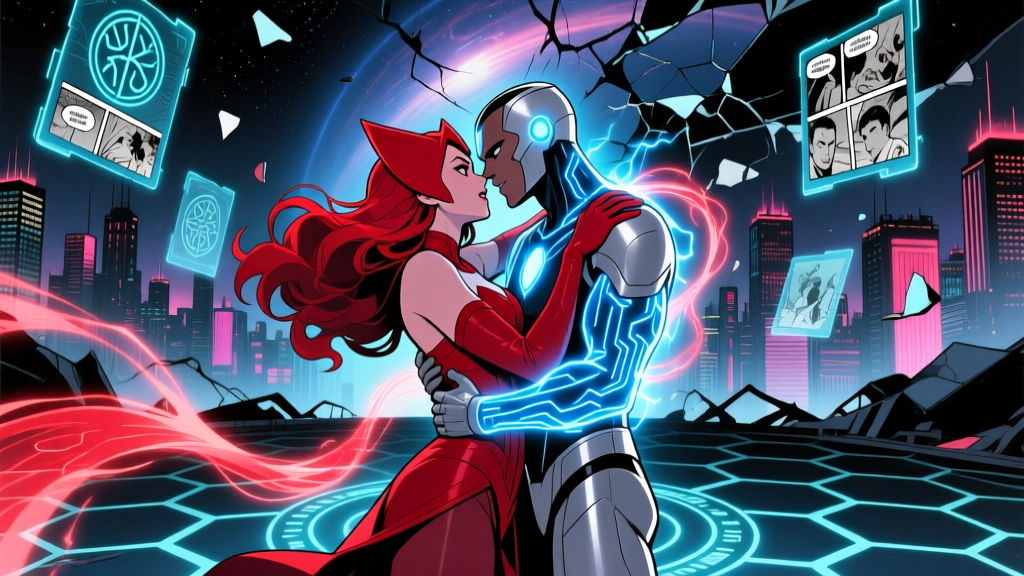
Picture this: a synthezoid built from the brain patterns of a dead hero and a witch who learned her craft from a man who once tried to conquer the planet. They fall in love, buy a house in the suburbs, and pretend everything is normal. Nothing about that sentence should work as a long-running comic narrative. Yet across four decades, dozens of writers have returned to the Scarlet Witch and the Vision, each time finding something new to say about marriage, identity, grief, and what it means to be human when you fundamentally are not one.
This guide walks through every major comic appearance of Wanda Maximoff and the Vision as a couple, from their first team-up in the late 1960s to the modern prestige runs that directly shaped Marvel Studios' WandaVision. If you have only ever seen these characters on screen, the comics hold decades of material that are stranger, darker, and far more emotionally ambitious than anything the MCU has attempted. Strap in.
Before They Were a Couple: The Avengers Years (1965–1975)
Wanda Maximoff first appeared in X-Men #4 (March 1964) as a reluctant member of the Brotherhood of Evil Mutants, alongside her twin brother Quicksilver and their father Magneto. Stan Lee and Jack Kirby gave her a vague power set called "hex bolts" and a meek personality that mostly involved looking worried. The Vision debuted four years later in Avengers #57 (October 1968), created by Roy Thomas and John Buscema as a synthezoid weapon built by the rogue AI Ultron from the brain patterns of Simon Williams, Wonder Man.
Both characters joined the Avengers, and their romantic relationship developed slowly through background interactions in Avengers issues throughout the early 1970s. Roy Thomas began pairing them in subtle ways — a shared panel here, a concerned glance there. By Avengers #108 (1973), Wanda was openly distraught over Vision's injuries, and readers started writing letters asking about the nature of their relationship. Marvel listened. The romance was made official, and it became one of the most unusual pairings in superhero comics: a mutant witch and an artificial man.
The 1982 Mini-Series: Vision and the Scarlet Witch
The four-issue limited series Vision and the Scarlet Witch (November 1982 – February 1983) was written by Steve Englehart with art by Richard Howell. It remains the first comic to treat their relationship as the central narrative rather than a subplot inside an Avengers title. The premise is disarmingly simple: Vision and Wanda leave the Avengers to live a quiet life in Leonia, New Jersey, a real suburban town just across the Hudson from Manhattan.
Englehart leaned hard into domestic storytelling. The threats they face are personal — Wanda's father Magneto keeps showing up uninvited, the ghost of Wonder Man (whose brain patterns form the basis of Vision's personality) haunts their home, and a villain called Amora the Enchantress manipulates events from the shadows. What makes the mini-series work is its tone: it reads like a supernatural romance wrapped around a sitcom premise. Howell's art captures the suburban unease perfectly — manicured lawns in the foreground, dark magical energy crackling in the background.
"We were writing a marriage between two people who could never quite believe they deserved happiness. That tension is built into the concept. Every quiet dinner they have together is shadowed by the question of whether it can last." — Steve Englehart, interviewed for Back Issue! magazine #31 (2008)
The mini-series sold well enough that Marvel greenlit an ongoing series, a rare move for a romance-driven title at the time.
The 1985 Ongoing: Vision and the Scarlet Witch Vol. 2
The ongoing series launched in October 1985 and ran for 13 issues, written primarily by Steve Englehart (issues #1–6) and then by Tom DeFalco, Mary Jo Duffy, and others through its conclusion in October 1986. Richard Howell returned for several issues, and the rotating art staff included Herb Trimpe and Jeff Parker.
The Children That Were Not Real
The single most consequential storyline in this series — and arguably in the entire history of these characters — is "Their Children," which unfolds across issues #3–5 (1985–1986). Wanda discovers she is pregnant, a biological impossibility given that Vision is a synthezoid. She gives birth to twin boys, Thomas and William, and for a handful of issues the comic commits fully to the absurdity: Vision builds a crib, Wanda deals with morning sickness, the neighbors bring casseroles.
The horror arrives in issue #5. The twins begin flickering in and out of existence. It is revealed that Wanda subconsciously used her chaos magic to create life from nothing — she literally willed two children into being, pulling fragments of the demon lord Mephisto's essence to form their souls. The children dissolve. Mephisto absorbs them back. Vision can offer no comfort because he does not know how to process grief for children he was never biologically capable of fathering in the first place. Wanda suffers a mental break.
This storyline is the direct source material for WandaVision. When the MCU showed Wanda creating Billy and Tommy inside the Hex, it was adapting "Their Children" almost beat for beat, right down to the unbearable moment where the children start to disappear.
What Else Happened in Vol. 2
Beyond the twins arc, the ongoing series dealt with:
- The Grim Reaper's return — Vision's "brother" (Wonder Man's actual brother, Eric Williams) attacked the family multiple times, driven by the twisted belief that Vision was a stolen version of Simon.
- Nexus beings and the Scarlet Witch's true power — Issue #12 introduced the concept that Wanda is a "nexus being," a rare individual who serves as an anchor point for the multiverse. This idea would not be fully explored until decades later, but it established that Wanda's chaos magic operates on a cosmic scale.
- Norman Osborn's early machinations — A subplot in later issues hinted at corporate villains eyeing Vision's technology, presaging storylines that would not pay off until the 1990s.
West Coast Avengers and "Vision Quest" (1984–1989)
Vision and Wanda both served as core members of the West Coast Avengers, which launched in 1984 under writer Roger Stern and artist John Byrne. For the first several years the WCA was a fairly traditional team book, but everything changed when Byrne took over as writer with issue #42 (February 1989) and delivered "Vision Quest," a four-issue arc that dismantled the Vision as a character and a person.
The Dismantling
In West Coast Avengers #42–45, Vision is kidnapped by an international coalition of governments who fear that a synthezoid who once hacked every computer on Earth (a reference to an earlier storyline) is too dangerous to exist. They disassemble him — literally take him apart, piece by piece, removing his synthetic organs, his neural pathways, his personality matrix. By the time the Avengers rescue what remains, Vision has been reduced to a blank, emotionless shell.
What makes "Vision Quest" genuinely difficult to read is not the violence done to Vision's body. It is the aftermath. Vision's personality was built on the brain patterns of Wonder Man, Simon Williams. To restore him, the Avengers need Simon's consent to re-copy his mind into Vision. Simon refuses. He says he does not want to live half a life through someone else's body. The Avengers cannot argue with this. Vision is rebuilt physically, but he is white now — his green and red coloration stripped away — and emotionally hollow. He looks at Wanda and feels nothing.
John Byrne drew Vision's blank face with a clinical detachment that makes the sequence almost unbearable. Wanda's reaction is worse: she does not cry. She simply stops speaking. The marriage does not end with a fight or a betrayal. It ends because one partner has been erased and the other cannot bear to love a stranger wearing a familiar face.
"Byrne took a character who was defined by his capacity to love and removed that capacity. It was the cruelest thing you can do to a fictional person, and it worked because Byrne never once flinched or offered the reader an easy out." — Sean McMillan, Comics Journal #182 (1995)
"Vision Quest" remained the definitive Vision story for 26 years. No writer attempted to fully reverse its damage until Tom King.
The Wilderness Years: 1990s–2014
For roughly two decades after "Vision Quest," the Scarlet Witch and Vision appeared together only sporadically. Wanda's character underwent radical changes. In the 1990s she was written as increasingly unstable, her hex powers growing in unpredictable ways. The "Avengers Disassembled" storyline (2004) by Brian Michael Bendis established that Wanda's grief over her lost children had been festering for years and erupted as reality-warping chaos magic that killed several Avengers. This led directly into "House of M" (2005), where Wanda rewrote all of reality to create a world where mutants ruled and she had her children back, before Wolverine and Layla Miller broke the illusion.
Vision, meanwhile, was killed during "Avengers Disassembled" (torn apart by She-Hulk under Wanda's influence), rebuilt, killed again, and rebuilt again in a cycle that became almost farcical. The character lost narrative momentum. Various writers attempted to restore his personality, with mixed results. By the time the 2010s arrived, Vision existed primarily as a supporting Avenger without a clear identity of his own.
The couple did not share meaningful page time together between roughly 1991 and 2015. Wanda was too busy being a villain or a victim, and Vision was too busy being dead or rebooted.
Tom King's The Vision (2015–2016): The Run That Changed Everything
When Marvel announced that novelist and former DC writer Tom King would helm a solo Vision series in 2015, expectations were modest. The character had been through multiple reboots, the MCU version had just been introduced in Age of Ultron, and the audience for a synthezoid suburban drama was not obviously large. What King delivered across 12 issues was one of the most acclaimed comic runs of the decade.
The Suburban Nightmare
King's premise: Vision decides to become human by adopting a nuclear family. He builds a wife, Virginia, from his own code. He builds two teenage children, Viv and Vin. They move into a house in Arlington, Virginia, near Washington D.C. Vision goes to work. Virginia tends the garden. The kids go to high school. Everything is meticulously, aggressively normal.
Then a teenager breaks into the house. Virginia kills him in self-defense. The family covers it up. And the entire series becomes an exercise in watching a family of synthezoids try to maintain the performance of suburban life while a body rots under the patio.
King wrote the series in a flat, declarative prose style that mirrored Vision's own speech patterns. Every character speaks with the same measured precision, which creates a deeply uncanny effect — these people are trying so hard to be human that their humanity becomes terrifying. Gabriel Hernandez Walta's art reinforced the tone: clean lines, muted colors, characters with faces just slightly too symmetrical to be comfortable.
Why This Run Matters for Wanda and Vision
Wanda appears only briefly in King's run, but her absence is the point. Vision built his family without her. He constructed a wife who is, in essence, a replacement — someone made from his own mind the way he was made from Simon Williams' mind. The series asks whether Vision is trying to recreate what he had with Wanda or whether he has moved past her entirely. The answer, when it arrives in issue #12, is devastating: Virginia sacrifices herself to save the family, and in her final moments she tells Vision that she knows she was never real to him. She was always a substitute.
King's run won the Eisner Award for Best Limited Series in 2018 and was widely cited as the primary creative inspiration behind WandaVision's suburban horror aesthetic. The image of a powered being pretending to live a normal suburban life while dark forces intrude — that is King's Vision, not Englehart's or Byrne's.
Scarlet Witch and Vision Comics: A Timeline at a Glance
| Series / Arc | Year(s) | Writer(s) | Issues | Core Event |
|---|---|---|---|---|
| Avengers (various) | 1968–1982 | Roy Thomas, Steve Englehart | ~40 issues | Romance develops within team book |
| Vision and the Scarlet Witch Vol. 1 | 1982–1983 | Steve Englehart | 4 issues | First domestic life in Leonia, NJ |
| Vision and the Scarlet Witch Vol. 2 | 1985–1986 | Englehart, DeFalco, Duffy | 13 issues | Birth and loss of Thomas & William |
| West Coast Avengers — "Vision Quest" | 1989 | John Byrne | 4 issues (#42–45) | Vision disassembled, marriage ends |
| Avengers Disassembled | 2004 | Brian Michael Bendis | 4 issues | Wanda's breakdown, Vision killed |
| The Vision (Tom King) | 2015–2016 | Tom King | 12 issues | Vision's artificial family, Eisner winner |
| Scarlet Witch Vol. 3 (James Robinson) | 2016–2017 | James Robinson | 15 issues | Wanda solo, references Vision throughout |
How the Comics Built WandaVision
When WandaVision premiered on Disney+ in January 2021, the showrunner Jac Schaeffer was explicit about her source material. The series pulled from multiple eras of the comics simultaneously, and understanding which elements came from where reveals just how deep the adaptation goes.
Direct Adaptations
The children Billy and Tommy — their creation through Wanda's magic, their impossible existence, their dissolution — comes directly from the "Their Children" arc in Vision and the Scarlet Witch Vol. 2, issues #3–5. The show even mirrors the comics' emotional core: the children are not simply illusions. They carry fragments of Wanda's soul, which in the comics means pieces of Mephisto and in the MCU means pieces of Wanda's own chaos magic that later allow them to be reborn (connecting to the Young Avengers in the comics and Doctor Strange in the Multiverse of Madness on screen).
The suburban setting — Wanda and Vision living in an American neighborhood, performing domesticity while hiding something fundamentally wrong — is Tom King's Vision more than any other source. King's Arlington setting maps almost perfectly onto WandaVision's Westview. The show took King's vision of a synthezoid family trying to be normal and applied it to a witch and a synthezoid together.
Thematic Borrowings
"Vision Quest" gave WandaVision its emotional architecture: the idea that Vision can be taken apart and reassembled but will never be the same. The show's White Vision — a colorless, personality-free reconstruction of Vision's body — is a direct lift from Byrne's post-Vision-Quest white Vision. When Wanda confronts White Vision in the finale and restores his memories by asking him to define what the Vision is, she is performing the same act of identity reconstruction that the comics have been exploring since 1989.
The show also borrowed the concept of Wanda as a nexus being from the comics, a detail that Marvel Studios seems positioned to develop further in future projects. Agatha Harkness, who appears as a neighbor in WandaVision, has a long history in the comics as Wanda's magical mentor, first appearing in Fantastic Four #94 (1970).
What the Show Changed
The biggest departure is structural. In the comics, Wanda and Vision's tragedy unfolds over decades, with slow erosion and long silences. WandaVision compresses the entire arc into a single explosive event — Wanda seizes a town, creates a false reality, and lives out the marriage that the comics let her have for years before tearing it away. This compression works for television but loses something the comics had: the accumulated weight of time. When Vision looks at Wanda in West Coast Avengers #45 and feels nothing, that silence carries the weight of 15 years of shared history. The show cannot replicate that.
Where to Start Reading: A Practical Order
If this history has made you want to read the source material, here is a curated entry path that prioritizes the strongest material and skips the filler:
- Tom King's The Vision (2015–2016) — The best standalone entry point. You need zero prior knowledge. Twelve issues, complete story, modern art, and it redefined the character. Start here if you only read one thing.
- "Vision Quest" (West Coast Avengers #42–45) — John Byrne at his most ruthless. Four issues. Read this second to understand the emotional damage that King's run is responding to.
- Vision and the Scarlet Witch Vol. 2 #1–5 — The "Their Children" arc. Dated art and 1980s dialogue, but the raw emotional material that WandaVision adapted. Read for historical context.
- Vision and the Scarlet Witch Vol. 1 #1–4 — Englehart's original mini-series. Gentle and melancholy. A palate cleanser after the brutality of the later entries.
- Avengers Disassembled / House of M — Read these last, and read them as Wanda's story rather than Vision's. Bendis and Brian Bendis treat Wanda more as a plot device than a character, which can be frustrating after the intimacy of the earlier runs.
The Thread That Holds It All Together
Across 50-plus years and dozens of creative teams, one question recurs in every Scarlet Witch and Vision story: can love survive when the people involved are not what they appear to be? Vision is a machine who wants to feel. Wanda is a witch whose power grows in direct proportion to her grief. Together, they are two people who should never have been able to build a life, and who tried anyway, and who paid for trying.
The comics never resolved that question. Englehart believed they could be happy if the world would let them. Byrne believed the world would never let them. King believed Vision could build something approximating happiness without Wanda, but only by repeating the same impossible act of creation that defined their marriage. And WandaVision argued that the love was real even if the reality around it was not.
None of these answers is wrong. All of them are incomplete. That is why writers keep coming back. The story of a witch and a synthezoid in a suburban house is, in the end, a story about every relationship that persists despite the odds. And those stories do not have endings. They just get new tellers.
Frequently Asked Questions
Are the Scarlet Witch and Vision still married in the comics?
No. Their marriage effectively ended with "Vision Quest" in 1989. Various storylines since then have brought them back into contact — most notably during Jonathan Hickman's Avengers run (2012–2015) and Al Ewing's Avengers (2018–2022) — but they have not resumed a romantic relationship in any sustained way. Wanda's 2016 solo series by James Robinson treated her as single and processing grief. The MCU's WandaVision and subsequent appearances have reignited fan interest in a reunion, but Marvel Comics has not committed to one.
Did the comics' version of Vision ever fully regain his emotions?
Partially. After "Vision Quest," Vision was rebuilt without his original personality for years. During the 2010s, various writers restored aspects of his emotional capacity, and Tom King's 2015 run explored a Vision who deliberately re-engineered his own emotional life by building a family. In current continuity (as of 2026), Vision exists as a somewhat emotionally functional being, but the damage from "Vision Quest" has never been fully undone in a permanent way. The character carries his trauma as a permanent feature, much like Wolverine's berserker rage or Spider-Man's guilt.
What happened to Wanda's comic children, Thomas and William?
In the comics, Thomas and William were absorbed back into Mephisto in Vision and the Scarlet Witch Vol. 2 #5. However, their soul fragments were eventually reincarnated as Billy Kaplan (Wiccan) and Tommy Shepherd (Speed) in Allan Heinberg's Young Avengers (2005). Billy and Tommy are not aware of their origins initially, but later storylines confirmed they carry the same soul fragments that once constituted Wanda's magically created children. Billy Kaplan has since become a major Marvel character in his own right, headlining series like Empyre and The Last Annihilation.
Is Tom King's Vision run considered canon?
Yes. King's 12-issue run is fully in Marvel continuity. Elements from the series — particularly Virginia's death and Vision's psychological state — have been referenced in subsequent Avengers titles and in Ewing's Avengers run. The series won the 2018 Eisner Award for Best Limited Series and is widely regarded as one of the best Marvel comics of the 2010s.
Which comics should I read before watching the next WandaVision-style MCU project?
Read Tom King's The Vision first — it is the most modern, the most accessible, and the most directly relevant to where the MCU seems to be heading with Vision as a character. Then read "Vision Quest" for the emotional backbone, and skim the "Their Children" arc for plot context. That combination gives you the thematic foundation without requiring you to read 50 years of Avengers back issues.