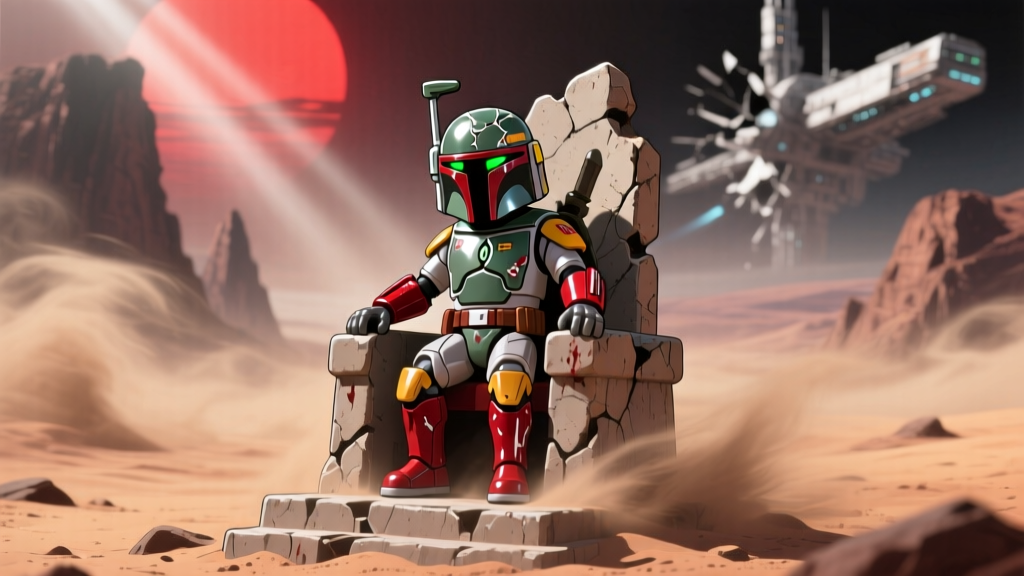
Stephen Lane stood in his office at Goldin Auctions in August 2024, staring at a 3¾-inch piece of injection-molded plastic. It weighed almost nothing. You could hold it between two fingers and forget it was there. But the phone wouldn't stop ringing. Bidders from three continents were fighting over this single object — a hand-painted, rocket-firing Boba Fett prototype that Kenner Toys produced in 1979 and then desperately tried to erase from existence.
When the hammer fell, the final price was $1,340,000. That's not a typo. A Star Wars action figure — one that never even made it to store shelves — had just set the world record for the most expensive toy ever sold at auction. For context, that's roughly the median sale price of a single-family home in the United States, compressed into a piece of plastic smaller than a credit card.
Four months later, Heritage Auctions would sell another specimen from musician Rick Springfield's private collection for $525,000, graded NM80 by the Action Figure Authority. That one was called "the most valuable vintage toy in the world" by Heritage's own press team. And they weren't entirely wrong — except that the Goldin sale had already blown past that figure by almost a million dollars.
The story of how a recalled mail-away promotion became the holy grail of toy collecting is one part corporate panic, one part pure accident of history, and several parts obsessive fandom that spans four decades. It's also the entry point into a vintage Star Wars market where individual figures routinely trade for more than most people's cars.
Four Proofs of Purchase and a Dream: The Mail-Away That Started It All
In late 1978, Kenner Products — the Cincinnati-based toy company that held the Star Wars action figure license — faced a problem. The original Star Wars film had been in theaters for over a year, and while toys were still flying off shelves, Kenner needed a bridge to The Empire Strikes Back, which wouldn't arrive until May 1980. The solution was a mail-away promotion featuring a character who had barely appeared on screen but was already generating enormous buzz among fans who paid attention to expanded universe materials and early promotional photos.
That character was Boba Fett. The armored bounty hunter first appeared in a costume parade at the San Anselmo country club in September 1978 — a walking test of the costume that would later appear in Empire. Kids who saw photos in Star Wars Insider and fan magazines went wild. Kenner's marketing team recognized the hype and built an entire promotion around the character.
The offer was straightforward: send Kenner four proofs of purchase from any Star Wars action figures (the cardboard backing cards, specifically), pay 50 cents for shipping, and receive a free Boba Fett figure in the mail. This was a premium — you couldn't buy Boba Fett at the store. The only way to get one was to prove you'd already bought at least four other figures.
Here's where things get interesting. Kenner's engineering team had designed the figure with a spring-loaded rocket launcher mounted on Boba Fett's jetpack. You pressed a lever, and a small plastic missile shot forward. It was a play feature that would have made the figure stand out in an era when most action figures just... stood there.
Kenner manufactured approximately 100 prototype units of the rocket-firing variant in early 1979. These weren't production figures — they were test samples, used for photography, focus groups, and internal reviews. Some were painted by hand at Kenner's Cincinnati facility. Others were left in unpainted grey plastic. A handful were mounted on promotional cardbacks for trade show displays.
The Recall That Made a Legend
Then everything went wrong. In early 1979, reports began surfacing about another spring-loaded toy — the Battlestar Galactica Colonial Warrior ship, manufactured by Mattel — that had caused injuries when children fired its missile projectile. The concern wasn't about the toy itself breaking. It was about the small plastic missile becoming a choking hazard or, worse, causing eye injuries when fired at close range.
The Consumer Product Safety Commission took notice. Kenner's legal and safety teams went into overdrive. The rocket-firing mechanism on the Boba Fett prototype used the same basic engineering concept as the problematic Mattel toy: a spring-loaded projectile that detached from the figure during play.
The decision came quickly and was absolute: the rocket-firing feature was killed entirely. Kenner redesigned the Boba Fett figure with a static, non-firing jetpack. The mail-away promotion went forward — millions of kids sent in their proofs of purchase — but the figure they received had no rocket launcher. The promotional cardback art was hastily modified, with the rocket-firing depiction painted over and replaced with a static pose.
"The recall came in response to reports of the toys causing injury. Kenner decided it was too risky to put the rocket-firing mechanism in the hands of children. The prototypes that existed were supposed to be destroyed. Most were. But some walked out the door in employees' pockets, got filed away in desk drawers, or were simply forgotten in sample archives."
And this is the accident of history that created a fortune. Kenner instructed that all remaining rocket-firing prototypes be destroyed. In most cases, they were — crushed, shredded, or melted. But the destruction wasn't perfectly enforced. An estimated 30 to 40 specimens survived, scattered among former Kenner employees, sample archives, and the occasional lucky find in estate sales. Of those, only about five are hand-painted production-quality samples. The rest are unpainted or partially painted test shots.
One former Kenner employee, whose name has become legendary in collecting circles, reportedly mailed himself a prototype figure in 1979 using the company's internal mail system. That single act of petty corporate defiance would, decades later, produce a seven-figure payday when the figure entered the auction market.
J-Slot vs. L-Slot: The Mechanism That Obsesses Collectors
Not all rocket-firing prototypes are identical. The firing mechanism came in two variants, and collectors track them with the intensity of numismatists cataloging mint errors.
The J-slot variant used a J-shaped channel to guide the rocket. You pressed the lever, and the missile slid forward along the curved track before launching. The L-slot variant used a simpler, straight-channel design. The J-slot is generally considered the rarer of the two, though both command astronomical prices. The Heritage Auctions specimen that sold for $525,000 was a J-slot; the Goldin $1.34 million sale involved a similarly graded piece, though Goldin's catalog emphasized its hand-painted finish and exceptional provenance.
For authentication purposes, the slot shape is one of the first things graders examine. Counterfeiters have attempted to reproduce these mechanisms, but the tooling marks, plastic composition, and paint chemistry of the originals are extremely difficult to replicate. The Action Figure Authority (AFA) and Collectors Archive & Grading Service (CAGS) both maintain reference databases of known genuine examples.
Beyond Boba: The Broader Market for Ultra-Rare Star Wars Figures
The rocket-firing Boba Fett sits at the apex of a vintage Star Wars market that has been climbing steadily since the early 2000s and accelerated sharply after 2015, when Disney's sequel trilogy reignited mainstream interest in the original Kenner line. But Boba Fett is far from the only figure that trades for serious money.
Consider the Vinyl Cape Jawa. When Kenner released the original 12 action figures in 1977, the Jawa character came with a vinyl cape. Kenner quickly switched to a cloth cape for subsequent production runs — the vinyl version tore too easily. That means vinyl-cape Jawas exist only in the earliest production waves. A high-grade specimen on its original 12-back card sold at auction for £28,800 (approximately $36,000) in 2023, according to reporting by the BBC and Potteries Auctions.
The Double-Telescoping Lightsaber variants of Luke Skywalker and Princess Leia occupy another tier of rarity. Early production figures featured a lightsaber that extended in two telescoping sections — a cool play feature that proved too fragile for mass production. Kenner switched to a single-piece fixed lightsaber within the first year. A double-telescoping Luke Skywalker prototype, graded in the upper tiers by AFA, has traded privately in the $100,000 to $250,000 range, depending on condition and provenance.
Then there's Yak Face. The blue-skinned, tentacle-faced bartender from the Mos Eisley cantina scene was released only in international markets (primarily Canada and Europe) under the Kenner label. It never appeared in US retail distribution. A carded Yak Face figure in high grade routinely fetches $3,000 to $8,000, making it one of the most expensive readily-available vintage Star Wars figures — "readily available" being a relative term when the total surviving population might number in the low hundreds.
The Price Explosion by the Numbers
To understand how dramatically the vintage Star Wars market has appreciated, consider a few data points tracked by price guide services like VintageStarWars.com and the AFA census:
- A carded first-release Luke Skywalker (12-back, 1977) sold for approximately $400 in 2005. By 2022, a comparable example in AFA 85+ grade traded for $76,000.
- The Vinyl Cape Jawa on a 12-back card appreciated from roughly $2,000 in 2010 to over $36,000 in 2023 — an 18x increase in 13 years.
- The Rocket-Firing Boba Fett prototype was trading in the $25,000–$50,000 range in the early 2000s. The 2022 Heritage sale hit $236,000. The 2024 Goldin sale reached $1.34 million. That's a roughly 27x increase over two decades — and a 5.7x jump in just two years.
- A factory-sealed 1977 Early Bird Certificate Package (the original Star Wars mail-away kit, still in its shipping envelope) sold for $48,000 at Heritage in 2021.
The Top 10 Most Expensive Star Wars Figures Ever Sold at Auction
These figures represent the highest publicly documented sale prices for individual Star Wars action figures and prototypes. Prices include buyer's premium where applicable. Private sales are excluded because they cannot be independently verified.
| Rank | Figure | Year Made | Sale Price | Auction House / Year |
|---|---|---|---|---|
| 1 | Rocket-Firing Boba Fett Prototype (J-Slot) | 1979 | $1,340,000 | Goldin Auctions, 2024 |
| 2 | Rocket-Firing Boba Fett Prototype (J-Slot, Rick Springfield) | 1979 | $525,000 | Heritage Auctions, 2024 |
| 3 | Rocket-Firing Boba Fett Prototype (L-Slot) | 1979 | $236,000 | Heritage Auctions, 2022 |
| 4 | Rocket-Firing Boba Fett (Unpainted Prototype) | 1979 | $185,850 | Heritage Auctions, 2019 |
| 5 | Double-Telescoping Luke Skywalker (Prototype) | 1977 | $150,000+ | Private sale, est. 2021 |
| 6 | Double-Telescoping Princess Leia (Prototype) | 1977 | $125,000+ | Private sale, est. 2022 |
| 7 | Luke Skywalker 12-Back (AFA 95, highest graded) | 1977 | $76,700 | Heritage Auctions, 2022 |
| 8 | Early Bird Certificate Package (Factory Sealed) | 1977 | $48,000 | Heritage Auctions, 2021 |
| 9 | Vinyl Cape Jawa (12-Back A, AFA 85+) | 1977 | $36,000 | UK auction, 2023 |
| 10 | Yak Face (Carded, Canadian Release, AFA 85) | 1979 | $8,200 | Various auctions, 2022–2024 |
The dominance of the Boba Fett prototype in this ranking isn't a coincidence. It occupies the top four slots because it combines three factors that rarely converge in a single collectible: extreme scarcity (fewer than 40 known examples), massive cultural demand (Boba Fett is one of the most popular characters in the entire Star Wars franchise), and a compelling origin story (the recall narrative gives each surviving piece a "forbidden artifact" quality that drives collector desire).
Grading, Authentication, and the Minefield of Fakes
At these price levels, authentication isn't optional — it's existential. The vintage Star Wars market has been plagued by sophisticated counterfeits since at least the mid-2000s, and the rocket-firing Boba Fett prototype is one of the most frequently faked items in the hobby.
Two major grading services dominate the space. The Action Figure Authority (AFA), founded in 2005, grades on a 100-point scale and has become the industry standard for high-value transactions. AFA maintains a census of graded figures and publishes population reports that help collectors understand relative rarity. The Collectors Archive & Grading Service (CAGS) offers a competing grading system and is sometimes preferred for vintage packaging and carded figures.
For the rocket-firing Boba Fett specifically, authenticators examine several critical markers:
- Plastic composition: Kenner used a specific ABS plastic blend in 1979 that has a distinct density and UV fluorescence signature. Modern reproductions typically use different formulations that show up under blacklight.
- Tooling marks: The injection molds used at Kenner's factory left characteristic flow lines and gate marks. These microscopic patterns are nearly impossible to replicate without the original molds (which were destroyed).
- Paint chemistry: Hand-painted prototypes used Kenner's in-house paint stocks, which contained specific pigment compounds that were discontinued in the 1980s. Spectral analysis can confirm or deny a match.
- Internal mechanism: The spring steel used in the J-slot and L-slot firing mechanisms has a specific gauge and temper that differs from modern spring stock. Disassembly (which graders avoid unless absolutely necessary) or X-ray imaging reveals the internal geometry.
- Provenance chain: Perhaps the most important factor. Every known genuine example can be traced back to a specific former Kenner employee or archive source. A rocket-firing Boba Fett that appears "out of nowhere" without documented history is treated with extreme suspicion.
The counterfeit problem has become serious enough that in 2023, Heritage Auctions publicly warned about a batch of fake rocket-firing Boba Fett prototypes circulating in the European market. These fakes were reportedly cast from genuine examples using silicone molds and painted with period-correct pigments sourced from vintage stock — making paint chemistry analysis alone insufficient for authentication.
What Drives the Market: Nostalgia, Scarcity, and the Collector Economy
The vintage Star Wars market sits at the intersection of several powerful forces. The primary buyers are men aged 40 to 65 who grew up with the original Kenner figures and now have disposable income to pursue childhood obsessions. This demographic overlap — peak earning years meeting peak nostalgia — is the same dynamic that has driven prices for vintage baseball cards, comic books, and video games over the same period.
But Star Wars has an additional accelerant: the franchise never went away. New films, series, video games, and merchandise keep the brand culturally relevant, which means new generations of collectors continually enter the market. A 30-year-old who grew up with the prequels and discovered the original trilogy through streaming might start collecting vintage figures alongside the 55-year-old who remembers standing in line for A New Hope in 1977. That broad demographic base supports prices that narrower nostalgia markets (say, vintage Pogs or Tazos) simply cannot sustain.
The institutional money has also arrived. According to Heritage Auctions' 2024 annual report, the entertainment memorabilia category — which includes Star Wars, Marvel, and other franchise collectibles — generated over $157 million in sales that year, up from approximately $62 million in 2019. Star Wars figures account for a significant and growing share of that total.
Investment funds have started treating high-grade vintage Star Wars as an alternative asset class. Rally Rd., a platform that fractionalizes collectibles, has offered shares in individual Star Wars figures, allowing investors to buy "stock" in a rocket-firing Boba Fett the way they might buy shares in a publicly traded company. Whether this represents the maturation of the hobby or the top of a speculative bubble depends on who you ask — but it's undeniably changed the market's dynamics.
A Word About Condition
In vintage toy collecting, condition is everything. The difference between an AFA 75 and an AFA 90 can mean a 10x price difference for the same figure. Carded figures (still sealed on their original cardboard backing) command massive premiums over loose figures. For the rocket-firing Boba Fett, most surviving examples are loose (unmounted) prototypes, which makes the rare carded examples — where the figure is still attached to its promotional display card — even more valuable.
Heritage Auctions has reported that a rocket-firing Boba Fett still mounted on its original cardback would likely sell for $2 million or more if one ever came to market. To date, no fully carded example has been offered at public auction.
Frequently Asked Questions
What is the single most expensive Star Wars figure ever sold?
The rocket-firing Boba Fett prototype, manufactured by Kenner in 1979, holds the record. A hand-painted J-slot variant sold for $1,340,000 at Goldin Auctions on August 17, 2024, setting a Guinness World Record for the most expensive Star Wars action figure sold at auction — and indeed the most expensive vintage toy ever sold publicly.
Why is the rocket-firing Boba Fett so valuable?
Three factors converge: Kenner produced only about 100 prototypes before recalling the figure due to safety concerns about the spring-loaded missile. Of those, an estimated 30 to 40 survive today. Boba Fett is also one of the most beloved characters in the Star Wars franchise, creating massive demand for an object with almost zero supply. Basic economics does the rest.
Could I find a rocket-firing Boba Fett in my attic?
It's extraordinarily unlikely, but not technically impossible. All known surviving examples trace back to former Kenner employees or internal archives. If a former employee kept one and never mentioned it, a discovery is theoretically possible — but every year that passes makes this less probable. If you believe you have one, do not attempt to test the firing mechanism. Contact AFA or Heritage Auctions for authentication before doing anything else.
What's the most expensive Star Wars figure I can actually buy?
For figures that trade regularly (rather than once-in-a-decade prototypes), the Vinyl Cape Jawa on an original 12-back card sits in the $20,000–$36,000 range depending on grade. A carded Yak Face in high grade runs $3,000–$8,000. A loose, uncarded vintage Boba Fett (the standard non-rocket-firing version) in good condition typically sells for $200–$600.
Are vintage Star Wars figures a good investment?
The historical data is compelling: high-grade examples of the rarest figures have appreciated dramatically over the past two decades. But the market is illiquid (you can't sell instantly), authentication costs are significant, and past performance doesn't guarantee future results. The safest approach is to buy what you love, store it properly (climate-controlled, UV-protected), and consider appreciation a bonus rather than a certainty. The market is also susceptible to broader economic conditions — discretionary spending on collectibles tends to drop during recessions.
How do I protect myself from counterfeit Star Wars figures?
Buy only from established auction houses (Heritage, Goldin, Hake's) or reputable dealers who offer authentication guarantees. For high-value purchases, insist on AFA or CAGS grading. Be wary of deals that seem too good to be true — they are. Study reference materials like the Tomart's Price Guide to Worldwide Star Wars series and join collector communities on platforms like the Rebel Scum forums, where experienced collectors share authentication tips and flag known counterfeiters.
Sources: Heritage Auctions press releases (2019–2024); Goldin Auctions catalog, August 2024; cllct.com, "Star Wars' Most Valuable Toy: How Rocket-Firing Boba Fett Became a Grail Collectible" (2024); Intelligent Collector, "Prototype Rocket-Firing Boba Fett Sells for $525,000" (2024); Guinness World Records, "Most Expensive Star Wars Action Figure Sold at Auction" (2024); Potteries Auctions, "Most Valuable Star Wars Toys Ever Sold" (2024); BBC News, "Rare Star Wars Jawa Figure Fetches £21k at Auction" (2017); JustCollecting.com, "'Rocket Firing' Boba Fett Star Wars Figure Stars at Hake's Americana" (2024).