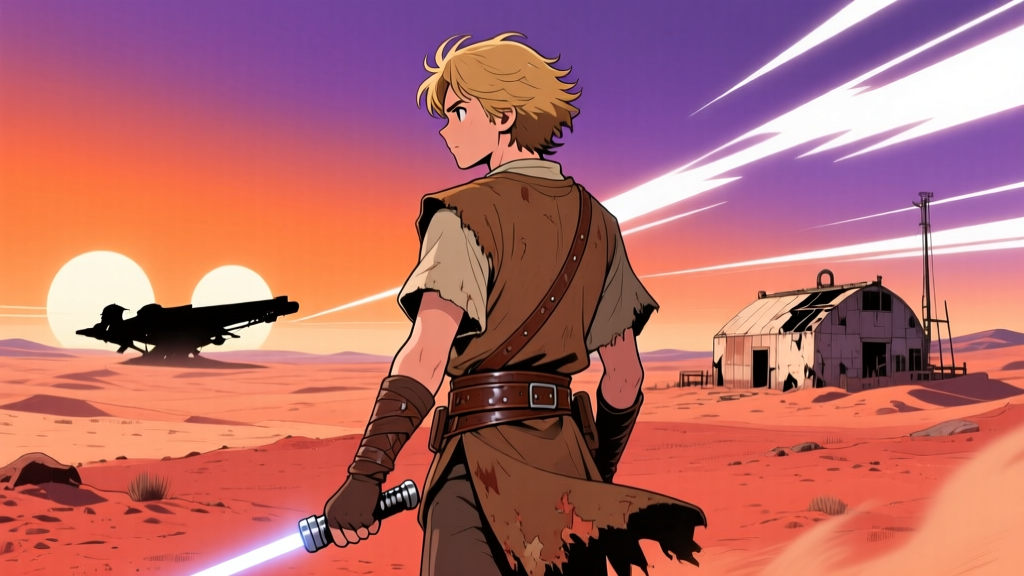
Before the legend, before the Jedi Master, before the myth — there was just a kid on a dirt ball staring at two suns going down.
SenpaiSite · Otaku Culture · Star Wars Franchise · 14 min readThe camera sits low, almost at ground level. Dust and sand fill the frame. A young man in an off-white tunic crouches beside a landspeeder that has clearly seen better decades, not just better days. He is frustrated. He is restless. His uncle wants him working the moisture vaporators. His friends are off at the Academy, flying real ships, living real lives. And he is stuck here, on a rock so remote and so thoroughly irrelevant to anything that matters that even the Empire does not bother to garrison it. Then he looks up. Two suns are sinking into the desert horizon, painting the sky in colors that feel too large for a world this small. John Williams' score swells — not triumphantly, but with an aching, yearning quality that catches you somewhere behind the ribs. In that single shot, before any lightsaber ignites or any starship jumps to hyperspace, Star Wars tells you everything you need to know about Luke Skywalker. And it tells you without a single line of dialogue.
Casting a Nobody: How Mark Hamill Became the Farmboy
George Lucas did not want a star. That was the whole point. When casting directors Fred Roos and Vic Ramos began assembling the principal cast for what was then called The Adventures of Luke Starkiller, Lucas made one thing absolutely clear: the actor playing Luke had to feel ordinary. Not handsome in a matinee-idol way. Not imposing. Not the kind of face you would pick out of a crowd. Lucas wanted someone who looked like he belonged behind the counter of a hardware store in Modesto, not like someone destined to topple an empire. The entire emotional architecture of the film depended on the audience believing that this kid was nobody special — until the moment he proved he was.
Mark Hamill was twenty-three years old when he walked into the audition room. He had done some television work — a recurring role on The Texas Wheelers, guest spots on The Bill Cosby Show and Cannon — but he was, by any industry standard, unknown. His face was open, unguarded, with a kind of earnest quality that read as either genuine sincerity or naivete depending on the lighting. He was not the first choice. Lucas had considered a long list of young actors, including names that would later become famous in their own right. Rob Lowe auditioned. So did Kurt Russell. Jodie Foster was briefly considered for Leia, which would have changed the entire dynamic of the film's romantic subplot.
What sealed the deal for Hamill, according to multiple accounts from the casting process, was the car accident. In January 1977, roughly five months before the film's release, Hamill was involved in a serious automobile collision on a California highway. He suffered fractures to his nose and left cheekbone, injuries that required reconstructive surgery and left him with a face that looked subtly different from the one that had filmed the movie. Lucas and the producers were concerned enough to consider reshooting some of Hamill's close-ups with a body double, but ultimately decided that the differences were minor enough that audiences would not notice. They were right. But the accident had an unintended consequence: it made Hamill's Luke look slightly more weathered, slightly less fresh-faced, in the later scenes than in the earlier ones. Viewers who pay close attention can spot the shift. It adds a strange, accidental texture to the performance.
"I read for it like any other job. I didn't think anything of it. The script had these weird names and this whole mythology, and honestly I thought it might be one of those sci-fi things that just goes straight to drive-in theaters. George saw something in me that I didn't see in myself — he saw a kid who was frustrated and eager and a little bit lost. Which, to be fair, is exactly what I was." — Mark Hamill, reflecting on the casting in interviews collected for Star Wars: The Making Of (J.W. Rinzler, 2005)
Hamill's inexperience turned out to be the production's greatest asset. Luke Skywalker is supposed to be a fish out of water — a provincial kid thrust into a galactic conflict far larger than anything he has ever encountered. Hamill's own unfamiliarity with the machinery of a major film production mirrored Luke's bewilderment at the wider galaxy. When Luke stares at the cantina's alien patrons with wide-eyed disbelief, that reaction is, at some level, Hamill staring at a film set populated by creatures built from foam latex and imagination. The performance works because it is not really a performance at all. It is a young man reacting honestly to extraordinary circumstances.
Dressed for Dust: The Farmboy's Wardrobe and Design
John Mollo, the film's costume designer, faced a problem that most people watching the final product never think about: how do you dress a character who lives on a desert planet with no textile industry? Luke's wardrobe had to communicate poverty, practicality, and a kind of rough frontier existence, while also looking visually interesting enough to hold the screen. Mollo's solution was elegant in its simplicity — he built Luke's look from layers of undyed, loosely woven fabric that suggested hand-made clothing produced from whatever materials the Lars homestead could source or trade for.
The iconic tunic from A New Hope is a two-piece affair: a long-sleeved inner shirt in a coarse, cream-colored cotton, overlaid with a sleeveless outer tunic in a slightly darker shade of off-white. The fabrics were intentionally distressed — Mollo's team sanded, stained, and repeatedly washed the costumes to strip away any sense of newness. The moisture farm was not a clean environment, and Luke's clothes needed to look like they had been worn hard under twin suns for years. The belt is a simple leather strap. The boots are knee-high, practical, and scuffed. There is nothing decorative about any of it. This is work clothing.
Luke's 1977 Wardrobe Breakdown:
- Inner tunic: Undyed coarse cotton, cream, long-sleeved with a mandarin-style collar — designed to protect against sun exposure during outdoor vaporator maintenance
- Outer tunic: Sleeveless tabard in rough-woven fabric, a few shades darker than the inner layer — provides minor protection from sand abrasion
- Belt: Simple brown leather with a rectangular metal buckle, functional rather than decorative — holds a utility pouch in some scenes
- Boots: Knee-high tan leather, scuffed and dust-coated — consistent with someone who spends significant time outdoors on unpaved terrain
- Lightsaber (later): Anakin Skywalker's weapon, inherited via Obi-Wan Kenobi — the single element of Luke's kit that breaks from the "desert farmhand" aesthetic and signals his connection to a larger destiny
The genius of Mollo's design becomes apparent when you compare Luke's outfit to the other characters in the film. Han Solo wears a vest and boots that suggest a working smuggler — practical but with a hint of personal style. Leia's white gown is regal, almost ceremonial. Obi-Wan's robes are layered and flowing, deliberately evoking a monk or a wizard. Vader is encased in black armor. Each costume tells you who the character is before they speak a word. Luke's costume tells you he is nobody. Which makes it all the more powerful when he picks up a lightsaber and becomes someone.
The later addition of the Rebel flight suit for the Death Star sequence presented its own design challenge. The orange flight suit — officially designated as a "snub fighter pilot's pressure suit" in production notes — needed to look like something the Rebellion would issue to its combat pilots. Mollo based it loosely on real-world flight suits from the Vietnam era, with visible zippers, shoulder patches, and a slightly oversized fit that suggested mass-produced military gear rather than custom tailoring. The bright orange was a deliberate contrast to the sterile greys and whites of the Death Star interior, making the Rebel pilots visually distinct against the Imperial environment. When Luke climbs into the X-wing wearing that suit, the transformation from farmboy to fighter pilot is complete — and it happens entirely through clothing.
• • •Tatooine: The Scenes That Built a Character in Fifteen Minutes
The Tatooine scenes in A New Hope occupy roughly the first thirty-five minutes of the film, and they accomplish something that most screenwriting textbooks spend hundreds of pages trying to explain: they make you care about a character whose life is objectively boring. Luke does not do anything exciting on Tatooine. He fixes a droid. He argues with his uncle. He chases after a runaway R2 unit. He meets an old man in the desert. These are not action sequences. They are character-building scenes, and they work because every single one of them communicates the same core truth: Luke is trapped, and he knows it.
The Binary Sunset — Two Minutes That Changed Everything
Let's talk about the binary sunset. It is, without question, one of the most iconic images in the history of cinema. Two suns — one red-orange, one smaller and whiter — sinking below the dune line while a young man watches from the doorway of his uncle's homestead. John Williams' "Binary Sunset" theme (sometimes called "The Force Theme" in its later iterations) plays over the shot, and the combination of image and music creates an emotional payload that no amount of dialogue could match.
The shot was filmed in Tunisia, near the town of Tataouine — yes, that is the real place name that Lucas adapted for his fictional desert world. The production shot on location in March and April 1976, enduring sandstorms, equipment failures, and the general logistical nightmare of running a film crew in the Sahara. The binary sunset itself was achieved through optical compositing: the live-action footage of Hamill standing in the doorway was combined with a separately filmed matte painting of the twin-sun sky by Harrison Ellenshaw. The final image required precise alignment between the live-action foreground and the painted background, a process that, in 1976, meant painstakingly hand-compositing elements frame by frame on an optical printer.
What makes the scene work emotionally is Hamill's face. He does not grimace. He does not cry. He does not deliver a monologue about his dreams. He simply looks out at the horizon with an expression that mixes longing and resignation in equal measure. It is the face of someone who knows the world is bigger than where he lives and is not sure he will ever get to see any of it. Every person who has ever felt stuck — in a job, in a town, in a life that does not feel like theirs — recognizes that expression. The binary sunset is not a special effect. It is a mirror.
The Garage Scene — A Character Revealed Through Props
Early in the film, Luke retreats to his garage to work on a damaged landspeeder and tinker with various electronic components. The scene lasts less than two minutes, but the set dressing tells you everything about who this kid is. The garage is cluttered with spare parts, salvaged droid components, and half-finished projects. There are tools hanging on the walls. A workbench covered in circuit boards. A small, personal space that belongs entirely to him — the kind of space where a young person goes to think and dream and build things that might, someday, get them out.
Roger Christian, the film's set decorator (who would later win an Academy Award for his work on the original film's art direction), filled the garage with what the production called "used future" props — objects that looked salvaged, repurposed, and repaired rather than manufactured new. This aesthetic, which became one of the defining visual signatures of Star Wars, is on full display in Luke's garage. Nothing matches. Nothing looks like it came from the same factory. The impression is of a technology-poor environment where people make do with whatever they can scavenge. Luke's garage is not a workshop. It is a manifesto: this kid builds things because he is trying to build a way out.
Then there is the scene where Owen Lars shuts Luke down. "You can waste time with your friends when your chores are done. Now, come on, get to it." Uncle Owen is not cruel. He is not abusive. He is a practical man who needs labor on the farm and who, whether he realizes it or not, is afraid of losing his nephew to the same restless impulse that apparently consumed Luke's father. Dennis playing Owen invests the character with a kind of weary pragmatism that makes his resistance to Luke's dreams feel grounded rather than villainous. The audience sympathizes with Luke, but Owen is not wrong that the harvest needs hands. This is the film's first moral complexity, delivered casually, in a throwaway exchange that most viewers absorb without analyzing.
• • •Obi-Wan and the Call to Adventure
Alec Guinness was not Lucas's first choice for Obi-Wan Kenobi. The role was originally envisioned for Japanese actor Toshiro Mifune, the legendary star of Kurosawa's Seven Samurai and The Hidden Fortress — the latter being one of the direct inspirations for Star Wars' plot structure. Mifune declined, reportedly because he was concerned about the film's potential impact on his samurai image. Guinness, a towering figure in British cinema with two Academy Awards to his name, was recruited instead, and his casting fundamentally shaped what Obi-Wan became on screen.
Guinness brought gravitas to a role that, on paper, could easily have been played as a generic mentor figure. The script called for an old hermit who delivers exposition about the Force and hands the hero a lightsaber. In lesser hands, Obi-Wan would have been a plot device with a beard. Guinness made him a person. His performance is quiet, almost understated — he speaks in measured tones, with a warmth that sits just beneath the surface of his words. When he tells Luke "The Force is what gives a Jedi his power," he does not sound like he is reciting doctrine. He sounds like a man remembering something he once believed in fully and now holds onto with deliberate effort.
The scene in Obi-Wan's dwelling — a small, cave-like structure carved into the Tatooine rock — is one of the film's most important exposition sequences, and it works because both actors play it as a conversation rather than a lecture. Luke asks questions. Obi-Wan answers some of them and sidesteps others. There is a moment, easy to miss, where Obi-Wan says "Your father was the best starpilot in the galaxy and a cunning warrior" and his voice catches almost imperceptibly, as if the memory carries weight that he is not willing to share with this boy who does not yet know the truth about his parentage. Guinness layers that single line with so much subtext that it retroactively gains enormous power once you have seen Empire Strikes Back.
Obi-Wan's gift of Anakin's lightsaber is the scene's emotional anchor. The weapon is old, battered, and clearly cherished by its current keeper. When he extends it to Luke, he is not just handing over a prop — he is passing along a legacy, a connection to a history that Luke has been deliberately kept from knowing. The lightsaber itself, designed by set decorator Roger Christian from a Graflex camera flash handle with added grips and a D-ring attachment, is one of the most recognizable objects in twentieth-century cinema. In the 1977 film, it does not glow with the saturated, neon-like blade colors of later entries. The blade is a soft, white-blue rotoscoped effect, slightly flickering, almost ghostly. It looks like something ancient being brought back to life.
• • •The Death Star Trench Run: Eight Minutes of Pure Cinema
The final act of A New Hope is, at its core, a World War II movie. Lucas has spoken openly about how he modeled the Death Star assault on the aerial combat sequences from films like The Dam Busters (1955) and Sixty Glorious Years (1943), cross-pollinated with the aerial dogfights of Tora! Tora! Tora! (1970). He even had his editors cut together a sixteen-minute reel of aerial combat footage from various war films, using it as a frame-by-frame reference for the Death Star sequence. Every shot of an X-wing diving toward the surface was matched to a corresponding shot of a Spitfire or a Lancaster bomber making a run on a target.
The trench run itself lasts approximately eight minutes of screen time, from the moment the Rebel fighters enter the Death Star's magnetic field to the moment Luke's torpedoes drop into the exhaust port. Eight minutes. That is an eternity in action filmmaking, and Lucas fills every second with escalating tension, clear spatial geography, and character beats that keep the audience emotionally invested even as the technical effects dominate the frame.
The X-Wing Cockpit: Acting Inside a Box
The X-wing cockpit sequences were filmed on a soundstage at Elstree Studios in England. The cockpit set was a full-scale, enclosed capsule that could be mounted on a gimbal system to simulate the pitch and roll of a starfighter in flight. Hamill, along with the other pilots, performed inside these capsules while stagehands shook the sets and lighting crews swept colored gels across the canopy to simulate laser fire and passing stars. There were no digital effects visible through the windshield on set. Hamill was reacting to light cues and his own imagination.
What makes Hamill's cockpit performance remarkable is how much he communicates through voice and facial expression alone. When Luke switches off his targeting computer, the audience needs to understand that this is a significant act of faith — a pilot abandoning his instruments in the middle of a combat run and trusting something he can barely explain. Hamill does it with a breath, a slight widening of the eyes, and a shift in vocal tone from tactical focus to something quieter and more certain. "I'm all right, trust me." Two words carry the weight of the entire film's thematic argument: faith over technology, instinct over calculation, the Force over the machine.
The Shot That Launched a Thousand Debates
Luke's proton torpedo shot into the two-meter exhaust port remains one of the most analyzed moments in science fiction cinema. The technical premise, as laid out in the Rebel briefing scene, is absurd on its face: a target two meters wide at the end of a twenty-meter-deep shaft, requiring a precision strike at combat speed while under fire from pursuing TIE fighters. The odds are presented as nearly impossible, which is the entire point — the sequence is designed to make the audience believe that only something beyond normal skill could pull it off.
The visual effects team at ILM, led by John Dykstra, achieved the trench run using motion-controlled camera passes over detailed miniature surfaces. The Death Star trench was a series of modular model sections, each roughly four feet long, covered in greebling — the technique of applying hundreds of small plastic and metal detail parts to create the illusion of mechanical complexity. The camera moved along a track parallel to the trench at a precisely calibrated speed, while the miniature X-wings and TIE fighters were photographed separately on a blue-screen stage and composited into the trench footage during post-production.
| Element | 1977 Original | Technical Detail |
|---|---|---|
| Trench miniatures | 6 modular sections | Each ~4 ft long, 18 in wide, covered in hand-applied greebling from plastic model kit parts |
| Camera system | Dykstraflex motion control | Computer-controlled camera rig capable of repeatable multi-axis passes, developed specifically for Star Wars |
| X-wing models | 3 primary scales | 22-inch hero model, 12-inch mid-range, and 3-inch pyrotechnic models for explosion shots |
| Compositing method | Optical printer, blue screen | Up to 12 individual film elements combined in a single shot; each pass risked generational quality loss |
| Laser bolt effects | Rotoscoped animation | Hand-painted frame by frame on animation cels, then composited over live-action and model footage |
| Exhaust port explosion | Practical pyrotechnic | High-speed camera filming a controlled explosion of a miniature Death Star surface section at 480 fps |
| Total VFX shots in sequence | Approximately 75 | Represented roughly 20% of the film's total 365 visual effects shots |
| Production cost for VFX | ~$2.5 million (ILM budget) | Equivalent to roughly $13 million in 2026 adjusted dollars |
The Dykstraflex camera system deserves its own moment of recognition. John Dykstra and his team essentially invented modern motion control photography for this film. The system used a VistaVision camera — which ran 35mm film horizontally through the gate, producing a frame twice the normal size and therefore significantly sharper — mounted on a multi-axis rig that could be programmed to repeat identical movement paths. This meant the camera could make a pass filming the trench, then make an identical pass filming a model X-wing, then another identical pass filming a blue screen for compositing, and all three elements would align perfectly when combined. Before Dykstraflex, compositing multiple moving elements into a single shot was prohibitively difficult. After Star Wars, it became standard practice in the visual effects industry. The entire modern VFX pipeline traces a direct line back to that camera rig.
Sound designer Ben Burtt created the X-wing engine sound by recording a real aircraft — a P-51 Mustang — and processing the recording through filters and pitch adjustments to produce the distinctive whine that rises and falls with the fighter's speed. The laser cannons were derived from recordings of a guy-wire on a radio tower being struck with a wrench, an accident of sound design that Burtt recognized as perfect for the energy bolts. The TIE fighter scream, perhaps the most recognizable sound effect in the franchise, was produced by combining an elephant bellow with the sound of a car driving on wet pavement. Every sonic element in the trench run was sourced from the real world, processed by hand, and layered with obsessive precision.
• • •Why the 1977 Luke Remains the Purest Version
Forty-nine years later, the character of Luke Skywalker has been portrayed across six live-action films, multiple animated series, dozens of novels, and an ocean of merchandise. He has been a Jedi Knight, a Jedi Master, a broken exile, a Force ghost, and a puppet-wielding hermit on a remote island. Each iteration has added layers to the character, some of them rewarding, others controversial. But the 1977 version — the kid in the cream tunic staring at the horizon — remains the purest distillation of what Luke Skywalker was always supposed to be.
The reason is structural as much as it is performative. In A New Hope, Luke is not yet a Jedi. He is not yet powerful. He is not yet wise. He is a young man with an unexplained sensitivity to something larger than himself, an uncle who does not understand him, and a stubborn refusal to accept that the boundaries of his world are the boundaries of his life. That is it. That is the entire character. And it is enough. The film does not need Luke to be a warrior or a philosopher. It needs him to be a kid who takes a chance on something he cannot fully comprehend, and Hamill delivers that performance with a sincerity that later films, for all their technical sophistication, never quite recaptured.
Part of what makes the 1977 Luke so effective is the film's refusal to explain him. We do not get a training montage. We do not see Luke studying the Force or practicing with a lightsaber. His one attempt at using the remote training droid aboard the Millennium Falcon lasts less than ninety seconds and ends with Obi-Wan telling him to "let go" — advice Luke does not actually follow until the trench run. The Force, in 1977, is not a power system with rules and midi-chlorian counts. It is a mystery. And Luke's relationship to it is one of instinct rather than instruction. He feels it more than he understands it, and that feeling is what guides his final shot into the exhaust port.
The later films — Empire, Jedi, and especially the sequel trilogy — necessarily complicate this simplicity. Empire reveals that Luke's father is Vader, turning the character's origin story into a Shakespearean family drama. Jedi asks Luke to confront that legacy and choose compassion over violence. The Last Jedi presents a Luke who has become disillusioned with the Jedi Order's failures and retreated from the galaxy entirely. Each of these choices has narrative merit. But each one also moves further from the core image: a boy, a desert, and two suns going down.
The Audience's Luke
There is a reason the 1977 Luke resonates beyond the Star Wars fandom. He is an archetype that predates cinema: the callow youth who answers a call to adventure and, through courage rather than mastery, achieves something extraordinary. Joseph Campbell's monomyth framework, which Lucas explicitly drew on during the writing process, is visible in every frame of the Tatooine sequences. Luke is the hero in the ordinary world, receiving a call (Leia's hologram), initially refusing it (his uncle's objections), meeting a mentor (Obi-Wan), and crossing the threshold (the Mos Eisley cantina and departure aboard the Falcon). Campbell's The Hero with a Thousand Faces (1949) maps onto A New Hope with such precision that film scholars have used the two works as paired teaching tools for decades.
But what separates Luke from other monomyth heroes is his ordinariness. Frodo is a hobbit, but Tolkien surrounds him with elves and wizards who dwarf him in power and knowledge. Harry Potter is an orphan, but he is also famous, wealthy by inheritance, and naturally gifted at magic. Luke in 1977 has none of that. He has no special powers, no inherited status, no training. What he has is a willingness to try. When Obi-Wan tells him to trust the Force, Luke does not ask for a manual or a tutorial. He turns off his targeting computer and fires. That act of faith — irrational, untrained, desperate — is the emotional climax of the film, and it works because the audience has spent two hours watching a kid who has every reason to give up and none of the tools to succeed, and yet keeps going anyway.
That is why fans who grew up with the original trilogy tend to be protective of the 1977 Luke. He belongs to them in a way that the later, more complicated versions do not. He is the version they saw before they knew anything about the Expanded Universe, before the prequels recontextualized the Jedi Order, before the sequels deconstructed the character's mythology. He is the version that made them believe, even briefly, that an ordinary person could matter on a galactic scale. You do not need the Force for that. You just need to refuse to stay on the farm.
• • •Luke Across Eras: How the Character Shifted
| Film / Year | Luke's Role | Tone of Portrayal | Key Visual Marker |
|---|---|---|---|
| A New Hope (1977) | Naive farmboy turned reluctant hero | Earnest, wide-eyed, hopeful | Cream tunic, unscarred face, boyish energy |
| Empire Strikes Back (1980) | Impatient student confronting his darkness | Darker, frustrated, physically battered | Dagobah fatigues, mechanical hand, scarred face |
| Return of the Jedi (1983) | Confident Jedi Knight facing his father | Calm, controlled, quietly determined | Black robes, green lightsaber, composed demeanor |
| The Last Jedi (2017) | Disillusioned exile questioning the Jedi legacy | Bitter, weary, self-questioning | Grey beard, hermit's clothing, isolated on Ahch-To |
| The Rise of Skywalker (2019) | Force ghost offering guidance | Warm, forgiving, gently wise | Translucent blue glow, reclaimed Anakin's saber |
The table above makes something clear: every film after 1977 adds psychological weight to the character. Empire gives him trauma. Jedi gives him moral authority. The Last Jedi gives him regret. Rise of Skywalker gives him peace. These are all valid character progressions, and Hamill's performance across all five films is remarkably consistent in its emotional honesty. But the 1977 Luke is the only version that carries no baggage. He has not yet lost a hand. He has not yet learned that his father is a war criminal. He has not yet watched the Jedi Order fail or the galaxy reject everything he tried to build. He is the blank page, and there is something irreplaceable about that.
• • •Frequently Asked Questions
How old was Mark Hamill when he filmed A New Hope?
Mark Hamill was born on September 25, 1951, making him twenty-four years old during principal photography in the spring and summer of 1976. He turned twenty-five shortly before the film's release on May 25, 1977. Luke Skywalker is presented as roughly nineteen or twenty in the film, though his exact age is not stated on screen. The age gap between actor and character was small enough that Hamill's youthful appearance sold the illusion without difficulty.
Was the binary sunset in the original Star Wars real or a special effect?
The binary sunset was a composited special effect. The live-action footage of Hamill standing in the doorway of the Lars homestead was filmed in Tunisia, near the town of Tataouine. The twin-sun sky was a matte painting created by Harrison Ellenshaw at ILM and optically composited over the location footage using an optical printer. The practical challenges of filming in the Sahara — including sandstorms that damaged equipment and forced production delays — are well documented in J.W. Rinzler's The Making of Star Wars (2005).
Did Luke Skywalker have a lightsaber in the 1977 film?
Yes, but he barely uses it. Obi-Wan gives Luke his father's lightsaber roughly thirty minutes into the film, during the scene in Obi-Wan's desert dwelling. Luke trains with a remote droid aboard the Millennium Falcon for less than two minutes of screen time. He uses the lightsaber in combat exactly once in A New Hope — to cut open the belly of a dead tauntaun on Hoth in Empire Strikes Back, which is a different film. In the 1977 movie itself, the lightsaber functions more as a symbolic inheritance than as an active weapon. The lightsaber blade in A New Hope is a rotoscoped animation effect, giving it a softer, more ethereal glow compared to the brighter, more saturated blade colors used in later films.
Why did George Lucas cast an unknown actor as Luke Skywalker?
Lucas wanted the character to feel like an ordinary person thrust into extraordinary circumstances. Casting a well-known star would have undermined the film's central thesis that heroism can come from anywhere. He also had practical reasons: the film's budget was tight (approximately $11 million), and a bankable lead actor would have consumed a significant portion of it. Unknown actors were cheaper and, in Lucas's view, more believable as residents of a lived-in galaxy far, far away. This same logic guided his casting of Carrie Fisher and Harrison Ford, neither of whom was a major star at the time of production.
What was Luke's callsign during the Death Star trench run?
Luke flew as Red Five during the Battle of Yavin. The call sign has become one of the most recognizable in the franchise, and it was later reused as an homage in other media. The original Rebel briefing scene lists Red Squadron as the primary attack wing, with Luke assigned to the fifth position after joining the squadron at the last minute. His X-wing, designated as a T-65B model in expanded materials, is visually distinguished by the red and white striping on its S-foils.
How much did the original 1977 Star Wars earn at the box office?
A New Hope grossed approximately $775 million worldwide across its original run and subsequent re-releases, according to Box Office Mojo's adjusted figures. Its initial domestic run in 1977 earned roughly $221 million, making it the highest-grossing film of all time until it was surpassed by E.T. in 1982. The film's production budget was approximately $11 million, making its return on investment one of the most dramatic in Hollywood history. Adjusted for inflation to 2026 dollars, the worldwide gross exceeds $2.1 billion.