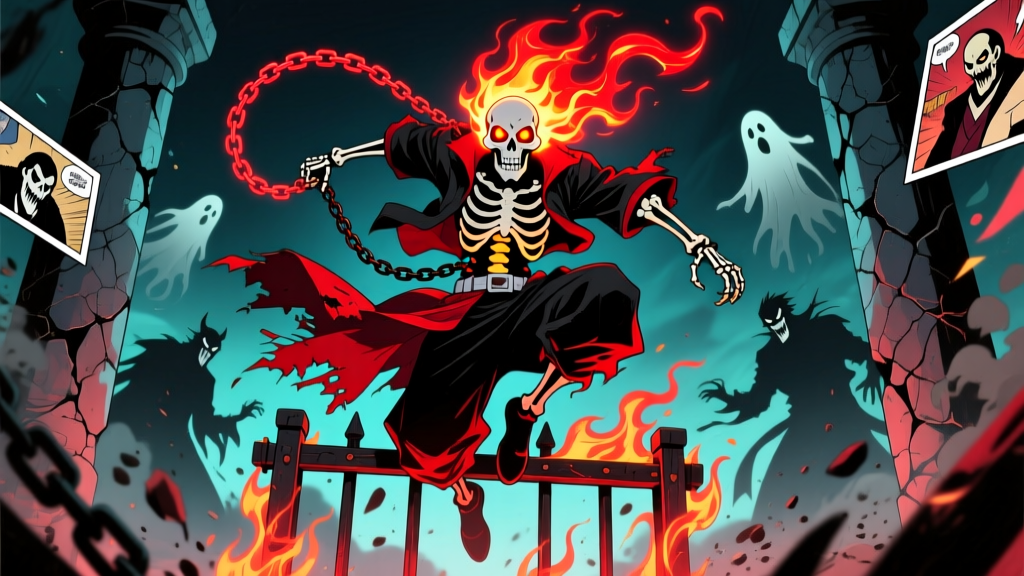
February 16, 2007. A Friday. I remember sitting in a half-empty multiplex theater in suburban New Jersey, watching a leather-jacketed Nicolas Cage burst into flames on a motorcycle that looked like it crawled out of a Hieronymus Bosch painting. The audience — mostly teenagers, a few die-hard comic fans, and one very confused elderly couple — went absolutely feral when the Hellcycle first roared to life. People cheered. Someone in the back row actually yelled "RIDE." The critics had already sharpened their knives. Rotten Tomatoes would settle at a dismal 27% approval rating from professional reviewers. But that night, in that theater, none of that mattered. The ghost rider movie had us.
Almost two decades later, here's the punchline nobody expected: the film grossed $228.7 million worldwide against a $110 million budget, spawned endless memes, launched a cottage industry of Hellcycle replicas, and sits comfortably in the cult canon of "so committed it transcends its own flaws." Critics were wrong. Not entirely — the script has problems, the editing is rough in places, and Blackheart remains one of Marvel cinema's more forgettable villains — but wrong about the thing that actually matters. The ghost rider movie has soul. Specifically, it has a flaming skull for a soul, and that counts for more than any Metacritic score ever could.
☠ ☠ ☠Nicolas Cage Sold His Soul to This Role (And It Shows)
Let's get this out of the way immediately: Nicolas Cage is not a subtle actor, and Johnny Blaze does not require subtlety. The character is a stunt motorcyclist who makes a literal deal with the Devil, transforms into a skeletal demon wreathed in hellfire, and rides a motorcycle made of bones and rage through the American Southwest. What Cage understood — what the critics largely missed — is that Ghost Rider isn't a character who benefits from restraint. He's a pulp hero dropped into a pulp narrative, and Cage commits to the bit with the kind of feral sincerity that most A-list actors would be too embarrassed to attempt.
Watch the early scenes again. Before the transformation, Cage plays Blaze as a man carrying genuine weight — a stuntman haunted by a Faustian bargain made in desperation, living off the grid, running from his own damnation. There's a scene where Blaze stares at a photo of his father, and Cage lets something real flicker behind those famously unhinged eyes. It's a small moment. It lasts maybe four seconds. But it anchors everything that follows, because when the skull finally catches fire, you understand what was lost.
"I signed on to do Ghost Rider because I thought it was a great American myth. A guy who sells his soul and then tries to get it back — that's the American dream in reverse." — Nicolas Cage, MTV Movie Blog interview, January 2007
Cage reportedly studied the comic work of Gary Friedrich and Mike Ploog, who co-created the character in Marvel Spotlight #5 (1972), and he specifically asked that the film preserve the "lonely rider" archetype from those early issues. The result is a performance that splits the difference between gothic tragedy and midnight-movie excess. When Cage-as-Rider points a gloved finger and delivers the Penance Stare — "Look into my eyes" — it's simultaneously ridiculous and magnetic. That duality is the entire film in microcosm.
The Physicality Problem Nobody Talks About
One thing that rarely gets discussed is how much physical work Cage did for the role. At 43 years old during filming, he performed several of his own motorcycle stunts and insisted on wearing the full leather costume — zippers, chains, pentagram pendant and all — during the transformation sequences so that the CGI team could match his actual body mechanics. According to VFX supervisor Kevin Mack, Cage spent hours in a motion-capture rig to nail the specific way the Rider tilts his head, the way his shoulders move when he's not quite human anymore. That physical investment is visible on screen. The Ghost Rider doesn't move like a CGI puppet. He moves like Nicolas Cage in pain, which, given the costume, he probably was.
☠ ☠ ☠The Flaming Skull: A VFX Breakdown That Still Hits
The ghost rider movie's flaming skull is, without exaggeration, one of the most technically ambitious CGI character effects of the mid-2000s. Sony Pictures Imageworks, the studio behind the visual effects, had to solve a problem that had stymied previous Ghost Rider adaptation attempts for over a decade: how do you make a skeleton on fire look believable?
The answer was a multi-layered simulation pipeline. The skull itself was sculpted digitally from Cage's actual facial structure — CT-scanned, according to production notes published in Cinefex magazine (Issue 109, Spring 2007) — and then wrapped in a fire simulation built on a modified version of the fluid dynamics software RealFlow. The fire wasn't just a texture slapped onto a model. It was volumetric, meaning the flames had actual depth, density, and light interaction. The team rendered over 400 individual VFX shots for the film, with the most complex skull sequences requiring up to 72 hours per frame on Sony's render farm.
What Makes the Fire Work (and Where It Stumbles)
- The good: The fire casting light on the Rider's leather jacket, the way embers trail behind him during high-speed sequences, the subtle blue-white core of the flame when the Rider is enraged — all of this holds up remarkably well for 2007 CGI.
- The great: The transformation sequence itself, where Blaze's skin peels back to reveal the skull beneath while his clothes ignite. It's body horror meets comic book spectacle, and it still makes audiences wince.
- The shaky: A handful of wide-angle shots where the full-body Rider is visible against complex backgrounds. The compositing isn't always seamless, and in a few frames you can see where the CGI skull doesn't quite sit right on the practical costume body.
Still, compare this skull to what other comic book films were doing in the same window. Superman Returns (2006) was struggling with its own CGI problems. The Fantastic Four sequel was months away and looked worse. For a character who is literally a skeleton engulfed in supernatural fire, Imageworks delivered something that felt dangerous and alive.
☠ ☠ ☠Mark Steven Johnson's Pulp Gospel
Director Mark Steven Johnson came to the ghost rider movie with two things most comic book directors lacked at the time: he'd written for the medium (his screenplay credits include the 1993 Grumpier Old Men and, more relevantly, an uncredited pass on Daredevil), and he understood that Ghost Rider's DNA isn't superhero — it's horror-adjacent biker pulp. The film's visual grammar borrows more from 1970s exploitation cinema and spaghetti westerns than from the Marvel Cinematic Universe playbook that was, at that point, still being written. Iron Man wouldn't arrive for another fourteen months.
Johnson made a deliberate choice to set the film in the American Southwest — the dusty small towns, the vast empty highways, the neon-lit roadside attractions — rather than the urban jungle most superhero movies default to. It was a smart instinct. Ghost Rider is, at his core, an American Gothic character. He belongs in the landscape of desert isolation and evangelical tent revivals, not Manhattan skyscrapers. The fictional town of San Venganas, where much of the film's mythology is rooted, evokes the kind of borderland ghost towns that pepper southwestern folklore.
The Pacing Problem
Where Johnson stumbles — and this is the film's most legitimate critical complaint — is pacing. The second act sags badly. After the initial transformation and the first spectacular Rider action set piece, the movie spends nearly forty minutes on setup, exposition, and character scenes that don't earn their screen time. The romantic subplot between Blaze and Roxanne Simpson (Eva Mendes) feels rushed in places and padded in others. Mendes is charismatic, but the script gives her character almost nothing to do beyond reacting to things that happen around her.
The editing, handled by three separate editors (a red flag in any production), occasionally lurches between tones. A horror-tinged cemetery sequence cuts directly to a lighthearted gas station comedy bit. It's jarring. You can feel the studio notes and the director's vision grinding against each other in real time.
But when Johnson is locked in — when the Hellcycle is tearing across a desert highway at midnight, flames licking the asphalt, Christopher Young's score swelling into a full orchestral roar — the film hits a frequency that very few comic book movies have ever reached. It's not "good filmmaking" in the traditional sense. It's something harder to define. It's conviction.
☠ ☠ ☠The Hellcycle: Metal, Bone, and Pure Theatrical Excess
Every great superhero vehicle tells you something about its rider. The Batmobile is militarized precision. The Millennium Falcon is lived-in chaos. The Hellcycle — Ghost Rider's motorcycle, transformed alongside its owner — is pure id. It's what happens when you take a chopper and let Hell redesign it.
The production design team, led by Kirk Petruccelli, built multiple practical versions of the Hellcycle for different shooting needs. The hero bike, used for close-ups and static shots, featured real metalwork: twisted exhaust pipes that resembled rib cages, handlebars that curved like vertebrae, and wheels with spoke patterns modeled after demonic sigils. The flame effects on the practical bike were achieved through concealed propane jets — yes, they actually set a motorcycle on fire on set, under controlled conditions — which gave the VFX team real-world reference footage for how fire interacts with metal surfaces at speed.
The fully CGI Hellcycle, used in the film's most extreme action sequences, takes the design further than any practical build could. In the climactic chase, the cycle literally rides up the side of a building, its wheels leaving trails of fire on the concrete. It leaps between rooftops. At one point, it launches off a parking structure and the camera follows it in a sweeping crane shot that showcases the full flaming chassis against the night sky. It's one of the most visually striking images in any Marvel adaptation, and it works because the practical design groundwork makes the CGI feel grounded in physical reality.
"We wanted the bike to look like something that was built in Hell's own chop shop. Not sleek, not futuristic — tortured. Like the metal itself is in pain." — Kirk Petruccelli, Production Designer, Cinefex #109 (2007)
The Hellcycle's cultural afterlife has arguably outlasted the film itself. Hot Wheels released a Ghost Rider cycle in 2007 that became one of their top sellers that year. Diamond Select Toys produced a premium statue. Cosplay builds of the Hellcycle regularly appear at conventions from San Diego to Tokyo. The bike became an icon independent of the movie that birthed it, which is exactly what great production design should accomplish.
☠ ☠ ☠Blackheart, Mephistopheles, and the Villain Deficit
No honest appraisal of the ghost rider movie can sidestep the villain problem. Blackheart, played by Wes Bentley, is the son of Mephistopheles (Peter Fonda), and the film positions him as the primary antagonist — a demon who's come to Earth to retrieve a contract that gives him claim to a thousand corrupted souls. On paper, it's a serviceable premise. In execution, Blackheart is one of those villains who exists primarily to give the hero something to punch in the third act.
Bentley plays the character with a kind of sneering malice that works in isolated moments — his introduction scene, where he and his demon henchmen terrorize a small-town gas station, has genuine menace — but the script never gives Blackheart the dimensionality it affords Johnny Blaze. We don't understand his relationship with Mephistopheles beyond surface-level daddy issues. We don't know what he wants beyond the contract. We don't get a single scene where he does something that complicates our understanding of him as a character. He's evil because the story needs evil.
Peter Fonda Steals Every Scene He's In
The irony is that the film's most compelling villain performance comes from Peter Fonda as Mephistopheles, and Fonda barely has ten minutes of screen time. Cast against type — the counterculture icon of Easy Rider playing the literal Devil — Fonda brings an amused, almost paternal quality to the role. His Mephistopheles doesn't rage or threaten. He negotiates. He smiles. He offers deals with the calm confidence of someone who has never lost. When he tells Blaze "I'm not the bad guy, son. I'm just the guy who reads the fine print," it's the best-written and best-delivered line in the entire film.
Fonda's presence also creates a fascinating meta-textual layer. Here's the man who defined the American motorcycle rebel in 1969's Easy Rider, now playing the Devil who owns a motorcycle-riding antihero. Johnson has acknowledged in interviews that this casting was intentional, and it adds a depth to the film's mythology that the script alone doesn't provide. When Fonda and Cage share the screen, the ghost rider movie briefly becomes something smarter than it has any right to be.
☠ ☠ ☠Critics Hated It. Audiences Didn't Care.
The critical response to the ghost rider movie was brutal and, in several notable cases, bizarrely personal. Roger Ebert gave it 1.5 out of 4 stars, writing that it "seems to have been assembled from the spare parts bin of other, better superhero movies." The New York Times called it "a punishing experience." Rolling Stone's Peter Travers awarded it half a star and suggested that Cage "may have finally found a role too ridiculous even for him." On Rotten Tomatoes, the 27% critic score stands in stark contrast to a 62% audience score — a gap that tells its own story about the disconnect between professional criticism and genre fan enjoyment.
| Metric | Score / Value | Context |
|---|---|---|
| Rotten Tomatoes (Critics) | 27% | Based on 173 reviews; consensus: "laughably bad" |
| Rotten Tomatoes (Audience) | 62% | Based on 250,000+ user ratings |
| Metacritic | 35/100 | "Generally unfavorable" from 20 critics |
| CinemaScore | B | Opening night audience poll — solid for a comic book film |
| Worldwide Box Office | $228.7 million | Against $110M production budget |
| Opening Weekend (Domestic) | $45.4 million | #1 at the box office, Presidents' Day weekend |
| DVD/Blu-ray Sales (first year) | ~$74 million | Strong home video performance |
The numbers tell a clear story: people went to see this movie, and they kept going. The opening weekend of $45.4 million was the biggest February opening at the time (a record since broken, but significant for 2007). The film held its audience through a four-week theatrical run. DVD sales were robust. The international numbers were particularly strong — the ghost rider movie played well in markets like Japan, South Korea, and Latin America, where the visual spectacle and Cage's star power translated more effectively than the English-language critical consensus.
What the Critics Got Wrong
The fundamental critical error was reviewing the ghost rider movie as if it were trying to be The Dark Knight or Spider-Man 2. It wasn't. Johnson wasn't making a prestige superhero film. He was making a midnight exploitation picture dressed in a Marvel costume, and judged by that standard — the standard of pulp cinema, of grindhouse energy, of unapologetic spectacle — the film succeeds far more often than it fails. Ebert, who gave high marks to Robert Rodriguez's Sin City (a film operating in a very similar register), seemed unable to extend the same generosity to Ghost Rider, perhaps because Cage's committed weirdness reads differently than Mickey Rourke's committed weirdness.
☠ ☠ ☠The Cult That Refuses to Burn Out
Here's where the story gets interesting. In the years since 2007, the ghost rider movie has not faded into obscurity the way most critically panned superhero films do. Catwoman (2004) is remembered as a punchline. Green Lantern (2011) is remembered as a cautionary tale. Ghost Rider is remembered as a vibe.
The film's cult following coalesced around several overlapping communities. Comic book fans who grew up with Friedrich and Ploog's original run appreciated that the film, for all its flaws, took the source material seriously — it preserved the Penance Stare, the chain weapon, the hellfire mythology, and the core tragedy of Johnny Blaze's character. Motorcycle enthusiasts latched onto the Hellcycle design and the film's genuine love of chopper culture. And then there's the Cage contingent — the legion of fans who watch everything Nicolas Cage makes and have elevated his "committed to a bad movie" performances into their own subgenre of cinema.
Social media accelerated the cult. The image of Ghost Rider pointing a flaming finger at a cowering villain became one of the most versatile reaction memes of the early 2010s. The Penance Stare found new life on Twitter and Reddit as shorthand for calling out bad behavior. TikTok edits of the transformation sequence, set to everything from death metal to hyperpop, have accumulated millions of views. The ghost rider movie, in other words, became more culturally relevant in the streaming era than it ever was during its theatrical run.
The Sequel, the Reboot, and the MCU Question
The 2011 sequel, Ghost Rider: Spirit of Vengeance, tried to course-correct by going darker and more violent, with directing duo Neveldine/Taylor (Crank) bringing their hyperkinetic style. It didn't work. The sequel grossed just $132 million worldwide and was met with even worse reviews. The character eventually found its way into the Marvel Cinematic Universe through Agents of SHIELD, where Gabriel Luna played Robbie Reyes — a different Ghost Rider for a different era — and delivered a version that many fans considered closer to the spirit of the comics. But the MCU Ghost Rider has never had the big-screen moment that Cage's version had, and there's a growing sentiment online that the 2007 film deserves a reappraisal.
☠ ☠ ☠Christopher Young's Score: The Soundtrack Hell Deserved
One element of the ghost rider movie that even hostile reviews tended to praise is Christopher Young's score. Young, a veteran horror composer (Hellraiser, Species, The Grudge), understood the assignment perfectly. His main theme is a thundering, brass-heavy march that sounds like a demonic biker gang rolling into town behind a wall of distorted guitars. The quiet cues — the lonely acoustic guitar that underscores Blaze's isolation, the eerie choral passages that accompany Mephistopheles — give the film an emotional texture that the script sometimes struggles to provide.
The score's standout moment arrives during the highway chase sequence, where Young layers a relentless percussion pattern beneath a wailing electric guitar solo that mirrors the Ghost Rider's own screaming flames. It's operatic in the most unpretentious way possible. It's loud, it's aggressive, it's completely over the top, and it matches the on-screen spectacle beat for beat. The soundtrack album sold respectably and remains a staple of horror-action score playlists.
☠ ☠ ☠What the Ghost Rider Movie Actually Got Right
Strip away the critical baggage and the legitimate complaints about pacing and villain development, and you're left with a film that accomplished several genuinely difficult things:
- It made the character iconic for a new generation. Before 2007, Ghost Rider was a deep-cut Marvel character known primarily to comic readers. After 2007, he was globally recognizable. That's not a small achievement.
- The visual identity holds. The flaming skull, the leather jacket, the Hellcycle, the chain weapon — the film created a cohesive visual language that has influenced every subsequent iteration of the character across comics, animation, and live action.
- Cage's commitment is total. There is no phoning it in. No winking at the camera. No ironic detachment. Cage plays Johnny Blaze / Ghost Rider as if it's the most important role of his career, and that sincerity radiates through every frame.
- It respects the horror roots. The Penance Stare sequence — where the Rider forces a criminal to feel the pain of every person he's ever hurt — is one of the most effective horror scenes in any superhero film. The cemetery transformation. Mephistopheles' contract scene. These are horror movie moments, and Johnson shoots them with genuine genre literacy.
- The action sequences deliver. The final freeway chase and the climactic battle against Blackheart are technically proficient and visually inventive in ways that many more expensive, more acclaimed superhero films have failed to match.
Things People Won't Stop Asking About This Movie
Is the 2007 ghost rider movie worth watching today?
Absolutely, provided you go in with the right expectations. It's not a prestige superhero film. It's a pulp action-horror picture with a committed lead performance, impressive VFX for its era, and a hell of a soundtrack. Watch it the way you'd watch a great 1980s action movie — turn off your analytical brain, turn up the volume, and let the flames wash over you.
How accurate is the ghost rider movie to the original comics?
Surprisingly faithful in the broad strokes. Johnny Blaze's origin — the deal with Mephistopheles, the stuntman background, the connection to Roxanne — all come directly from the original Marvel Spotlight run. The Penance Stare, the hellfire chain, and the Hellcycle are all comic-accurate. The biggest departure is Blackheart, who was created specifically for the film and doesn't appear in the source material. In the comics, the villain is typically Mephisto himself or the demon Zarathos.
Why did critics hate the ghost rider movie so much?
Several factors converged: 2007 was a transitional year for superhero films, and critics were primed for more "serious" entries (The Dark Knight was on the horizon). Ghost Rider's pulpy, exploitation-adjacent tone felt retrograde to reviewers expecting the genre to mature. Cage's performance style — big, committed, weird — also polarized critics who preferred more naturalistic superhero portrayals. And the film's genuine pacing issues in the second act gave reviewers legitimate ammunition.
Will Ghost Rider return to the MCU in a new movie?
As of mid-2026, Marvel Studios has not announced a standalone Ghost Rider film for the MCU, though the character has been rumored for inclusion in several upcoming projects. Gabriel Luna's Robbie Reyes version appeared in Agents of SHIELD and was reportedly considered for a Hulu series that was ultimately shelved. The character's popularity has remained consistent enough that another big-screen appearance seems inevitable — the question is when, not if.
What's the difference between the theatrical cut and the extended version?
The extended cut (sometimes labeled the "Extended Edition" on Blu-ray) runs approximately 8 minutes longer and restores several scenes that were trimmed for pacing, including an expanded opening sequence with young Johnny Blaze, additional dialogue between Blaze and Mephistopheles, and a longer version of the Penance Stare scene. Most fans consider the extended cut the definitive version, as it gives the character relationships more room to breathe.
Did Nicolas Cage actually ride the motorcycle in the ghost rider movie?
Cage performed several of the riding sequences himself, particularly the slower, character-driven scenes on the pre-transformation motorcycle. The high-speed and stunt-heavy sequences were handled by professional stunt riders, and the fully transformed Hellcycle shots are entirely CGI. Cage has stated in interviews that he holds a motorcycle license and has been riding since his twenties.
☠ ☠ ☠There's a moment near the end of the ghost rider movie that I think about more than any superhero scene has a right to occupy in my brain. Blaze has defeated Blackheart. Mephistopheles appears one last time, offering to release Blaze from the contract, to take back the curse. Blaze refuses. He knows what he is now. He knows the fire is part of him, that the skull beneath the skin was always there, waiting. He mounts the Hellcycle and rides into the darkness alone, flames trailing behind him like a comet's tail.
It's not deep. It's not artful. It's not the kind of cinema that wins awards or lands on best-of-decade lists. But it's honest in a way that most superhero films, with their focus-grouped quips and universe-building post-credit scenes, have forgotten how to be. The ghost rider movie is a man on a flaming motorcycle riding through hell because he believes the ride itself matters. And nineteen years later, we're still watching him go.
"He who rides with fire doesn't fear the dark."— Johnny Blaze