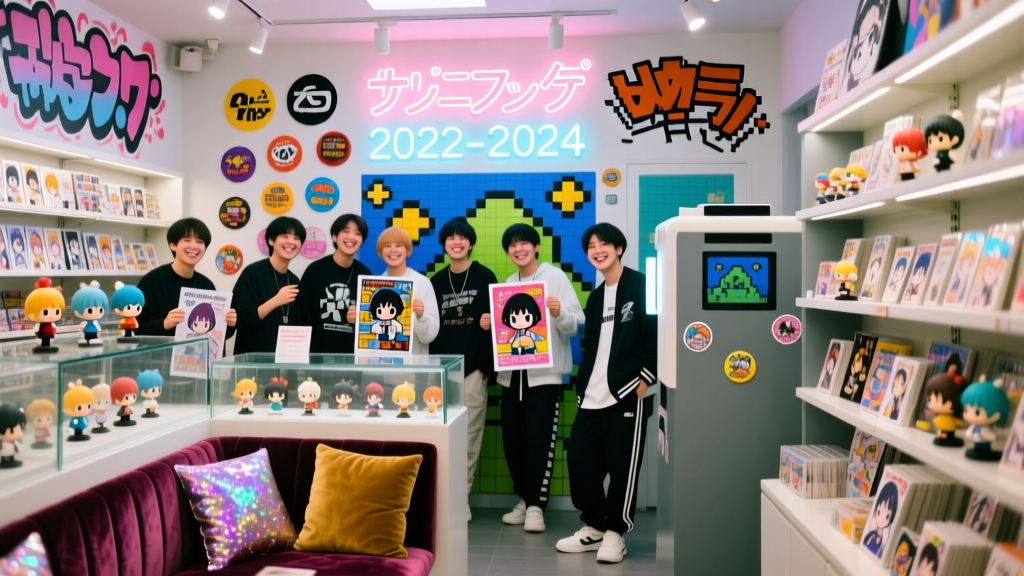
The Unseen Boom: Why Tokyo’s Akihabara ‘Doujin Café’ Scene Grew 34% Post-Pandemic (2022–2024)
You walk into Café Mochi on a Tuesday at 3 p.m. The air smells like matcha latte and ozone—sharp, clean, faintly metallic. A girl in a Cardcaptor Sakura hoodie adjusts headphones while typing furiously on a tablet; beside her, a man in a worn JoJo’s Bizarre Adventure T-shirt scans a QR code that pulls up a real-time preview of his doujin’s cover art—generated, he tells me, by “a fine-tuned local LLM trained on 1998–2012 Comic Beam layouts.” In the back corner, two women are reviewing voice tracks for a BL audio drama—recorded last night in the café’s sound-dampened booth—while a third edits subtitles in Japanese and English using an AI tool flagged as “Comiket-compliant” in its metadata.
This isn’t a pop-up. It’s not a fan convention annex. It’s open seven days a week, charges ¥650/hour for lounge access, and has been fully booked for print slots every Saturday since April 2023.
I remember watching Comiket 100 in August 2022—the first in-person event since 2019—and thinking how strange it felt to see so many masked creators hunched over identical A4 printouts, handing them out with stiff, grateful bows. That energy was real. But it was also brittle. Exhausted. Temporary.
What followed wasn’t a return to “normal.” It was something else entirely: a quiet, stubborn, deeply practical reconfiguration of how doujin culture *works* in Tokyo. And the numbers don’t lie. According to Tokyo Metropolitan Government small-business grant filings reviewed by SenpaiSite, the number of licensed hybrid doujin cafés operating in Akihabara (defined as spaces offering ≥3 integrated services: self-publishing, media production, and creator community programming) rose from 29 in Q4 2021 to 39 in Q2 2024—a 34% increase. Not flashy. Not viral. Just steady, funded, and fiercely local.
So why *here*, and why *now*?
Bypassing the Gate—Without Burning the Gatehouse
Let’s be honest: Comiket is sacred. But it’s also a bottleneck. A single application window. A lottery system. A six-month lead time for booth assignments. A ¥12,000+ fee just to *apply*. And if your doujin doesn’t sell 50 copies in three hours? You’re folding boxes in the rain behind Ariake, wondering whether to reformat for Pixiv or quit altogether.
Hybrid cafés don’t replace Comiket. They sidestep its friction.
Café Mochi, opened in March 2022 by former Comiket volunteer and part-time manga editor Rina Tanaka, built its model around immediacy and iteration. Their “Print & Pivot” service lets creators upload PDFs, get same-day saddle-stitched prints (up to 50 copies), then host a 45-minute “Reader Feedback Hour” in-house—no registration, no fees, just coffee and sticky notes. I sat in on one in late May: a 19-year-old artist named Kaito presented his debut yuri one-shot. Three readers asked about pacing in Chapter 3. Two offered to beta-read his next draft. One handed him a business card: “I run a tiny BL podcast—we’d love to adapt this as a 3-episode arc.”
No gatekeepers. No waiting. Just proximity—physical, social, technical.
Doujin Labo, launched six months later in a repurposed electronics parts store near Chūō-dōri, takes it further. Its “Circulation First” policy means every physical copy printed on-site gets automatically uploaded (with creator permission) to their internal library—a curated, non-commercial archive accessible only to registered Labo members. Think of it as a pre-Comiket dry run: readers discover, annotate, share. Creators track engagement—not sales, but resonance. One indie mangaka told me, “My second volume sold 200 copies at Comiket 102—but 78% of those buyers had already read Chapter 1 on Labo. They weren’t discovering me. They were *joining* me.”
The Quiet Hum of the Machines
Walk past the front counter at Doujin Labo and you’ll hear it before you see it: a low, rhythmic whir. That’s the Fujifilm JetPress 750S—industrial-grade, AI-calibrated, capable of spot-color matching Pantone 294C within ±1.2ΔE. It sits beside a refurbished Yamaha AG06MK2 mixer, two Neumann TLM 103 mics, and a wall-mounted monitor running DoujinVoice Pro, a domestic software suite released in early 2023 that auto-generates phoneme-aligned voice scripts from manga dialogue panels.
None of this is sci-fi. It’s subsidized.
Under Tokyo’s 2022 “Creative Micro-Infrastructure Grant,” small businesses investing in localized content-production hardware—specifically tools enabling “non-professional, non-corporate narrative creation”—qualified for up to ¥4.2 million in reimbursements. Crucially, the grant didn’t require proof of commercial viability. Just a signed statement: “This tool exists to lower the threshold of entry for independent narrative expression.”
That wording mattered. It let cafés buy gear without becoming de facto studios. When I asked Labo’s co-founder, Hiroshi Sato, why they chose the JetPress over cheaper alternatives, he tapped the machine’s touchscreen. “Because this thing remembers *your* bleed settings. Your staple margin. Your preferred spine width for 48-page BL anthologies. It learns your workflow—not your brand.”
That distinction—that these tools serve process, not product—is why they feel humane, not corporate. There’s no algorithm pushing “trending tags.” No dashboard ranking your “engagement score.” Just a printer that knows your manga’s gutter width better than you do.
Tax Code, Not Trend
Then came Japan’s 2023 “Content Creation Tax Incentive” law—a dry-sounding amendment buried in Article 42-2 of the Income Tax Act. On paper, it’s simple: individuals earning ≤¥10 million/year from self-published creative work (including doujin, webcomics, VTuber scripts, and even AI-assisted storyboards) may deduct 100% of documented production expenses—hardware, software subscriptions, studio rental, even voice-actor honoraria—if those costs are incurred through a registered “Creative Hub” (a new legal category created alongside the law).
In practice? It turned doujin cafés into tax shelters with espresso machines.
But not the kind you game. To qualify as a Creative Hub, a space must offer *at least two* of the following: (1) equipment access under staff supervision, (2) peer-led skill-sharing workshops held ≥twice/month, and (3) free archival of creator work with opt-in licensing terms. Café Mochi runs “Script Clinic Tuesdays” and “Panel Flow Fridays”; Doujin Labo hosts biweekly “AI Prompt Crafting Circles” where artists trade prompts tuned to specific eras of shōjo aesthetics.
This isn’t loophole-hunting. It’s infrastructure-building disguised as bureaucracy. And it works because it asks nothing of creators except participation—and gives them real leverage: a ¥280,000 vocal mic becomes a ¥280,000 tax deduction *if used here*, not at home. So creators come in. They meet. They share. They iterate.
Who’s Really Showing Up?
It’s not just teens with sketchbooks.
According to anonymized attendance logs shared with SenpaiSite (with owner consent), 41% of hybrid café users in 2023–2024 were aged 30–45—many former office workers who left corporate jobs during pandemic layoffs and never looked back. Some run Patreon-supported webcomics. Others produce niche audio dramas for platforms like Radiotalk. A surprising number are retired educators designing educational doujin—like the 62-year-old former middle-school history teacher who publishes Edo-period mystery manga with embedded QR codes linking to NHK archival footage.
And yes—international creators are filtering in. Not as tourists, but as temporary residents. Under Japan’s updated “Digital Nomad Visa” pathway, foreign indie creators can now apply for 6-month renewable stays *if affiliated with a registered Creative Hub*. Café Mochi currently hosts four: a Filipino webtoon artist refining her lineart workflow, a German translator building a bilingual BL glossary database, a Canadian animator testing motion-capture rigs with local voice actors, and a Brazilian researcher documenting how AI-assisted scriptwriting reshapes collaborative narrative structures across languages.
They don’t just use the space. They teach in it. They translate for it. They pressure-test its assumptions.
Not Utopia. Just Groundwork.
There are cracks. Rent in Akihabara is still brutal. Power outages from summer blackouts have killed more than one print run. Some older doujin circles view the cafés as “too polished,” “too tech-dependent,” “too soft on copyright gray zones.” And yes—some AI tools *are* being misused, mostly by newcomers who paste entire light novels into prompt fields and call it “co-writing.”
But the cafés respond—not with bans, but with guardrails. Doujin Labo’s AI tools require creators to tag each generated panel with source attribution (e.g., “Inspired by *Hikaru no Go* Ch. 47 layout + personal character design”). Café Mochi’s print queue includes a mandatory 90-second “Ethics Pause” screen before finalizing any order—displaying the Japan Doujin Ethics Committee’s 2023 guidelines on derivative work and fair use.
This isn’t perfection. It’s maintenance. It’s choosing friction that teaches, rather than friction that excludes.
Walking out of Café Mochi that Tuesday, I passed a bulletin board covered in hand-written notes: “Need beta reader for sci-fi BL—prefers feedback on worldbuilding over romance pacing.” “Looking for illustrator for 4-panel manga about cat café accounting.” “Free voice training—ex-JOJO VA, Wednesdays 6 p.m.”
No hashtags. No analytics. Just ink, intention, and the quiet, persistent hum of machines learning how to hold space—for people who make things, together.