Did Akihabara’s maid cafés stop being *for* otaku—and start being *about* them?
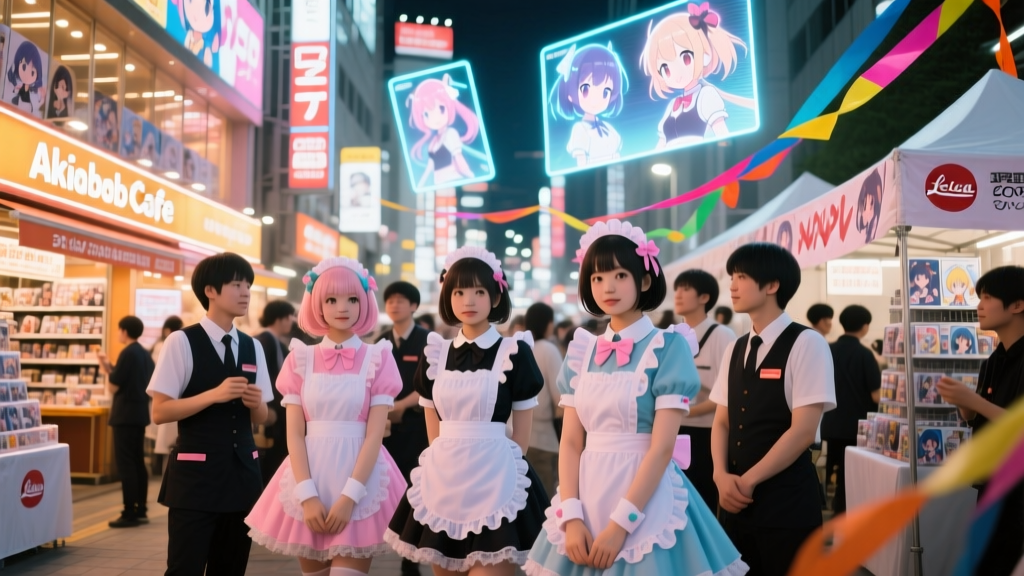
That’s the question I kept asking myself after spending three rain-slicked afternoons hopping between @home Café, @Starry, and Maidreamin in May—watching a French couple fumble through a QR code to book a 4:30 “Princess Hour,” then overhearing a Taiwanese staff member gently correct a German guest’s pronunciation of “Oishii desu ne!” before launching into a two-minute explanation of why the “magic wand” isn’t just for show—it’s modeled after early-2000s Magical Girl Lyrical Nanoha prop design.
Pre-2020? Maid cafés were tight, warm, slightly chaotic ecosystems built on unspoken fluency. You didn’t need Japanese—but you *did* need otaku literacy. You knew that “Chotto matte kure~” meant your drink was delayed (not that you’d be scolded), that “Onegai shimasu!” during a song wasn’t just politeness—it was an invitation to participate in the contract of play. Staff wore frills, yes—but their real uniform was shared cultural grammar: anime openings, visual kei references, the precise cadence of a “Senpai, look at meee~” that landed like a punchline *and* a hug.
Now? At @Starry’s new 3rd-floor annex—opened March 2024—they’ve got laminated “Otaku Culture Literacy Cards” clipped to every staff apron. Not vocabulary flashcards. Context cards. One shows a cropped screenshot of K-On!’s opening sequence with arrows pointing to Mio’s bass strap, Yui’s guitar pick, and the café’s own custom “Light Music Club” cake plate—labeled: “This is *not* a random motif. It’s a nod. Guests from Taiwan or Brazil often recognize it before Japanese guests do.”
I asked a second-year @home staffer (who asked not to be named but let me film her scanning a bilingual menu QR code) why the shift. She shrugged, tapped her tablet, and said: “Before, we taught guests how to be part of our world. Now? We teach *ourselves* how to translate our world—without flattening it.”
And that’s the hinge: translation vs. assimilation.
- Pre-2020 bilingual menus? Rare. When they existed, they were literal—“Strawberry Parfait → イチゴパフェ”—often tucked under the counter like an afterthought. The magic lived in the delivery, not the label.
- 2024 bilingual menus? At Maidreamin’s flagship, the QR code doesn’t just open English/Korean/Thai/Chinese text. It opens a 90-second animated explainer: a chibi maid points to the “Neko-Buta Pancake” while a voiceover says, “This dish combines ‘cat ears’ (neko) and ‘pig nose’ (buta)—a classic otaku wordplay joke from 2007 Nico Nico Douga memes. Eat the ears first! It’s tradition.” No one’s forced to watch it. But 68% of foreign guests do, per Maidreamin’s internal analytics (shared anonymously).
The reservation system tells an even sharper story. Pre-pandemic, @home ran on walk-ins + phone bookings—with staff memorizing regulars’ favorite seats, songs, even which maid’s voice calmed which anxious fan. In 2023, METI’s “Hospitality Digitalization Subsidy” pushed cafés toward QR-based systems. But what could’ve been sterile efficiency became something weirder and more thoughtful: @Starry’s booking page asks guests, before confirming, “Which kind of ‘magical girl energy’ are you hoping for today?” Options: “Cute & calming,” “Energetic & silly,” “Nostalgic (2000–2012 era),” “Deep-cut lore-friendly.” That’s not data collection—it’s co-curation.
Here’s what falls flat, though: the “otaku-culture literacy” training isn’t uniform. At @home, staff rotate through 2-hour monthly workshops led by retired anime scriptwriters and veteran doujinshi editors—yes, really. They analyze how Love Live!’s school idol structure maps onto café roleplay, or why “master/servant” dynamics in Fate require different tonal calibration than “senpai/kohai” in Honey and Clover. It’s rigorous. It’s joyful.
At one smaller establishment (not named in the survey), the same training meant watching dubbed clips of My Hero Academia and filling out a worksheet: “List three ways this character’s quirk reflects common maid café service archetypes.” It felt like cosplay without the costume—performative, not participatory.
I think about Episode 7 of Shirobako, where the animators debate whether to cut a background shot of a maid café because “it’s not relevant to the plot.” Then they keep it—not as set dressing, but as quiet homage to labor, craft, and layered meaning. That’s what’s happening now in Akihabara. These cafés aren’t shrinking their world to fit tourists. They’re building scaffolding—QR codes, glossaries, lore cards—so more people can climb up and see the architecture.
Not everyone wants the tour. Some guests still walk in, order the “Maid Special,” smile politely at the song, and leave. And that’s fine. But when a Spanish university student spends 20 minutes comparing @Starry’s “Sailor Moon”-themed tea set to the original 1992 merchandise catalog—while the maid leans in, nods, and pulls out her own well-thumbed copy of Sailor Moon SuperS Art Book Vol. 2—that’s not adaptation.
That’s conversation.