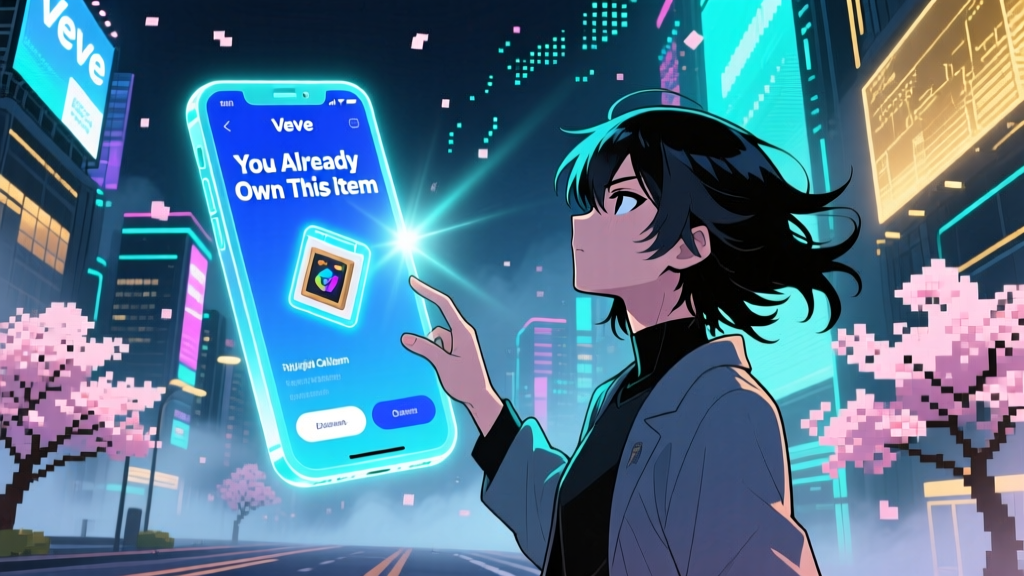
Picture this: it's drop day on VeVe. A new Star Wars blind box set just went live — maybe it's a Boba Fett variant with a holographic base, or a limited-run Grogu figurine sculpted by the same artist who did the Hot Toys Mandalorian piece. You tap "Purchase," adrenaline already kicking in, and the app stops you cold with a flat, almost dismissive line: "You already own this item."
No error code. No explanation link. Just a greyed-out button and the quiet implication that you've been here before. For anyone who has spent time collecting on VeVe, that message is a rite of passage. For newcomers, it's confusing, sometimes frustrating, and almost always misunderstood.
What's actually happening behind that screen is a collision of blockchain mechanics, licensing constraints, and a deliberate product decision by ECOMI (the Singapore-based company that builds and runs VeVe) to prevent a specific type of collector behavior. This article unpacks all of it — what the message means, why it exists, and what your actual options are once you see it.
The Mechanics Behind the Message
When VeVe displays "You already own this item," the platform is telling you that your account wallet — the internal VeVe wallet tied to your user profile — already holds a tokenized copy of that specific collectible. Not a similar one. Not another piece from the same franchise. The exact same SKU, in VeVe's internal catalog terminology.
VeVe mints each collectible as a token on its proprietary Collect Chain (the successor to the GoChain infrastructure the platform originally used). Your copy of, say, a Star Wars Dark Vader (First Appearance) figurine carries a unique edition number — let's say #3,412 of 12,500 — and is bound to your wallet address. When you attempt to purchase that same figurine again through the primary drop interface, VeVe's smart contract layer checks your wallet holdings against the item you're trying to buy. If it finds a match, the transaction is blocked and you get the message.
This isn't a bug. It isn't a UI oversight. It's an intentional gate built into the purchasing smart contracts, and it serves three distinct purposes that most users don't fully appreciate.
Edition Limits and Fair Distribution
VeVe drops operate on scarcity. A typical Star Wars figurine release might be limited to 12,500 or 16,000 total units, divided across rarity tiers: Common, Uncommon, Rare, Ultra Rare, and Secret Rare. If one collector could purchase dozens of copies from a single drop through the primary interface, the edition-based economy breaks down. Duplicate purchase prevention forces wider distribution. It's the same logic comic shops use when they limit new issue purchases to one per customer on release day — except enforced at the code level, with no backroom deals.
During the Aston Martin DB5 James Bond drop in early 2022, which sold out in minutes across 130+ countries, the duplicate restriction meant that approximately 1.2 million queued users competed for roughly 25,000 total units. Without the one-per-account rule, the distribution would have been even more lopsided toward buyers running scripts or multi-account setups (which VeVe's terms of service explicitly prohibit, though enforcement remains an ongoing challenge).
Licensing Compliance
Here's the part most collectors don't think about: Lucasfilm, Marvel, Disney, DC, and Universal don't just license their IP to VeVe and walk away. These agreements include distribution controls. A licensor like Disney wants their characters spread across as many fans as possible — that's brand-building. They don't want a single wallet hoarding 200 copies of a limited-edition Mickey Mouse figurine and then flooding the secondary market to manipulate prices. The duplicate purchase restriction isn't just VeVe's product choice; it's often a contractual requirement baked into the licensing deal.
Secondary Market Protection
Counterintuitively, preventing duplicate primary purchases protects the secondary market. When one person holds 50 copies of a Common-tier Star Wars collectible, they can single-handedly crash the floor price by undercutting every other seller. By enforcing one-per-account at the primary sale level, VeVe ensures that secondary market supply comes from many different sellers rather than a few bulk holders. It's not a perfect system — determined flippers still find workarounds — but it raises the friction enough to keep the marketplace functioning for regular collectors.
The Secondary Marketplace: Where "You Already Own It" Doesn't Apply
Here's where it gets interesting. The "You already own this item" restriction applies to primary drops — the initial sale where VeVe mints and sells collectibles directly. It does not apply universally to the secondary marketplace, although the mechanics differ depending on how you access that market.
VeVe's in-app secondary market allows collectors to list their pieces for sale and purchase from other users. Prices are set by sellers, and transactions settle in VeVe Gems (the app's internal currency, purchased with fiat or earned through promotions) or, increasingly, in OMI tokens following the platform's 2025–2026 integration with the StackR Marketplace. If you already own a Common-tier Grogu figurine and someone lists an Ultra Rare variant of the same sculpt, the app treats that as a different item entirely. Different edition tier, different rarity, different SKU. You can buy it. No "already own" message appears.
The nuance comes with identical-tier purchases on the secondary market. VeVe's behavior here has evolved. In the platform's earlier years (2021–2023), the secondary market generally allowed you to purchase a second copy of the same item, even at the same tier. Some collectors did this intentionally — buying a second Common-tier piece to hold as a speculative asset or to trade. More recently, VeVe has tightened this on certain drops, particularly those tied to promotional campaigns or free giveaways where the intent is clearly one-per-user distribution.
| Purchase Channel | Duplicate Blocked? | Notes |
|---|---|---|
| Primary Drop (standard sale) | Yes | One per account enforced at smart contract level; cannot be bypassed in-app |
| Primary Drop (free/promo) | Yes (stricter) | Additional account verification sometimes applied; multi-account abuse actively monitored |
| Blind Box Drops | Variable | Randomized allocation means you could receive a different variant; duplicate blocking applies to the specific variant received |
| In-App Secondary Market | Generally No | Different rarity tiers count as separate items; same-tier duplicates usually permitted |
| StackR External Marketplace | No | Peer-to-peer trading via OMI; VeVe's in-app restrictions don't carry over to external platforms |
The StackR integration deserves its own mention. Announced in late 2025 and rolling through 2026, StackR became the first external marketplace where VeVe collectibles could be bought and sold using OMI tokens directly. Because StackR operates as a separate platform with its own wallet connections, the duplicate purchase rules from VeVe's primary drops don't apply there. A collector who already owns a specific Darth Vader figurine on VeVe can purchase another copy on StackR if a seller lists one. The two copies would both exist in the collector's linked wallet, visible in-app.
Blind Boxes: Where the Message Gets Weird
VeVe's blind box format adds a layer of complexity to the "you already own this item" question that trips up even experienced collectors. In a blind box drop, you don't choose which variant you receive. The system randomly allocates a rarity tier at the moment of purchase. A Star Wars blind box might contain a Common Stormtrooper (55% probability), an Uncommon variant (25%), a Rare (13%), an Ultra Rare (5%), or a Secret Rare (2%).
Here's the scenario that catches people off guard: you buy a blind box and receive a Common-tier Luke Skywalker (Blue Milk variant). Two weeks later, a new blind box wave drops for the same set. You buy another box, and the randomizer hands you the exact same Common-tier Luke. Now you own two copies. The app didn't block the second purchase because the blind box SKU and the specific collectible SKU are different entities in VeVe's system. You purchased a blind box — not a specific figurine. The duplicate check would only trigger if you tried to buy the same blind box product again in a context where VeVe's system could verify the contents pre-purchase, which it generally can't.
Some collectors view this as a design flaw. Others see it as a feature — blind boxes are supposed to be random, and randomness means duplicates. Physical blind box collectors at Hot Topic or GameStop deal with the same reality when they pull two identical Funko Mystery Minis in a row. The secondary market on VeVe exists partly to absorb these duplicates: you list your extra Luke, someone else lists their extra Han Solo, and you both end up with the variant you actually wanted.
"Duplicates aren't a VeVe problem. They're a blind box problem. The platform just makes them more visible because every transaction is recorded on-chain and you can literally see the surplus in your wallet." — r/VeVeCollectables community moderator, January 2025
Collection Management: Living with What You Own
Once you've accumulated a meaningful collection on VeVe — whether through primary drops, secondary market purchases, or blind box pulls — the platform offers several tools to manage, display, and organize your holdings. These features have matured significantly since VeVe's 2021 launch.
The Virtual Showroom
VeVe's Showroom V2, rolled out progressively through 2024 and 2025, is the platform's primary display feature. You create virtual rooms, place your collectibles on shelves or pedestals, customize lighting and backgrounds, and then walk through the space in a first-person 3D view. The showroom supports Augmented Reality projection, meaning you can point your phone camera at your actual living room desk and watch a VeVe Star Wars figurine appear on it, rendered to scale with environmental lighting estimation. The AR implementation uses ARKit on iOS and ARCore on Android, and while it works well in bright, evenly lit spaces, it still struggles with reflective surfaces and dim rooms — a limitation of the underlying mobile AR frameworks rather than VeVe's own rendering engine.
From a collection management perspective, the showroom doubles as an inventory visualization tool. You can filter by franchise (Marvel, Star Wars, Disney, DC, etc.), by rarity tier, by acquisition date, or by whether an item is currently listed on the secondary market. This matters when your collection grows past 50 or 100 pieces. At that point, scrolling through a flat grid becomes impractical.
Edition Numbers and Provenance
Every VeVe collectible carries an edition number. If a Star Wars figurine was minted in a run of 12,500, your specific piece might be #87, #4,312, or #12,499. Lower numbers generally command higher resale value — particularly numbers under 100, which serious collectors treat as grail-tier regardless of rarity classification. Your edition number is permanently recorded on-chain and cannot be changed, swapped, or reassigned. If you sell your #87 edition and later buy another copy of the same collectible on the secondary market, you'll receive whatever edition number the seller held. You don't get your original number back.
The provenance trail is another consequence of on-chain recording. If you buy a collectible from a known collector or content creator — someone with a recognizable wallet address — that ownership history persists. Some buyers pay premiums for items previously held by prominent community members. It's the digital equivalent of buying a baseball card that once belonged to a famous collector; the provenance adds intangible but real value.
The VeVe Vault
For collectibles you don't want displayed or actively traded, VeVe offers a Vault feature — essentially a cold-storage tier where items are removed from your active showroom and secondary market visibility. Vaulted items can't be accidentally listed for sale (a genuine risk when you have 200+ items in your collection and misclick). Retrieving an item from the Vault takes a short processing period, similar to how some financial platforms impose a delay on moving assets from cold to hot storage. This is a deliberate friction point designed to prevent impulsive decisions.
Ownership on VeVe: The Question Nobody Wants to Ask
Let's address the elephant that haunts every VeVe-related Reddit thread: do you actually own your VeVe collectibles?
The technical answer is yes, with caveats that apply to nearly every consumer blockchain product. Your collectible exists as a token on VeVe's Collect Chain. Your wallet holds it. The edition number is yours. If VeVe's servers went offline tomorrow, the token would still exist on the blockchain. In that narrow technical sense, ownership is real.
The practical answer is more complicated. VeVe's wallet is custodial by default, meaning ECOMI manages the private keys on your behalf. You can, in theory, connect an external self-custody wallet, but the process is not seamless and most collectors — particularly those who came to VeVe through Marvel or Star Wars fandom rather than crypto enthusiasm — never bother. If ECOMI were to shut down the platform entirely, your tokens would still exist on-chain but the 3D models, AR features, showroom, and marketplace would vanish. You'd own a token pointing to metadata, not a fully functional collecting experience.
This is the tension at the heart of VeVe and every platform like it. The blockchain provides a layer of permanence that traditional digital goods (Kindle books, Steam games, iTunes purchases) lack. But the experience of collecting — the 3D viewer, the AR display, the community trading — depends entirely on ECOMI continuing to operate the platform. You own the token. You rent the experience.
VeVe's Head of Brand addressed this directly in a 2026 community AMA: "The Collect Chain migration was designed specifically to give collectors stronger on-chain guarantees. We're moving toward a model where the token and the metadata are more tightly coupled, so that ownership means something even outside our app." Whether that promise materializes remains to be seen.
What to Do When You See the Message
So you've just been told "You already own this item." Here's the practical playbook:
1. Check your collection. Open the VeVe app, navigate to your collection view, and search for the item. Filter by franchise and name. Verify that you do, in fact, hold a copy. Sometimes the confusion comes from owning a different variant of the same character — you might own a Common-tier Spider-Man (Classic Suit) but attempted to buy a Rare-tier of the same sculpt, which should be allowed. If the app is blocking a legitimately different variant, that's a bug worth reporting to VeVe support.
2. Check the edition tier. If you own a Common and you're trying to buy an Uncommon of the same piece, the app should not block you. But if you somehow triggered a purchase for the exact same tier and edition, the block is correct. Your move here is the secondary market.
3. Use the secondary market for upgrades. If you own a Common edition and want to upgrade to a Rare or Ultra Rare, search the in-app secondary market or check StackR. You'll pay a premium over the original drop price, but you'll get the rarity tier you want. When you acquire the higher-tier version, you can choose to sell your Common to offset the cost, or hold both.
4. Consider trading with the community. VeVe's community hubs on Discord, Reddit, and the in-app social features are active trading venues. Many collectors swap duplicates rather than selling them outright. A Common-tier Boba Fett for a Common-tier Mandalorian is a clean trade that costs both parties nothing beyond the in-app transfer mechanics.
5. Don't create duplicate accounts. The temptation is real, especially during hyped drops. But VeVe's terms of service explicitly prohibit multi-accounting, and the platform employs device fingerprinting, payment method matching, and IP analysis to detect it. Accounts caught circumventing duplicate purchase restrictions face bans, and the collectibles on those accounts may be frozen or revoked. It's not worth the risk for a $10 figurine.
How VeVe Compares to Other Digital Collectible Platforms
The duplicate purchase question isn't unique to VeVe, but the platform handles it differently than its competitors. NBA Top Shot, built on the Flow blockchain by Dapper Labs, uses a similar one-per-moment-per-account restriction on primary sales but has a much more liquid secondary market where duplicates are common and expected. Sorare, the football card platform, allows multiple purchases of the same player card on its primary market as long as supply exists. And traditional NFT marketplaces like OpenSea have zero purchase restrictions — you can buy the same token type as many times as you want, limited only by your wallet balance.
VeVe's approach sits somewhere in the middle. It's more restrictive than OpenSea but less restrictive than early NFT drops that used allow-list mechanics to limit one-per-wallet purchases across the entire blockchain. The key difference is that VeVe's restriction is account-level, not wallet-level, which means it's tied to your identity within VeVe's system rather than a public blockchain address. This gives ECOMI more granular control but also means the restriction can be circumvented by creating new accounts — hence the platform's investment in anti-fraud detection.
Star Wars Collectors: Specific Considerations
The Star Wars franchise on VeVe deserves its own section because it generates a disproportionate number of "you already own this item" questions, for a few reasons specific to how Lucasfilm and VeVe structure these drops.
First, Star Wars drops on VeVe tend to be recurring. The same character sculpt — say, an Ahsoka Tano figurine — may appear in multiple drops over time, sometimes with different packaging, different base designs, or different promotional tie-ins. A "Galactic Hunt" Ahsoka from a 2024 drop and a "Clone Wars Anniversary" Ahsoka from a 2025 drop are different SKUs in VeVe's system, even if the figurine model is identical. The app recognizes them as separate items, so no duplicate message appears. But if a re-run or re-issue uses the exact same SKU, the block triggers.
Second, the May 2026 Star Wars campaign introduced a free digital collectible giveaway designed to onboard new users. These free items have the strictest duplicate controls because the cost of creating throwaway accounts to farm freebies is essentially zero. VeVe added additional verification layers to these promotional drops, including device-level checks and account age requirements (typically accounts must be at least 30 days old to qualify).
Third, Star Wars blind box drops have produced some of the most visible duplicate scenarios on the platform. The BB-8 blind box series, which ran through multiple waves, is a textbook example. Collectors who bought several boxes in a single wave often ended up with two or three of the same Common-tier variant. The secondary market absorbed most of these, but the community frustration was loud enough that VeVe adjusted later blind box algorithms to slightly reduce duplicate probability within a single purchase session — not eliminating it entirely, but reducing the odds of pulling the same variant twice in a batch of three to five boxes.
Frequently Asked Questions
Can I own two copies of the same VeVe collectible?
Yes, but not through the same purchase channel. You can't buy two copies from a single primary drop, but you can acquire a second copy through the in-app secondary market or external platforms like StackR. Many collectors hold duplicates intentionally — one to display in their showroom and one to hold as a tradeable asset.
Why does VeVe block duplicate purchases at all?
Three reasons: fair distribution across the collector base, compliance with licensor agreements that require broad availability, and prevention of market manipulation by bulk buyers. The restriction is enforced at the smart contract level and applies to every user equally.
Does the "you already own this item" message mean I was charged?
No. When the message appears, the transaction has been blocked before any payment is processed. You were not charged, and no Gems or OMI were deducted from your balance. If you see a charge alongside this message, contact VeVe support immediately — that would indicate a processing error.
If I sell my collectible, can I buy it again later?
Yes. Once you sell or transfer a collectible out of your wallet, it's no longer associated with your account. You can repurchase it through the secondary market or, if the item appears in a future drop with the same SKU, through the primary interface. However, you'll receive a new edition number — your original edition number stays with the collectible in its new owner's wallet.
Are blind box duplicates worth anything on the secondary market?
It depends entirely on the character and tier. A duplicate Common-tier piece from a high-demand Star Wars set might sell for slightly above the original blind box price. A duplicate from an oversaturated set might sit unsold for months. Check the secondary market floor price before listing — if there are already 50 copies listed at or below drop price, your duplicate won't move unless you undercut further. Treat blind box duplicates as trading fodder rather than profit opportunities.
What happens to my collection if VeVe shuts down?
Your collectibles exist as tokens on the Collect Chain. If ECOMI ceases operations, the tokens remain on-chain, but the 3D viewer, AR features, showroom, and marketplace would become inaccessible. VeVe has indicated plans to improve metadata self-sufficiency so that tokens remain meaningful outside the app, but as of mid-2026, the full collecting experience depends on ECOMI's platform remaining operational.
Can I transfer my VeVe collectibles to another person?
VeVe supports in-app transfers between users, though the feature has limitations depending on the collectible type and any active promotional restrictions. Some free or promotional items carry a lock-up period during which they can't be transferred. For regular purchased collectibles, transfers function similarly to secondary market sales, minus the payment component.
The Bigger Picture
The "You already own this item" message is a small UI element that points to a much larger conversation about how digital ownership works in a platform-controlled ecosystem. VeVe has built something that sits between two worlds: the blockchain promise of permanent, verifiable ownership and the practical reality that most collectors interact with their pieces entirely through a single app on their phone.
That tension isn't going away. If anything, it's becoming more visible as VeVe scales. The Collect Chain migration, the StackR integration, the gradual push toward self-custody options — these are all moves toward giving collectors more durable ownership. But every new feature also introduces new edge cases, new moments where the app has to decide what "owning" something actually means in practice.
For now, the practical advice is simple: treat VeVe as a collecting platform first and a blockchain tool second. The duplicate purchase restriction is a feature, not a punishment. The secondary market exists to handle what primary drops can't accommodate. And if you see that message — "You already own this item" — take it as a sign that your collection already has the piece you were reaching for, and turn your attention to the one you don't have yet.
The shelf is digital. The instinct is ancient. And there's always another drop coming.