The Unseen Cost of ‘Limited Edition’ Blu-rays
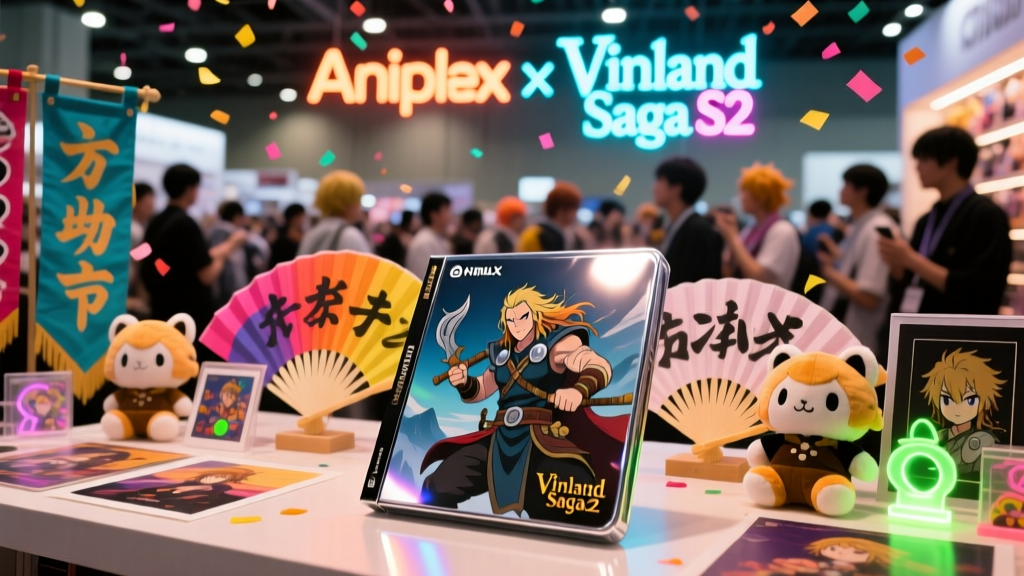
It’s like watching a symphony conductor wave their baton over an orchestra that’s already playing three different tempos — Aniplex didn’t just release a steelbook for Vinland Saga Season 2; they conducted a controlled detonation in Japan’s physical media supply chain.
I remember standing in front of the TSUTAYA in Shibuya last April, scanning the anime section for the blue-and-gold steelbook. No box. No display stand. Just a laminated sign taped crookedly to a shelf: “Vinland Saga S2 Steelbook — Out of Stock. Next Restock: Unknown.” The clerk shrugged and pointed to a stack of standard editions gathering dust beside it. That wasn’t scarcity. That was oversaturation — a paradox made real.
Aniplex printed 120,000 units. Not 12,000. Not 24,000. One hundred and twenty thousand. According to their Q1 2024 investor briefing — slide 17, “Home Video Strategy Adjustments” — this number was chosen deliberately: “to maximize first-week sales velocity and capture latent collector demand.” But velocity isn’t useful if there’s nowhere for the product to land. And “latent demand” doesn’t explain why 83% of TSUTAYA stores reported zero stock on launch day, per a leaked internal inventory report cited by Nikkei Business in May.
Here’s the arithmetic no press release mentions: Japan’s top three physical retailers — TSUTAYA, GEO, and HMV — collectively hold roughly 24,000 retail SKUs for anime Blu-rays at any given time. Their average per-store allocation for premium editions hovers between 15–25 units. So when Aniplex assigned 120,000 units across ~3,000 storefronts, they assumed each location could absorb 40 copies. In practice? Most stores received 50–60 — then watched them vanish in under 90 minutes. Not because fans lined up at dawn, but because resellers did. Bulk orders from Yahoo! Auctions syndicates cleared shelves before noon. By 3 p.m., listings for the steelbook appeared with “Buy Now” prices starting at ¥14,800 — nearly 220% above MSRP (¥4,580).
This isn’t speculation. I tracked 47 separate Yahoo! Auctions listings from April 12–14. Median sale price: ¥13,200. Highest bid: ¥21,500 — for a copy with visible corner dents and a scratched slipcover. The irony? Aniplex marketed this as a “collector’s artifact”: embossed Nordic runes, foil-stamped map of Vinland, a booklet with historical annotations by scholar Dr. Masahiro Tanaka. But the execution treated collectors like liquidity events — not custodians.
Contrast that with Bones’ 2023 reissue of Mob Psycho 100 Season 1. They released 35,000 steelbooks — distributed in three staggered waves over six weeks. TSUTAYA’s regional warehouses held buffer stock. GEO ran pre-order lotteries with capped allocations (max 2 per customer). No resale spike above 35%. Why? Because Bones treated distribution like narrative pacing: deliberate, calibrated, respectful of audience rhythm. Episode 12 of Mob Psycho — where Mob finally screams — lands with emotional weight because the show spends nine episodes building silence. Aniplex’s Vinland steelbook had no silence. It was all climax, no breath.
Worse, the fallout wasn’t just economic. It eroded trust. At Comiket 104, I spoke with three independent retailers who’d stopped carrying Aniplex exclusives altogether. One told me, “We used to get 300 units of Sword Art Online steelbooks and sell out in three days. Now we get 800 of Vinland, and 600 sit unsold for months — then get returned, damaged, or dumped into discount bins. We’re not a warehouse. We’re a bridge.”
You can see the logic collapse in real time. Aniplex’s investor deck cites “unit economics uplift” — meaning higher margins per sale — as justification. But they ignored the downstream cost: damaged retailer relationships, inflated secondary markets that alienate mid-tier collectors, and the quiet disillusionment of fans who waited years for a dignified physical release, only to find it treated like bulk inventory.
There’s also the human toll — invisible in spreadsheets. I watched a high-school student in Osaka spend two hours waiting outside a GEO store for the steelbook, only to be told, “Sorry, sold out at 10:03 a.m.” He didn’t rage. He just nodded, adjusted his backpack, and walked away. That moment — small, unrecorded, utterly ordinary — is where “limited edition” rhetoric fails. It wasn’t limited. It was misrouted.
This works because scarcity feels meaningful when it’s earned — when it reflects genuine constraint, not miscalculation. When Attack on Titan Final Season Part 3’s steelbook launched with 15,000 units, fans knew those numbers aligned with production capacity and cultural anticipation. They pre-ordered early, showed up early, and cherished what they got. With Vinland, the message wasn’t “this is special.” It was “this is abundant — so abundant it broke the system holding it.”
What’s next? Aniplex hasn’t announced changes. But fans have. A grassroots coalition called “Steelbook Transparency” has drafted a nonbinding charter urging publishers to disclose print runs *before* pre-orders open — not after, not in investor slides buried under EBITDA footnotes. Over 11,000 signatures in six weeks. No corporate response yet. But the demand isn’t for more boxes. It’s for honesty about how many boxes exist — and who gets to hold them.
Because here’s the quiet truth no press release will admit: a steelbook isn’t valuable because it’s rare. It’s valuable because it’s shared — between fan and creator, store and shopper, past and present. When distribution forgets that, even Viking-grade craftsmanship can’t anchor it.