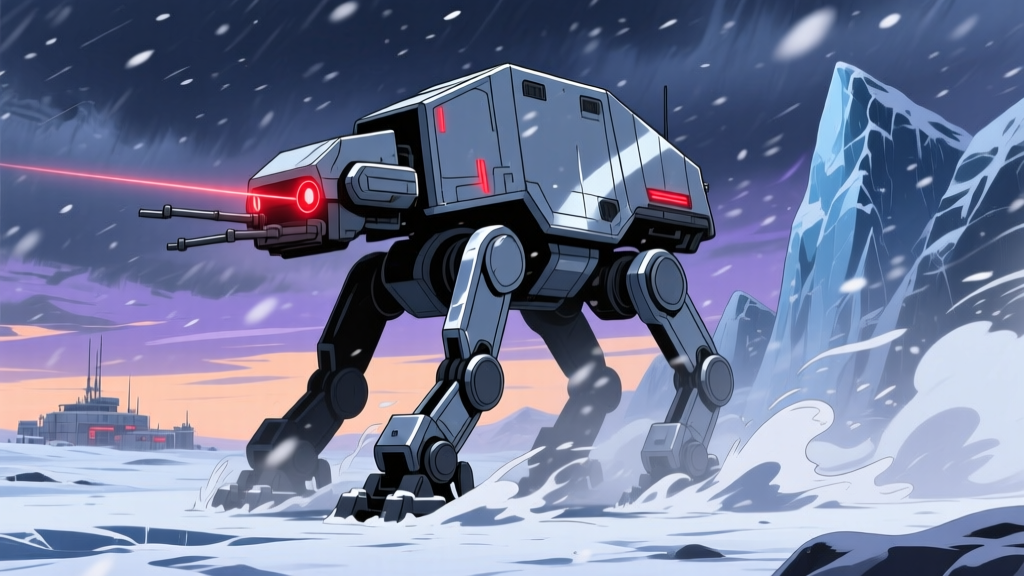
Four legs. Twenty-two meters tall. Zero mercy for anything standing in their path.
SenpaiSite · Otaku Culture · Star Wars Franchise · 13 min readThe screen is white. Blinding, featureless white. Then the snow erupts — not from wind, but from something massive driving its foot into the frozen ground. The camera tilts upward past armored legs, past hydraulic joints, past a neck that cranes forward like a predatory bird, until the head comes into view: a blunt, angular snout bristling with blaster cannons, scanning the horizon with mechanical indifference. The AT-AT has arrived. And nothing about the Battle of Hoth — or the way audiences thought about Star Wars — would ever be the same.
Design Origins: How Oakland Cranes Became the Empire's Deadliest Walkers
The All Terrain Armored Transport did not spring fully formed from George Lucas's imagination. Like so much of the original trilogy's production design, it was born from the collision of real-world industrial engineering and the fever-dream creativity of concept artists working under impossible deadlines.
Joe Johnston, the film's art director and one of the most inventive visual minds in Hollywood, has told the story many times. During pre-production for The Empire Strikes Back, Lucas asked for a ground assault vehicle that felt fundamentally different from anything audiences had seen in science fiction. Not a tank. Not a hovercraft. Something that walked. Johnston and his team at ILM began sketching bipedal and quadrupedal machines, cycling through dozens of variations that ranged from sleek and insectoid to bulky and dinosaurian.
The breakthrough came from an unlikely source: the shipping cranes of Oakland, California. Johnston and the effects team studied the massive gantry cranes that line the Port of Oakland, enormous structures that stride across the waterfront on four pillar-like legs. These machines are not fast. They are not elegant. But they project a sense of unstoppable industrial force, and that was precisely what Lucas wanted for the Imperial assault on Echo Base. The AT-AT would not chase its enemies. It would march toward them with the inevitability of a glacier, and the Rebels would understand, on a visceral level, that running was probably their best option.
Ralph McQuarrie, the legendary concept artist whose paintings defined the visual language of the original trilogy, produced some of the earliest and most influential AT-AT paintings. His versions emphasized the walker's scale and menace, often placing tiny human figures at the base of the legs to underscore just how towering these machines were meant to be. McQuarrie's color palette leaned into cold greys and muted steel tones, reinforcing the idea that the Empire built weapons the way it built everything else: functional, brutal, and utterly without warmth.
AT-AT Design Lineage:
- Early concepts explored bipedal walkers, rejected as too similar to Japanese mecha and too unstable-looking for the heavy armor concept
- Quadrupedal designs won out because four legs conveyed stability and weight — the machine would feel planted, immovable
- The "head" and "neck" assembly was added to give the walker a predatory silhouette, distinguishing it from a simple walking box
- Oakland gantry cranes directly inspired the columnar leg structure and the slow, deliberate stride cycle
- Final design settled at approximately 22.5 meters tall in-universe, making it one of the largest ground vehicles depicted in the original trilogy
Stuart Freeborn and the creature shop also contributed to the walker's personality. The chin-mounted blaster cannons were given a slight downward angle that, combined with the cockpit "eyes," made the head resemble a snarling face. This was deliberate. The Empire's machines were designed to terrify as much as to destroy, and an AT-AT bearing down on you with what looks like an expression of contempt was a psychological weapon in its own right.
Stop-Motion Magic: How ILM Brought the Walkers to Life
The Battle of Hoth sequence in The Empire Strikes Back remains one of the most technically ambitious practical effects set pieces ever committed to film. In 1979 and early 1980, there was no CGI safety net. No digital compositing. No motion-capture suits feeding data into rendering farms. There was a stage, a collection of meticulously crafted miniature models, and the hands of some of the most talented stop-motion animators on the planet.
Industrial Light & Magic, still a relatively young company at the time, built multiple AT-AT miniatures at different scales. The primary hero model, used for close-up shots where detail mattered most, stood roughly two feet tall. It was constructed from a combination of machined metal, plastic kit parts, and hand-sculpted elements. The greebling — the practice of covering a model's surface with small, seemingly functional details to create a sense of mechanical complexity — was applied with surgical precision. Every panel line, every bolt head, every conduit running along the legs served the illusion that this was a real machine, built by real engineers, operating under real physics.
Phil Tippett and Jon Berg handled the bulk of the stop-motion animation for the AT-AT sequences. Tippett, who would go on to become one of the most important figures in visual effects history, animated the walkers frame by frame. At twenty-four frames per second, a single AT-AT taking one step required roughly a dozen individual adjustments to the model's joints, each photographed separately. A ten-second shot of an AT-AT walking across the Hoth landscape could take an entire day or more to produce.
"Every step had to feel heavy. These weren't nimble robots — they were walking tanks, and the animation had to communicate tons of mass shifting from one foot to the next. If the movement was too smooth, the illusion collapsed." — Phil Tippett, on the Hoth animation process
The trickiest challenge was the leg cycle itself. A four-legged walking machine has an inherently complex gait, and Tippett studied real quadrupeds — elephants, camels, even large dogs — to understand how weight transfers during movement. The AT-AT's gait in the finished film is a modified walking pattern where the machine moves its legs in diagonal pairs, similar to a horse's trot but slower and more deliberate. This gave the walkers their signature lumbering menace: each step lands with a perceptible thud, the body sways slightly, and the head compensates with small stabilizing adjustments that make the whole thing feel like it is fighting its own momentum.
The Hoth Set and Compositing
The live-action Hoth sequences were filmed on the Hardangerjokulen glacier near Finse, Norway, in early 1979. The production crew endured temperatures well below freezing, with equipment frequently malfunctioning in the cold. Mark Hamill later recalled that the conditions were so harsh that the crew would huddle behind snow banks between takes just to feel their extremities again.
Back at ILM's facilities in California, the stop-motion AT-AT footage had to be composited into the Norwegian location plates. This was done using an optical printer, a device that re-photographs multiple strips of film onto a single piece of stock to combine them. The matte paintings that filled in the distant Hoth horizon were created by Harrison Ellenshaw and Michael Pangrazio, who painted frozen landscapes on glass with cutout sections that allowed the live-action and stop-motion elements to slot into the final frame.
The result was seamless enough to fool audiences in 1980 and still holds up remarkably well today. The AT-ATs feel present in the environment. They kick up snow. They cast shadows consistent with the on-location lighting. When one topples — the famous cable-tow scene — the physics of its fall feel convincing because Tippett and his team spent weeks studying how a top-heavy structure would actually collapse under gravity.
• • •The Tactical Debate: Were AT-ATs Actually a Good Idea?
Here is where the Star Wars fandom splits into two camps and starts yelling at each other across the internet. Were AT-ATs a tactically sound weapon, or were they a spectacular waste of resources that only looked good in propaganda posters?
The Case For the AT-AT
The Empire did not design the AT-AT to win battles. The Empire designed the AT-AT to win wars through terror. The psychological impact of a twenty-two-meter-tall armored walker striding toward your trench cannot be overstated. Rebel troops on Hoth are shown reacting with barely concealed panic as the walkers approach, and the ground defenses — tow cables, turret emplacements, speeder bikes — are clearly improvised responses to a threat the Rebellion never expected to face on a frozen ice ball.
From a pure firepower perspective, the AT-AT carries chin-mounted heavy blaster cannons capable of punching through the reinforced walls of Echo Base's shield generator building in a matter of seconds. The armor plating is thick enough to shrug off standard infantry blaster fire and light vehicle-mounted weapons. In the film, the Rebel snowspeeders' laser cannons are shown bouncing harmlessly off the walker's hull, forcing the pilots to improvise the tow-cable strategy. That is not a design flaw. That is a design triumph.
The AT-AT also serves as a troop transport. The body compartment carries up to forty stormtroopers plus five speeder bikes, meaning a squadron of walkers can deliver a substantial ground force directly into a combat zone while providing heavy fire support. It is a self-contained assault package.
The Case Against the AT-AT
Now for the other side. The AT-AT's weaknesses are numerous and, in some cases, embarrassingly obvious. The most glaring is the legs. Four tall, narrow, articulated legs supporting a massive body create an extremely high center of gravity. A tow cable wrapped around one leg is enough to trip the entire machine and send it crashing to the ground. That is not a minor vulnerability. That is a catastrophic engineering failure that would get any real-world defense contractor investigated by a congressional committee.
The neck joint is another problem. The head is connected to the body by a relatively thin, flexible neck section that, in the film, is penetrated by a harpoon-fired grappling hook and a thermal detonator. If the neck is the weak point — and it clearly is — then the entire design philosophy of putting the heaviest armor on the body while leaving the neck exposed is questionable at best.
Speed is the third major issue. AT-ATs are slow. Painfully, deliberately slow. On Hoth, the Rebel snowspeeders zip around them at several hundred kilometers per hour while the walkers plod forward at a walking pace. Any military doctrine that values mobility and flexibility would look at the AT-AT and ask why the Empire is committing resources to a vehicle that cannot pursue its own targets.
| Specification | AT-AT Walker | AT-ST Walker | AAT (Trade Federation) | Snowspeeder (T-47) |
|---|---|---|---|---|
| Height / Length | 22.5 m tall | 8.6 m tall | 9.75 m long | 4.5 m long |
| Crew | 5 (commander, pilot, gunner, 2 engineers) | 2 (pilot, gunner) | 6 (pilot, commander, 4 gunners) | 2 (pilot, gunner) |
| Troop Capacity | 40 troops + 5 speeder bikes | None | None | None |
| Max Speed | 60 km/h | 90 km/h | 55 km/h | 650 km/h (atmospheric) |
| Primary Armament | Heavy blaster cannons, medium blasters | Twin blaster cannons, concussion grenades | Heavy laser cannons, antipersonnel blasters | Twin laser cannons, rear harpoon |
| Armor | Heavy durasteel plating (impervious to small arms) | Light plating | Moderate plating | Minimal (cockpit only) |
| Known Weakness | Legs (tow cables), neck joint | Legs (unbalanced on rough terrain) | Slow turret traverse | No shields, light construction |
The speed differential tells the story. A snowspeeder is roughly ten times faster than an AT-AT in atmosphere. That means the walker can never chase down its most dangerous adversary. It can only stand there, fire its cannons, and hope something hits. The entire Battle of Hoth, from a tactical standpoint, boils down to the Empire betting that brute force and terror would overwhelm a Rebel defense that was always going to be outmatched in raw numbers, not in ingenuity.
• • •The Tow-Cable Scene: Two Minutes That Defined a Generation
Strip away the lightsaber duels, the Force revelations, the bounty hunters and the space battles. If you ask a Star Wars fan born before 1990 to name the single most thrilling sequence in the original trilogy, a significant percentage will say the same thing: Luke Skywalker flying a snowspeeder between the legs of an AT-AT while Wedge Antilles fires a harpoon cable around its ankle.
The scene works on every conceivable level. The setup is desperate: the Rebel shield generator is under assault, the walkers are advancing, and the snowspeeder pilots have already discovered that their forward lasers cannot penetrate the AT-AT's armor. Luke, flying as Rogue Leader, improvises on the fly. "Use the tow cables!" he shouts over the comms, and the audience instantly understands the plan even before they see it executed. Go for the legs.
What follows is roughly two minutes of filmmaking that has never been improved upon. Wedge Antilles and his gunner Janson dive their speeder toward the lead AT-AT, threading between the massive front legs while blaster fire erupts around them. Janson fires the harpoon. The cable wraps around the walker's ankle in a clean spiral. Wedge pulls up hard, banking the speeder into a tight turn that pulls the cable taut. And then, in one of the most satisfying shots in the history of cinema, the AT-AT begins to tip.
The sound design in this sequence is as important as the visuals. Ben Burtt, Star Wars' legendary sound designer, created the AT-AT's footstep sound by recording a hydraulic metal stamping press and then slowing the playback down significantly. Each impact registers as a deep, resonant thud that you feel in your chest. When the walker falls, the crash is layered with groaning metal, shattering ice, and the muffled explosion of the walker's own weight crushing its internal structure. It sounds like a building collapsing.
Phil Tippett's stop-motion animation of the fall is a masterclass in weight and physics. The AT-AT does not simply tip over like a toppled toy. Its legs buckle and fold as the center of gravity shifts past the point of recovery. The neck whips forward. The head plows into the snow. Debris flies. The entire sequence takes about three seconds of screen time, but Tippett spent weeks refining the motion because every frame had to communicate the destruction of a twenty-two-meter machine under the force of its own mass.
The moment when the Rebel troops cheer is the moment when the audience cheers. It is one of those rare sequences where the filmmaking is so precise, so perfectly calibrated, that the emotional response is universal. You do not need to understand military tactics or Star Wars lore to feel the rush. You just need to see a tiny speeder take down a giant. David and Goliath, told with tow cables and stop-motion animation.
After the Fall
The victory is short-lived, of course. The Rebels destroy one AT-AT, possibly two, before the remaining walkers reach the shield generator and blast it apart. The Battle of Hoth is a Rebel defeat. The evacuation is a desperate scramble, not a triumph. But the tow-cable scene gives the audience something essential: proof that the Empire's machines are not invincible. That courage and improvisation can, at least momentarily, topple the seemingly unstoppable. That theme carries through the entire saga and finds its ultimate expression when Lando and Wedge fly into the second Death Star's reactor core three years later.
• • •The AT-AT in Expanded Lore and Later Appearances
The AT-AT did not disappear after The Empire Strikes Back. It became a staple of the Star Wars visual vocabulary, appearing in Return of the Jedi (where a variant, the AT-ST, took over as the primary walker on Endor), the prequel trilogy's Clone Wars sequences, and numerous animated series, video games, and novels.
In The Clone Wars animated series, AT-ATs appear during several large-scale ground battles, and the show takes care to depict them as both formidable and flawed. Episodes show Separatist forces exploiting the same leg and neck vulnerabilities that the Rebels discovered on Hoth, reinforcing the idea that the AT-AT was always more terror weapon than practical combat vehicle.
Rogue One, set just before A New Hope, features a brief but stunning appearance of AT-ATs during the Battle of Scarif. The walkers stride through shallow water, firing into Rebel positions, and the shot is composed to echo the Hoth sequence almost exactly — a deliberate callback that links the two films visually and thematically. Gareth Edwards, Rogue One's director, has spoken about how the AT-AT is the single most iconic vehicle design in the franchise and that including it was non-negotiable.
In The Last Jedi, the First Order deploys updated AT-AT variants during the assault on Crait. These machines are sleeker and more refined than their Imperial predecessors, with improved armor and joint articulation, but the fundamental design philosophy has not changed. Four legs. Heavy armor. Big guns. Walk slowly and dare the enemy to stop you. The Resistance, predictably, finds ways to exploit them.
Collectibles: Bringing the Walker Home
If you want an AT-AT on your shelf, you are in luck. The walker is one of the most consistently reproduced Star Wars vehicles in the collectibles market, with options at virtually every price point.
Lego AT-AT (75288)
The current Lego AT-AT set, released in 2020 as part of The Empire Strikes Back 40th anniversary lineup, contains 1,267 pieces and retails for $159.99. It stands roughly eighteen inches tall when assembled, with posable legs, an opening troop compartment, and a spring-loaded shooter in the head. It is not the most detailed AT-AT Lego has produced, but it is the most accessible, and the posability makes it a favorite for display and photography.
The earlier Lego Ultimate Collector's Series AT-AT (set 10178), released in 2007, is a different beast entirely. With 3,152 pieces and a retail price of $299.99 at launch, it was one of the largest Lego Star Wars sets of its era. Sealed copies now trade for $800 to $1,500 on the secondary market, making it one of the better-performing Lego investments in the Star Wars line. The set's defining feature was its sheer size — nearly two feet tall, with a level of structural detail that made it feel like a genuine scale model rather than a toy.
Hasbro and Kenner Action Figures
Kenner's original 1980 AT-AT was a landmark toy. Standing roughly fourteen inches tall, it featured motorized walking action, a removable troop compartment, and the ability to carry the accompanying AT-AT Driver figure. It was expensive even by the standards of the day ($40 in 1980, which adjusts to roughly $150 today), and it became one of the most sought-after Star Wars toys of the original vintage era. Mint-condition examples in the original packaging now sell for $2,000 to $5,000 at auction, depending on the condition of the box and the completeness of the accessories.
Hasbro revived the AT-AT in multiple lines over the decades. The 2004 Saga Collection AT-AT was a fan favorite, with improved sculpting and more accurate proportions than the Kenner original. The 2010 Vintage Collection reissue brought it back for a new generation. In 2023, Hasbro's HasLab crowdfunding platform produced a 3.75-inch-scale AT-AT that stood over twenty inches tall, with extensive interior detail and multiple included figures. The campaign funded successfully and shipped to backers, with secondary market prices now hovering around $350 to $450.
Premium Collectibles
At the high end, companies like Gentle Giant and EFX Collectibles have produced large-scale AT-AT replicas and busts. Gentle Giant's 1:18 scale AT-AT replica, released in a limited run, stands approximately twenty inches tall and features museum-quality paint application with weathering effects that replicate the battle damage seen in the film. Original retail was around $600, with secondary prices reaching $900 to $1,200.
For the truly committed, Sideshow Collectibles and other premium manufacturers have offered full diorama pieces — AT-ATs on Hoth base displays with snow-textured terrain, miniature Rebel trenches, and even tiny snowspeeder accessories. These run from $300 to $1,500 depending on scale and detail level.
Entry-Level Options
Bandai's Star Wars Vehicle Model Kit line includes a 1/4800 scale AT-AT that retails for roughly $15 to $20. Despite the small size, the snap-fit construction captures the walker's silhouette with surprising accuracy, and the articulation at the leg joints allows for dynamic posing. Hot Wheels has produced multiple AT-AT castings over the years, typically available for $5 to $10. For fans who want a desk piece that reads as "AT-AT" without requiring a dedicated display shelf, these are hard to beat.
Funko Pop! released an AT-AT figure in their Star Wars line, and while it sacrifices all sense of scale and proportion in favor of the Funko aesthetic, it has its charm. A ten-dollar figure that puts a bobblehead walker on your desk is, in its own way, a small tribute to the absurdity and brilliance of the design.
• • •Why the AT-AT Endures
Strip it down to basics and the AT-AT makes no practical sense. It is slow, top-heavy, vulnerable at the joints, and absurdly expensive to manufacture compared to a conventional armored vehicle. By every metric that matters to a military logistics officer, the AT-AT is a failure.
But Star Wars is not a military simulation. It is mythmaking. And in the grammar of myth, the AT-AT is perfect. It is the dragon that the hero must outwit rather than overpower. It is the giant whose size becomes its undoing. It is the embodiment of an empire that mistakes scale for strength and armor for invulnerability. The Rebels win on Hoth not because they have better technology but because they have better ideas. They see the weakness that the Empire, in its arrogance, never bothered to address.
That is why the AT-AT has endured for more than four decades. It is not just a cool-looking robot. It is a storytelling device compressed into steel and hydraulics. Every time a new generation encounters the Battle of Hoth for the first time — whether on a theater screen, a streaming service, or through a Lego set assembled on a rainy afternoon — the same thing happens. The walker rises out of the snow. The camera tilts up. And someone, somewhere, whispers: "That thing is enormous."
That whisper is the sound of imagination being captured. And no amount of tactical analysis, no spreadsheet of design flaws, no logical deconstruction of its military utility will ever diminish it. The AT-AT walks. And we watch. That is the deal George Lucas struck with his audience in 1980, and it is a deal that has paid dividends every year since.
• • •Frequently Asked Questions
What does AT-AT stand for?
AT-AT stands for All Terrain Armored Transport. The designation reflects the walker's intended role as a heavy assault and troop-carrying vehicle capable of operating on virtually any planetary surface. The "All Terrain" claim is somewhat aspirational — as the Battle of Hoth demonstrated, the AT-AT struggles with tow cables, and the forests of Endor would have made its towering profile an easy target for Ewok traps and guerrilla tactics. The Imperial military bureaucracy was never known for modesty in its naming conventions.
Were the AT-ATs in The Empire Strikes Back stop-motion or CGI?
Entirely stop-motion and practical effects. The film was released in 1980, more than a decade before CGI became viable for complex creature and vehicle animation. Phil Tippett and Jon Berg at Industrial Light & Magic animated the AT-AT miniatures frame by frame using go-motion, a refinement of traditional stop-motion that used motion blur to make the animation look smoother on screen. The go-motion technique involved computer-controlled rods that moved the model slightly during each frame exposure, creating natural-looking blur that traditional stop-motion lacked. Some wide shots used compositing to place the stop-motion walkers into the Norwegian location footage.
How tall is an AT-AT in Star Wars canon?
The canonical height of an AT-AT is 22.5 meters, or roughly 73.8 feet. For reference, that is approximately the height of a seven-story building. The walker's body compartment sits about fifteen meters off the ground, high enough that infantry on the surface cannot reach the troop bay without climbing equipment or a ladder. The head and neck assembly extends several meters above the body, giving the gunner and commander a commanding view of the battlefield from an elevated position that would, in a real combat scenario, also make them the most visible target for miles.
Why didn't the Rebels just use the ion cannon on the AT-ATs?
The ion cannon at Echo Base was a fixed emplacement designed to fire upward into orbit, targeting Star Destroyers in space to create a window for Rebel transports to escape the blockade. It was not designed for ground-to-ground combat and could not be easily repositioned to target approaching walkers. The Battle of Hoth was a fighting retreat, not a planned engagement. The Rebels were scrambling to evacuate while the Empire threw overwhelming ground forces at them. Using the ion cannon against walkers would have required a fundamental redesign of the weapon system, something the Rebels did not have time or resources to accomplish during the assault.
Are there real-world military vehicles inspired by the AT-AT?
No military has built a full-scale quadrupedal combat walker, and most defense analysts consider the concept impractical for the same reasons Star Wars fans debate — high profile, vulnerable joints, and prohibitive manufacturing cost. However, the AT-AT has influenced real-world military aesthetics and thinking in subtler ways. Boston Dynamics' BigDog and LS3 quadrupedal robots drew inevitable comparisons to the Imperial walker, and several DARPA-funded research projects have explored legged locomotion for rough-terrain logistics. The visual language of the AT-AT — angular, grey, menacing — has also been adopted by concept artists working on next-generation military vehicle designs, creating a feedback loop between science fiction and defense industry aesthetics.
What happened to the AT-AT that Luke brought down on Hoth?
In current Star Wars canon, the downed AT-AT on Hoth remained on the battlefield after the Rebel evacuation. The 2021 series The Book of Boba Fett and other canon materials have referenced the wreckage on Hoth as a landmark. In the old Legends continuity, various novels and comics depicted salvage operations on Hoth, with both Imperial and scavenger crews picking through the remains of the battle. The downed walker became something of a tourist attraction in the Expanded Universe, a frozen monument to the day the Rebellion proved that even the Empire's biggest machines could bleed.