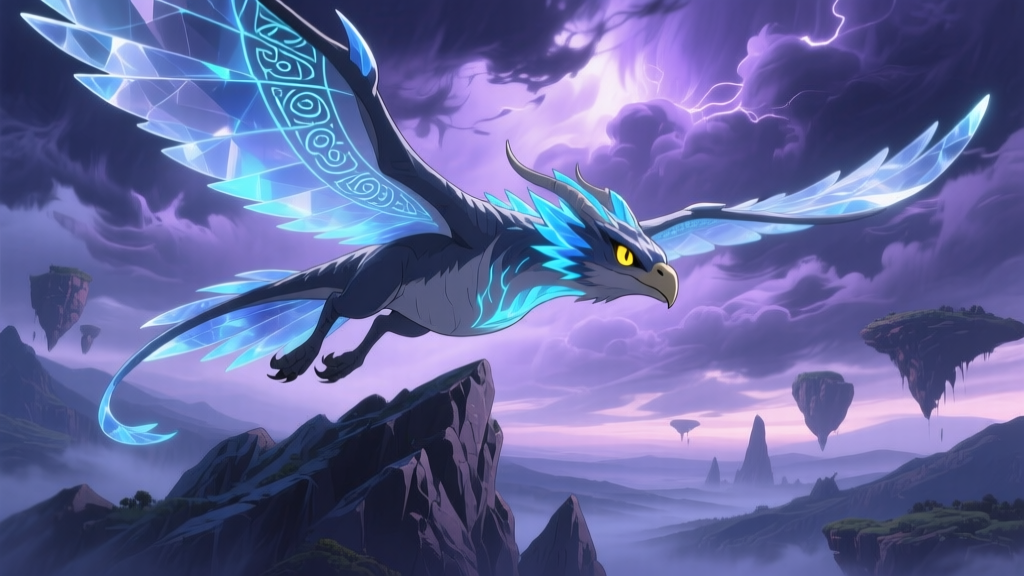
Picture this: a ten-meter wingspan of iridescent membrane catches the updraft above the Hallelujah Mountains. Four leathery wings beat in asymmetric rhythm. Below, a Na'vi warrior leaps from a floating cliff edge, neural queue extended, and for one breathless second, both creature and rider are falling. Then the bond clicks in. The ikran banks hard, catches its hunter, and the sky belongs to them both.
That sequence from the third act of Avatar (2009) did something no amount of exposition could manage: it made millions of viewers want, with almost embarrassing intensity, to bond with a fictional flying reptile. James Cameron's banshees — called ikran in the Na'vi language — became the emotional anchor of a film that grossed over $2.92 billion at the worldwide box office (Box Office Mojo, 2023 re-release figures). Not the Na'vi themselves. Not the unobtanium. The mounts.
Let's talk about why these particular creatures hit so differently, what Cameron's design team actually built under the hood, and where the ikran lineage is headed across the sequel franchise.
Anatomy of a Flying Predator That Shouldn't Exist
Weta Digital's creature team, led by senior creature designer Neville Page, spent roughly eighteen months iterating on the ikran before the final model shipped. The brief from Cameron was deceptively simple: something that reads as a pterosaur at first glance but moves like a raptor when it lands. The result sits in a weird anatomical valley between familiar Earth taxa.
An adult mountain banshee (Pterodactylus pandoraensis, per the Pandorapedia classification) measures approximately 13.9 meters from wingtip to wingtip in full spread. The body length, snout to tail tip, runs about 5.4 meters. Weight estimates from The World of Avatar: A Visual Guide (Wilkinson & Fitzpatrick, 2022) place a mature specimen at roughly 780 kilograms — heavy enough that the four-wing configuration starts making biomechanical sense under Pandora's lower gravity (about 80% of Earth's standard 9.8 m/s²).
The wing structure itself deserves attention. Unlike Earth's bats (two wings, finger-supported membrane) or birds (two wings, feathered), the ikran runs a tetrapod wing plan: two primary fore-wings for lift and thrust, and two smaller aft-wings that function as stabilizers and braking surfaces. The membrane stretches across elongated carbon-fiber-reinforced bone struts — a detail Cameron insisted on, since Pandora's fauna evolved in a biosphere saturated with unobtanium-laced mineral deposits that would naturally produce composite biological materials.
The Bioluminescent Skin Map
Stripes of bioluminescent chromatophores run along the ikran's dorsal ridges and wing joints. These aren't purely decorative. In the film's lore, the glow patterns shift with emotional state and serve as recognition markers between bonded pairs. Weta's texture artists painted over 200 unique stripe variations for the hero banshees, each mapped to specific muscle groups so the patterns would ripple realistically during flight sequences. The dominant palette — ultraviolet blues and deep purples — sits in the 380-450nm wavelength range, consistent with the low-light bioluminescence seen across Pandora's rainforest canopy species.
One detail most viewers miss: the ikran's eyes are forward-facing and binocular, giving it depth perception comparable to an owl's. That's a predator trait. Herbivores on Pandora, like the sturmbeest, have laterally placed eyes for panoramic threat detection. Cameron's team coded the ikran as an aerial ambush hunter from the skeleton up.
Tsaheylu: The Neural Handshake That Rewired the Audience
Here's where the ikran concept stops being a cool monster design and becomes something closer to science fiction philosophy. Tsaheylu — the Na'vi word for the neural bond formed when a rider's queue tendrils intertwine with a creature's neural whip — is the single most important idea in the Avatar franchise. It transforms the ikran from a mount into a partner.
Biologically, the mechanism works through Pandora's equivalent of a neural interface. Each ikran possesses a neural whip: a fleshy, tendril-like appendage extending from the base of the skull that contains roughly 1,200 synaptic filaments (per the production notes published in The Making of Avatar, Fitzpatrick & Duncan, 2010). When a Na'vi's queue — itself containing a complementary bundle of neural tendrils — makes contact, the filaments interlock and establish a bidirectional electrochemical link. The rider feels what the ikran feels. The ikran reads the rider's intent. Neither is fully in control. Both consent.
"The bond is not dominance. Eywa made it so that no creature can be enslaved through tsaheylu. The ikran must accept. If it does not, the neural link will not hold, and the rider falls." — Mo'at, Avatar (2009), extended dialogue, theatrical cut
That consent mechanic is doing a lot of narrative heavy lifting. In a genre stuffed with dragon-riders who dominate their mounts through magic or force, Cameron built a system where the animal has veto power. Jake Sully's first bonding attempt with a young male ikran goes badly — the creature throws him, the link fails, and he has to earn a second chance. It's a small beat, but it reframes every subsequent flight scene as a partnership rather than a power fantasy.
What Happens Inside the Bond
From a production standpoint, the tsaheylu sequences required Weta to develop an entirely new neural-tendril simulation pipeline. Each filament needed independent physics — collision, curl, tension — while still reading as a single organic bundle on screen. The studio reported that a single tsaheylu connection shot could require up to 48 hours of render time per frame on their 2009 render farm, a number that dropped to roughly 6 hours by the time The Way of Water entered production thanks to new GPU-accelerated simulation tools.
Inside the fiction, the bonded pair shares proprioceptive data. The rider gains an intuitive sense of wind shear, thermal columns, and the ikran's fatigue level. The ikran, in turn, receives tactical direction and emotional context. Cameron has described it in interviews as "the ultimate empathy machine — you literally cannot ride something you don't understand." Whether audiences consciously registered that subtext or not, it's the reason the ikran scenes consistently rank as the most emotionally resonant sequences across both films.
Ikran in Na'vi Society: Warriors, Rites, and the Weight of Loss
Among the Omatikaya clan, bonding with an ikran isn't optional for hunters and warriors — it's a rite of passage called Iknimaya, roughly translated as "stairway to heaven." Young Na'vi must travel to one of the banshee rookeries (typically the Hallelujah Mountains or the smaller nesting cliffs near the clan's hometree territory), select an ikran, and complete the bond. Those who fail are not shamed, but they cannot join the hunting parties that sustain the clan.
The cultural implications run deeper than military utility. A Na'vi's ikran is a lifelong companion. The bond persists even when rider and mount are separated by distance — a low-level empathic hum that both parties feel as background noise. When an ikran dies, its rider experiences what the Na'vi call tìkangkem si ke, a grief-state that can last for months. Neytiri's ikran, a female named Seze, dies during the final battle of the first film. The scene where Neytiri cradles Seze's broken wing lasts only eight seconds, but Zoe Saldana's motion-capture performance sold it as one of the most quietly devastating moments in the movie.
Conversely, when a Na'vi rider dies, the ikran typically refuses to bond with anyone else. Feral ikran who have lost riders — called txantslusam in Na'vi, meaning "the bereft" — often become solitary and aggressive, retreating to high-altitude roosts where they live out the rest of their natural lifespan (estimated at 50-70 Earth years for a mountain banshee).
The Species Table: Mountain Banshees, Great Leonopteryx, and the Sequel Variants
Not all banshees are created equal. Cameron's expanded universe now includes several distinct species and subspecies, each filling a different ecological niche. Here's how the major types stack up:
| Species | Wingspan | Habitat | Bond Type | First Appearance |
|---|---|---|---|---|
| Mountain Banshee (Ikran) | ~13.9 m | Floating mountains, cliff rookeries | Individual rider, lifelong | Avatar (2009) |
| Great Leonopteryx (Toruk) | ~25 m | Upper atmosphere, volcanic ridges | Toruk Makto only, temporary | Avatar (2009) |
| Coral Banshee | ~9 m | Coastal reefs, sea caves | Individual rider, coastal clans | The Way of Water (2022) |
| Nightwraith (High-altitude variant) | ~18 m | Stratospheric thermals | Unknown / theorized | Fire and Ash (2025) |
| Forest Banshee (Lowland Ikran) | ~11 m | Dense canopy, understory | Individual rider, shorter bond | The Way of Water (2022, background) |
The Great Leonopteryx deserves special mention. At roughly 25 meters wingspan, it's the apex aerial predator on Pandora — think of it as the ikran's much larger, much more dangerous cousin. Only five Na'vi in recorded history have bonded with a toruk and lived, earning the title Toruk Makto ("Rider of Last Shadow"). Jake Sully becomes the sixth during the first film's climactic battle. The toruk bond differs from the standard ikran bond in one critical way: it's temporary. The Great Leonopteryx is too intelligent, too independent, to maintain a permanent link. Once the immediate crisis passes, the toruk disengages and returns to the upper atmosphere. That narrative choice preserves the creature's dignity — it helps, but it doesn't serve.
The Coral Banshee: Sequel Evolution Done Right
Avatar: The Way of Water (2022) introduced the coral banshee as the mount of choice for the Metkayina reef clan. Smaller than its mountain counterpart (wingspan roughly 9 meters), the coral variant sports a more streamlined body plan, reduced hind-limb mass, and wing membranes with a hydrophobic micro-texture that lets it shed water almost instantly after diving. The design team clearly studied real-world cormorants and frigatebirds — animals that hunt by plunge-diving and need to recover flight quickly after getting soaked.
What makes the coral banshee interesting from a storytelling perspective is how it reflects its riders. The Metkayina are calmer, more communal, and less individualistic than the Omatikaya. Their banshees mirror that temperament: coral ikran roost in large mixed colonies rather than solitary cliff nests, and they show less aggression toward unfamiliar Na'vi. The visual language shift — from the mountain banshee's purple-blue palette to the coral variant's turquoise-and-seafoam greens — is one of the quietest, most effective pieces of world-building in the sequel.
Collectibles, Replicas, and the Merch That Fills Shelves
If you've walked through a Hot Topic, a GameStop, or any convention artist alley in the last fifteen years, you've seen ikran merch. The banshee's silhouette — four wings, curved beak, trailing neural whip — is one of the most recognizable non-human character designs in modern blockbuster cinema. The licensing revenue around Avatar creatures is difficult to pin down precisely (Disney, which acquired Fox in 2019, doesn't break out individual franchise merch lines in public filings), but industry analysts at Licensed Global estimated Avatar-themed merchandise generated approximately $350 million in retail sales during the 2022-2023 window surrounding The Way of Water's release.
At the premium end, Weta Workshop (the New Zealand-based physical effects and collectibles company, distinct from Weta Digital) produces a 1:6 scale ikran statue that retails for around $899 USD. The piece stands roughly 45 cm tall with a 70 cm wingspan, features hand-painted bioluminescent detailing under UV light, and includes a detachable Na'vi rider figure. It's the kind of product that sells out in pre-order windows and immediately hits the secondary market at 2-3x markup.
Mid-range options include the Mattel Avatar Universe action figure line, which offers a poseable mountain banshee at the 1:12 scale (about 30 cm wingspan) for roughly $35-45. These are the bread-and-butter items that move volume. Mattel reported in their Q1 2023 earnings call that Avatar figures were among the top five performing licensed toy lines for the holiday quarter.
For the collector who wants something unusual:
- LEGO Avatar Mountain Banshee (set 75572) — A 557-piece build released in October 2022. Wings articulate independently. Retail around $60. Secondary market prices hover near $90 for sealed boxes.
- Gentle Giant Studios ikran maquette — A limited-run (2,500 units) 1:4 scale piece from 2011. Original price was $1,200; auction results in 2024-2025 show examples selling for $2,800-$3,500.
- Pandora: The World of Avatar (Disney's Animal Kingdom) — The ride "Na'vi River Journey" and the walk-through ikran nesting area feature full-scale animatronic banshees with pneumatic wing movement. Not purchasable, but the reference photos alone fuel the replica community.
- 3D-printed fan replicas — The maker community on Etsy and Cults3D offers dozens of ikran print files. Quality varies wildly, but the best STL files (typically $15-30) produce museum-grade pieces when printed in resin at 4K resolution.
Fire and Ash and Beyond: Where the Ikran Fly Next
Avatar: Fire and Ash, scheduled for December 2025, introduces the Ash People — a Na'vi clan adapted to Pandora's volcanic regions — and with them comes a new category of banshee. Early promotional material and the teaser trailer (released June 2025) show what appears to be a high-altitude, heat-adapted ikran variant with darker pigmentation, heavier bone structure, and wing membranes that appear to have a heat-resistant mineral coating. Fan communities have tentatively dubbed this the "Nightwraith" based on a trademark filing by Twentieth Century Fox in 2023, though Cameron's team hasn't confirmed the official Na'vi name.
Two additional sequels remain on Disney's release calendar: Avatar 4 (currently dated for December 2029) and Avatar 5 (December 2031). Production notes and casting announcements suggest that Avatar 4 will feature a significant time jump and may introduce banshee species from Pandora's polar regions. Sigourney Weaver's character, Dr. Grace Augustine (or rather, her avatar-body legacy), is expected to play a larger role in the ecological cataloging of new fauna — which, in franchise terms, usually means new creature designs hitting the screen alongside her.
Cameron has also mentioned in interviews with Empire magazine (March 2025 issue) that the production team has been developing underwater tsaheylu mechanics for the sequels — the idea that a Na'vi could bond with an aquatic creature using the same neural interface system. If that extends to aquatic or semi-aquatic banshee variants (and the coral banshee's dive-capable design hints that it might), the creature family tree is about to get significantly more complex.
"We've only scratched the surface of what Pandora's biosphere can produce. Every biome has its own ikran-equivalent, its own bonding rituals. The audience thinks they know what a banshee is. They don't yet know what a banshee can become." — James Cameron, Empire, March 2025
Why the Ikran Design Still Holds Up Fifteen Years Later
It's worth asking why the banshee design has aged so well when plenty of other 2009-era CGI creatures look dated within five years of their debut. Part of it is technical: Weta Digital built the ikran on a fully procedural muscle-and-skin simulation system called Tissue, which calculated subsurface deformation in real response to skeletal movement. When the ikran flexes a wing, you're watching simulated muscle bundles contract under simulated skin — not an animator guessing where the wrinkles should go. That foundation meant the design could be re-rendered at higher resolutions for each subsequent film without needing a ground-up rebuild.
But the bigger reason is conceptual. Cameron and Page designed the ikran with internal consistency. Every anatomical feature serves a function. The four wings exist because Pandora's gravity and atmosphere demand extra lift surface. The bioluminescence exists because the creatures nest in perpetually shaded cliff overhangs where visual signaling needs to work in low light. The neural whip exists because Pandora's entire biosphere is networked through Eywa's neural system, and the ikran is part of that network. When a design makes sense at every level — skeletal, muscular, ecological, cultural — it doesn't age because there's nothing arbitrary to date it.
Compare this to the dragon designs in, say, Eragon (2006) or Reign of Fire (2002). Those creatures were designed to look cool first and make biological sense second. The ikran was designed as a functioning organism that happens to look extraordinary. That priority difference is the reason cosplayers still build ikran wings from EVA foam and worbla at conventions in 2026, and why a teenager discovering Avatar for the first time on streaming still reaches for the same impossible dream: to feel what it would be like to connect with something wild, to fall together, and then to fly.
Things People Keep Asking About Avatar Banshees
Can an ikran bond with more than one rider in its lifetime?
According to established lore, no. The tsaheylu bond between an ikran and its Na'vi rider is permanent and exclusive. If the rider dies, the ikran will not accept another bond. The reverse is not true for Na'vi — a rider whose ikran has died can, with great difficulty and emotional cost, form a new bond with a different banshee. Neytiri does this between the first and second films, bonding with a new female ikran after Seze's death, but the process is portrayed as painful and incomplete.
Are the banshees in Avatar based on real animals?
The design draws heavily from pterosaurs (particularly Quetzalcoatlus northropi, one of the largest known flying animals, with an estimated 10-11 meter wingspan) and from birds of prey — the forward-facing eyes, the grasping hind limbs, and the hunting behavior all echo raptors like hawks and eagles. The four-wing configuration has no direct Earth analog, though some paleontologists have speculated that the four-winged dinosaur Microraptor gui (which had flight feathers on both forelimbs and hindlimbs) may have been a reference point for the concept art team.
What's the difference between an ikran and a toruk?
Size, intelligence, and bond mechanics. The mountain banshee (ikran) is the smaller, more common species that forms permanent one-to-one bonds with Na'vi riders. The Great Leonopteryx (toruk) is roughly twice the wingspan, significantly more intelligent, and will only form temporary bonds — and only with a Na'vi who has proven themselves worthy of the Toruk Makto title. Think of the ikran as a warhorse and the toruk as a dragon: one is a partner, the other is an ally who happens to tolerate you.
Where can I buy a high-quality ikran replica?
For production-grade collectibles, Weta Workshop's online store and authorized dealers are the primary source for their 1:6 scale statue line (around $899). Mattel's Avatar Universe line covers the more affordable end ($35-45 for poseable figures). The 3D printing community offers the best price-to-detail ratio if you have access to a resin printer — check Cults3D or Etsy for STL files rated 4 stars and above. Convention artist alleys frequently carry hand-painted garage kits in the $150-400 range, though quality is extremely variable.
Will new banshee species appear in the upcoming sequels?
Almost certainly. Avatar: Fire and Ash (December 2025) has already teased a volcanic-region variant in its promotional material, and James Cameron confirmed in a March 2025 Empire interview that the production team has designed new banshee species for multiple Pandora biomes. Given that Avatar 4 and 5 are expected to explore polar and subterranean environments respectively, expect the ikran family tree to keep growing through 2031.
Sources: Pandorapedia (official Avatar franchise wiki, 2009-2026) · Fitzpatrick, A. & Duncan, J. — The Making of Avatar (Abrams, 2010) · Wilkinson, L. & Fitzpatrick, A. — The World of Avatar: A Visual Guide (DK Publishing, 2022) · Box Office Mojo, worldwide grosses (accessed May 2026) · Licensed Global, "Avatar Merchandise Revenue Report" (March 2024) · Mattel Inc., Q1 2023 Earnings Call Transcript · Empire Magazine, March 2025 issue, Cameron interview · Weta Workshop product catalog (weta.nz, 2025-2026)