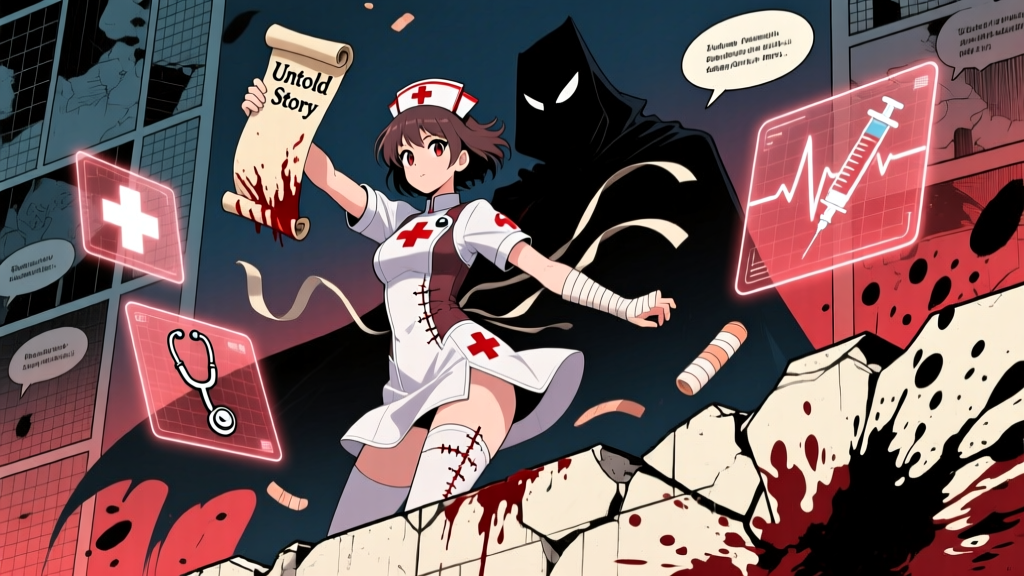
I remember the exact moment. A dusty longbox at a 2019 comic convention in Portland, digging past battered issues of X-Men and Spawn, and there it was — Night Nurse #1, November 1972, cover price 20 cents. Linda Carter in her white uniform, red cross on the chest, staring down at a wounded man with an expression that was equal parts compassion and fury. The vendor had it priced at $85. I paid without haggling. That single issue opened a rabbit hole I've been falling through ever since: the surprisingly rich, often overlooked, occasionally infuriating history of nurse characters across comic books, manga, and anime.
Nurses in comics aren't just background decoration for hospital scenes. They've been wartime propaganda tools, horror genre icons, romantic leads, and — in the best cases — fully realized characters whose medical expertise drives entire storylines. From Florence Nightingale rendered in sequential art panels to the nurse characters of Monster who hold narrative weight far beyond their scrubs, this corner of pop culture has more depth than most collectors realize.
From Battlefield Sketches to Four-Color Pages: A Brief History
Nurses appeared in comic-adjacent art long before the medium crystallized into what we now call comic books. During the Crimean War (1853–1856), illustrated newspapers like The Illustrated London News published sequential-panel depictions of Florence Nightingale's work at Scutari Hospital. These weren't comics in the modern sense, but they established a visual grammar: the nurse as a figure of light in dark surroundings, often literally drawn with a lamp or halo-like glow.
When American comic books exploded in the late 1930s, nurses showed up almost immediately — but mostly as love interests or civilians in peril. The Golden Age wasn't subtle about gender roles. A nurse might patch up the hero's wounds in panel three and be kidnapped by the villain in panel four. Still, even within those constraints, some writers gave their nurse characters sharp dialogue and quiet competence that readers noticed.
Wartime Comics: Nurses as Patriotic Symbols
The real shift came with World War II. Between 1941 and 1945, the U.S. government actively encouraged comic publishers to support the war effort, and nurse characters became vehicles for recruitment propaganda. Titles like War Comics (Dell, 1942) and various Army Nurse Corps promotional comics depicted nurses as brave, skilled professionals working under fire. According to the U.S. National Library of Medicine's exhibition archives (2018), over 120 distinct comic-book titles featured nurse protagonists or prominent nurse characters during the war years.
These weren't always great comics — many read like recruitment pamphlets with speech bubbles — but they accomplished something important: they made the nurse a visible character type in the medium. Readers, particularly young women, saw themselves represented in four-color print. The Army Nurse Corps reported a 38% increase in voluntary enlistments in regions where these promotional comics were distributed, according to declassified War Manpower Commission records from 1944.
The Comics Code and the Vanishing Act
Then came 1954 and the Comics Code Authority. Horror comics — which had used nurse characters to great effect as both victims and heroes in supernatural scenarios — were gutted. EC Comics' Tales from the Crypt and The Haunt of Fear frequently featured nurses in morally complex stories. After the Code, nurse characters largely retreated into romance comics and the occasional war title. The 1950s and 1960s gave us plenty of nurses in white uniforms looking concerned behind hospital desks, but very few who carried a story.
It took the direct market boom of the 1970s and the erosion of Code restrictions to bring nurses back as protagonists worth reading about.
Night Nurse: Marvel's Most Underrated Clinic
Here's the comic that started it all for modern nurse-character fandom. Night Nurse, created by Stan Lee and published by Marvel Comics, ran for four issues from November 1972 to May 1973. The premise was deceptively simple: Linda Carter, a registered nurse, opens a walk-in clinic specifically for superheroes who can't afford to be identified at regular hospitals. Spider-Man shows up with a bullet wound. Daredevil needs stitches after a rooftop fight. They can't exactly walk into Mount Sinai.
What made Night Nurse compelling wasn't the superhero cameos — it was Linda Carter herself. She was written as genuinely competent. Not a sidekick, not a love interest orbiting a male lead, but a medical professional whose skills were the entire point of the story. In issue #2, she performs emergency surgery on a costumed vigilante with nothing but clinic-grade equipment and raw nerve. The scene has more tension than most superhero battles because the stakes feel real: if she fails, someone dies on her table.
"Night Nurse was one of the first Marvel titles where the protagonist's power wasn't a mutation or a magic hammer — it was a nursing degree and the willingness to work at 3 AM for people who couldn't give their real names." — The Marvel Reader's Companion, Schiffer Publications, 2015
The series was short-lived — four issues, cancelled due to low sales in an overcrowded market — but Linda Carter resurfaced decades later in the Daredevil television series on Netflix (2016), played by Rosario Dawson as Claire Temple, a night-shift nurse who patches up street-level heroes. The adaptation changed the name but kept the core concept: a nurse whose medical skills make her indispensable to people who live dangerously.
For collectors, Night Nurse #1 in near-mint condition (CGC 9.4 or above) typically sells in the $400–$600 range at Heritage Auctions. Issue #4, the final issue, is rarer and commands $250–$400 depending on grading. The complete four-issue run in a single lot is a prize — one sold for $1,800 at a 2021 ComicLink auction.
Nurse Nightingale and Historical Figures in Sequential Art
Florence Nightingale has been adapted into comic form more times than most people realize. The most notable is probably the Florence Nightingale graphic biography published by Icon Books in 2018, illustrated by Petr Kopl. This isn't a superhero comic — it's a full-length graphic novel that traces Nightingale's life from her privileged upbringing through her statistical work on soldier mortality during the Crimean War. (Yes, Nightingale was also a pioneering statistician. She invented a form of pie chart called the polar area diagram. Most people don't know that.)
Before the graphic novel treatment, Nightingale appeared in educational comics throughout the 1960s and 1970s. The Classics Illustrated series and its various imitators frequently adapted historical figures for young readers, and Nightingale was a recurring subject. These comics tended toward hagiography — the Lady with the Lamp, the Angel of the Crimea — but they introduced generations of readers to a woman who was, in reality, one of the most formidable administrators and data analysts of the 19th century.
In the manga world, historical nurse figures appear less frequently but with interesting results. Osamu Tezuka, the godfather of manga and himself a trained physician, wove medical themes throughout his work. While he didn't create a standalone Nightingale adaptation, his medical manga — particularly Ode to Kirihito (1970–1971) and Black Jack (1973–1983) — feature nurse characters who carry genuine narrative weight. In Black Jack, the nurse Pinako (later revealed as a surgeon) serves as Black Jack's moral compass and occasional conscience, a role that goes far beyond the typical assistant character.
When the Hospital Becomes the Story: Medical Manga and Anime
Japanese manga and anime have produced a substantial body of medical-themed work, and nurse characters in these stories tend to be written with more nuance than their Western comic counterparts. Part of this is cultural: Japan's healthcare system and the social status of nursing create a different context for storytelling. Nurses in Japanese media are more often depicted as skilled professionals making autonomous decisions, rather than assistants waiting for physician orders.
The Heavy Hitters
Monster (Naoki Urasawa, 1994–2001): Nina Fortner, one of the series' central characters, works as a nurse before her past catches up with her. Urasawa uses her medical training as a narrative device — her ability to treat wounds, assess injuries, and remain calm under pressure makes her one of the most capable characters in a thriller full of dangerous people. Her nursing background isn't window dressing; it's integral to how she survives and how she helps others survive. The series sold over 20 million copies in Japan alone.
Team Medical Dragon (Iryu: Team Medical Dragon, 2002–2011): This seinen manga about a brilliant but unorthodox surgeon features an ensemble of hospital staff, including several nurse characters who navigate the political minefield of a Japanese university hospital. The series is known for its surgical accuracy — Urasawa reportedly consulted with practicing surgeons — and its nurse characters reflect real workplace dynamics in Japanese medical institutions.
Black Jack (Osamu Tezuka, 1973–1983): Already mentioned above, but worth expanding. The 232-chapter run includes numerous nurse characters across its medical-of-the-week format. Some are competent, some are corrupt, some are terrified — Tezuka refused to treat any profession as monolithic. The series has been adapted into multiple anime, OVAs, and films, keeping these nurse characters visible across decades of Japanese pop culture.
Dr. Koto's Clinic (Dr. Kotou Shinryoujo, Takatoshi Yamada, 2000–present): Set on a remote island with minimal medical infrastructure, this series forces its nurse characters into roles that would normally belong to entire hospital departments. The nurse, Mina, handles triage, emergency surgery assistance, patient counseling, and pharmacy duties. It's a realistic portrayal of rural healthcare nursing that most urban readers had never encountered in fiction.
The Genre-Benders
Not every nurse character in manga plays it straight. Nurse Angel Ririka SOS (1995) mashes up the magical girl genre with nursing themes — the protagonist transforms into a magical nurse who heals people and fights evil. It sounds ridiculous, and it is, but it was popular enough to run for four manga volumes and a 35-episode anime series. The show aired on TV Tokyo in 1995 and maintained a 6.2% audience share in its timeslot, respectable for a weekday afternoon slot.
Then there's Nurse Witch Komugi (2002–2004), an OVA series that parodies both the magical girl and nursing genres simultaneously. It's a love letter to otaku culture wrapped in nurse cosplay, and it became a cult hit precisely because it never takes itself seriously. The character design spawned a significant figure and merchandise line — more on that below.
The Comics Table: Nurse Characters Across Mediums and Decades
| Character | Title / Franchise | Year | Medium | Role & Significance |
|---|---|---|---|---|
| Linda Carter | Night Nurse (Marvel) | 1972 | American Comic | Protagonist; runs underground clinic for superheroes |
| Claire Temple | Daredevil / Marvel Netflix | 2015 | TV Adaptation | Night-shift nurse; recurring across 5 Marvel/Netflix series |
| Pinako | Black Jack (Tezuka) | 1973 | Manga | Nurse/surgeon; moral anchor for the protagonist |
| Nina Fortner | Monster (Urasawa) | 1994 | Manga | Nurse-turned-investigator; central protagonist |
| Ririka | Nurse Angel Ririka SOS | 1995 | Manga / Anime | Magical girl nurse; genre hybrid |
| Komugi Nakahara | Nurse Witch Komugi | 2002 | OVA / Anime | Parody magical nurse; otaku culture icon |
| Mina | Dr. Koto's Clinic | 2000 | Manga | Island nurse; rural healthcare realism |
| Florence Nightingale | Graphic Biography (Icon Books) | 2018 | Graphic Novel | Historical biography; statistical pioneer |
| Various wartime nurses | Army Nurse Corps comics | 1941–1945 | Promotional Comics | Recruitment propaganda; 120+ titles produced |
Representation: What Got Better, What Still Needs Work
The trajectory of nurse characters in comics roughly mirrors how the nursing profession itself has been perceived in popular culture. Early portrayals leaned heavily on two archetypes: the angelic caregiver (pure, self-sacrificing, almost sexless) and the naughty nurse (a fetishized figure with little connection to actual nursing). Both reduce a complex profession to a single dimension.
The 1970s brought marginal improvement. Night Nurse gave us a nurse with agency and expertise. Underground comix artists like those publishing in Wimmen's Comix (1972–1992) occasionally featured nurse characters who grappled with real workplace issues: mandatory overtime, physician disrespect, the emotional toll of patient loss. These weren't mainstream titles, but they were honest.
Japanese manga has generally done better. The cultural context matters: in Japan, nursing carries different social weight, and manga's willingness to explore workplace dynamics (the "shokunin" or craftsman trope applied to medical professionals) has produced nurse characters who feel like actual people doing actual work. Team Medical Dragon is probably the best example — its nurse characters have personal ambitions, office rivalries, and ethical dilemmas that have nothing to do with their romantic availability.
The gap that persists: male nurses are almost entirely invisible in comics. According to the U.S. Bureau of Labor Statistics (2023), approximately 12% of registered nurses in the United States are men, yet you'd struggle to find a single prominent male nurse character in mainstream American comics. Manga does slightly better here — Team Medical Dragon includes male nursing staff as recurring characters — but it's still a blind spot across the medium.
Collecting Nurse Comics: A Buyer's Field Guide
If reading this has triggered a collecting impulse, here's what the market looks like. Nurse-themed comics occupy a specific enough niche that prices haven't inflated the way superhero keys have, which means there are genuine opportunities for thoughtful collectors.
What to Hunt For
- Marvel's Night Nurse #1–4 (1972–1973): The cornerstone. Complete runs in VG+ or better condition sell for $600–$1,200. Watch for reprints — Marvel has reprinted issue #1 at least twice, and the reprints lack the original's newsstand indicia.
- Wartime nurse comics (1941–1945): Army Nurse Corps promotional issues and Dell's war titles. These are fragile — wartime paper quality was poor — so condition is everything. A surviving copy in FN or better is a legitimate find. Prices range from $50 to $300 depending on title and condition.
- Monster tankoubon volumes (Japanese editions): The original 18-volume Japanese release holds value, particularly volumes 1 and 18 in first-printing condition. Expect to pay ¥3,000–¥8,000 per volume from Japanese booksellers like Mandarake or Surugaya.
- Nurse Witch Komugi figures and merchandise: The character spawned PVC figures, garage kits, and dakimakura covers. First-edition PVC figures by Alter (2004) now trade at $180–$250 on the secondary market, triple their original retail price.
- Florence Nightingale graphic novel (Icon Books, 2018): Still in print and affordable. A good entry point for collectors interested in the historical/biographical side of nurse comics rather than the superhero or manga angle.
Where to Buy
Here's a practical breakdown of where to look, depending on what you're hunting:
- Heritage Auctions (ha.com) — The gold standard for graded Bronze Age keys like Night Nurse. Expect competitive bidding and accurate grading.
- eBay completed listings — Use the "sold items" filter to gauge actual market value before bidding on ungraded copies. Listed prices mean nothing; sold prices tell the truth.
- MyComicShop.com — Reliable inventory for Bronze Age Marvel titles. Consistent grading standards and fair pricing.
- Mandarake (mandarake.co.jp) — The most trustworthy source for Japanese manga tankoubon, doujinshi, and vintage anime merchandise. International shipping available.
- Surugaya (suruga-ya.jp) — Competitive pricing on second-hand figures, garage kits, and manga. Their online marketplace is well-organized for international buyers.
For English-translated manga, RightStufAnime and Crunchyroll's store carry licensed editions of most titles mentioned above.
Collector's tip: always verify the indicia page on Bronze Age Marvel comics. Reprints from the 1980s and 1990s often use the same cover art but will list a different publication date or indicate "reprint" in the fine print. The difference between a $400 original and a $15 reprint lives in that small print.
Frequently Asked Questions
Which nurse comic character has appeared in the most titles?
Claire Temple, the TV adaptation of the Night Nurse concept, has appeared across five separate Marvel/Netflix series: Daredevil, Jessica Jones, Luke Cage, Iron Fist, and The Defenders. In pure comic appearances, Linda Carter (the original Night Nurse) has shown up in various Marvel titles over 50+ years, including guest spots in Daredevil, Spider-Man, and Avengers tie-ins.
Are nurse comics from the 1940s still readable, or just historical artifacts?
Surprisingly readable. The best wartime nurse comics — particularly those produced by Dell Comics, which had higher production standards than most publishers — tell genuine stories with functional art and dialogue. They're dated, obviously, both in terms of gender politics and storytelling conventions, but they're not the crude propaganda pieces you might expect. The Army Nurse Corps promotional comics are more pamphlet than narrative, but they're valuable as historical documents.
What's the best medical manga if I care specifically about nurse characters?
Monster by Naoki Urasawa, without question. Nina Fortner is a fully realized character whose nursing background shapes how she approaches problems throughout the series. If you want a pure hospital setting, Team Medical Dragon offers the most nuanced ensemble of nursing staff in any manga I've read. Both are available in English — Viz Media publishes Monster, and Vertical (Kodansha) handles Team Medical Dragon.
Is Night Nurse worth reading today, or is it just a collector's item?
It holds up better than most early-70s Marvel titles. The writing is straightforward, the art is clean, and Linda Carter is a character you can root for without wincing at outdated stereotypes every other page. Four issues is a quick read — you'll finish in an hour. The concept of a nurse running an off-the-books clinic for superheroes is genuinely inventive, and it's easy to see why the Netflix adaptation revisited the idea forty years later.
Where do I start if I've never read manga but want to explore nurse/medical stories?
Start with Black Jack. It's episodic, which means you can jump in at almost any volume. Tezuka's art is accessible even to readers unfamiliar with manga conventions, and each chapter tells a self-contained medical story. From there, move to Monster for a long-form thriller, and then Team Medical Dragon if you want something grounded in real hospital politics.
One Last Panel
That Night Nurse #1 I found in Portland sits in a Mylar sleeve in my office, not in a box. I look at it sometimes and think about the distance between Linda Carter's underground clinic and the nurse characters we see in comics today. The distance isn't as far as it should be, but it's farther than most people give the medium credit for.
Nurses in comics have been brave, competent, complex, and occasionally revolutionary — usually in titles that sold poorly and got cancelled too soon. If there's a pattern here, it's that the most interesting nurse characters exist at the margins: in four-issue miniseries, in seinen manga that never topped the charts, in graphic biographies that bookstores shelve in the history section rather than the comics aisle.
The margins are where the good stuff lives. You just have to dig through the longbox to find it.