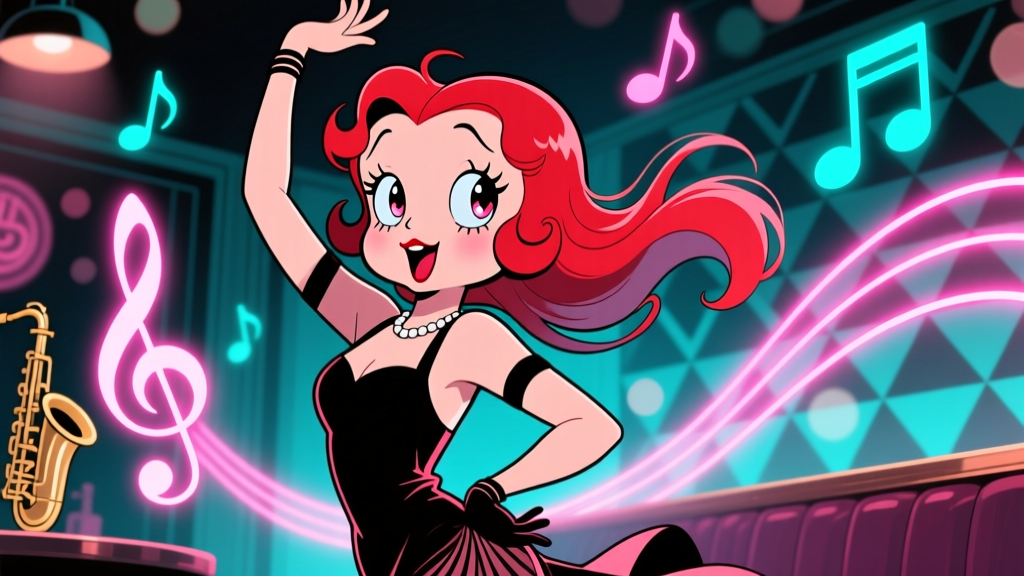
The lights dim. A spotlight hits a stage made of ink and celluloid. A girl with a head the size of a birthday cake, legs like exclamation points, and a garter on her left thigh starts to shimmy. The band—sometimes Cab Calloway himself, sometimes Louis Armstrong or Rudy Vallee—kicks in hot. Her hips swing side to side in a rhythm that seems physically impossible for a body made of twelve drawings per second. Her eyelashes flutter at precisely the moments a real flirt would let them fall. That girl is Betty Boop, and for about four years in the early 1930s, she was the most electrifying dancer anyone had ever seen on a movie screen, animated or otherwise.
Forget everything you think you know about cartoon characters. Betty Boop didn't walk into frame—she arrived. Every step, every hip roll, every shimmy was a declaration that animation could do something live-action couldn't: bend the human body into shapes that felt more alive than life. And the betty boop dancing phenomenon, nearly a century later, still refuses to die.
From a Poodle's Ears to the Most Famous Legs in Animation
Here's a piece of trivia that still throws people: Betty Boop started as a dog. Not metaphorically—literally. In the Talkartoon short Dizzy Dishes, released on August 9, 1930, she appeared as a hybrid creature with the body of a woman and the head of a French poodle, complete with floppy ears that later morphed into her signature hoop earrings. Max Fleischer, the head of Fleischer Studios in New York, had his lead animator Grim Natwick sketch the character based on a commission to create a girlfriend for Bimbo the Dog. Natwick reportedly based her face on singer Helen Kane, whose "boop-boop-a-doop" scat style was already a national sensation by 1928.
The poodle ears became human earrings by Any Rags (January 1932), and the transformation was complete: Betty Boop was now fully human, a teenage flapper with an impossible figure—the animators drew her with roughly a 16-inch waist on a 5-foot frame, proportions that would have killed a real woman but worked perfectly in ink. Her black curls, short dress, and that ever-present garter became the uniform of the Jazz Age rendered in pen and ink.
Fleischer Studios, located at 1600 Broadway in Manhattan, operated differently from Disney's West Coast operation. Where Disney chased wholesome fairy tales, the Fleischers—Max and his brother Dave—leaned into the grit of New York City nightlife. Dave Fleischer had actually managed a song-plugging department at a Tin Pan Alley publisher before joining the studio, which meant music wasn't an afterthought in Betty Boop cartoons. It was the engine. Every short was built around a song, and every song demanded that Betty move.
The Dance Routines That Broke the Frame
What made betty boop dancing so hypnotic wasn't just the choreography—it was the way Fleischer's animators treated the human body as a rubber instrument. Real dancers have joints and gravity to contend with. Betty didn't. When she shimmied in Minnie the Moocher (1932), her entire torso could compress and expand like an accordion. When she kicked her legs in The Scaredy Cats or tapped across a tabletop in Betty Boop's Rise to Fame (1934), the animators would stretch her limbs a frame or two beyond anatomical possibility, then snap them back. The eye reads it as energy, not distortion.
The Cab Calloway Connection
Three Fleischer shorts feature Cab Calloway's orchestra providing the soundtrack, and they contain some of the most feverish dance animation ever produced. Minnie the Moocher (March 1932) opens with live-action footage of Calloway and his Cotton Club orchestra performing "St. James Infirmary," then cuts to Betty and Bimbo fleeing through a cave filled with ghosts. Betty's dance in the cave sequence—hips swiveling, arms flailing, head bobbing at roughly 140 beats per minute—was animated by Shamus Culhane, who later estimated he spent three weeks on that single sequence, producing roughly 400 individual drawings.
Snow-White (1933) gave us Koko the Clown performing "St. James Infirmary" in rotoscoped Calloway fashion, but Betty's role in that short is smaller. The real treasure is The Old Man of the Mountain (August 1933), where Calloway voices the titular character and Betty hikes up a mountain to confront him. Their duet on "You Gotta Hi-De-Ho" features Betty matching Calloway step for step, her small frame vibrating against his lanky silhouette. The contrast was deliberate—Fleischer's animators loved pairing her compact, explosive energy against tall, angular partners.
Louis Armstrong and the Hot Chocolate Soldiers
In I'll Be Glad When You're Dead You Rascal You (1932), Louis Armstrong and his orchestra appear in live-action bookends, and Betty dances to Armstrong's trumpet through a jungle chase sequence. Armstrong's hot jazz—tempo pushing 180 BPM on the choruses—demanded that the animators work at their fastest rhythmic clip. Animator Rudy Zamora handled Betty's movement here, and his style was distinctly more angular and percussive than Culhane's flowing approach. You can see it in how Betty's knees snap on each beat rather than glide.
The Hays Code Changed Everything
On July 1, 1934, the Production Code Administration under Joseph Breen began enforcing the Motion Picture Production Code with real teeth. For Betty Boop, the crackdown was devastating. Her garter disappeared. Her skirt grew longer. Her boyfriend Bimbo—who was, remember, a dog—was dropped because the censors considered an inter-species romance obscene. And her dancing? It got restrained. The wild, full-body shimmies gave way to polite tap routines and domestic scenarios where Betty played housewives and schoolteachers.
By 1939, when Fleischer Studios released its final Betty Boop short, Rhythm on the Reservation, the character was essentially unrecognizable from the jazz-baby who'd scandalized parent groups seven years earlier. She'd been domesticated. The dancing remained technically proficient, but the danger was gone.
"Betty Boop was the first animated character to embody sexual energy through movement alone. She didn't speak about desire—she danced it. Every hip swing was a sentence, every eyelash flutter a punctuation mark. When the censors took that away, they didn't just change a character. They killed a genre."
How Betty Boop's Dancing Rewired Animation
Before Betty, animated characters largely moved in one of two modes: the bouncy walk cycle (think Felix the Cat) or the rubber-hose flail (early Mickey Mouse). Fleischer's team introduced a third vocabulary: rhythmic seduction. Betty's movement was synced to specific musical beats, not just general tempo. Animators would count frames against the soundtrack—at 24 frames per second, a quarter note at 120 BPM meant exactly 12 frames per beat. Every hip swing started on the downbeat and resolved on the two. This level of musical precision in character animation had never been attempted at this scale.
The technique rippled outward. When Ub Iwerks saw what Fleischer's team was doing with Betty's dance sequences, he began experimenting with similar beat-synced animation in his Flip the Frog series. Warner Bros.' Termite Terrace animators—particularly Bob McKimson and Rod Scribner—later cited Betty Boop shorts as an influence on the way they animated characters like Honey (Bugs Bunny's occasional girlfriend) and the various showgirls who populated early Merrie Melodies.
Even Disney noticed. In a 1985 interview published in the Animation Journal, former Fleischer animator Myron Waldman recalled that a Disney story artist visited the Fleischer studio in 1933 specifically to study how Betty's dance cycles were constructed. Whether that directly influenced the dance sequences in Snow White and the Seven Dwarfs (1937) is debatable, but the timeline fits. Snow White's dancing with the dwarfs has a rhythmic specificity that earlier Disney characters lacked.
The Rotoscope Factor
Max Fleischer held the patent on the rotoscope, a device that allowed animators to trace live-action footage frame by frame. While Betty Boop's dancing was primarily keyframe animation (drawn from imagination, not traced), Fleischer's team did use rotoscoping selectively for certain complex dance sequences, particularly in the later shorts. The rotoscope gave them a skeleton of real human movement, which they then exaggerated—stretching a leg extension three inches beyond what the live reference showed, or compressing a torso twist to twice the rotation a real spine could manage.
This hybrid approach—realism as a launchpad for exaggeration rather than an endpoint—became standard practice in the industry. It's the same principle behind modern motion capture in films like The Polar Express (2004) and Avatar (2009), except Fleischer's animators understood that the goal wasn't fidelity. It was amplification.
The Cultural Earthquake of a Dancing Cartoon Girl
Let's put Betty's dancing in context. In 1932, the United States was in the grip of the Great Depression. Unemployment hovered around 23%. Movie tickets cost a nickel to a quarter, and cartoons played before the feature as part of a program that might run three hours for the price of admission. For that quarter, you got escapism—and Betty Boop offered a very specific kind. She was a working-class girl (often depicted as a maid, a nurse, or a shopgirl in her shorts) who transformed into a star the moment the music started. Her dancing was an act of defiance against drabness, against poverty, against the grayness of Depression-era life.
The jazz musicians who scored her shorts weren't random picks. Calloway, Armstrong, and the Mills Blue Rhythm Band were Black artists performing in a segregated America. Fleischer Studios, based in New York, was comparatively progressive for its era—the studio employed several Jewish animators and had a more integrated creative culture than most Hollywood operations. Putting Calloway's music front and center in a Betty Boop cartoon, and having Betty dance to it with genuine reverence for the rhythm, was a quiet act of cultural integration that reached millions of viewers who might never have set foot in the Cotton Club.
The boop-boop-a-doop phenomenon crossed into live-action musicals, radio programs, and sheet music. Helen Kane sued Fleischer Studios and Paramount Pictures in 1932 for $250,000, claiming Betty Boop's singing style was stolen from her. The trial revealed that Kane's own "boop-boop-a-doop" had been derived from a Black performer named Baby Esther (Esther Jones), who'd been using similar scat phrases at the Everglades Club in Manhattan as early as 1926. Kane's case collapsed. The dancing, however, was nobody's property. It belonged to the Jazz Age itself.
Collectible Dancing Betty Boop Figures and Merchandise
Almost as soon as Betty Boop became a star, she became merchandise. King Features Syndicate began licensing her image in 1932, and within a year you could buy Betty Boop dolls, salt-and-pepper shakers, clocks, jewelry, and sheet music. The dancing versions—Betty caught mid-shimmy, one leg kicked up, arms raised—were consistently the best sellers.
The collectible market for Betty Boop memorabilia has only grown since the character entered the public domain conversation (her earliest shorts remain under copyright, but the character's trademark image has been aggressively licensed by King Features and later by Hearst Communications). Here's a breakdown of the most sought-after dancing Betty Boop collectibles:
| Item | Era / Manufacturer | Approx. Value (Mint) | Notes |
|---|---|---|---|
| 1932 Cameo Doll (dancing pose, composition) | 1932, Cameo Doll Co. | $3,500–$8,000 | Original paint; extremely rare in dancing variant |
| Wind-up Tin Litho Dancing Betty (walking/dancing) | 1930s, various Japanese manufacturers | $400–$1,200 | Mechanism still functional in ~30% of surviving units |
| Danbury Mint "Betty Boop Dancing" Porcelain Figurine | 1990s, Danbury Mint | $80–$200 | Part of the Classic Animation Collection; hand-painted |
| Dark Horse Deluxe Vinyl Figure (Shimmy pose) | 2018, Dark Horse Comics | $25–$45 | Limited edition; 6-inch scale |
| Fleischer Studios Licensed Music Box (dancing Betty spins) | 1980s, Fleischer Studios licensing | $60–$150 | Plays "Don't Take My Boop-Oop-a-Doop Away" |
| Original 1932 Cel Art (dancing sequence, Minnie the Moocher) | 1932, Fleischer Studios | $5,000–$15,000+ | Auction records; provenance-critical for authentication |
The original animation cels from Betty's dance sequences command the highest prices. A single cel from Minnie the Moocher sold at Heritage Auctions in 2011 for over $12,000. The challenge with cel art is authentication—Fleischer Studios didn't archive its cels systematically, and many surviving examples were salvaged by former employees who took them home after production wrapped. If you're shopping for one, insist on documentation from a reputable dealer and expect to pay a premium for any piece that can be matched to a specific frame in a known short.
Modern Merchandise: What's Available Now
The current licensing landscape for Betty Boop is managed primarily through Hearst Communications' King Features division. As of 2025–2026, several manufacturers produce dancing Betty Boop merchandise:
- Funko Pop! has released multiple Betty Boop vinyl figures, including a "dancing" variant exclusive to certain retail chains, typically priced at $12–$15 retail.
- Betsyville / Applause plush dolls with musical mechanisms that play jazz riffs while Betty sways, in the $30–$50 range.
- Viz Media and Dark Horse have published Betty Boop comic collections that include original Fleischer-era dance sequence art, priced $15–$25 per volume.
- Independent artists on Etsy and Society6 produce custom dancing Betty Boop prints, enamel pins, and apparel, though the legality of unlicensed use is murky given Hearst's active trademark enforcement.
For collectors on a budget, the Japanese tin litho wind-up toys from the 1930s offer an interesting middle ground. They're old enough to be genuine antiques, they actually move (the wind-up mechanism makes Betty shimmy and kick), and they typically sell for $400 to $1,200 depending on condition. The key thing to check is whether the mechanism still works—about 70% of surviving units have seized gears or broken springs, and professional restoration can cost $150 to $300.
Betty Boop Dancing in the Age of Anime and Otaku Culture
It might seem like a stretch to place Betty Boop inside otaku culture, but the connections are deeper than they appear. Japanese animation has a long-standing fascination with the Fleischer style. Osamu Tezuka, the man who essentially invented modern anime aesthetics, was an outspoken admirer of Max Fleischer's work. The large eyes, the exaggerated proportions, the emphasis on expressive movement over realistic anatomy—all of these traits that define anime character design can be traced, in part, to what Fleischer's animators were doing with Betty Boop in the early 1930s.
In Japan, Betty Boop merchandise has been a staple of character goods shops since the 1980s. Stores like Kiddy Land in Harajuku have carried Betty Boop lines for decades, and the dancing poses—mid-shimmy, one leg kicked back, that eternal grin—are consistently the top sellers. The Japanese market tends to prefer Betty in her red-and-black color scheme, which aligns neatly with the art deco aesthetics that remain popular in Japanese design culture.
Several anime and manga have paid direct homage to Betty Boop's dance sequences. In the 2004 anime Steamboy, directed by Mamoru Oshii's contemporary Hiroyuki Okita, there's a brief scene where a mechanical figure performs a Betty Boop-style shimmy. More directly, the 2001 film Metropolis (directed by Rintaro, based on Tezuka's manga) features a sequence where a holographic performer dances in a style unmistakably referencing Fleischer's Betty. The influence extends to video games too—the character of Aigis in Persona 3 (2006) performs a victory dance that the animation team at Atlus confirmed was modeled on Betty Boop's shimmy from Minnie the Moocher.
What otaku culture recognizes in Betty Boop is something that transcends her era: the idea that a character's movement can communicate personality more powerfully than dialogue ever could. Every anime character with a distinctive walk, a signature pose, or a transformation sequence owes something to the twelve-drawings-per-second jazz-baby who proved that animation wasn't just a medium for children's stories. It was a medium for performance.
The Technical Anatomy of a Betty Boop Dance Cycle
For animation students and fans who want to understand what's actually happening when Betty shimmies across the screen, here's a quick technical breakdown. A standard Betty Boop dance cycle at Fleischer Studios was animated "on twos"—meaning one drawing held for two frames, yielding 12 unique drawings per second of screen time at the standard 24fps projection speed.
- The anticipation (frames 1–3): Betty squats slightly, knees bent inward, shoulders dropping. This compresses her body like a spring.
- The explosion (frames 4–6): She springs upward, hips leading, arms thrown wide. The animators would often add a "smear frame" here—a single drawing where her body is stretched vertically to simulate motion blur.
- The peak (frames 7–8): At the top of the movement, there's a held pose—often with one leg extended and her head tilted back. This is the "money drawing" that appears in promotional stills.
- The settle (frames 9–12): She descends back into the starting position, with the hips arriving slightly after the shoulders (creating that signature sway). The timing here is usually slower than the explosion—the animators let gravity do its work, even if Betty's gravity was fictional.
That 12-frame cycle would repeat, with variations, for the duration of a dance sequence. The genius was in the variation: a good Fleischer animator would never repeat a cycle exactly. The hip angle might shift two degrees. The arm position might open wider on the second pass. Betty's eyelashes—drawn with a single brushstroke by the most skilled inkers—might flutter one frame earlier on the third beat. These micro-variations are what separate a mechanical loop from a performance. Modern animators at studios like Kyoto Animation and MAPPA still use this principle: no cycle should ever repeat identically.
Where to Watch Betty Boop Dance Today
The good news: most of Betty Boop's original shorts are accessible. The bad news: quality varies wildly depending on where you look.
- Olive Films / Paramount Home Entertainment released restored Blu-ray sets in the 2010s with high-definition transfers from original negatives. These are the gold standard for home viewing. The "Essential Collection" volumes cover the best dance-heavy shorts.
- Internet Archive hosts many public domain Betty Boop shorts (those whose copyrights were not renewed), though the transfers are often from degraded 16mm prints with washed-out contrast.
- YouTube has dozens of fan-uploaded clips, including side-by-side comparisons of original animation drawings and finished sequences. Search for "Betty Boop dance animation breakdown" for some genuinely illuminating fan analyses.
- The Museum of Modern Art (MoMA) in New York holds several original Fleischer Studios cels and drawings in its permanent collection, and periodically screens Betty Boop shorts as part of animation retrospectives.
If you want to see the dancing at its absolute peak, start with these five shorts in order: Minnie the Moocher (1932), The Old Man of the Mountain (1933), Betty Boop's Rise to Fame (1934), I'll Be Glad When You're Dead You Rascal You (1932), and Betty Boop's Bamboo Isle (1932). That's roughly 40 minutes of screen time, and it contains about 12 minutes of pure dance animation that still holds up against anything produced in the medium since.
Frequently Asked Questions
Who animated Betty Boop's most famous dance scenes?
The primary animators responsible for Betty's dance sequences were Shamus Culhane (who handled most of the Cab Calloway shorts), Rudy Zamora (Louis Armstrong sequences), and Grim Natwick (who designed the character and animated her earliest appearances). Myron Waldman and Tom Johnson also contributed significant dance animation in the mid-1930s shorts. Culhane is generally considered the master of Betty's movement—he understood musical timing better than anyone else on the Fleischer staff.
Was Betty Boop's dancing based on a real dancer?
Not directly. While Helen Kane inspired the vocal style ("boop-boop-a-doop"), Betty's physical movement was largely invented by the Fleischer animators. Grim Natwick had studied life drawing at the Art Students League in New York and had a strong grasp of human anatomy, which he then deliberately distorted for comedic and rhythmic effect. Some dance historians have noted similarities between Betty's hip movements and the Charleston and Black Bottom dances popular in the late 1920s, but no single dancer served as a reference model.
Why did Betty Boop stop dancing in later cartoons?
The enforcement of the Motion Picture Production Code (the Hays Code) beginning July 1, 1934, forced Fleischer Studios to tone down Betty's sexuality. Her dancing became less provocative, her costumes more conservative, and her storylines shifted toward domestic comedy. By 1937, the wild jazz-baby of Minnie the Moocher had become a prim career girl. The cultural shift was broader than just Betty—the entire animation industry moved toward safer content as censorship pressure increased throughout the 1930s.
Is Betty Boop in the public domain?
It's complicated. Many of her early shorts (pre-1934) have entered the public domain due to copyright non-renewal, but the character herself remains a registered trademark of King Features Syndicate (a division of Hearst Communications). This means you can legally watch and share the public domain shorts, but you cannot create new commercial merchandise featuring Betty Boop without a license. The trademark status has been actively defended in court as recently as 2019.
What makes Betty Boop's dancing different from Mickey Mouse or other 1930s characters?
Mickey Mouse's movement in the early 1930s was primarily rubber-hose animation—limbs that bent without joints, movements that were energetic but not specifically choreographed to music. Betty Boop's dancing was synced to actual jazz recordings with frame-level precision. Her hips, shoulders, and head moved in polyrhythmic patterns that mirrored the syncopation in Calloway's and Armstrong's music. It was character animation in service of musical performance, not just movement for movement's sake. That distinction is why animation historians treat the Betty Boop shorts as a separate category from the more slapstick-oriented work coming out of Disney and Warner Bros. during the same period.
Where can I buy authentic dancing Betty Boop collectibles?
For vintage items (1930s originals), the most reliable sources are Heritage Auctions, Bonhams, and specialized dealers like Mel Birnkrant's collection sales. For modern licensed merchandise, the official King Features website lists authorized licensees. Avoid unlicensed merchandise on platforms like Amazon and Etsy—not only is it legally questionable, but the quality is typically inferior to officially licensed products. The Danbury Mint secondary market (eBay, collector forums) is a good source for porcelain figurines at reasonable prices.
SenpaiSite · Otaku Culture · Classic Animation Series
Boop-boop-a-doop.