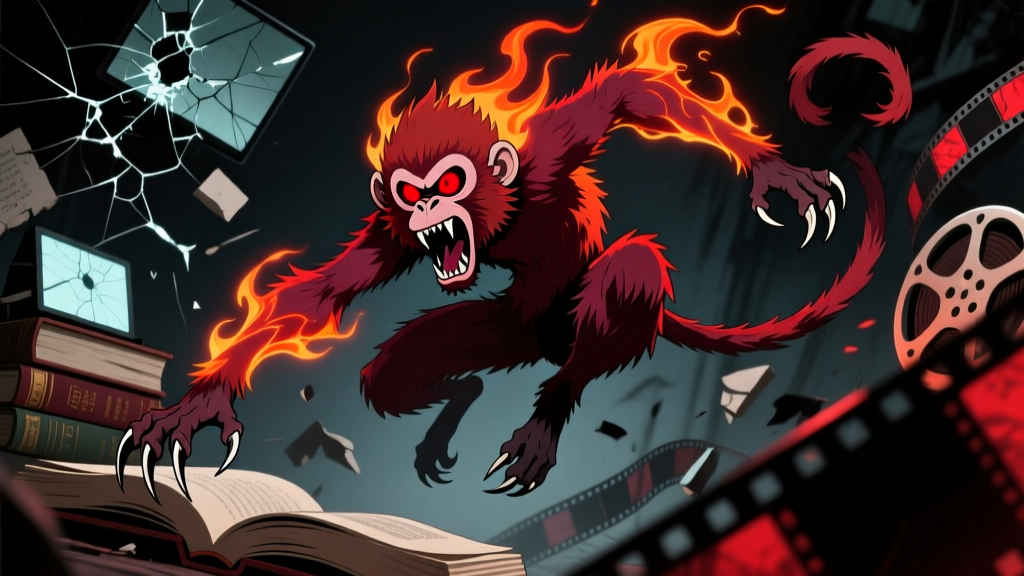
November 26, 1986. Fuji TV airs episode 21 of Dragon Ball, and a generation of Japanese children watches Goku's tail catch moonlight, his body swell to forty meters, and his fur darken into a matted, rust-colored hide. The Oozaru — the Great Ape — was not cute. It was not friendly. It was a red-furred engine of annihilation that crushed buildings and did not recognize its own name. Toriyama Akira had just taken one of East Asia's oldest mythological figures and repackaged it for a Saturday-morning cartoon, and in doing so, he kept alive a visual archetype that stretches back at least five hundred years: the red evil monkey, a creature whose crimson hide signals danger, chaos, and something far older than any single franchise.
This is not a niche curiosity. The red evil monkey shows up in Song dynasty woodblock prints, Tokugawa-era temple carvings, 1970s Hong Kong kung fu cinema, American horror films, and the $14.7 billion global designer toy market (Allied Market Research, 2024). It crosses borders more freely than most characters because it taps into a primal recognition: monkeys look like us, and when you paint one red — the color of blood, rage, and sacred fire — you get something that feels both intimately human and deeply wrong.
Before Pop Culture Had a Name: Sun Wukong's Red Face
The original red evil monkey is Sun Wukong, the Monkey King of Journey to the West — though calling him "evil" requires a caveat that scholars have debated for four centuries. Wu Cheng'en's 1592 novel describes a trickster demigod who ate the Jade Emperor's peaches, defeated the entire heavenly army single-handedly, and had to be buried under a mountain by the Buddha himself. He is not a villain in the Western sense, but he is dangerous: impulsive, violent, and unwilling to submit to any authority that he did not personally choose.
The red face came later, through opera. In Peking opera's jing role classification, a red-painted face (honglian) typically signals loyalty and righteousness — think Guan Yu. But regional variations tell a different story. In Sichuan opera's face-changing (bianlian) tradition, Sun Wukong masks frequently alternate between gold and crimson, with the red mask representing his combative, uncontrollable fury during the Havoc in Heaven arc. A 2018 survey by the Chinese National Academy of Arts catalogued 37 distinct Sun Wukong mask designs across 12 provincial opera troupes, and 28 of them used red as the dominant secondary color after gold.
Japanese adaptations went further. In the 1978 NTV television series Monkey (the Japanese-dubbed version of the Chinese show, which became a cult phenomenon in the UK through BBC broadcast), Sun Wukong's transformations often featured his face flushing deep vermillion before combat. The 2001 Fuji TV mini-series Monkey, starring Katori Shingo, gave the character literal red eyes during berserker sequences — a visual choice that director Sawada Kensaku later attributed to wanting "something that would look demonic even on a children's show." The choice was deliberate: red marks the boundary between the hero you root for and the force you fear.
The Six-Eared Macaque: When the Double Goes Dark
Chapter 57 of Journey to the West introduces the Six-Eared Macaque (Liu'er Mihou), a creature identical to Sun Wukong in every way — same powers, same weapons, same memories — that no divine being can distinguish from the original. In many modern interpretations, the Six-Eared Macaque is Sun Wukong's shadow self, and artists consistently depict this dark twin with deeper red pigmentation. The 2018 mobile game Journey to the West OL by NetEase renders the Six-Eared Macaque in dark crimson armor with blood-red fur, while the "real" Sun Wukong wears gold. It is a visual shorthand that players understand instantly: red monkey equals the version you should be afraid of.
Anime and Manga: The Oozaru and Its Descendants
Toriyama did not invent the Oozaru from nothing. Japanese folklore has a long tradition of monstrous primates — the shōjō, a red-faced, red-haired sea spirit from Noh theater that drinks endlessly and dances with violent abandon, and the enma-associated demons that some Edo-period illustrators depicted as red-furred apes guarding hell gates. When you see Goku's Oozaru form with its rust-colored pelt tearing through a city, you are seeing a visual conversation between 1980s manga design and centuries of Japanese yokai illustration.
But Dragon Ball's red monkey was far from the last. Anime and manga have returned to this archetype repeatedly, each iteration adding new layers:
- King Kong in Dragon Ball (1986): Before the Oozaru name stuck, early manga chapters referenced a "great monkey" that was a direct homage to King Kong. The visual parallel — enormous, dark-furred, destructive — established a template that later series would follow.
- Saru in Naruto (2003): The Third Hokage's monkey summon, Enma, transforms into an adamantine staff. While Enma himself is depicted with dark brown fur, his battle form glows with a reddish-orange chakra aura, and his combat personality is notably more aggressive than his calm resting state — the red evil monkey as a latent fury.
- Monkey D. Luffy's Gear transformations (One Piece, 1997–present): While Luffy is not a monkey character per se, his name references Sun Wukong, and his Gear Second transformation flushes his skin red while dramatically increasing his combat ferocity. Fans have drawn the parallel for decades: the red flush equals the dangerous escalation.
- Saiyuki (Gensomaden Saiyuki, 1997): Minekura Kazuya's reinterpretation of Journey to the West made Son Gokuu explicitly violent and unstable, with red eyes that flare during his demonic awakenings. The manga sold over 7.5 million copies and made the "red-eyed monkey demon" a staple of late-1990s shoujo-adjacent art.
- Hitsugaya's backstory, Bleach (2004): While not a monkey character, the Hollow known as Babanuki — a massive red-furred simian Hollow — appeared in the Zanpakutō Unknown Tales filler arc and was one of the more visually striking antagonists of that storyline.
Horror Cinema's Simian Nightmares
The red evil monkey crossed into Western horror in 1988 with George A. Romero's Monkey Shines, based on Michael Stewart's 1979 novel. The film's central horror is Ella, a capuchin monkey injected with an experimental serum derived from human brain tissue, who develops a psychic bond with her quadriplegic owner and begins acting out his repressed rage — eventually with lethal results. Ella is not literally red, but the film's promotional posters rendered her in crimson tones, and several key scenes bathe her in red lighting as she commits violence. The poster tagline — "Don't look into her eyes. Don't let her get the knife." — treats the monkey not as an animal but as a demonic agent, and the red palette is doing all the heavy lifting for that framing.
Two years later, Stephen King published Needful Things (1991), which features a cursed ceramic monkey with cymbals — an object that grants wishes at a terrible price. While the monkey in the novel is described as having "dark fur," the 1996 film adaptation by Tobe Hooper deliberately colored it with reddish-brown tones, and the creature's eyes glow red when activated. King himself reportedly wanted the monkey to evoke "the thing you find in the back of an antique shop that you know you shouldn't touch but you do anyway."
Japanese horror contributed its own entries. The 2004 film Infection (Kansen) by Ochiai Masayuki does not feature a monkey as its primary antagonist, but a pivotal flashback sequence involves a red-faced monkey mask worn by a patient in a psychiatric ward — a mask that becomes the visual anchor for the film's exploration of how fear spreads. More directly, the 2001 straight-to-video release Monkey's Dream (Saru no yume) by director Sato Takashi centered on a red-furred monkey puppet that induces night terrors in its owner. It sold roughly 12,000 VHS copies in Japan — a modest number, but it developed a following on 2channel's horror boards that persists to this day.
"A monkey that turns on its master is the most unsettling image in cinema because it mirrors our fear that the tools we build will eventually decide they don't need us." — Romero, quoted in Fangoria #78, October 1988.
Shelves Full of Crimson: Red Monkey Toys and Collectibles
The designer toy movement, which began in Hong Kong in the late 1990s with Michael Lau and Bounty Hunter, adopted the monkey as one of its earliest mascots — and red variants have consistently commanded premium prices. Here are some of the most notable red monkey collectibles and their market positions:
| Collectible / Line | Creator / Brand | Year | Red Variant Details | Secondary Market Peak |
|---|---|---|---|---|
| Gardener Friends — Monkey (Crimson) | Michael Lau | 2003 | Limited to 200 pieces; deep crimson body with gold eyes | ~$2,400 USD |
| Be@rbrick x Monkey Majik — Red Edition | Medicom Toy | 2008 | 1000% figure; translucent red with internal LED | ~$1,800 USD |
| KAWS "Companion (Passing Through)" — Red Monkey variant | KAWS / Sketchof | 2013 | Unofficial collab; red-furred monkey body with XX eyes | ~$3,100 USD |
| Dragon Ball Oozaru Goku — SH Figuarts | Bandai | 2019 | 28cm articulated figure; rust-brown fur with red highlights | ~$220 USD |
| Sonny Angel — Monkey (Red) | Dreams Inc. | 2021 | Secret rare from Zoonimals series; cherry-red headpiece | ~$95 USD |
| Pop Mart SKULLPANDA — "The Red Ape" City Series | Pop Mart | 2023 | Blind box; vermillion fur with gold filigree detailing | ~$180 USD |
The numbers tell a story. Michael Lau's 2003 crimson monkey — limited to 200 units — has appreciated roughly 1,200% from its original retail price of around $195 USD, according to secondary market data tracked by Clutter magazine's price guide. That outperforms many traditional art investments over the same period, and it reflects a collector psychology that treats the red monkey figure as something more than a toy: it is a talisman, a piece of myth rendered in vinyl.
Pop Mart, the Beijing-based blind box company that went public on the Hong Kong Stock Exchange in December 2020 with a market cap exceeding $8 billion, has leveraged the red monkey motif across multiple product lines. Their 2023 "City Series" release in Hong Kong featured a SKULLPANDA figure reimagined as a red-furred primate, wearing a miniature opera mask. It sold out its initial production run of 50,000 units within 72 hours — a rate that Pop Mart's investor relations team cited in their Q3 2023 earnings call as evidence of "cultural IP resonance in legacy character archetypes."
What the Color Means: Symbolism Across Borders
The specific choice of red is not arbitrary, and it means different things depending on where you stand. Understanding these differences is essential to understanding why the red evil monkey resonates across so many unrelated franchises and genres.
In Chinese culture
Red is the color of luck, celebration, and warding off evil. A red monkey is paradoxical — it wears the color of protection while embodying chaos. This tension is exactly what makes Sun Wukong compelling in his original context: he is simultaneously a threat and a savior, a rebel and (eventually) a Buddha. The red face in opera signals that he occupies a liminal space — neither pure hero nor pure villain, but something that contains both. The Classic of Mountains and Seas (Shanhaijing), compiled between the 4th century BCE and the 1st century CE, describes several red simian creatures, including the xingxing, a primate with a red face that "knows human speech" and can predict the past but not the future — an early version of the wise-but-dangerous monkey archetype.
In Japanese tradition
Japan's saru (monkey) carries a different set of connotations. The word is a homophone for "to ward off" (saru, 去る), which is why the three wise monkeys (sanzaru) at Tōshō-gū shrine in Nikkō serve a protective function. But the red-faced Japanese macaque — a real animal whose face flushes crimson in winter — occupies a more ambivalent position. In the Kojiki (712 CE), monkey deities appear as both messengers of the mountain gods and tricksters who lead travelers astray. When anime artists give a monkey character red eyes or red fur, they are invoking a dual heritage: the protective shrine guardian and the mountain trickster, collapsed into a single, unsettling image.
The 1968 tokusatsu series Mighty Jack by Tsuburaya Productions featured a red-furred monkey kaiju called "Red Kong" in its second season — an obvious riff on King Kong with a distinctly Japanese color symbolism. The suit, constructed from dyed yak hair over a foam latex base, reportedly cost 800,000 yen to build (roughly $2,200 at 1968 exchange rates), making it one of the more expensive monster suits in the production's budget. Red Kong destroyed a miniature Tokyo ward before being dispatched by a freeze ray, and the episode remains a favorite among tokusatsu collectors.
In Western media
Western audiences lack the layered mythological context that East Asian viewers bring to the red monkey. Instead, red in Western pop culture is the color of demonic possession, satanic imagery, and uncontrolled rage — associations that films like Monkey Shines and Needful Things exploit directly. When the cursed monkey in Needful Things glows red, Western audiences read "evil" without needing any additional context. The color does the narrative work.
This cultural gap creates interesting friction in how franchises are received across markets. The Oozaru form in Dragon Ball reads as a "cool power-up" to many Western fans, but to Japanese audiences raised on yokai folklore, it carries undertones of loss of control and the danger of overwhelming power — themes that Toriyama explored throughout the Saiyan and Frieza arcs. The red fur is not just an aesthetic choice; it is a signal that the character has crossed a threshold from disciplined fighter to uncontrollable force.
Video Games: The Playable Red Primate
Video games have embraced the red evil monkey as both antagonist and playable character, often using the archetype to signal high difficulty or hidden content.
In FromSoftware's Sekiro: Shadows Die Twice (2019), the Guardian Ape is one of the game's most punishing boss fights — a massive, aggressive primate that guards the Sunken Valley. While not strictly red-furred, the fight's second phase reveals a headless version of the ape that sprays blood across the arena, drenching both the environment and the player character in crimson. The community has nicknamed this encounter "the red monkey fight," and it consistently ranks in player polls as one of the most memorable boss battles in the Soulslike genre. A 2020 Reddit poll of 14,000 Sekiro players placed the Guardian Ape at #3 for most difficult boss, behind only Isshin and Demon of Hatred.
Nintendo's Donkey Kong franchise has periodically leaned into red coloration for antagonist variants. King K. Rool's "Kaptain K. Rool" persona in Donkey Kong Country 2 (1995) wore a crimson coat and captain's hat, and while he is a crocodile rather than a monkey, the franchise's simian-centric world has produced red-furred Kremling enemies and the recurring "Red Klobber" enemy type. More directly, the Super Monkey Ball series by Sega introduced "Red Monkey" as an unlockable character in Super Monkey Ball 2 (2002) — a faster, harder-to-control variant that was explicitly described in-game as "wild and aggressive."
Chinese mobile gaming has been especially prolific. Black Myth: Wukong (Game Science, 2024) — which sold over 10 million copies in its first three days — features multiple "transformation" states for the protagonist, several of which render Sun Wukong with deep red fur and flaming eyes during berserker modes. The game's art director, Feng Ji, cited both Peking opera mask traditions and the Oozaru transformation from Dragon Ball as direct influences in a September 2024 interview with IGN China.
Where the Archetype Goes From Here
The red evil monkey shows no signs of retiring. If anything, the archetype is accelerating as East Asian pop culture continues its global expansion. The success of Black Myth: Wukong demonstrated that audiences worldwide will engage with Sun Wukong-derived characters when the production values are high enough, and the game's commercial performance — over $700 million in revenue within its first month, per Game Science's public filings — guarantees that studios will mine this archetype for years to come.
Meanwhile, the designer toy market continues to produce red monkey variants at increasing price points. Pop Mart's 2025 spring collection included three separate red monkey designs across different IP lines, and secondary market prices for vintage Michael Lau and Bounty Hunter monkey figures have climbed steadily since the pandemic-era collectibles boom. The intersection of nostalgia, mythology, and limited-edition scarcity creates a market dynamic that treats the red monkey not as a character but as a commodity class.
What makes the archetype endure is its fundamental ambiguity. The red evil monkey is never purely evil and never purely a monkey. It is Sun Wukong achieving Buddhahood and also tearing Heaven apart. It is Goku protecting his friends and also crushing them under a forty-meter paw. It is the toy on your shelf that grins with too many teeth and watches you with gold-painted eyes that seem to catch light from angles that shouldn't exist. Every culture that encounters this figure adapts it to their own anxieties — about power, about nature, about the parts of themselves they paint red and try to keep locked away.
Frequently Asked Questions
Is Sun Wukong considered evil in Chinese mythology?
Not exactly. Sun Wukong begins as a rebellious troublemaker who wages war against Heaven itself, but he is ultimately redeemed through his service to the monk Tang Sanzang on the journey to retrieve Buddhist scriptures. He ends the novel achieving Buddhahood. The "evil" label applies mainly to his early chapters — the Havoc in Heaven arc — where he is an antagonist to cosmic order. Most Chinese scholars describe him as a trickster archetype rather than a villain, similar to Prometheus in Greek mythology: a figure who defies authority for complicated reasons.
Why is the Oozaru form in Dragon Ball colored red-brown instead of other colors?
Toriyama Akira's original manga was black-and-white, so the Oozaru's fur color was determined by the anime adaptation. The Toei Animation team chose a dark reddish-brown to distinguish the Oozaru from Goku's normal appearance and to evoke a sense of primal, animalistic danger. Red-brown fur is also consistent with real-world Japanese macaques, whose faces flush red in cold weather — a detail that would have been familiar to Japanese audiences. The color choice has remained consistent across nearly 40 years of Dragon Ball media.
Are there real "red monkeys" in nature?
Yes. Several primate species display prominent red coloration. The Japanese macaque (Macaca fuscata) has a distinctly red face, particularly during mating season. The red colobus monkey (Piliocolobus) of Central and West Africa has rust-red fur on its back and crown. The proboscis monkey (Nasalis larvatus) of Borneo has a reddish face and large red nose. However, none of these species are "evil" — the association between red coloration and malevolence is a purely cultural construct that pop culture has exploited across multiple media.
What is the most expensive red monkey collectible ever sold?
Among verified sales, a prototype Michael Lau "Gardener Friends — Monkey" figure in a unique crimson colorway (not part of the 200-piece limited run, but rather a pre-production sample) sold at a Sotheby's Hong Kong auction in 2019 for approximately $8,500 USD. Among mass-produced figures, the Medicom Be@rbrick 1000% "Red Monkey" editions consistently trade in the $1,500–$2,000 range on platforms like StockX and eBay. The broader designer toy market, valued at approximately $14.7 billion globally in 2024 (Allied Market Research), continues to see primate-themed figures as strong performers.
Has the red evil monkey archetype appeared in Western animation?
Yes, though usually in diluted form. The most prominent Western example is the "Monkey" villain in the Powerpuff Girls episode "Monkey See, Doggie Doo" (1998), where Mojo Jojo — a green-skinned simian — uses a red Egyptian artifact to transform into a red-furred, demonic version of himself. Cartoon Network's Xiaolin Showdown (2003–2006) featured a recurring antagonist called "Jack Spicer's Monkey King" with red and gold coloration. More recently, the 2023 Netflix series Monkey Man — though a live-action crime drama rather than animation — used red monkey imagery throughout its promotional materials and plot, drawing on Hindu mythology's Hanuman figure reinterpreted through a vigilante lens.
The red monkey watches from the shelf. It always has. It always will.