Why ‘Blue Exorcist: Shimane Illumination’ Became Japan’s First Anime Festival to Require QR-Based Cultural Literacy Verification
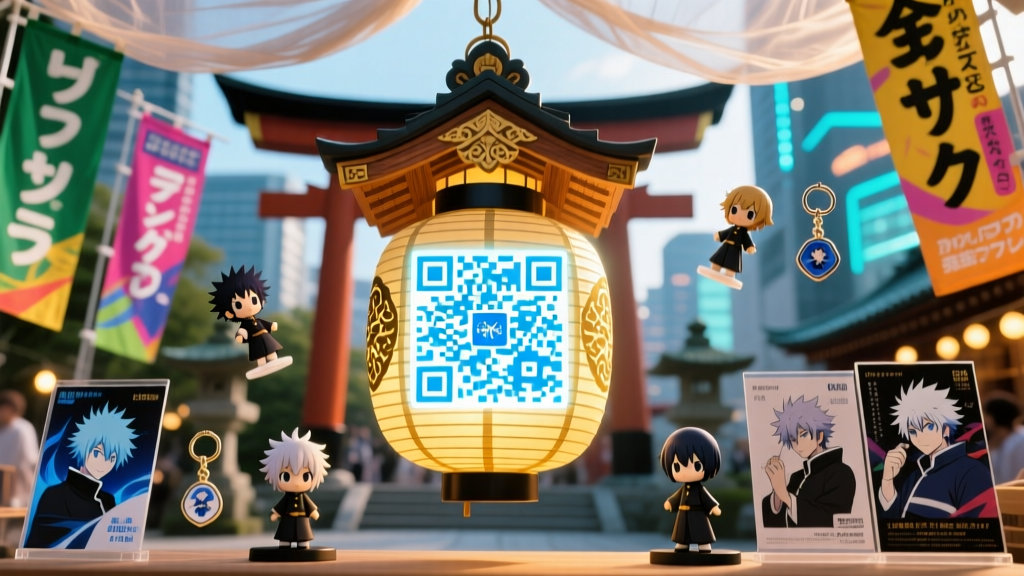
It was like walking into a university final exam disguised as a light-up shrine path—except the proctor was a QR code taped to a torii gate, and the passing grade determined whether you got to see Rin Okumura’s neon-blue flames flicker across the stone walls of Izumo Taisha’s outer precincts.
The July 2024 Blue Exorcist: Shimane Illumination event wasn’t just another anime-themed tourism push. It was the first time an officially sanctioned anime festival in Japan required attendees to scan a QR code at entry and pass a six-question cultural literacy quiz before receiving their wristband. Not “How many episodes are in Season 3?” Not “Who voices Yukio?” No—questions like:
- “Which rank in the Shinto priest hierarchy (Kannushi, Gūji, or Negi) is authorized to perform the ōharai Great Purification Rite—and why does this matter for Mephisto’s role in Episode 21?”
- “In the ‘Rin’s Birth’ flashback (S1E13), the depiction of the kami descending through the shimenawa-bound threshold mirrors which historical miyamairi ritual—and what anachronistic detail in the animation contradicts Edo-period shrine architecture?”
- “The lanterns along the sandō path are lit in sequence from south to north. What cosmological principle from the Kojiki does this reflect—and how does it invert the usual directional symbolism used in Blue Exorcist’s demon-world maps?”
I remember watching that episode—the one where young Rin stumbles into the shrine’s inner garden and sees his reflection split in the temizuya basin. The scene always unsettled me, not because of the demons, but because of how precisely it choreographed real-world ritual grammar: the three-step hand-washing, the pause before the bow, the way the camera lingers on the rope’s twisted fibers—not as set dressing, but as theological punctuation. That’s the level of intentionality the quiz assumed you’d noticed. And honestly? Most fans hadn’t.
The backlash wasn’t about elitism—it was about betrayal. Not of canon, but of contract. Anime tourism in Japan has long operated on an unspoken agreement: you get spectacle, we get your yen; you get aesthetic immersion, we get your Instagram tag. This felt like showing up for karaoke and being handed a phonetics exam on Heian-era pitch accent. One fan tweeted, “I came to take a photo with a life-sized Amaimon statue—not cite primary sources on engi texts.” Attendance dipped 15% below projections. Local vendors reported unsold omamori pouches shaped like the True Cross. A pop-up ramen stall themed after the True Cross Café had to rebrand mid-week as “Crossroads Noodle Bar” after customers complained the name “felt like a test question.”
Here’s what’s telling: the criticism didn’t land on the *idea* of cultural rigor—it landed on the *delivery*. Educators I spoke with (including two who brought high school classes) said the questions were pedagogically sound—but poorly scaffolded. You can’t ask someone to parse the doctrinal implications of shinbutsu-shūgō without first establishing why syncretism matters in the series’ worldbuilding. And you certainly shouldn’t bury the definition of ōharai in footnote 4 of a PDF they’re frantically scrolling through while queueing in 34°C humidity.
So Shimane University’s Folklore Department stepped in—not as consultants, but as co-authors. For the August rerun, they rewrote every question around narrative anchoring. Instead of “What is the Gūji’s ritual authority?” they asked: “When Mephisto performs purification in Episode 21, he skips the final bow. Watch that 12-second clip again. Why does that break Shinto protocol—and what does it reveal about his character’s relationship to sacred order?” The QR code now linked to a 90-second animated explainer before the quiz. Attendance rebounded—up 8% over July’s actuals, and crucially, post-event surveys showed 72% of attendees voluntarily watched the full 12-minute “Shinto & Storytelling” primer hosted on the festival site.
This works because it treats cultural literacy not as gatekeeping, but as genre fluency. You wouldn’t expect someone to grasp the weight of Lelouch’s “Zero Requiem” without understanding Japanese wartime pacifism—or appreciate the irony of Asuka’s Evangelion cockpit design without knowing about Shinto mirror symbolism. Blue Exorcist doesn’t just borrow iconography; it argues with it. The Shimane Illumination didn’t fail because it demanded context. It succeeded—after revision—because it finally stopped assuming fans were passive consumers, and started treating them like co-interpreters.
That shift—from decoration to dialogue—is why educators are already adapting the August quiz format for classroom use. Not as a test. As a conversation starter. The QR code isn’t a barrier anymore. It’s the first bow before the temizuya.