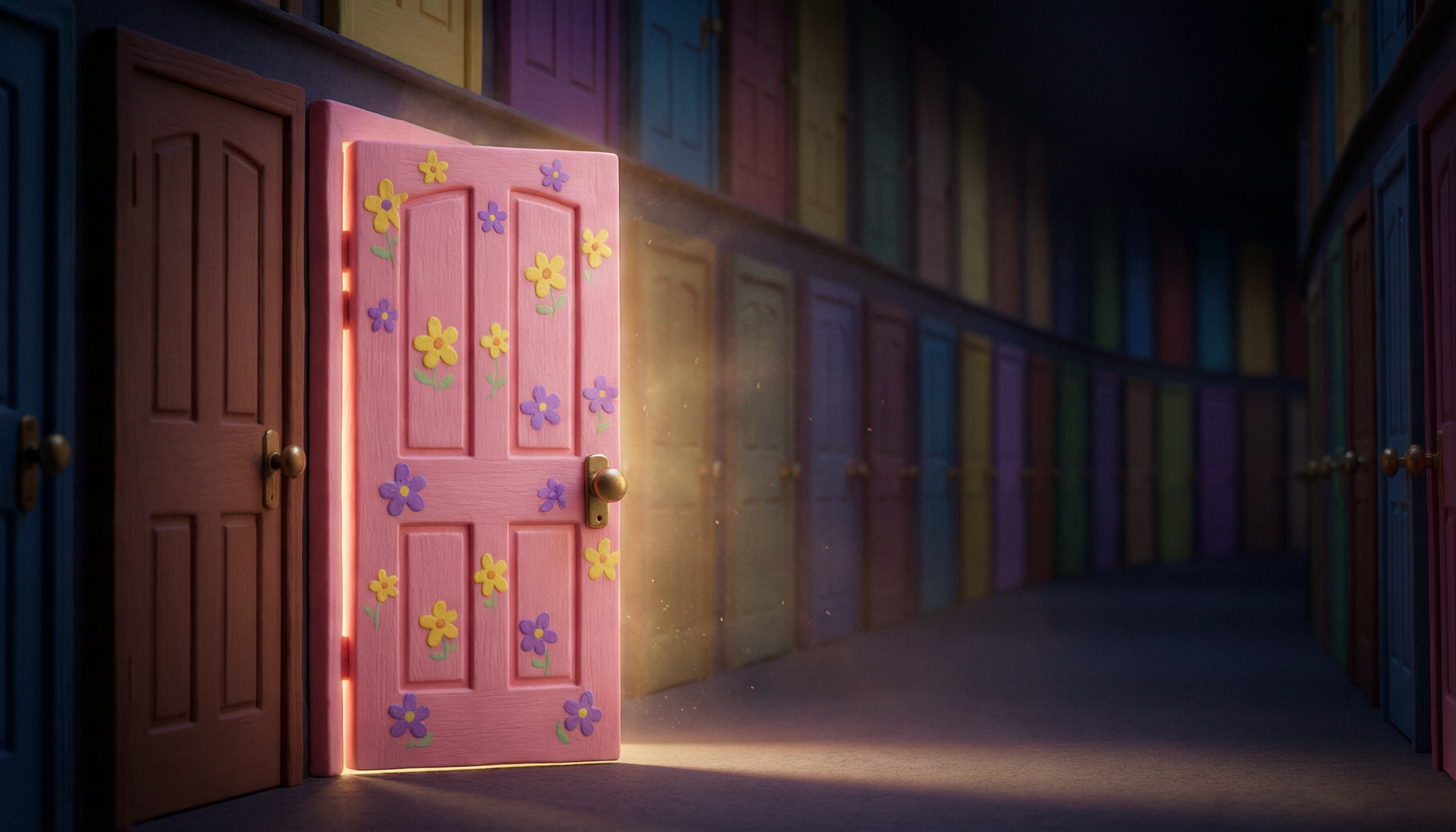
Boo's Door in Monsters, Inc. — The Piece of Wood That Broke a Generation
"There's a door in a vault somewhere inside Monsters, Incorporated's headquarters. It's pink. It has flowers on it. And for over two decades, it has made grown adults cry in public."
You know the moment. Sulley — the big, furry, blue-and-purple monster who started the film as a cocky top scarer — kneels in front of a tiny pink door. He opens it. A little girl in a pink onesie looks up at him and says, "Kitty." He smiles. She smiles. The door closes.
That's it. That's the whole emotional payload of Boo's door from Monsters, Inc. — a single piece of painted wood that Pixar turned into one of the most devastating narrative devices in animation history.
If you've ever found yourself unexpectedly emotional about a cartoon door, you're not alone. And if you've never understood why fans obsess over it, this is the deep breakdown you've been missing.
What Exactly Is Boo's Door?
Boo's door is the closet door that connects the human world to the monster world in the 2001 Pixar film Monsters, Inc. It belongs to a toddler named Mary — though nobody calls her that. Sulley and Mike call her "Boo," and the name stuck so hard that even the film's official merchandise uses it.
The door itself is painted a soft pink, decorated with hand-drawn flowers and crayon-style hearts. It's small — scaled to a child's bedroom closet — and it looks exactly like something a real four-year-old would have decorated. That detail isn't accidental. Pixar's art department studied hundreds of children's bedroom doors before settling on the final design.
Within the film's logic, every child's closet has a door that links to the monster world's factory floor. Monsters, Incorporated uses these doors as portals: a scarer walks through, frightens a sleeping child, collects the scream as energy, and walks back out. Boo's door is simply one of thousands — except she wasn't afraid. She followed Sulley back. And that broke the entire system.
The Door Vault Scene — Four Minutes That Changed Pixar Forever
The door vault sequence, which runs approximately four minutes and twenty seconds in the theatrical cut, is widely regarded as one of the most technically and emotionally ambitious set pieces Pixar had attempted up to that point.
Here's what happens on screen: Waternoose, the company's CEO, has been conspiring with Randall to kidnap children and extract screams by force. Sulley and Mike discover the plot. A chase erupts through the factory's door vault — a massive, cathedral-like warehouse storing millions of closet doors on a complex rail system.
The vault scene is a technical marvel. Doors slide, swing, rotate, and launch across tracks. Sulley and Randall fight on a conveyor of moving doors, each one opening into a different child's bedroom around the world. The animators at Pixar built a custom simulation tool to handle the door physics. According to production notes from the film's DVD commentary (2002), the vault contained over 5.7 million individually rendered doors in wide shots — a staggering number for a 2001 CGI production.
But the technical achievement isn't what people remember.
What sticks is the final beat. Waternoose is arrested. The factory shuts down. And Sulley realizes that Boo's door — the specific door that started everything — has been shredded in the factory's scream-extraction machine. She's gone. He can't get back to her.
Mike, being Mike, glues the shredded pieces back together. He presents the reconstructed door to Sulley with zero fanfare. Sulley opens it. Boo is there, drawing on the floor with crayons. She looks up. "Kitty."
The film cuts to black. Credits. No explanation. No promise of a sequel. Just a door, open.
Why That Scene Hits Different
The door vault chase is loud, kinetic, and full of visual comedy — Randall gets repeatedly punched through doors into increasingly absurd human-world locations (a snowy mountain, a tropical beach, a trailer occupied by a man who screams at the sight of him). It's classic Pixar: make you laugh before you get hit with the gut punch.
The contrast is deliberate. Director Pete Docter has spoken about this in interviews, noting that the entire film was structured around the tension between fear and love. The door vault embodies that tension physically — it's a cold, industrial space full of machinery and metal tracks, yet each door opens onto something intimate and personal. A child's room. A nightlight. A bedtime story.
Boo's door represents the most intimate connection in the film: not just any child, but the child. The one who drew pictures of Sulley. The one who called him "Kitty." The one who trusted him completely, without understanding what he was.
The Symbolism Nobody Planned (Until They Did)
Here's something most viewers don't realize: Boo's door wasn't always pink. Early concept art from the film's production — archived in The Art of Monsters, Inc. (Chronicle Books, 2001) — shows the door in various colors, including white, blue, and yellow. The final decision to go with pink was both practical and thematic.
Pink made the door instantly identifiable against the industrial grey-and-green backdrop of the factory. It also created a visual shorthand that the production team used throughout the film:
- Boo's onesie — pink, worn in every scene she appears in
- Boo's socks — visible in the scene where she climbs onto Sulley's back
- Boo's crayon drawings — the pictures she makes of Sulley, rendered almost entirely in pink
- The door itself — the final anchor of the color identity
Whenever you see pink on screen in Monsters, Inc., it means Boo. The door ties her identity to a single color in a way that makes her absence felt even when she's off screen.
The flowers and hearts drawn on the door serve a dual purpose. On one level, they mark it as belonging to a child — something handmade and imperfect, the opposite of the factory's precision engineering. On another level, they represent the emotional labor Boo put into her relationship with Sulley. She decorated her side of the door. She was waiting for him.
This kind of visual storytelling is Pixar's stock in trade, but Boo's door is one of their cleanest executions. Every element on that piece of wood communicates character, relationship, and stakes — without a single line of dialogue explaining it.
Boo's Door Across the Monsters Franchise
The door didn't stay confined to one film. Its cultural footprint expanded significantly over two decades of sequels, shorts, theme park attractions, and merchandise.
Monsters University (2013)
The prequel doesn't feature Boo's door directly — it's set years before Sulley meets her — but the door vault concept gets an earlier iteration. The Scare Floor in Monsters University shows the factory's door system in a less refined, more industrial state. The contrast makes Boo's hand-decorated door feel even more special when you revisit the original film.
Monsters at Work (2021–2024)
The Disney+ series Monsters at Work picks up six months after the original film. The factory has switched from scream power to laugh power, and the door system is still central to daily operations. Boo herself doesn't appear — the show focuses on a new character, Tylor Tuskmon — but her door is referenced as the catalyst for the entire systemic change. In the show's second season (2024), a brief background shot shows a pink door on the factory floor, though the series never confirms whether Sulley has reconnected with Boo off-screen.
Disney Theme Parks
At Disney's Hollywood Studios in Florida, the former Monsters, Inc. Laugh Floor attraction (2007–present, with periodic refurbishments) features a queue area decorated with closet doors, including a pink one modeled after Boo's. Visitors regularly leave stickers, notes, and drawings on it — an unofficial tradition that park staff have largely allowed to continue.
The Tokyo Disneyland version of the Monsters, Inc. ride (Monsters, Inc. Ride & Go Seek!, opened 2009) includes a scene where Boo's door swings open during the ride's finale, with a projection of Boo waving goodbye. Ride-through data from Tokyo Disney Resort's annual reports indicates the attraction has hosted over 38 million guests since opening.
Collectibles — What's Out There and What's Worth Buying
Boo's door has spawned a surprisingly deep collectibles market. If you're looking to own a piece of it, here's what the landscape looks like as of mid-2026.
| Item | Manufacturer | Year | Price Range (USD) | Notes |
|---|---|---|---|---|
| Door miniature replica (4-inch) | Hallmark Ornaments | 2003, 2015 reissue | $18–$45 | Original 2003 run most sought after |
| LEGO set 10321 "Monsters Inc. Door Vault" | LEGO (fan-voted Ideas set) | 2024 | $55–$75 | Includes Sulley, Mike, and Boo minifigs + 3 doors |
| Funko Pop! "Boo with Door" (exclusive) | Funko | 2020 D23 Expo exclusive | $35–$120 | Glow-in-the-dark variant; secondary market only |
| 1:1 scale prop replica | EFX Collectibles | 2018 | $280–$400 | Limited to 500 units; hand-painted flowers |
| Hot Topic "Boo's Door" hoodie | Hot Topic / Disney License | 2022–present | $40–$60 | Pink door graphic on black; regularly restocked |
| Disney Pin Trading "Boo's Door" pin | Disney Parks | 2019 | $12–$30 | Enamel pin; common in park trading |
The EFX Collectibles 1:1 replica is the grail item for serious collectors. It was produced in a run of just 500 units and sold exclusively through the EFX website and Disney's official merchandise channels. On the secondary market — primarily eBay and collector Facebook groups — sealed examples have traded for as high as $650, though that's an outlier driven by pandemic-era nostalgia bidding in 2020–2021.
For casual fans, the Hallmark miniature ornament is the sweet spot. The 2015 reissue is widely available and affordable, and it captures the door's essential details: the pink paint, the crayon flowers, even the small "BOO" scratched into the bottom corner (a detail the original film only shows in close-up).
"The door is the simplest object in the film — just a rectangle of wood with some paint on it — and it carries more emotional weight than any CGI spectacle Pixar has produced since. That's the power of attaching a physical object to a relationship."
— Jim Capobianco, story artist, in a 2016 interview for The Pixar Times
The Fan Theories That Won't Die
Boo's door sits at the center of one of Pixar fandom's most persistent theories: the Boo-is-Andy's-mom theory, which suggests that the little girl Sulley visits at the end of the film grows up to be Andy's mother in the Toy Story franchise. The evidence is circumstantial — Boo's full name is never confirmed in-film, and the theory relies on speculative timelines and a loose visual resemblance between an aged-up Boo and Andy's mom (who, notably, is never given a first name in any Toy Story film).
Pixar has never confirmed or denied the connection. Former Pixar director Lee Unkrich addressed it obliquely in a 2019 Q&A at the Animation Is Film festival, saying: "I think the beauty of leaving things open is that people can make them mean whatever they want." That non-answer, naturally, fueled more speculation.
A second, less mainstream theory suggests that Boo's door still exists in the Monsters, Inc. universe and that Sulley visits her periodically — a reading supported by the open-ended final shot of the original film but complicated by the Monsters at Work series, which conspicuously avoids showing Sulley's personal life.
Whether any of this is canon barely matters. The theories exist because the door created a wound that fans have been trying to heal for twenty-five years. Here's what keeps the speculation alive:
- The film's ending is deliberately ambiguous — Sulley opens the door, Boo says "Kitty," and we never see what happens after the credits roll.
- Pixar's shared-universe easter eggs (the Pizza Planet truck, the A113 classroom number) train fans to look for connections across films.
- The emotional weight of the Sulley-Boo relationship demands closure that the film refuses to provide.
It's the Pixar equivalent of "What happened to Jack and Rose's door?" — except nobody argues about whether Sulley could have fit. He clearly could. He chose not to.
Why a Cartoon Door Still Matters in 2026
There's a reason Boo's door resonates beyond the context of its film. It taps into something that doesn't have a clean name — the feeling of a connection that was real but can't be sustained, the memory of a relationship that existed in a specific place and time and then the door closed.
For the generation that grew up with Monsters, Inc. — the kids who were Boo's age in 2001 and are now in their late twenties — the door has accumulated personal meaning. It's not just Sulley's loss. It's the loss of the version of themselves that sat cross-legged in front of a CRT television and believed, completely, that a monster might open their closet door and make everything okay.
This is why fan art of Boo's door floods Tumblr, Pinterest, and Instagram every year around the film's November 2 anniversary. It's why TikTok edits of the final scene regularly pull 500K+ views. It's why a simple pink rectangle of animated wood has outlasted most of the CGI blockbusters released in the same decade.
The door works because it's specific. It's not a metaphor for "friendship" in the abstract. It's the door to a particular child's room, decorated by that particular child's hands, opened by a particular monster who loved her. Specificity is what makes fiction universal. And Pixar understood that in 2001 — before they made Cars 2, before they made Lightyear, before the franchise machine started grinding out sequels on autopilot.
Boo's door is what Pixar looked like when they were still afraid of getting it wrong. That fear made them get it right.
Frequently Asked Questions
What happens to Boo's door at the end of Monsters, Inc.?
Boo's door is shredded by Randall's scream-extraction machine during the film's climax. Mike Wazowski reassembles the pieces, and Sulley opens the reconstructed door to find Boo waiting on the other side. The film ends on this moment — the door open, Boo saying "Kitty" — without showing what happens next.
Is Boo's door pink for a specific reason?
The pink color was chosen for both visual contrast (it stands out against the factory's grey and green palette) and character association (Boo's onesie, socks, and crayon drawings are all pink). Early concept art explored other colors, but pink became her visual signature throughout production.
Does Boo appear in Monsters University or Monsters at Work?
No. Boo does not appear in Monsters University (the prequel is set before Sulley meets her) and does not appear in Monsters at Work (the Disney+ series focuses on new characters). Her door is referenced in both, and a brief visual callback appears in Season 2 of the series.
Where can I buy a Boo's door replica?
The most accessible option is the Hallmark miniature ornament (approximately $18–$45 depending on edition). For serious collectors, the EFX Collectibles 1:1 scale replica ($280–$400 at retail, higher on secondary markets) is the premium choice. LEGO's 2024 Door Vault set also includes a buildable version of the door.
How many doors are in the Monsters, Inc. vault?
According to the film's DVD commentary and production notes, the door vault contains approximately 5.7 million individually rendered doors in wide establishing shots. This was a significant technical achievement for 2001 CGI rendering and required Pixar to develop new instancing tools to handle the volume.
Is the Boo-is-Andy's-mom theory canon?
Pixar has never officially confirmed the theory. The connection between Boo and Andy's mother from Toy Story is fan-generated and based on circumstantial evidence. Former Pixar personnel have acknowledged the theory without endorsing it, preferring to leave the original film's ending open to interpretation.
Tagged: Monsters Inc · Boo's Door · Pixar · Disney · Door Vault · Otaku Culture · Animation · Collectibles
© 2026 SenpaiSite. All franchise imagery and character names are property of Disney/Pixar.