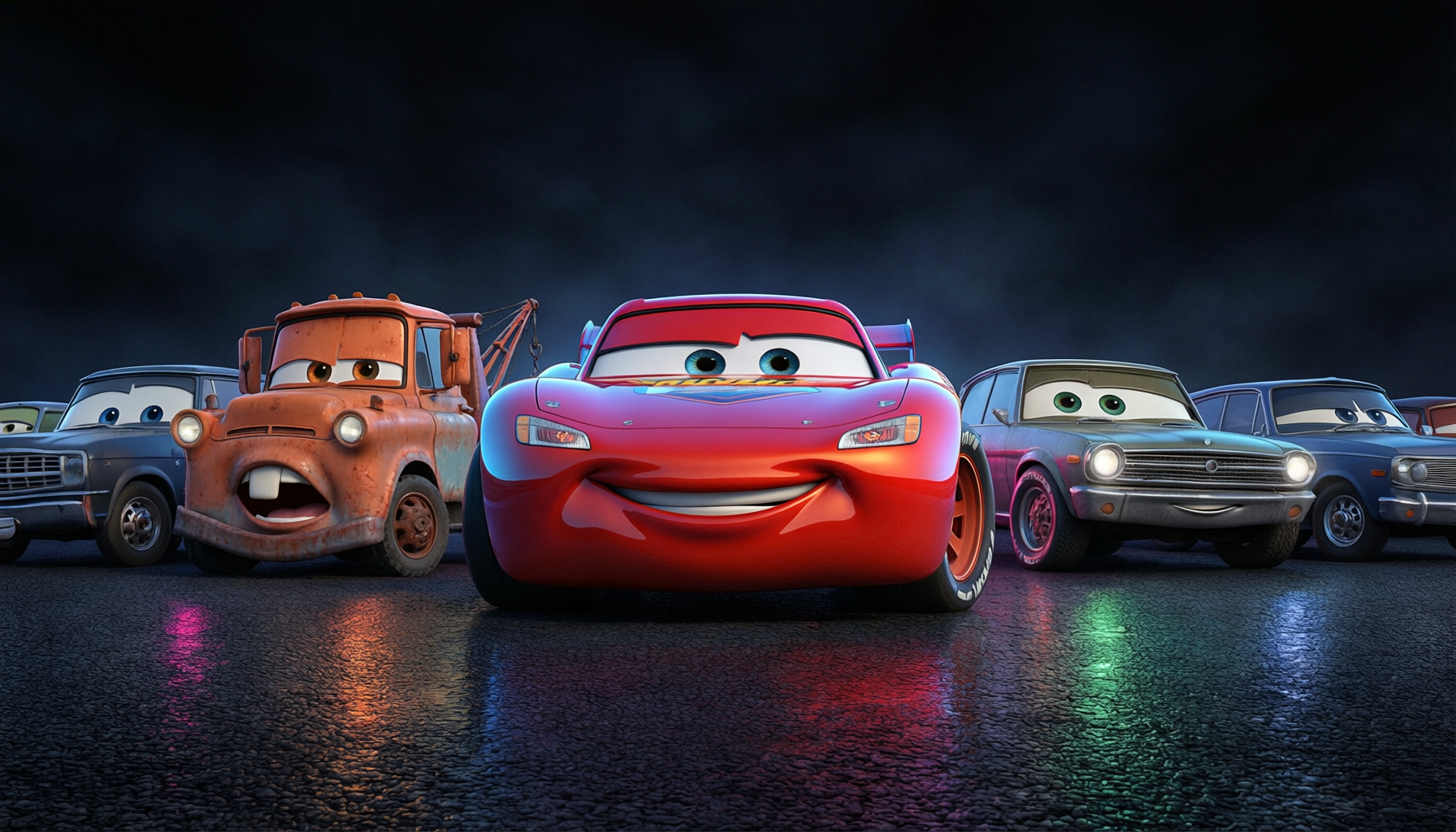
Cars Characters: The Full Roster of Radiator Springs and Beyond
There's a moment in the original 2006 Cars film where Lightning McQueen rolls into Radiator Springs for the first time, his paint job gleaming under desert stars, completely unaware that this busted-up roadside town will change everything about who he is. That scene works because Pixar didn't just build a world of talking vehicles — they built characters with genuine interior lives, egos that crack open, and relationships that feel earned. Over three theatrical films, two spin-offs, and roughly $2.8 billion in global box office receipts, the Cars franchise assembled one of the most recognizable ensemble casts in modern animation.
What makes these cars characters rather than just vehicles with eyes? The answer sits somewhere in the gap between John Lasseter's original pitch — "What if cars had feelings?" — and the surprisingly layered personality work that followed. Each character carries a specific worldview, a history that informs their choices, and a design language that communicates their soul before they speak a single line. This is a character-by-character breakdown of every major figure in the Cars universe, from the Piston Cup champions to the forklifts who keep the world turning behind the scenes.
Lightning McQueen — The Racer Who Learned to Slow Down
Lightning McQueen
ProtagonistLightning McQueen starts Cars as a 21st-century narcissist — young, fast, sponsored by a rust treatment company he's embarrassed by, and completely convinced that winning solves every problem. His number 95 is a direct nod to 1995, the year Pixar released Toy Story. His design borrows from NASCAR stock cars with a lower, sleeker profile, somewhere between a Gen-4 Chevrolet Monte Carlo and a Le Mans prototype.
What separates McQueen from a generic "cocky hero learns humility" arc is the specificity of his selfishness. He doesn't mistreat his pit crew out of cruelty — he simply never considered that they might matter. He doesn't dismiss Radiator Springs because he hates small towns; he dismisses it because his entire value system runs on speed, visibility, and Dinoco sponsorship offers. When Doc Hudson finally breaks through that armor, it lands because the audience has watched McQueen's ego function as genuine emotional insulation.
Across the franchise, McQueen evolves from a rookie who fires his entire pit team mid-race to a veteran who mentors Cruz Ramirez in Cars 3. The shift isn't cosmetic. By the third film, he's confronting the same obsolescence that destroyed Doc's career — the younger generation is faster, better funded, and built differently. His decision to step back and coach rather than compete reads as a genuine character choice, not a forced retirement. That's rare in franchise storytelling.
His catchphrase "Ka-chow!" works precisely because it's hollow at the start — a branding exercise — and becomes genuine joy by the end. Owen Wilson's vocal performance deserves credit here: the laid-back California drawl softens McQueen's arrogance into something almost endearing, even when he's being insufferable.
Mater — The Heart Hiding Under the Rust
Tow Mater
DeuteragonistMater is Pixar's most polarizing character, and that's worth examining. Critics dismissed him as lowbrow comic relief — the Jar Jar of the Cars universe. Audiences, particularly younger ones, made him the franchise's breakout star. The Cars Toons: Mater's Tall Tales shorts and his central role in Cars 2 exist because focus groups consistently ranked him as the character they wanted to see more of.
Design-wise, Mater is a masterpiece of visual storytelling. His model is based on a 1951 International Harvester tow truck, but Pixar stripped away the hood, added buck teeth formed from his front grille, and gave him eyes that sit too far apart — everything about his face communicates "unreliable narrator" before he opens his mouth. His missing side mirror, his rust patches, his backwards towing setup: each detail tells you this truck has lived a long, undignified life and couldn't care less.
But Mater's real function in the narrative is as McQueen's emotional anchor. He's the first Radiator Springs resident to treat McQueen as a friend rather than a problem. He doesn't want anything from McQueen — no autograph, no sponsorship connection, no ride along Route 66. He just wants someone to go tractor-tipping with. That unconditional acceptance is what actually cracks McQueen open, not Doc's mentorship or Sally's romantic interest. Those relationships matter, but Mater's friendship is the foundation.
Cars 2 made Mater the protagonist and paid for it critically — the film holds a 39% on Rotten Tomatoes, partly because audiences expected McQueen and got a spy comedy centered on a tow truck. But the film's emotional core (Mater believing McQueen is embarrassed by him) resonates if you let it. The scene where Mater realizes his friends might be ashamed of who he is plays as genuine heartbreak, not comic relief.
Sally Carrera — More Than the Love Interest
Sally Carrera
Supporting LeadSally's character does something uncommon for a love interest in a family film: she has an actual history that explains why she's where she is. She was a successful attorney in Los Angeles who burned out, drove west, broke down in Radiator Springs, and stayed because the town gave her something the city couldn't. That backstory, delivered in a single monologue during the mountain drive scene, reframes her entire relationship with McQueen. She isn't attracted to his fame — she already rejected that life.
Her model, a 2002 Porsche 911 (996 generation), was chosen deliberately. The 996 is the "affordable" 911, the one enthusiasts debate — refined enough for daily driving but not as raw as the GT3 or Turbo variants. It fits Sally perfectly: she's sophisticated without being pretentious, fast without needing to prove it. Pixar's design team even replicated the distinctive "fried egg" headlight design that made the 996 so controversial among Porsche purists.
Sally's function in the first film extends beyond romance. She's the character who articulates the thematic argument: that Radiator Springs has value not because of what it produces, but because of who lives there. Her speech about the town's history — "It was on the map for forty years before the interstate bypassed it" — is the emotional thesis of the entire franchise. McQueen saves the town, but Sally is the one who understood what needed saving.
Her role diminishes in the sequels, which is a missed opportunity. Cars 3 gives her a few meaningful scenes but mostly sidelines her into the supportive girlfriend role. Given the franchise's box office trajectory — Cars ($462M), Cars 2 ($562M), Cars 3 ($384M) — and the pivot toward new characters like Cruz Ramirez, Sally never got the narrative payoff her setup deserved.
Doc Hudson — The Legend Who Never Got His Finish Line
Doc Hudson
MentorDoc Hudson carries the heaviest emotional weight in the franchise, and it's not close. A three-time Piston Cup champion who dominated NASCAR's real-world equivalent in the early 1950s, Doc was pushed out of racing after a catastrophic crash — a scene that mirrors the very real dangers of stock car racing in that era. The racing world moved on without him. No museum. No commemorative paint job. Just a forgotten trophy case in a town the interstate forgot.
Paul Newman's performance elevates Doc beyond what the script alone achieves. Newman — who voiced the character in what became his final film role before his death in 2008 — brings the gravelly exhaustion of a man who spent decades pretending he didn't care about the sport that discarded him. When Doc finally trains McQueen on the dirt track, teaching him to drift through turns the way real stock car drivers did before modern aerodynamics, there's forty years of suppressed passion in every instruction.
The 1951 Hudson Hornet is one of the most significant cars in NASCAR history. The real Hornet dominated the 1952–1954 seasons with its low center of gravity and inline-six engine, winning 27 races in 1952 alone. Pixar's decision to make Doc a Hornet isn't trivia — it's a deliberate reference to a car that genuinely changed the sport. The "Fabulous Hudson Hornet" driven by Herb Thomas and Tim Flock is the direct template for Doc's backstory.
"I didn't quit racing. Racing quit me." — Doc's entire arc compressed into a single sentiment that the film conveys through visual storytelling rather than dialogue.
Doc dies between the first and second film, and the franchise handled it with unusual grace. Cars 3 builds its entire emotional architecture around his absence — McQueen confronts the same career-ending crossroads that Doc faced, and the film positions Cruz Ramirez as McQueen's opportunity to do for someone else what Doc did for him. The Doc Hudson legacy becomes the through-line of the trilogy.
Francesco Bernoulli — The Rival Who Actually Respects the Game
Francesco Bernoulli
Antagonist / RivalFrancesco Bernoulli is the most entertaining character in Cars 2, and he earns that distinction in about ninety seconds of screen time. Introduced as the World Grand Prix's top-ranked open-wheel racer, Francesco is arrogant, theatrical, and completely transparent about both qualities. He refers to himself in the third person. He flirts with the camera. He openly mocks McQueen's stock car design. But he never cheats, never sabotages, and never disrespects the sport itself.
John Turturro's vocal performance is a masterclass in comic timing. Francesco's Italian accent is exaggerated to the point of absurdity — "You are-a Lightning McQueen? You look like-a me, but less-a handsome!" — but Turturro commits so fully that it reads as the character's genuine personality rather than a stereotype. Francesco is a man who believes his own press coverage and has the talent to justify it.
Design-wise, Francesco is modeled after mid-2000s Formula 1 cars, with Ferrari's iconic red livery and the pronounced nose cone that distinguished the F2004 and F2005 chassis. His open-wheel design creates a visual contrast with McQueen's enclosed stock car body — two entirely different racing philosophies sharing the same track. This design tension mirrors the film's thematic exploration of whether different racing disciplines can respect each other.
Francesco's role expands in Cars 3, where he appears briefly but memorably. His respect for McQueen — grudging but real — provides one of the few moments where the franchise acknowledges that rivalry and friendship aren't opposites. They're often the same thing wearing different paint.
The Radiator Springs Ensemble — A Town Built from Misfits
Radiator Springs works as a setting because every resident arrived there for a different reason and stayed for a different reason. The town isn't a community of like-minded people; it's a collection of vehicles who had nowhere better to go and built something together anyway. That's what gives the first film's third act its weight — McQueen isn't saving a postcard-perfect village. He's saving a group of people who chose each other.
Ramone — The Artist Nobody Asked For
Ramone
SupportingRamone is the franchise's quiet argument that creativity doesn't require an audience. He repaints himself every morning — purple one day, green the next, sometimes a full flame job — for a town of roughly a dozen residents who have seen every combination he can produce. He's a customizer with no customers, an artist without a market, and he's completely content with that arrangement. His shop, Ramone's House of Body Art, is the visual highlight of Radiator Springs, a neon-lit lowrider cathedral that contrasts with the desert brown surrounding it.
The 1959 Impala is one of the most customized cars in American automotive history, particularly within Chicano car culture. Pixar consulted extensively with lowrider communities to get Ramone's hydraulic stance correct — his front end sits low enough to scrape, his rear rides high, and his paint jobs reference real custom work from artists like Larry Watson and Von Dutch. When Ramone repaints McQueen at the end of Cars, giving him a genuine custom flame job, it's not just a visual upgrade — it's Ramone sharing his art with someone who finally appreciates it.
Flo — The Backbone Operation
Flo
SupportingFlo is the social center of Radiator Springs — her V8 Cafe functions as the town's living room, its diner, and its gas station all at once. Her design references the General Motors Motorama concept cars of the 1950s, specifically the tail-fin extravagance that Harley Earl's design team produced to sell the American public on a futuristic automotive vision. Those fins weren't functional; they were aspirational. Flo herself is aspirational — a show car who could have been a museum piece chose to pour coffee for truckers instead.
Jenifer Lewis brings a warmth to Flo that makes every scene she's in feel like a family gathering. She's married to Ramone, and their relationship is one of the franchise's most understated details — two creative people who support each other's work without competing. Flo's role is small but structurally essential: she's the character who makes Radiator Springs feel like a place where someone would actually want to live, not just a collection of eccentric side characters.
Sheriff — Law and Order with a Sense of Humor
Sheriff
SupportingSheriff is the straight man in a town full of eccentrics, and that role is harder to play than it looks. He's a 1949 Mercury — the same model that became the basis for custom "lead sleds" in hot rod culture — but outfitted as a police cruiser with a single roof-mounted light and a push bar. He chases McQueen through the town's main street in one of the film's early set pieces, and the comedy comes from the contrast: this ancient, heavy police car pursuing a modern race car at 40 miles per hour through a town where nobody's in a hurry anyway.
Michael Wallis, who voices Sheriff, is actually a Route 66 historian and author who consulted on the film's geographic authenticity. His voice carries the cadence of someone who's spent decades driving the actual highway that inspired the movie. Sheriff's authority in Radiator Springs is real but gentle — he enforces laws that everyone agrees on because the community is small enough for consensus to work.
Fillmore and Sarge — The Odd Couple of Route 66
Fillmore
SupportingFillmore is a 1960 Volkswagen Type 2 bus who brews his own organic fuel in a backyard still and believes in conspiracy theories about the oil industry. His neighbor Sarge is a Willys Jeep who runs a surplus store and keeps his lawn mowed in military-grade stripes. They argue about everything — fuel sources, lifestyle choices, the proper way to maintain a gravel driveway — and they're clearly best friends.
George Carlin's casting as Fillmore is one of the franchise's smarter decisions. Carlin, whose comedy career was built on questioning authority and mocking establishment thinking, voices a character who genuinely believes everything he says. Fillmore isn't a parody of hippie culture; he's a sincere participant in it. His organic fuel actually works — McQueen runs better on it than on standard gasoline — which validates Fillmore's worldview in a way that most comedies wouldn't allow.
Sarge, voiced by Paul Dooley, represents the other end of the American roadside spectrum: military discipline, practical skills, and a deep suspicion of anything that can't be explained by a field manual. The Fillmore-Sarge dynamic works because neither character is wrong. They're both living their best lives in the same tiny town, arguing across a property line that neither of them takes seriously.
Cruz Ramirez — The New Generation's Burden
Cruz Ramirez
Protagonist (Cars 3)Cruz Ramirez enters the franchise in Cars 3 as a training technician at the Rust-eze Racing Center — essentially a driving simulator operator who's never been allowed on a real track. Her character addresses a genuine gap in the first two films: the Cars universe had no prominent female racer. Sally was a lawyer. Flo ran a cafe. The actual competition circuit was entirely male. Cruz's introduction corrects that, but the film does something more interesting than simply adding a woman to the grid.
Cruz wanted to race. She trained for it, dreamed about it, and then backed away because she didn't see anyone who looked like her on the track and decided that meant she didn't belong. That's not a racing-specific problem — it's a pattern that recurs in every industry where representation lags behind talent. Her storyline in Cars 3 tracks her journey from "I'm not ready" to actually lining up at the starting line, and it works because the film never pretends the obstacle was anything other than systemic.
When McQueen passes her Doc Hudson's number 51 at the film's climax, it's one of the trilogy's most emotionally resonant moments — not because of what it means for McQueen, but because Cruz is receiving a legacy she never knew she was part of. Doc trained McQueen. McQueen trained Cruz. The chain continues.
Her design, an original creation rather than a licensed model like most Cars characters, blends elements of modern sports cars — the low nose of a McLaren, the rear haunches of a C7 Corvette — into something that reads as "the future" without copying any specific manufacturer. That design choice is intentional: Cruz represents the next generation, and the next generation doesn't look like what came before.
Jackson Storm — The Machine That Made Itself
Jackson Storm
AntagonistJackson Storm is the most effective villain in the Cars franchise because he never does anything villainous. He doesn't sabotage McQueen. He doesn't conspire against him. He doesn't even seem to dislike him personally. Storm is simply better — younger, faster, more aerodynamic, trained on million-dollar simulators with analytics teams feeding him data in real time. He's the inevitability of progress wearing a smug expression.
His design reflects that clinical superiority. Where McQueen has curves that suggest a human designer's hand, Storm's body is all computational fluid dynamics — sharp creases, aggressive angles, and a rear spoiler that looks like it was shaped in a wind tunnel rather than a styling studio. His midnight blue-black paint job reads as the absence of personality, a car optimized for performance who never considered whether winning should feel like anything beyond data confirmation.
What makes Storm interesting is that he's not wrong. His methods work. The "next-gen" racers in Cars 3 genuinely are faster than the veterans, and no amount of heart or nostalgia changes that physics equation. The film's resolution — McQueen stepping aside for Cruz rather than defeating Storm himself — acknowledges that some races can't be won with determination alone. Sometimes the better car wins, and the mature response is to invest in the next generation rather than rage against the current one.
Chick Hicks — The Villain Who Won and Lost Everything
Chick Hicks
Antagonist (Cars 1)Chick Hicks is everything McQueen could become without the Radiator Springs intervention. He's a veteran racer who's spent his entire career finishing second to The King (Strip Weathers), and the resentment has calcified into something ugly. His signature move — clipping other racers to cause wrecks — isn't just a racing tactic; it's a philosophy. If you can't win clean, win dirty. If you can't be the best, make sure nobody else is either.
The 1987 Buick Grand National is a fascinating model choice. The real Grand National was NASCAR's dominant car in the mid-1980s, a turbocharged V6 that outperformed the V8 competition and was eventually regulated out of existence. It was a car that won through engineering rather than tradition, which makes it perfect for Chick — a racer who'd rather hack the system than earn his place in it.
Michael Keaton's voice performance is underrated. He gives Chick a nasal, grating quality that makes every line sound like a complaint, even when he's technically being polite. When Chick finally wins the Piston Cup in the three-way tie at the end of Cars, his celebration rings hollow because the audience has already seen what winning looks like when it means something. Chick got the trophy. The King got a career-ending injury. McQueen got a life education. Chick got a piece of metal.
The number 86 carries its own meaning in racing culture — to "86" something is to discard it, to throw it out. Chick Hicks is the character the racing world will eventually 86, and he knows it, which is what makes his desperation so palpable.
The King (Strip Weathers) — Grace Under the Checkered Flag
Strip "The King" Weathers
Supporting / Legacy CharacterThe King is a direct homage to Richard Petty, the seven-time NASCAR champion who drove the number 43 STP-sponsored Plymouth Superbird to dominance in the late 1960s and 1970s. Petty voices the character himself, which adds a layer of authenticity that no professional voice actor could replicate. When The King talks about the sport's history, it's not a script — it's a living legend narrating his own mythology through a cartoon car.
The 1970 Plymouth Superbird is one of the most visually distinctive race cars ever built, with its towering rear wing and elongated nose cone designed purely for Daytona superspeedway aerodynamics. Pixar replicated every detail — the wing height, the nose profile, even the Petty Blue paint that the real car wore throughout its career. The Dinoco sponsorship is a thinly veiled reference to STP, right down to the logo design.
The King's role in the narrative is as the racer McQueen idolizes but hasn't yet earned the right to emulate. When Chick Hicks causes The King's career-ending crash, McQueen's decision to push The King across the finish line — sacrificing his own Piston Cup shot — is the moment he stops imitating The King's racing and starts embodying his values. The King never asks McQueen to do that. He never asks for anything. That's why the gesture matters.
Mack, Luigi, and Guido — The Pit Crew That Never Gets a Lap
Every racer needs a team, and McQueen's support crew is one of the franchise's most rewarding ensemble dynamics — a group of working-class vehicles whose entire existence revolves around keeping someone else on the track.
Mack — The Long-Haul Friend
Mack
SupportingMack is a Mack truck — the name isn't subtle, and it doesn't need to be. He's McQueen's hauler, his driver, his road companion, and the only member of McQueen's original team who actually cares about him as a person rather than a sponsorship opportunity. John Ratzenberger, Pixar's lucky charm who appeared in every Pixar film from Toy Story through Onward, gives Mack a weary, blue-collar warmth that grounds the character in something real.
Mack's most significant moment comes early in Cars, when McQueen's entire pit crew quits mid-race and Mack is the only one who stays. He doesn't stay because he believes in McQueen's championship chances. He stays because that's what friends do — they show up, they drive the overnight haul, they wait in parking lots while their driver gets photographed with sponsors who couldn't name them. Mack is the invisible labor that makes the spectacle possible.
Luigi and Guido — The Italian Pit Stop Revolution
Luigi & Guido
Supporting DuoLuigi is a 1959 Fiat 500 who runs a tire shop in Radiator Springs and worships Ferrari with the devotion of a religious convert. Guido is his assistant — a tiny forklift based on the BMW Isetta — who communicates entirely in Italian that only Luigi understands. Together, they form the franchise's most efficient comedic duo and deliver one of its most satisfying payoff moments.
That moment arrives at the climax of Cars, during the tiebreaker race at the Los Angeles International Speedway. McQueen's pit crew has quit. Mack can't change tires. And then Luigi and Guido arrive, having driven cross-country to support their friend, and Guido executes a four-tire pit stop in approximately 1.5 seconds — a time that would be competitive with real NASCAR pit crews, who average around 12–14 seconds for a four-tire change. The entire stadium goes silent. The Ferrari pit crew in the next lane literally drops their equipment in shock. It's the moment the smallest car on the team proves he's the best at his job, and it lands because the film spent two hours establishing that Luigi and Guido were "just" small-town tire salesmen.
Full Character Roster at a Glance
| Character | Model | First Film | Voice Actor | Role | Racing # |
|---|---|---|---|---|---|
| Lightning McQueen | Custom stock car | Cars (2006) | Owen Wilson | Protagonist | #95 |
| Tow Mater | 1951 Intl. Harvester tow truck | Cars (2006) | Larry the Cable Guy | Deuteragonist | — |
| Sally Carrera | 2002 Porsche 911 Carrera | Cars (2006) | Bonnie Hunt | Supporting Lead | — |
| Doc Hudson | 1951 Hudson Hornet | Cars (2006) | Paul Newman | Mentor | #51 |
| Francesco Bernoulli | F1-style open-wheel | Cars 2 (2011) | John Turturro | Rival | — |
| Cruz Ramirez | 2017 CRS Sports Coupe | Cars 3 (2017) | Cristela Alonzo | Protagonist (Cars 3) | #51 |
| Jackson Storm | 2017 Piston Cup Custom | Cars 3 (2017) | Armie Hammer | Antagonist | #20 |
| Chick Hicks | 1987 Buick Grand National | Cars (2006) | Michael Keaton | Antagonist | #86 |
| The King | 1970 Plymouth Superbird | Cars (2006) | Richard Petty | Legacy Character | #43 |
| Ramone | 1959 Chevy Impala lowrider | Cars (2006) | Cheech Marin | Supporting | — |
| Flo | 1950s Motorama show car | Cars (2006) | Jenifer Lewis | Supporting | — |
| Sheriff | 1949 Mercury Club Coupe | Cars (2006) | Michael Wallis | Supporting | — |
| Fillmore | 1960 VW Bus (Type 2) | Cars (2006) | George Carlin | Supporting | — |
| Mack | 1980s Mack Super-Liner | Cars (2006) | John Ratzenberger | Supporting | — |
| Luigi | 1959 Fiat 500 | Cars (2006) | Tony Shalhoub | Supporting | — |
| Guido | Isetta forklift | Cars (2006) | Guido Quaroni | Supporting | — |
What Makes These Characters Stick — Beyond the Merchandising
The Cars franchise has generated roughly $10 billion in merchandise revenue since 2006 — die-cast toys, bedding, lunchboxes, video games, and the sprawling Cars Land area at Disney California Adventure that cost an estimated $1.1 billion to build. That commercial footprint is staggering, but it doesn't explain why the characters endure. Plenty of franchises sell merchandise. Fewer create characters that audiences actively think about between purchases.
What the Cars cast shares is a consistency of internal logic. Every character's model matches their personality in ways that reward close attention:
- Doc Hudson drives a Hudson Hornet — a car that genuinely dominated NASCAR before being rendered obsolete by rule changes. His entire identity mirrors his machine's arc.
- Chick Hicks sits behind the wheel of a Buick Grand National — a turbocharged V6 that some considered unfair competition. The car won through engineering loopholes, just like Chick wins through dirty driving.
- Sally Carrera is a Porsche 911 — refined, precise, built for a specific kind of driver who values substance over spectacle.
- Mater is literally a tow truck — a vehicle whose sole purpose is helping broken-down cars. His personality is his function.
- McQueen is a stock car — fast, loud, designed for oval tracks where the only direction is forward. His growth comes from learning to turn.
Nobody in Radiator Springs drives a car that contradicts who they are. That's not coincidence — it's design philosophy applied at the character level.
The voice casting reinforces this alignment with unusual precision. These aren't random celebrity bookings — they're casting choices that collapse the distance between actor and character:
- Paul Newman as Doc Hudson — a retired champion playing a retired champion, in what became his final film role before his 2008 death.
- Richard Petty as The King — the seven-time NASCAR champion voicing a seven-time Piston Cup champion. The parallel writes itself.
- George Carlin as Fillmore — the comedian whose career was built on questioning authority, voicing a conspiracy-minded hippie bus.
- Larry the Cable Guy as Mater — a blue-collar comedian from Nebraska voicing a blue-collar tow truck from nowhere.
- Michael Wallis as Sheriff — a Route 66 historian and author voicing the lawman of a Route 66 town. He literally wrote the book on the highway.
Every casting decision makes the line delivery feel like autobiography rather than performance. That consistency is a directorial achievement, not an accident.
There's also something to be said for the franchise's willingness to let characters age. Doc dies. The King retires. McQueen gets slower. Cruz represents a generation that trains differently, thinks differently, and races differently. Most animated franchises reset their characters to factory settings between installments. Cars lets time pass, and the characters change with it. That's a choice, and it's the right one.
Questions Readers Actually Ask About the Cars Universe
Who is the most popular Cars character?
Lightning McQueen remains the franchise's most recognizable character and its merchandising anchor, but Mater consistently outperformed him in audience polling during the Cars 2 era. Disney's internal research (reported by various entertainment outlets in 2011) showed Mater as the top-requested character among the 4–8 age demographic, which directly influenced his expanded role in the second film and the Mater's Tall Tales shorts.
Is Lightning McQueen based on a real car?
Not a single real car. McQueen's design is an original creation that borrows elements from NASCAR Gen-4 stock cars (the low, wide body), the Chevrolet Corvette C6 (the headlight design and overall proportions), and Le Mans prototypes (the rear diffuser and aerodynamic profile). Pixar's design team, led by Bob Pauley, intentionally avoided licensing a specific model so that McQueen would remain unique to the franchise.
Why does Doc Hudson's number appear on Cruz Ramirez in Cars 3?
McQueen gives Cruz the number 51 — Doc's original racing number — as a symbolic passing of the torch. Doc mentored McQueen, McQueen mentored Cruz, and the number represents that unbroken chain of knowledge and support. It's also a narrative callback to Doc's legacy, ensuring that the character who died between films remains present in the story's emotional architecture.
How many characters are in the Cars franchise total?
Across three theatrical films, two Planes spin-offs, the Cars Toons shorts, and the Cars on the Road Disney+ series, the franchise has introduced over 250 named characters. However, the core cast that appears across multiple installments and carries narrative weight numbers around 25–30 characters. The 16 profiled in this guide represent the most significant figures in terms of screen time, character development, and franchise impact.
Will there be a Cars 4?
As of mid-2026, Pixar has not officially announced Cars 4. The Cars on the Road series (2022) continued McQueen and Mater's adventures in a short-form format, and the franchise's merchandise performance remains strong enough to justify continued investment. Producer Kevin Reher stated in a 2023 interview that the studio is "always looking at what's next" for the franchise but had no active production in development at that time.
What real NASCAR drivers inspired Cars characters?
Several direct parallels exist. The King (Strip Weathers) is modeled on Richard Petty, who voices him and drove the #43 Plymouth Superbird. Doc Hudson's career arc mirrors the "Fabulous Hudson Hornet" drivers Herb Thomas and Tim Flock. Chick Hicks' aggressive driving style references real NASCAR rivalries of the 1980s, particularly the contentious relationship between Dale Earnhardt Sr. and drivers he considered obstacles to his championships. Lightning McQueen's rookie-year swagger draws from Jeff Gordon's entry into NASCAR in the early 1990s — young, marketable, and resented by the old guard.
The Cars franchise occupies a strange space in Pixar's filmography — critically overshadowed by Toy Story, WALL-E, and Inside Out, yet commercially unmatched within the studio's catalog. Its characters work not because of critical acclaim but because they were built with the same care that goes into engineering a race car: every component serves a purpose, every detail communicates function, and nothing exists without reason. Lightning McQueen doesn't just look like a race car. He thinks like one — fast, forward-focused, and initially unwilling to check his mirrors. By the time he learns to look back, the audience has already been looking forward with him the entire way.