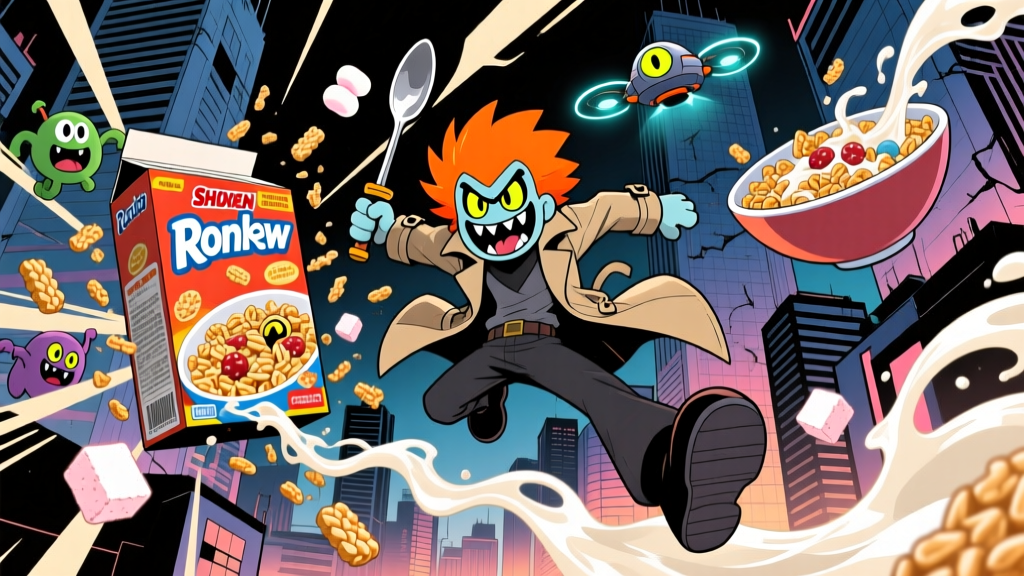
How one artist turned corporate mascots into grotesque mirrors of American consumption
By SenpaiSite Editorial |Walk into any American kitchen in 1985 and you'd find them staring back from the pantry: the grinning tiger, the winking pirate captain, the honey-bear with innocent eyes. These mascots sold sugar-laden grain to children while parents trusted the familiar faces on the boxes. Ron English looked at those same boxes and saw something else entirely—a visual language ripe for hijacking.
Born in 1959 in Decatur, Illinois, English didn't grow up wanting to destroy capitalism. He just wanted to paint. After earning his Bachelor of Fine Arts from the University of North Texas, he found himself drawn to the visual vocabulary of advertising—the same imagery that saturated American consciousness from billboards, television commercials, and yes, cereal boxes. What made English different from other painters wasn't his technical skill (though he had plenty); it was his refusal to accept commercial imagery at face value.
"Art doesn't change the world; it changes the channel."
The Birth of POPaganda
Somewhere in the late 1980s, English coined a term that would define his entire career: POPaganda. The portmanteau—part pop culture, part propaganda—captures his artistic mission perfectly. High culture meets low culture in a collision that leaves neither unscathed. A Renaissance painting technique applied to a cartoon character. The gravitas of fine art married to the disposability of breakfast cereal marketing.
The concept emerged from English's observations on how advertising shapes cultural values. While working as a commercial artist, he witnessed firsthand how corporations spent billions engineering emotional responses to their mascots. A child doesn't just recognize Tony the Tiger—they feel something when they see him. That emotional conditioning, English realized, was more powerful than most political messaging.
So he started hijacking it.
Over the course of three decades, English has illegally altered more than 1,000 billboards across the United States. He didn't just deface them—he performed surgery. A Joe Camel cigarette advertisement became a skeletal death figure still wearing that trademark grin. A Winston cigarettes billboard featured a corpse mid-puff. These weren't random acts of vandalism; they were precise interventions designed to expose the lies embedded in the original messaging.
The authorities arrested him multiple times. The corporations threatened lawsuits. Neither stopped him.
Cereal Killers: The Last Supper of American Mascots
If English's billboard work was guerrilla warfare, Cereal Killers represents his formal declaration of war against breakfast marketing. The series takes familiar cereal mascots—the characters designed to make children demand specific brands at grocery stores—and transforms them into grotesque reflections of what they're actually selling.
The collection functions as what English calls "a Last Supper of corporate mascots." Twelve characters sit at the table, each one a twisted parody of a real cereal mascot. The wordplay in the title—"Cereal Killers" instead of "Serial Killers"—isn't accidental. These characters, English argues, have been killing us slowly. Diabetes, obesity, heart disease. The smiling faces on cereal boxes have been accomplices to a public health crisis marketed directly to children.
The Lineup: Twelve Mascots, Twelve Indictments
Each character in the Cereal Killers lineup targets a specific aspect of cereal marketing or the mascots themselves:
- Cap'n Corn Starch — A bloated, skeletal take on Cap'n Crunch. The nautical uniform remains, but the captain now looks like he's been subsisting on his own product. The figure references the actual nutritional emptiness of corn starch-heavy processed cereals.
- Sugar Frosted Fat — Tony the Tiger's worst nightmare. Where the original mascot promises strength and vitality, this character embodies the metabolic reality of sugar-frosted flakes: expanding waistlines and insulin resistance.
- Fat Tony — Another tiger interpretation, this one even more grotesque. Fat Tony represents the cumulative effect of lifelong cereal consumption, a mascot who's eaten too much of his own product.
- Yucky Children Charmer — Perhaps the most disturbing of the bunch. This character satirizes how cereal marketing specifically targets children, with the "charmer" basking in the effects of sugary cereals on young bodies and developing taste buds.
- Sugar Smack — A direct hit at Sugar Smacks (now Honey Smacks), a cereal that the UK's Advertising Standards Authority actually banned from advertising to children in 2019 due to its sugar content exceeding 50% by weight.
- Sugar Diabetic Bear — Honey Bear transformed into a cautionary tale. The cuddly mascot now carries the medical consequences of his own product name.
- Delusionville — Represents the fantasy world cereal advertising creates, where cartoon characters live in impossible landscapes and eating processed grain somehow leads to adventure rather than dental appointments.
- Qhrist — English's recurring character appears in Cereal Killers context as well, representing the quasi-religious devotion that brand marketing attempts to cultivate.
- Smack, Crack, and Pot — A trio that draws direct parallels between sugar addiction and harder substances. The naming convention deliberately echoes drug terminology, suggesting that breakfast cereals function as socially acceptable chemical dependencies.
From Canvas to Collectible: The Vinyl Figure Revolution
English's Cereal Killers exist in multiple formats—paintings, prints, and perhaps most significantly, vinyl collectible figures. The transition from two-dimensional art to three-dimensional objects wasn't just an aesthetic choice; it was a strategic one. Vinyl figures occupy the same physical space as actual cereal boxes. They sit on shelves in kitchens and offices, confronting owners daily.
The figures have been produced across multiple series, with Mindstyle handling manufacturing for the definitive 3-inch mini figure collection. A complete set of twelve runs approximately $350 on the secondary market, though individual figures can be found for $25-$50 depending on rarity and condition.
| Series | Year Released | Figure Count | Size | Notable Characters |
|---|---|---|---|---|
| Series 1 (Original) | 2017-2018 | 12 figures | 3 inches | Cap'n Corn Starch, Sugar Frosted Fat, Yucky Children |
| Series 2 | 2019 | 6 figures | 3 inches | Sugar Diabetic Bear, Delusionville variants |
| Smack, Crack & Pot | 2020 | 3 figures | 3 inches | Drug-themed trio |
| Series 4 (VeVe Digital) | 2022 | 8 figures | Digital/Vinyl | New character variants, digital collectibles |
| Mini Figure Box Set | 2019 | 12 figures | 3 inches | Complete collection in display case |
| Note: Release dates are approximate and vary by region. Secondary market prices fluctuate based on availability. | ||||
The vinyl figure market has become its own ecosystem, with platforms like StockX treating limited editions similarly to sneakers. English's Cereal Killers benefit from this crossover appeal—collectors who might never visit a gallery will hunt for a rare vinyl figure. The 2022 collaboration with VeVe brought the series into digital collectibles, expanding the audience beyond physical object enthusiasts.
Gallery Shows and Institutional Recognition
Despite his guerrilla tactics and anti-corporate stance, English has achieved significant institutional recognition. The same art world that initially dismissed street art as vandalism now courts him actively. This tension—between English's subversive intent and his commercial success—creates interesting contradictions.
Jonathan LeVine Gallery (later Jonathan LeVine Projects) in New York became English's primary institutional home. LeVine's gallery was instrumental in legitimizing street art and Pop Surrealism, and English's solo shows there drew both critical attention and substantial sales. The gallery's "Delusional" anniversary exhibition in 2010 featured English alongside other street art luminaries.
In 2020, during the COVID-19 pandemic lockdowns, English presented "POPaganda on Paper," a virtual exhibition that adapted to the circumstances. Rather than large-scale paintings, the show featured works on paper—intimate pieces that could be photographed and shared digitally. English noted that he spent "a year and a half in the studio developing new ideas" during this period, emerging with work that felt both fresh and connected to his foundational practice.
The Museo de la Paz de Gernika in Spain hosted "Ron English: Reimagining Guernica," demonstrating how far his work has traveled from American billboard interventions to European museum walls. The show reinterpreted Picasso's masterwork through English's distinctive lens—a commentary on how war, propaganda, and commercial messaging share DNA.
Other notable exhibition venues include the Carandente Museum in Spoleto, Italy (Pop Surrealism exhibition), Brooklyn's various street art showcases, and PMQ in Hong Kong for his "East Meets West" solo show. Each venue represents a different facet of English's practice—the street artist, the fine art painter, the cultural commentator.
Beyond Cereal: The Extended Universe
Cereal Killers represents only one thread in English's broader practice. His other notable characters and works include:
- MC Supersized — Perhaps English's most recognized original character. A skeletal figure in a McDonald's-style uniform, MC Supersized has been produced in multiple sizes, from 10-inch vinyl figures to massive sculptures. The character directly critiques fast food marketing.
- Abraham Obama — Created during the 2008 presidential campaign, this hybrid figure merged Abraham Lincoln and Barack Obama into a single character, commenting on how political campaigns are marketed like consumer products.
- The Grin Series — A collection of characters wearing the signature "Ron English grin," a rictus that appears across his work as a symbol of forced happiness and manufactured satisfaction.
- Rabbit Hole — A recurring three-eyed rabbit character that references both Alice in Wonderland and mutation, suggesting that the world English depicts is already distorted.
The Documentary: POPaganda on Film
The 2010 documentary "POPaganda: The Art and Subversion of Ron English" (directed by Pedro Carvajal) brought English's work to audiences who might never encounter street art or gallery shows. The film follows English through his process—from illegal billboard interventions to studio painting to gallery openings.
What makes the documentary compelling isn't just the visual content; it's English's articulate explanation of his motivations. He doesn't position himself as a hero fighting evil corporations. Instead, he presents a more nuanced view: advertising is a language, and he's simply speaking it back to itself, exposing the gaps between promise and reality.
The film also captures something essential about English's personality—he's funny. The work is serious, the critique is sharp, but English approaches it with the playfulness of someone who genuinely enjoys the game of subversion. This humor comes through in the Cereal Killers series particularly. The character names are puns. The designs are grotesque but also cartoonish. You're supposed to laugh before you feel uncomfortable.
Cultural Commentary: Why Cereal Killers Still Matters
When English began the Cereal Killers series, the conversation around sugar consumption and children's health was already established. What he added wasn't new information—it was a new frame. Instead of public service announcements and nutritional charts, he offered grotesque parody. Instead of telling people that cereal mascots were harmful, he showed those mascots as the monsters they already were.
This approach aligns with a broader tradition of culture jamming—the practice of subverting mainstream media messages by altering them slightly. Groups like Adbusters magazine and the Billboard Liberation Front have used similar tactics since the 1980s. What distinguishes English's work is his technical skill and his willingness to create original characters rather than simply defacing existing ones.
The Cereal Killers series also intersects with the art toy movement that emerged in the late 1990s and early 2000s. Artists like Michael Lau, James Jarvis, and English himself recognized that vinyl figures could function as affordable, accessible art objects. Unlike paintings that might sell for $50,000 and disappear into private collections, a $30 vinyl figure sits on someone's desk, visible daily. This democratization of art ownership aligns with English's populist instincts.
The series gained additional relevance as actual cereal companies began reformulating products in response to health concerns. In 2015, General Mills announced it would remove artificial colors and flavors from all children's cereals. In 2019, the UK banned Honey Smacks (the real cereal that inspired Sugar Smack) from advertising to children. Reality was catching up to English's satire.
Collecting Cereal Killers: A Practical Guide
For collectors interested in acquiring Cereal Killers pieces, the market offers multiple entry points:
Entry Level ($25-$50): Individual 3-inch vinyl figures from Series 1 or 2. These are widely available on eBay, at specialty toy retailers, and through secondary market platforms. Common characters like Cap'n Corn Starch and Sugar Frosted Fat typically fall in this range.
Mid-Range ($100-$350): Complete sets or rare individual figures. The complete 12-figure mini set runs around $350. Limited edition variants, artist proofs, and figures from later series command higher prices.
High-End ($500-$5,000+): Original paintings, large-scale sculptures, and signed limited edition prints featuring Cereal Killers imagery. English's fine art pieces appear at auction houses and through his gallery representation. A large canvas might sell for $10,000 or more at established galleries.
Digital Collectibles ($10-$100): The VeVe platform offers digital versions of Cereal Killers figures, accessible through their app. These appeal to collectors interested in the imagery but without physical storage space.
Authentication matters. English's popularity means counterfeit figures exist, particularly for rare variants. Buy from established retailers, verified secondary market sellers, or directly through POPaganda (English's official brand) when possible.
The Broader Context: Pop Surrealism and Lowbrow Art
English's work, including Cereal Killers, fits within the Pop Surrealism movement that emerged in California during the 1970s and gained international traction by the 2000s. The movement—sometimes called "Lowbrow Art"—rejects the intellectualism of the mainstream art world while maintaining serious technical skill and conceptual depth.
Key characteristics of Pop Surrealism visible in Cereal Killers include: familiar commercial imagery rendered in unfamiliar ways, technical precision combined with cartoon aesthetics, dark humor, and accessibility. The work doesn't require art historical knowledge to appreciate. A child recognizes Cap'n Crunch; an adult recognizes the critique.
The movement's relationship to street art creates interesting overlaps. Artists like English, Shepard Fairey, and Banksy share visual strategies—appropriation, subversion, humor—while operating in different contexts. English's unique contribution is his focus specifically on advertising as both subject matter and methodology. He doesn't just critique ads; he makes better ones.
Frequently Asked Questions
Who is Ron English and why is he called the "Godfather of Street Art"?
Ron English (born 1959, Decatur, Illinois) is an American contemporary artist known for subverting advertising imagery through his concept of POPaganda. He's called the "Godfather of Street Art" because his billboard interventions in the 1980s and 1990s—altering corporate advertisements to expose their harmful messages—pioneered techniques that later street artists adopted. His work bridges the gap between illegal street interventions and legitimate gallery practice.
What does "POPaganda" mean?
POPaganda is a term English coined combining "pop culture" and "propaganda." It describes his artistic approach: taking familiar commercial imagery (pop culture) and revealing the manipulative messaging (propaganda) embedded within it. The term also serves as his brand name for official merchandise and releases.
Are Cereal Killers figures still being produced?
As of 2026, Cereal Killers figures are available through secondary markets, specialty retailers, and digital platforms like VeVe. New series or variants are released periodically. Check POPaganda.com for official releases and authorized retailers for authentic pieces.
How much do original Cereal Killers paintings cost?
Original paintings featuring Cereal Killers imagery typically range from $5,000 to $50,000+ depending on size, complexity, and provenance. These pieces appear through English's gallery representation and at auction. The vinyl figures offer a more accessible entry point at $25-$350.
Has Ron English faced legal consequences for his billboard work?
Yes, English has been arrested multiple times for his illegal billboard interventions. However, as street art gained cultural legitimacy and his reputation grew, corporations became less likely to pursue legal action. Some have even commissioned work from him—a irony English acknowledges with characteristic humor.
Where can I see Ron English's work in person?
English's work appears in galleries worldwide, with Jonathan LeVine Projects in New York being his primary U.S. gallery. His official website POPaganda.com lists current and upcoming exhibitions. Major cities with active street art scenes often feature his work in group shows.
The Lasting Impact
Ron English's Cereal Killers series succeeds because it operates on multiple levels simultaneously. As art, it's visually striking—bright colors, technical skill, imaginative design. As cultural critique, it makes its point without preaching. As collectible objects, the vinyl figures democratize art ownership. And as humor, it lands because the jokes are built on uncomfortable truths.
The series also represents something important about the evolution of street art from the 1980s to the present. English started by illegally altering billboards—criminal acts of visual dissent. Four decades later, his work hangs in museums, sells in galleries, and exists as licensed collectibles. The system he critiqued has absorbed his critique, commodified it, and sold it back. Whether that represents victory or defeat depends on your perspective.
English himself seems unbothered by the contradiction. He continues creating, continues subverting, continues finding new targets for his POPaganda approach. The cereal mascots were just the beginning. Advertising saturates every aspect of contemporary life. There will always be new billboards to hijack, new mascots to distort, new lies to expose.
The next time you walk down a grocery store cereal aisle, take a closer look at those smiling faces on the boxes. Ron English has already done that looking for you—and what he found should make you think twice about what's actually in that colorful cardboard box.
And somewhere, probably right now, he's painting a version of that box where the mascot's grin stretches too wide, where the colors are slightly wrong, where the truth peeks through the marketing veneer. That's the gift of Cereal Killers: once you've seen it, you can't unsee it. Every breakfast becomes a small act of resistance.
--- END OF DRAFT ---