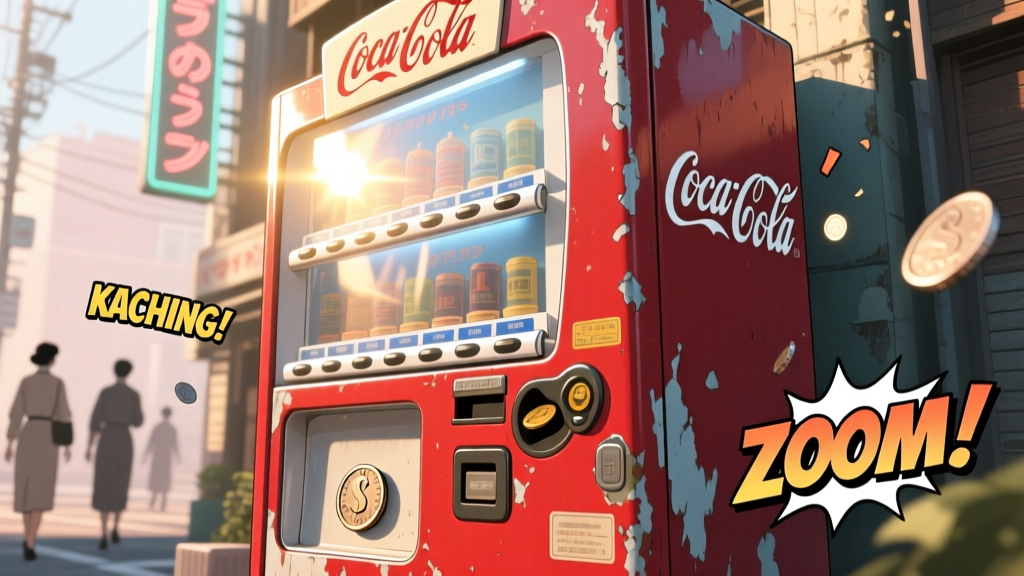
Picture this: a rain-spotted barn outside Macon, Georgia. Inside, past a stack of rusted license plates and a tower of mildewed National Geographics, sits a six-foot slab of porcelain-coated steel. The coin mechanism is seized. The compressor died sometime during the Reagan administration. But the script lettering on the front—that looping, confident "Drink Coca-Cola"—still gleams under the bare bulb like it was painted yesterday. A collector from Chattanooga just paid $2,800 for it, sight unseen, based on a photograph posted to a Facebook group at 11 PM. Within fourteen minutes, three other buyers had sent messages. The machine was a Vendo 44, manufactured in 1951, and it would never dispense another bottle of Coke. It didn't matter. That machine was going to get restored, photographed, and placed in a man-cave where it would become the most interesting object in the room.
This is the world of vintage Coca-Cola vending machine collecting—a hobby that sits at the crossroads of industrial design history, Americana nostalgia, and the kind of obsessive mechanical tinkering that produces 3,000-word forum posts about the correct shade of red for a 1957 Cavalier cabinet. There are thousands of active collectors in North America alone, and the secondary market for restored units has climbed steadily for two decades. What drives it is not nostalgia in the abstract. It is the specific, tactile appeal of these machines: the weight of a steel coin slider, the thunk of a bottle dropping into the bin, the glow of backlit bubble-glass lenses on a darkened patio.
The Machines That Built a Habit: 1940s Through the 1960s
Before the 1940s, Coca-Cola was sold almost exclusively at soda fountains and grocery store coolers. Vending existed, but the machines were small, top-opening ice chests with hand-painted signs—functional, forgettable, and not especially durable. The post-war boom changed that. Returning GIs had money, cars, and an appetite for convenience. The Coca-Cola Company, already running the most recognized brand on the planet, saw an opening: put a machine on every street corner, in every barbershop, outside every gas station.
The Vendo Company, founded in Kansas City, Missouri, in 1931 by the Weber brothers, became Coke's primary vending partner. Their early models—the Vendo 6 and Vendo 10—were simple gravity-fed units that held a handful of bottles on ice. Crude by later standards, but they proved the concept. By 1947, Vendo introduced the model that would become the cornerstone of serious collections: the Vendo 44.
The Vendo 44: Every Collector's Gateway Drug
The Vendo 44 is the machine people picture when they hear "vintage Coca-Cola vending machine." Produced from 1947 to approximately 1955, it stands roughly 59 inches tall, weighs about 275 pounds empty, and holds 44 bottles across two columns. Its defining feature is the bubble-glass lens—a curved, translucent panel above the bottle compartment that glows amber-white when the interior light is on. The cabinet was finished in Coca-Cola red with white script lettering, and the coin mechanism accepted only nickels. No dimes, no quarters. A nickel for a Coke. That was the deal.
What makes the Vendo 44 special to collectors is not rarity—Vendo manufactured tens of thousands of them. It's the proportions. The machine has an Art Deco holdover elegance: rounded top corners, a slightly tapered profile, chrome-plated coin slider and bottle carrier handle. It photographs beautifully. It fits against a wall in a den or garage without dominating the space the way the larger models do. Restored examples with original porcelain fronts (not repainted—original porcelain) command $3,500 to $7,500 on the collector market, depending on condition and provenance. Machines with the original "Drink Coca-Cola" decal intact under the glass, rather than a later silk-screen reproduction, sit at the top of that range.
The Vendo 81: The Chrome-Trimmed Flagship
If the Vendo 44 is the gateway, the Vendo 81 is the machine collectors aspire to own once they've been in the hobby for a few years. Introduced around 1955 and produced through the early 1960s, the Vendo 81 is a full-size, floor-standing unit that holds 81 bottles. It stands approximately 68 inches tall and weighs in the neighborhood of 430 pounds without product.
The design language shifted with the 81. Gone were the soft curves of the 44. In their place: a squarer, more assertive profile with heavy chrome trim around the bottle compartment door and along the top edge. The coin mechanism was upgraded to accept nickels, dimes, and quarters, and the vending mechanism used a rotating carrier that lifted the bottle from the stack and deposited it into the delivery bin with a satisfying mechanical choreography that no modern machine has ever replicated. The sound alone—the motor engaging, the carrier rotating, the glass bottle clunking into the metal bin—is a reason people restore these.
Vendo 81 prices have risen sharply since 2015. A project-quality machine (needs full restoration, some rust, missing coin mechanism) starts around $1,200 to $1,800. A professionally restored example with correct decals, rebuilt compressor, and re-chromed hardware runs $6,000 to $12,000. The highest documented private sale I've encountered in collector forums was $14,500 for a 1958 Vendo 81 with original porcelain front, matching serial-dated compressor, and a documented chain of ownership from a Coca-Cola bottling plant in Birmingham, Alabama.
The Cavalier 72: The Other Contender
Cavalier Corporation, based in Chattanooga, Tennessee—Coca-Cola's own backyard—produced the Cavalier 72 starting in 1955. The Cavalier 72 holds 72 bottles and has a distinctly different aesthetic from the Vendo machines. Where Vendo went chrome-heavy and architectural, Cavalier leaned into smoother, more rounded forms. The Cavalier 72 has a wrap-around front panel with the Coca-Cola script set against a slightly warmer red, and the bubble-glass lens above the vending compartment has a more pronounced curvature, almost a dome.
Cavalier machines are somewhat less common on the secondary market than Vendo models, partly because Cavalier produced fewer units and partly because many Cavalier machines ended up in the Southeast, where humidity and salt air accelerated corrosion. Finding a Cavalier 72 with an intact porcelain front panel is genuinely difficult. Most surviving examples have been repainted at least once, and the quality of those repaints varies wildly from factory-accurate to "a guy with a rattle can in his driveway."
Pricing reflects scarcity. A Cavalier 72 in unrestored, complete condition (all mechanical parts present, even if non-functional) typically lists between $2,000 and $4,000. A fully restored example with documented original porcelain can reach $8,000 to $11,000. Collectors who specialize in Cavaliers—and there is a vocal subset who prefer them to Vendos—will pay premiums for machines with the original "Ice Cold" emblem on the upper lens, a small detail that reproduction kits almost never get right.
From Steel Cabinets to Touchscreens: Four Decades of Design Evolution
The transition from the chrome-and-porcelain era to the modern vending landscape happened in distinct waves, each driven by changes in packaging, economics, and technology.
The 1960s–1970s: Cans, Stack Vendors, and the End of the Bottle Bin
The introduction of the aluminum can changed everything. Cans were lighter, cheaper to ship, and didn't require a deposit-return system. Vendo and Cavalier both pivoted to stack-vendor designs—tall, narrow machines where cans dropped from vertical columns. The Vendo 96 and the Cavalier CS-96 represented this generation. They were less photogenic than their predecessors: boxier, painted rather than porcelain-finished, with flat acrylic lenses replacing the curved glass. The chrome trim vanished. These machines were designed for utility, not beauty, and most of them were scrapped when they were retired rather than saved. That said, a niche group of collectors focuses on this era precisely because the machines are underappreciated and undervalued. You can still find a Vendo 96 for $400 to $800.
The 1980s–1990s: Electronic Controls and the Glass-Front Merchandiser
The glass-front merchandiser—the kind of machine you see in most office break rooms today—became dominant in the 1980s. Companies like Dixie-Narco (later acquired by Crane) and Westomatic introduced electronic coin mechanisms, LED pricing displays, and refrigeration systems that used R-134a refrigerant instead of the old R-12. These machines were more reliable and easier to service, but they also became generic. A Coke machine from 1992 looked almost identical to a Pepsi machine from the same year. The brand-specific design character that made the 1950s machines collectible had been engineered out of them in favor of interchangeable, fleet-deployment efficiency.
The 2000s–Present: Smart Machines and the Collector's Paradox
Modern Coca-Cola vending machines—the Coca-Cola Freestyle being the flagship example—are essentially touchscreen soda factories. The Freestyle, introduced in 2009, uses microdispensing technology (originally developed for insulin delivery, a fact that never fails to surprise people) to offer over 100 beverage options from a single unit. It connects to a central server via cellular network, reports inventory in real time, and adjusts syrup ratios based on altitude and water mineral content.
From a collector's standpoint, these machines are irrelevant. Nobody is hauling a Coca-Cola Freestyle into their garage to restore it. They're leased, not sold. They contain proprietary circuit boards and software that Coca-Cola controls. When they break, they get swapped, not repaired. The irony is that each technological advance has made vending machines less collectible, more disposable, and more anonymous. The Vendo 44 was a piece of furniture. The Freestyle is an appliance.
The Restoration Workshop: What It Actually Takes
Restoring a vintage Coca-Cola vending machine is not a weekend project. It is a months-long process that requires metalworking skills, electrical knowledge, access to specialized parts, and a tolerance for frustration that borders on masochism. Here is what the process looks like in practice.
Disassembly and Assessment
A proper restoration starts with complete disassembly. Every piece of chrome hardware is removed: coin slider, handle, hinges, bottle carrier, trim pieces. The refrigeration unit is pulled out and evaluated separately. The cabinet is stripped to bare metal. This is where you discover the real condition of the machine. Surface rust that looked manageable from the outside often hides perforation around the bottom edges and inside the bottle channels. It is not unusual for a collector to spend three days stripping a cabinet only to find that the bottom panel needs complete fabrication because it has rusted through.
Metalwork and Paint
Rust repair on a Vendo or Cavalier cabinet typically involves cutting out corroded sections with a cutoff wheel, welding in new steel, and then filling, sanding, and priming until the surface is perfectly smooth. The paint is a specific challenge. Original Coca-Cola red from the 1950s was a slightly warmer, more orange-leaning red than the modern Pantone 484C that Coca-Cola uses today. Collectors who want concours-level accuracy mix custom paint formulas based on color samples taken from protected areas of the original finish—inside the coin box door, for instance, or behind the bottle carrier plate where sunlight never reached.
The most desirable machines have porcelain-coated fronts rather than painted surfaces. Porcelain was baked onto the steel at high temperature, producing a glass-hard finish that resists chipping and fading. But porcelain cannot be touched up. If the original porcelain is damaged, the only real option is to have the panel re-porcelainized by one of the handful of specialty shops in the U.S. that still offer the service. The cost runs $800 to $1,500 per panel, and the turnaround time is typically six to ten weeks.
The Refrigeration Question
This is where restoration gets ethically complicated, at least within the collector community. Original compressors from the 1950s used R-12 refrigerant (Freon), which was phased out under the Montreal Protocol due to ozone depletion. Running an original R-12 system is legal if the system was never opened, but recharging a leaking R-12 system requires EPA Section 608 certification and access to dwindling supplies of reclaimed R-12, which now costs $50 to $80 per pound.
Most restorers who intend to use their machines functionally—actually keeping drinks cold—swap the original compressor for a modern Embraco or Danfoss unit running R-134a. The original compressor is cleaned, preserved, and stored alongside the machine for provenance. This is considered acceptable practice by most collectors, but a hardline faction insists on full-original restorations, R-12 and all. The debate occasionally reaches the intensity of the "numbers-matching" arguments in the classic car world, though with lower financial stakes.
The Money: What These Machines Are Actually Worth
The secondary market for vintage Coca-Cola vending machines operates through a patchwork of channels: eBay, Facebook collector groups (the "Coca-Cola Vending Machine Collectors" group has over 12,000 members), dedicated forums like Coca-Cola Collections (cocacola-collections.com), live auctions through Morphy Auctions in Denver, Pennsylvania, and private sales between known collectors. Prices have climbed steadily since the early 2000s, driven by a demographic wave of Baby Boomers with disposable income and garage space.
According to Morphy Auctions' published results from their Advertising Auction series (2023 and 2024 sessions), fully restored Coca-Cola vending machines consistently achieve hammer prices in the mid-four figures, with exceptional examples breaking into five figures. A Vendo 81 with documented original porcelain and factory-correct decals sold for $11,500 (including buyer's premium) at Morphy's November 2023 auction. A Cavalier 72 in comparable condition brought $9,800 at the same sale.
"I've been collecting Coke machines for thirty-one years. When I started in the early '90s, you could pull a Vendo 44 out of a barn for two hundred bucks and nobody cared. Now that same machine, if it has original porcelain, starts at four thousand and people fight over it. The hobby grew up, and the machines that were just 'old junk' became artifacts."
— Harlan W., collector and restorer, Ringgold, Georgia (quoted in Soda Pop Gazette, Spring 2024)
Here is a current market snapshot based on completed sales from multiple channels (2024–2025 data):
| Model | Production Years | Project Condition | Professionally Restored | Key Value Factors |
|---|---|---|---|---|
| Vendo 44 | 1947–1955 | $800 – $1,500 | $3,500 – $7,500 | Original porcelain, bubble lens condition, nickel-only mech |
| Vendo 81 | 1955–1963 | $1,200 – $1,800 | $6,000 – $12,000 | Chrome trim completeness, carrier mechanism, serial-matched compressor |
| Cavalier 72 | 1955–1962 | $2,000 – $4,000 | $8,000 – $11,000 | Original porcelain rarity, "Ice Cold" emblem, Southeast corrosion |
| Vendo 6 / Vendo 10 | 1930s–1940s | $600 – $1,200 | $2,500 – $5,500 | Pre-war examples rare, hand-painted sign condition |
| Vendo 96 (can vendor) | 1965–1978 | $150 – $400 | $800 – $1,800 | Era-specific graphics, working coin mech, underappreciated |
| Prices reflect private sales and auction results (hammer + premium). Regional variation is significant. Machines with documented bottling-plant provenance command 15–30% premiums. | ||||
A few observations from the data. First, the gap between project-condition and restored values is substantial—typically 4x to 5x. This reflects the real cost of restoration: a full professional restoration of a Vendo 81, including metalwork, paint, re-chroming, compressor rebuild, and decal application, runs $3,000 to $5,500 in parts and labor alone. If you're doing the work yourself, the dollar cost drops but the time investment is enormous. Experienced restorers report 80 to 150 hours per machine for a thorough job.
Second, the Cavalier 72 commands a premium over the Vendo 81 in comparable condition despite being a smaller machine. This is a supply-and-demand story: fewer Cavaliers were produced, fewer survive, and the Chattanooga connection gives them an emotional resonance for collectors who see Coca-Cola through a Southern lens.
The Community: Forums, Swap Meets, and the Parts Economy
No collector operates in isolation. The Coca-Cola vending machine collecting community has built a surprisingly robust support infrastructure. The main Facebook groups serve as real-time marketplaces, technical help forums, and social spaces. When someone posts a photo of a machine they found, the comments section fills within hours with identification, condition assessments, and sometimes offers to buy.
Parts availability is better than you might expect for machines that are sixty to seventy years old. Several small businesses specialize in reproduction parts for Vendo and Cavalier machines: decal sets (typically $80 to $200 for a complete set in correct colors and fonts), reproduction coin mechanism components, bottle carrier springs, replacement bubble-glass lenses (the originals were made by a glass company in Ohio that closed in 1971, and reproductions are molded from original tooling by a shop in Indiana), and even complete reproduction coin boxes. The Coca-Cola Company itself does not sell parts for vintage machines, but it has historically not interfered with the aftermarket, which collectors consider a tacit blessing.
Swap meets are another pillar. The largest is arguably the annual Coca-Cola Collectors Club International (CCCI) convention, which rotates cities and typically includes a vendor hall, restoration workshops, and a show-and-display area where collectors bring their best machines. Regional meets—particularly the Southeastern Coca-Cola Collectors swap meet held each spring in Atlanta—draw hundreds of attendees. These events are where you find the parts that aren't listed online: a box of original Vendo 81 chrome trim pieces that a restorer has leftover from a project, or a working Cavalier compressor that someone pulled from a machine that had a damaged cabinet.
Buying Your First Machine: A Practical Field Guide
If you are considering entering this hobby, here are the things that experienced collectors wish someone had told them before their first purchase.
- Buy complete machines only. A machine missing its coin mechanism, bottle carrier, or compressor is not a bargain—it's a parts hunt that could take years. Missing components are the single biggest reason restoration projects stall and get resold unfinished.
- Check the bottom. Lift the machine or photograph underneath. Bottom-panel rust is the most common and most expensive structural problem. If the bottom is perforated, walk away or negotiate hard.
- Original porcelain is everything. A repainted machine is worth 40–60% less than the same model with original porcelain, even if the repaint is high quality. Learn to spot repainted surfaces: look for overspray on interior surfaces, paint buildup around rivets and seams, and color that doesn't match known original samples.
- Shipping is a real cost. These machines weigh 275 to 450 pounds. Freight shipping a Vendo 81 across the country on a pallet will cost $350 to $700 depending on distance and whether you have a loading dock. Factor this in before agreeing to buy a machine in another state.
- Document everything. Photograph the machine from every angle before disassembly. Keep every screw, spring, and washer in labeled bags. Restorers who skip this step routinely find themselves six months later holding a piece of chrome and having no idea where it goes.
Why These Machines Still Matter
There is a temptation to frame collecting as investment, to talk about appreciation curves and comparable sales. And yes, a well-bought Vendo 81 in 2005 has likely tripled in value by now. But that's not what keeps people in this hobby. What keeps them is the moment the restored machine lights up for the first time. The bubble lens glows. The compressor hums. You drop a nickel into the slot—an actual nickel, because the mechanism only takes nickels—and the carrier rotates, and a glass bottle of Coke tumbles into the bin with a sound that hasn't changed since 1951.
These machines were built to sit outside gas stations and barber shops. They were manufactured by the thousands, worked hard for a decade or two, and then got hauled to scrap yards or left to rust in storage sheds. The ones that survived did so by accident, not by design. And the fact that people now spend thousands of dollars and hundreds of hours bringing them back—that they argue about paint formulas and hunt for original decals and drive three states to pull a machine out of somebody's barn—says something about the human relationship with objects that were never meant to be precious but became precious anyway.
The Coca-Cola vending machine is a small monument to a version of America that ran on nickels and glass bottles. Collecting them is not about Coca-Cola, really. It's about holding onto a time when everyday objects were built to last, designed with care, and beautiful enough to save.
Frequently Asked Questions
How do I identify which model of Coca-Cola vending machine I have?
Check the data plate, usually riveted to the inside of the coin box door or on the rear panel near the compressor. It will list the model number (e.g., "Vendo 44," "V-81," "Cavalier 72"), serial number, and often the manufacture date. If the data plate is missing, count the bottle capacity and compare the cabinet profile and trim style against reference photos on collector forums. The Vendo 44 has a distinctive bubble-glass upper lens and nickel-only coin slot. The Vendo 81 is taller, with heavier chrome trim. The Cavalier 72 has a rounder, more curved cabinet profile.
Is it legal to own and display a Coca-Cola vending machine with the Coca-Cola logo?
Yes. The Coca-Cola Company has not pursued legal action against private collectors who own, restore, and display vintage machines bearing original Coca-Cola branding. The machines are purchased as physical property, and the first-sale doctrine generally protects resale and display. However, reproducing Coca-Cola trademarks on newly fabricated items (like custom-built mini machines or signs) is a different matter and can attract trademark enforcement. Collectors stick to authentic, period-correct branding on original hardware.
Can I still get parts for a 1950s Vendo or Cavalier machine?
Yes, through aftermarket suppliers and the collector community. Reproduction decal sets, bubble lenses, coin mechanism parts, bottle carrier components, and gaskets are available from several small vendors who advertise on collector forums and at swap meets. Original chrome hardware is harder to find but surfaces regularly on eBay and in parts lots at CCCI conventions. Compressor replacements are straightforward since modern units from Embraco and Danfoss fit the original mounting footprints with minimal modification.
What is the most valuable Coca-Cola vending machine ever sold?
Publicly documented auction records show restored Vendo 81 machines selling in the $11,000 to $14,500 range at venues like Morphy Auctions. However, the highest prices are typically private sales that don't get reported. Industry consensus among long-time collectors is that a handful of exceptionally rare pre-war vending units—machines from the 1930s with original hand-painted graphics and documented provenance from specific Coca-Cola bottling plants—have changed hands for $18,000 to $22,000 in private transactions, though these sales are rarely verified publicly.
Should I restore a machine myself or hire a professional?
This depends on your skills, tools, and goals. If you have welding experience, a paint booth (or access to one), and patience for mechanical work, a DIY restoration can be deeply satisfying and save $2,000 to $4,000 in labor. But a bad restoration—wrong paint color, sloppy decals, mismatched chrome—can actually reduce a machine's value below what you paid for the project. If the machine has original porcelain that you don't want to risk damaging, or if the metalwork is extensive, a professional restorer is the safer choice. Reputable restorers are listed on the CCCI website and on major collector forums. Expect a wait list of three to six months for quality shops.