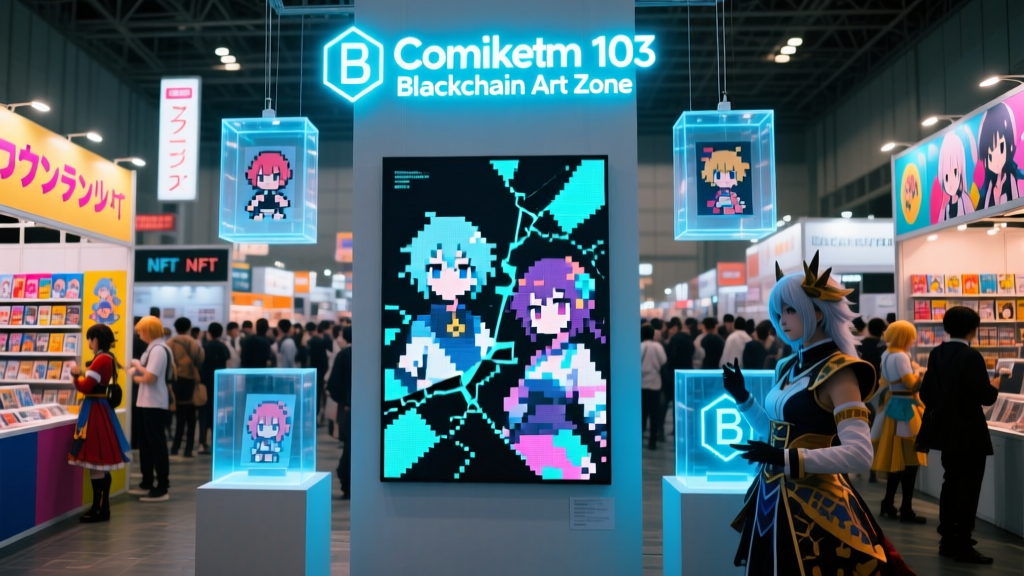
Comiket 103’s Blockchain Pavilion Didn’t Fail Because It Was Too Weird—It Failed Because It Wasn’t Weird *enough*
Let me tell you about the smell of Comiket 103’s Digital Frontier Pavilion on Day One: ozone from overheating laptops, stale matcha latte, and the faint, metallic tang of panic.
I stood in line behind a guy wearing a Neon Genesis Evangelion x Polygon hoodie (yes, really) while his friend scrolled through Etherscan on a cracked iPhone screen, muttering, “Why is my ‘Hedgehog Girl’ NFT still pending? Did I set the gas too low or too high? Is this why she’s not loading in the VR gallery?”
This wasn’t the Comiket I knew—the one where you elbow your way to a table at 7 a.m. for a hand-stapled 16-page doujinshi drawn with a 0.3mm Sakura Micron pen, then get handed a free eraser shaped like a catgirl’s ear. This was Comiket trying to speak fluent Web3—and tripping over its own shoelaces mid-sentence.
The Digital Frontier Pavilion was supposed to be the big leap: a co-branded zone with Polygon and Kadokawa, tucked into Tokyo Big Sight’s West Hall, complete with QR-triggered AR overlays, “mint-to-own” physical-digital bundles, and live NFT drops synced to panel schedules. On paper? Bold. In practice? A masterclass in misaligned incentives, infrastructure friction, and cultural whiplash.
“We Spent 72 Hours Trying to Get Our Wallets to Talk to Each Other”
I spoke with five circles who signed up—including Hoshizora Logic, whose Serial Experiments Lain remix doujin sold out in 90 seconds at Comiket 102, and Tsubasa Works, a veteran circle known for meticulous analog print runs and zero social media presence beyond a single Pixiv album updated every six months.
Hoshizora Logic’s representative—a woman named Yuki who wore glasses taped together with washi tape—told me flatly: “We brought three laptops, two tablets, and a portable Wi-Fi hotspot that kept dropping because the venue’s network couldn’t handle the handshake load between MetaMask, the Polygon ID verifier, and Kadokawa’s legacy CMS. We minted 47 NFTs before lunch. Then the gas spiked from 35 gwei to 182. Our fans started asking if ‘pending’ meant ‘canceled’ or ‘ghosted.’ By 2 p.m., we unplugged everything and handed out printed QR codes that linked to a Google Drive folder.”
Tsubasa Works didn’t even get that far. Their rep, Kenji (who declined photos and asked not to have his surname used), said: “We showed up with our usual 300-copy run—half physical books, half ‘digital bonus’ PDFs on USB sticks. The Pavilion staff told us we *had* to convert the PDFs into ERC-1155 tokens and assign them to individual wallets. We asked, ‘Can we just email the PDF?’ They said no. We asked, ‘Can we print a QR code that downloads it?’ They said no—it had to be ‘on-chain verifiable.’ So we sat there for six hours watching other circles struggle. At 4 p.m., we packed up and went to Hall 5. Sold all 300 copies in 22 minutes. No wallet. No gas. No verification. Just a smile, ¥800, and a sticker.”
That’s the quiet truth no press release mentioned: the analog workflow still works better than the blockchain one—because it’s designed for people, not protocols.
The Numbers Don’t Lie (But They Do Mislead)
Yes—82% of participating circles withdrew after Day One. But that stat gets tossed around like proof of “Web3’s failure in otaku culture.” That’s lazy. The real story isn’t rejection of digital; it’s rejection of *unnecessary complexity masquerading as innovation.*
Let’s compare: Mandarake’s “Scan & Share” system—launched quietly at the same event—wasn’t flashy. No blockchain. No tokenomics. Just a laminated card stapled inside each secondhand doujin, embedded with a NFC chip. Tap your phone, and you get: (1) a high-res scan of the cover and first page, (2) a timestamped provenance log showing which Mandarake store acquired it and when, and (3) an opt-in link to join a Discord channel dedicated to that specific circle’s reprints and fan translations.
I watched a high school girl tap her phone, blink, and say, “Wait… this is the *same copy* my senpai bought in Osaka in 2019? And they scanned it *themselves*?” She bought the book, then spent ten minutes scrolling the Discord, laughing at a fan-made timeline comparing the author’s early character designs to their latest manga.
No wallet setup. No seed phrase. No fear of losing access forever if she forgot her password. Just a tap, a story, and continuity.
What Actually Broke in the Pavilion (Spoiler: It Wasn’t the Tech)
The tech mostly worked—if you were already fluent. Polygon’s testnet integration was smooth. The AR viewer rendered correctly. Even the “dynamic rarity” feature (where NFT traits changed based on real-time Comiket foot traffic data) functioned… technically.
But fluency isn’t the baseline for Comiket. It’s the exception. Circles range from 14-year-olds printing their first BL one-shot on a borrowed printer to 60-year-old veterans who still use WordPad and dial-up-era FTP clients. Comiket’s magic lives in that spectrum—not in gatekeeping.
The Pavilion failed because it assumed adoption would follow infrastructure. It didn’t ask: What does a circle gain by adding this layer? Not “a new revenue stream” (most made more selling physicals in Hall 4). Not “long-term IP control” (they already own their art—no smart contract needed). What it offered instead was *administrative labor*: wallet management, gas estimation, KYC-like identity checks for “creator verification,” and mandatory metadata tagging that felt more like tax filing than fandom.
Contrast that with Mandarake’s system again: zero setup for circles. Mandarake handles scanning, chip encoding, and Discord moderation. The circle gains discoverability, archival visibility, and organic community growth—all without touching a terminal.
So Why Did Kadokawa and Polygon Do This?
Because they confused *infrastructure* with *culture.*
Kadokawa wants to future-proof licensing. Polygon wants enterprise adoption metrics. Neither spent enough time watching how doujin circles actually operate: late-night Slack huddles over LINE calls, shared Google Sheets tracking print costs down to the yen, handmade correction fluid fixes on final proofs. Their systems aren’t broken. They’re *human-scaled.*
Blockchain isn’t wrong for doujin—but it has to serve the circle’s rhythm, not override it. Imagine a system where you drop a physical book at a kiosk, and *it auto-mints a low-cost NFT receipt* tied to that exact copy—no wallet required on your end, just a text message with a redemption link. Or where fan translations are token-gated *only for editors*, not readers—so quality stays high without paywalls.
That’s not sci-fi. That’s design empathy.
The Real Lesson From Day One Isn’t “Blockchain Bad”—It’s “Context Is Everything”
I walked out of the Digital Frontier Pavilion on Day Two and straight into Hall 2, where a circle called Mochi Paradox was selling hand-bound notebooks filled with generative AI sketches—trained on public-domain Meiji-era woodblock prints—printed on washi paper, with each book including a unique, non-NFT “stamp code” you could enter on their site to download the raw prompt library.
No blockchain. No fees. Just craft, curiosity, and a quiet invitation: Want to play too? Here’s how.
That’s the energy Comiket runs on. Not consensus algorithms—but consensus of feeling. Shared jokes in margins. Inside references passed like secret handshakes. The thrill of finding the *exact* doujin that makes you whisper, “They *get it.*”
Web3 can amplify that. But only if it stops shouting over it.
Comiket 103’s Pavilion wasn’t killed by gas fees or wallet fatigue. It was killed by forgetting what Comiket *is*: not a marketplace, not a launchpad, not a tech demo—it’s a gathering. And gatherings don’t scale with throughput. They scale with warmth.
Next time, skip the whitepapers. Bring more matcha. And maybe—just maybe—ask a circle what *they’d* build if someone handed them a budget, a laptop, and zero requirements.
I bet it wouldn’t involve private keys.