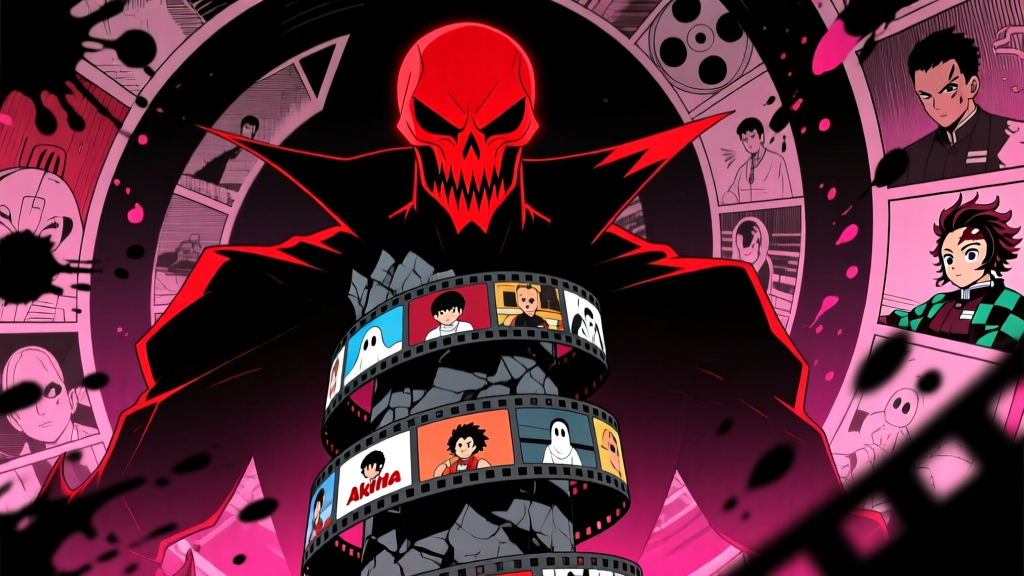
The first time Red Skull appeared on screen, he was barely more than a comic panel with a voice bolted on top. Grantray-Lawrence Animation took Jack Kirby's ink lines, added a thin wobble, and let Paul Soles snarl through the dialogue. It was 1966, the budget was practically zero, and the result looked like a slideshow narrated by someone who had just stubbed his toe. Yet something about that crimson-faced Nazi resonated. Kids watching The Marvel Super Heroes on syndicated television remembered the skull. Not Captain America's shield, not the star on his chest—the skull.
That tells you everything worth knowing about Johann Shmidt as an animated villain. He is the rare antagonist who translates across art styles, voice casts, and production budgets without losing menace. From rotoscoped cels to Japanese anime to Disney+ prestige animation, Red Skull keeps showing up—and he keeps working. This is the full story of how a crimson death's-head became one of the most persistent villain designs in animation history.
The Panel-With-a-Pulse Era: Grantray-Lawrence's 1966 Experiment
1966 – 1967To understand Red Skull's animated debut, you have to understand what Grantray-Lawrence was doing. The Toronto-based studio won the contract to produce Marvel's first animated series by promising something cheap and fast: take existing comic book art, trace it onto cels, add minimal movement, and slap it over a stock soundtrack. They called it "animatics" in production memos. Everyone else called it motion comics—half a century before the term became an industry standard.
The Captain America segments ran as part of The Marvel Super Heroes, a half-hour show that rotated between Captain America, the Hulk, Iron Man, Thor, and Namor. Each seven-minute segment adapted stories from the comics with surprising fidelity—surprising because the animators were literally copying Kirby panels frame by frame. Red Skull appeared in multiple episodes, voiced by Paul Soles, the same actor who handled Spider-Man in the show's Spidey segments.
Soles' Red Skull was theatrical, almost Shakespearean in his contempt. Where later voice actors would lean into guttural menace, Soles gave Shmidt a clipped, aristocratic sneer—the voice of a man who considered himself superior to everyone in the room and had the tactical genius to back it up. The limited animation actually helped: because the character barely moved, every gesture felt calculated. He didn't fidget. He didn't pace. He stood still and issued orders like a field marshal reviewing a firing squad.
The design was pure Kirby—broad-shouldered Nazi officer uniform, peaked cap, and that unmistakable crimson skull face with hollow black eye sockets. Because the animators were tracing directly from the source material, the 1966 Red Skull is essentially a moving Jack Kirby illustration. The colors were flat (limited palette printing for TV cels), the shading minimal, but the silhouette was unmistakable. Even at 12 frames per second with no in-between animation, you knew exactly who this character was.
Paul Soles would later recall in interviews that he recorded his Captain America segments in a Toronto studio with no other actors present—he performed both Cap and Red Skull in isolation, switching voices take by take. The entire Captain America run for the series was reportedly produced for under $150,000 CAD across all 13 episodes.
The Wilderness Years: Cameos, One-Offs, and the 1981 Iceman Incident
1979 – 1999After the Grantray-Lawrence series ended, Red Skull largely disappeared from animation for over a decade. Marvel's licensing strategy in the 1970s and 1980s focused on Spider-Man and the Hulk—characters with higher toy-sale potential. A Nazi supervillain didn't fit neatly into Saturday morning programming guidelines, and networks were skittish about broadcasting swastika-adjacent imagery to children.
Spider-Man and His Amazing Friends (1981–1983)
Red Skull made a notable appearance in Spider-Man and His Amazing Friends, the NBC series that paired Spider-Man with Iceman and Firestar. The episode "The Quest of the Red Skull" gave the villain a rare starring role outside Captain America's own title. The animation quality here was a significant step up from 1966—this was proper limited animation with actual character movement, not traced comic panels. Red Skull's design softened slightly: the skull face remained, but the Nazi regalia was toned down, with the swastika insignia replaced by generic Hydra-style iconography. Network Standards and Practices had made their position clear.
This version leaned into pulp adventure rather than war drama. Red Skull was less a military commander and more a globe-trotting megalomaniac, closer to a Bond villain than a Wehrmacht officer. It worked for the format—Spider-Man and His Amazing Friends was aimed at younger viewers and treated its villains as puzzle-box obstacles rather than ideological threats.
The Long Gap
Between the mid-1980s and the late 1990s, Red Skull appeared in scattered direct-to-video features and syndicated anthology episodes, but never held a recurring role. The 1994 Spider-Man animated series on Fox Kids featured a sprawling multi-season narrative with dozens of Marvel villains, but Red Skull's appearance was limited to a brief flashback sequence set during World War II—barely enough to register. The 1999 series The Avengers: United They Stand ran for only 13 episodes before cancellation, and while Captain America appeared as a team member, Red Skull's presence was minimal at best.
This was the era where Marvel's animation division was in freefall. The company filed for bankruptcy in 1996, and licensing deals were scattered across competing studios with little creative oversight. Red Skull, like many B-list Marvel villains, drifted between productions without a consistent voice, design, or narrative direction.
The Golden Age of Animated Red Skull: Earth's Mightiest Heroes (2010–2012)
2010 – 2012Everything changed with The Avengers: Earth's Mightiest Heroes. Produced by Marvel Animation and Film Roman for Disney XD, this series is still regarded by comic fans as the most faithful animated adaptation of the Marvel Universe ever produced. Showrunner Christopher Yost and head writer Chris Yost (no relation to the X-Men scribe) built the show around long-form serialized storytelling, pulling directly from decades of comic continuity.
Red Skull appeared as one of the primary antagonists in the show's Captain America arcs, voiced by Steve Blum—the same actor who brought Spike Spiegel to life in Cowboy Bebop and later voiced dozens of video game villains. Blum's take on the character was a departure from Soles' aristocratic sneer. His Red Skull was colder, quieter, and more controlled. Where Soles performed Shmidt as a man who enjoyed his own villainy, Blum played him as someone who had moved beyond enjoyment into pure purpose. The rage was still there, but it sat beneath a surface of absolute conviction.
"He doesn't hate Captain America. He pities him. That's what makes him dangerous."The design team, led by character designer Thomas Perkins, reimagined Red Skull for a modern audience while respecting the Kirby foundation. The Nazi officer's coat remained, but the proportions shifted—broader shoulders, a more angular jaw beneath the skull face, and detailed military insignia that drew from both WWII German uniforms and the fictional Hydra aesthetic. The crimson skin was rendered with subtle shading gradients that the 1966 flat-color approach could never achieve. In close-up shots, you could see the texture of the skull face: the way the skin pulled tight over the cheekbones, the depth of the eye sockets, the thin scar-like line where the lips should have been.
The series' two-part episode "The Man in the Ant Hill" and subsequent Captain America flashbacks gave Red Skull a proper origin story in animation for the first time. Viewers saw Johann Shmidt as a calculating Nazi officer who gained the skull visage through a failed super-soldier serum experiment—mirroring the comic book origin established by Stan Lee and Jack Kirby in Captain America #298 (1984) and retroactively fleshed out in later issues.
What made Earth's Mightiest Heroes special was how it treated Red Skull as an ideological threat, not just a physical one. The show's writers understood that the character's power comes from his worldview: a belief that strength justifies domination, that the strong owe nothing to the weak, and that order imposed through terror is superior to democratic freedom. These themes ran through every scene he appeared in, and they resonated with audiences in a way that a simple punch-fight with Captain America never could.
The Disney XD Shared Universe: Avengers Assemble and Beyond (2013–2019)
2013 – 2019When Marvel Animation restructured its television output around a shared continuity across Avengers Assemble, Ultimate Spider-Man, and Hulk and the Agents of S.M.A.S.H., Red Skull was positioned as a cross-series threat. The role was recast with Liam O'Brien, a voice actor whose credits span anime dubbing (Naruto's Gaara), video games (Asura in Asura's Wrath), and Western animation. O'Brien has voiced Red Skull in at least 12 separate productions, making him the most prolific performer to tackle the character.
Avengers Assemble (2013–2019)
In Avengers Assemble, Red Skull appeared as a recurring antagonist starting in Season 1. The show's approach to the character was deliberately different from Earth's Mightiest Heroes. Where that series treated Red Skull with gravitas, Assemble integrated him into a broader villain roster alongside Thanos, Dracula, and the Cabal. He schemed, he allied with other villains, he was defeated and returned—the standard animated villain lifecycle.
But the show did something unexpected in later seasons: it explored Red Skull's relationship with Captain America on a personal level. Episodes touched on the idea that Shmidt and Rogers were mirror images—two products of the same super-soldier program, one embodying everything America aspired to be, the other embodying everything it should never become. O'Brien's voice work sold this dynamic. His Red Skull didn't just want to defeat Captain America; he wanted to convert him, to prove that Rogers' idealism was a mask over the same hunger for control that drove Shmidt himself.
The character design shifted again for Assemble. The show used a sleeker, more stylized art direction across all characters—sharper angles, brighter colors, and a slightly more cartoonish proportion system. Red Skull's design adapted to this house style while maintaining the essential elements: the crimson skull face, the dark military coat, the imposing physicality. In Season 3's "Secret Wars" arc, Red Skull briefly adopted a civilian identity as Dell Rusk (an anagram of "Red Skull" that comic readers first encountered in Invaders Vol. 3), and the animators had fun depicting the character in business attire while keeping subtle visual tells—the way his hands gripped a desk, the slight red tint at his hairline.
Cross-Series Appearances
O'Brien's Red Skull crossed over into Ultimate Spider-Man and Hulk and the Agents of S.M.A.S.H., maintaining consistency across shows that had very different visual styles. Ultimate Spider-Man used a more exaggerated, anime-influenced design language with big expressions and speed lines. Hulk had a chunkier, more muscular aesthetic built around the show's oversized title character. Red Skull's design adapted to each house style while remaining recognizable—proof that the core visual concept is nearly indestructible. The skull face is so iconographically powerful that it reads clearly regardless of art style, line weight, or color palette.
The Japanese Connection: Disk Wars and Future Avengers
2014 – 2018Marvel's partnership with Japanese animation studios produced two series that gave Red Skull a distinctly different visual treatment. Marvel Disk Wars: The Avengers (2014–2015), produced by Toei Animation, reimagined the Marvel roster through a lens heavily influenced by shonen anime and collectible-card game aesthetics. Red Skull appeared as one of the major villains trapped in "DISK" containment devices, and his design was given a sharper, more angular look that fit Toei's house style.
The anime Red Skull had more detailed facial features than his Western counterparts—the skull face was rendered with finer line work, deeper shadow in the eye sockets, and a more pronounced jaw structure. His Nazi officer coat was given a more dramatic silhouette with flowing tails and exaggerated epaulettes. It was Red Skull filtered through the visual grammar of Japanese villain design: taller, thinner, more elegant, with the kind of bishounen-adjacent menace that Toei had perfected across decades of anime production.
Marvel Future Avengers (2017–2018), produced by Madhouse, continued this trend. The episode "Red Skull of Despair" featured the villain clad in nano-machine armor—a modernization that reflected both contemporary Marvel Comics design direction and anime's fondness for mecha-adjacent tech wear. The Madhouse animators brought a cinematic quality to the character's scenes: dramatic camera angles, detailed mechanical animation on the armor, and fluid fight choreography that Western TV budgets rarely matched.
For Japanese audiences unfamiliar with Captain America's WWII history, Red Skull was positioned more as a generic megalomaniacal threat than a specifically Nazi one. The ideological underpinnings were softened, and the character's visual design did more of the storytelling work. The skull face, the dark color palette, the military bearing—these communicated "evil" without requiring knowledge of European fascism. It's proof of the design's versatility that it functions across cultures without losing impact.
What If...? and the Prestige Animation Turn (2021–Present)
2021 – PresentMarvel Studios' What If...? brought Red Skull into the MCU's animated canon with a level of production quality that no previous animated outing could match. The series used a hybrid 2D/3D animation pipeline developed by Blue Spirit and Flying Bark Productions, with cel-shaded CGI characters rendered over painterly backgrounds that evoked comic book splash pages.
In the premiere episode, "What If... Captain Carter Were the First Avenger?", Red Skull appeared as the primary antagonist in an alternate WWII timeline where Peggy Carter received the super-soldier serum instead of Steve Rogers. The character was voiced by Ross Marquand, who had previously taken over the live-action role from Hugo Weaving in Avengers: Infinity War (2018) and Avengers: Endgame (2019).
The What If...? design stayed closest to Hugo Weaving's live-action portrayal: a Nazi officer whose face was transformed into a permanent crimson skull by the imperfect super-soldier serum. But the animated medium allowed for more expressive performances than live-action prosthetics could achieve. The skull face could contort, sneer, and grimace with a range that practical makeup couldn't replicate. During the episode's climax, when Captain Carter confronted Red Skull aboard the Valkyrie bomber, the animators pushed the character's expressions to near-operatic levels—wide-eyed mania giving way to terror as the Tesseract's power consumed him.
This version also benefited from the MCU's established continuity. Audiences already knew Red Skull from the live-action films, and What If...? leveraged that familiarity to take narrative shortcuts. The show didn't need to explain who Johann Shmidt was or why he mattered—the audience brought that context with them. This freed the writers to explore a thematic question that the live-action films never addressed: what would have happened if Red Skull faced a different kind of Captain America?
Red Skull's Animated Appearances: A Complete Reference Table
| Series / Production | Year | Voice Actor | Studio | Notes |
|---|---|---|---|---|
| The Marvel Super Heroes | 1966 | Paul Soles | Grantray-Lawrence | Motion-comic style; traced from Kirby panels; 13 Cap segments |
| Spider-Man and His Amazing Friends | 1981–83 | Various | Marvel Productions | Episode "The Quest of the Red Skull"; toned-down Nazi imagery |
| Spider-Man (Fox Kids) | 1994–98 | Various | Marvel Films Animation | Brief WWII flashback appearance only |
| The Avengers: United They Stand | 1999–00 | Various | Marvel Studios / Saban | Minimal screen time; series cancelled after 13 episodes |
| Avengers: Earth's Mightiest Heroes | 2010–12 | Steve Blum | Marvel Animation / Film Roman | Primary Cap antagonist; proper animated origin story |
| Avengers Assemble | 2013–19 | Liam O'Brien | Marvel Animation | Recurring villain; Dell Rusk civilian identity arc |
| Ultimate Spider-Man | 2012–17 | Liam O'Brien | Marvel Animation | Crossover appearances in shared-universe episodes |
| Hulk and the Agents of S.M.A.S.H. | 2013–14 | Liam O'Brien | Marvel Animation | Adapted to chunky art style; cross-series continuity |
| Marvel Disk Wars: The Avengers | 2014–15 | Japanese VA cast | Toei Animation | Anime redesign; angular bishounen-influenced aesthetic |
| Marvel Future Avengers | 2017–18 | Japanese VA cast | Madhouse | Nano-machine armor design; "Red Skull of Despair" episode |
| What If...? (Season 1) | 2021 | Ross Marquand | Marvel Studios / Blue Spirit | MCU continuity; cel-shaded CGI; Captain Carter timeline |
Translating the Skull: Why the Design Survives Every Art Style
Here's something that's easy to overlook: Red Skull's design works in animation for the same reason it works on a comic book cover. The silhouette is instantly readable. A crimson skull face on a black-coated figure communicates everything a viewer needs to know in a single frame. There's no ambiguity, no subtlety to preserve, no fine detail that gets lost when you shrink the character down or change the line weight.
Compare this to a villain like Baron Zemo, whose mask design requires specific color values and proportion ratios to read correctly. Or even Loki, whose horned helmet and green-and-gold palette can look either regal or ridiculous depending on the animator's skill. Red Skull's design is bulletproof because it's fundamentally simple: a human body with a death's-head for a face. Every adaptation, from Grantray-Lawrence's traced panels to Madhouse's fluid anime keyframes, has been able to capture this core concept without compromise.
The design also benefits from its built-in contrast. Crimson red against dark backgrounds. A skull face on a body dressed in severe military clothing. The visual tension between the organic (the face) and the structured (the uniform) creates a sense of wrongness that registers even at thumbnail size. Art directors across five decades have understood this and have built the character's animated color palettes around maximizing that contrast—dark shadow backgrounds, muted grey-and-black costuming, and that single explosive note of red.
The Voice Problem and How Each Actor Solved It
Every voice actor who has played Red Skull has faced the same challenge: how do you make a Nazi sound threatening to an audience that increasingly views Nazis as historical absurdity rather than genuine menace? Each performer found a different answer:
- Paul Soles (1966) leaned into theatricality—his Shmidt was a stage villain, almost camp, but delivered with enough conviction to land. The limited animation meant his voice carried 90% of the character's presence.
- Steve Blum (2010–2012) went quiet and controlled. His Red Skull rarely raised his voice; the menace came from restraint. When he did get loud—as in the confrontation scenes with Captain America—the shift was jarring precisely because it broke the pattern.
- Liam O'Brien (2013–present) found a middle path: a Red Skull who was articulate, intelligent, and genuinely persuasive. His version could hold a philosophical conversation and almost make you agree with him before the fascism slipped through. This made him effective across the multiple series he appeared in, from the action-heavy Avengers Assemble to the more comedic Ultimate Spider-Man.
- Ross Marquand (2021) brought live-action physicality to animation. Having played the role in motion-capture-adjacent MCU films, he understood how the character moved and breathed, and he carried that embodied knowledge into the voice booth for What If...?
What the Comics Gave Animation (and What Animation Gave Back)
Red Skull's journey between comics and animation has always been bidirectional. The 1966 cartoon established the character's visual template for a generation of viewers who had never read a comic book. When Stan Lee and Jack Kirby revived Red Skull in the Silver Age of comics (Captain America #101, 1968), they were working with an audience that already had an animated image of the character in their heads. The comic book version evolved accordingly—becoming more theatrical, more expressive, more suited to the kind of dramatic poses that translated well to screen.
In the other direction, Avengers: Earth's Mightiest Heroes directly adapted the Ed Brubaker and Steve Epting run on Captain America (2005–2011), pulling visual references from Epting's detailed, realistic art style. The animated Red Skull's facial structure, uniform details, and body language in that series owe more to Epting's panels than to Kirby's original designs. And when Rick Remender's Captain America run (2012–2014) introduced the Iron Skull—an armored variant of the character—the design showed up almost immediately in Marvel Future Avengers's nano-machine armor episode.
This feedback loop between print and screen is one reason Red Skull remains relevant as an animated villain. He doesn't stagnate. Every new comic book creative team reinterprets him, and every new animated series pulls from the latest comic iteration, ensuring that the character evolves even as his core visual identity remains constant.
Why Red Skull Endures When Other Villains Fade
Marvel's villain roster is enormous. Dozens of characters have appeared in one or two animated series and then vanished—forgotten because their designs didn't translate, their motivations were too convoluted, or they simply didn't generate audience interest. Red Skull has appeared in animated productions across every decade since the 1960s. That's not an accident.
Part of it is the simplicity of his concept. A Nazi who hates Captain America. You don't need a paragraph of backstory to understand the conflict. Part of it is the design's visual durability, as discussed above. But the biggest factor may be the character's thematic relevance. As long as authoritarianism, fascism, and supremacist ideology remain real-world concerns, Red Skull remains a useful narrative device. He is the villain who represents the worst impulses of organized power—the belief that some people deserve to rule and others deserve to kneel.
Animation gives writers and artists a freedom that live-action can't always provide. You can push Red Skull's expressions to grotesque extremes. You can place him in impossible scenarios—commanding armies of robots, wielding cosmic power, facing off against teams of heroes who can fly and shoot energy beams. You can explore his psychology through visual metaphor in ways that a $200 million live-action film might consider too risky for a global audience. The animated Red Skull is, in many ways, the purest version of the character: unbound by practical effects budgets, actor availability, or ratings board concerns about Nazi imagery.
The best villain designs are the ones that work as a shadow on a wall. Red Skull's silhouette has been casting that shadow for nearly sixty years of animation—and it hasn't softened yet.Frequently Asked Questions
Who was the first voice actor to play Red Skull in animation?
Paul Soles, a Canadian voice actor based in Toronto, voiced Red Skull in The Marvel Super Heroes (1966), produced by Grantray-Lawrence Animation. Soles also voiced Spider-Man in the same series, recording both roles in solo sessions with no other actors present. He recorded the entire Captain America run in Toronto for a reported budget under $150,000 CAD.
Which animated series gave Red Skull the most screen time?
Avengers Assemble (2013–2019) featured Red Skull as a recurring antagonist across multiple seasons, with Liam O'Brien providing the voice. The series explored his relationship with Captain America in depth and even adapted the Dell Rusk civilian identity storyline from the comics. Across the shared-universe Disney XD shows (Assemble, Ultimate Spider-Man, Hulk and the Agents of S.M.A.S.H.), O'Brien voiced the character in well over a dozen episodes.
How did Red Skull's design change in Japanese anime?
Toei Animation's Marvel Disk Wars: The Avengers (2014–2015) gave Red Skull a sharper, more angular redesign influenced by anime villain aesthetics—taller proportions, finer linework on the skull face, and a more dramatic coat silhouette. Madhouse's Marvel Future Avengers (2017–2018) further modernized the character with nano-machine armor. Both Japanese productions softened the Nazi-specific iconography, positioning Red Skull as a more generalized megalomaniacal threat for audiences unfamiliar with Captain America's WWII origins.
Why was Red Skull rarely shown in 1980s and 1990s cartoons?
Network Standards and Practices departments were reluctant to broadcast Nazi-associated imagery during children's programming blocks. Marvel's licensing strategy also prioritized Spider-Man and the Hulk for toy-driven animated series. The character's fascist ideology made him difficult to adapt for younger audiences without sanitizing him into a generic villain, which reduced what made him distinctive.
Does Red Skull appear in What If...? on Disney+?
Yes. Red Skull appears in the first episode of What If...? (Season 1, 2021), "What If... Captain Carter Were the First Avenger?", voiced by Ross Marquand. Marquand had previously played the character in the live-action MCU films Avengers: Infinity War (2018) and Avengers: Endgame (2019). The animated version used a hybrid cel-shaded CGI style that allowed for more expressive facial animation than the live-action prosthetic makeup.
What makes Red Skull's design so effective across different animation styles?
The core design—a crimson skull face on a black-uniformed figure—relies on silhouette and contrast rather than fine detail. This means it reads clearly whether rendered in Grantray-Lawrence's flat-color traced panels, Disney XD's stylized digital animation, or Madhouse's detailed anime linework. The visual tension between the organic skull face and the structured military uniform creates a sense of wrongness that communicates "villain" at any scale or resolution.
Sources: The Marvel Super Heroes production notes, Grantray-Lawrence Animation Archives (referenced via Tom Brevoort's 2021 production history post); Behind the Voice Actors (BTVA) character credit database, accessed 2026; The Avengers: Earth's Mightiest Heroes series bible and Christopher Yost interviews (Animation Magazine, 2010–2012); Marvel Studios What If...? production notes (Disney+ press materials, August 2021); Ed Brubaker, Captain America Vol. 5 (Marvel Comics, 2005–2011) visual reference materials.