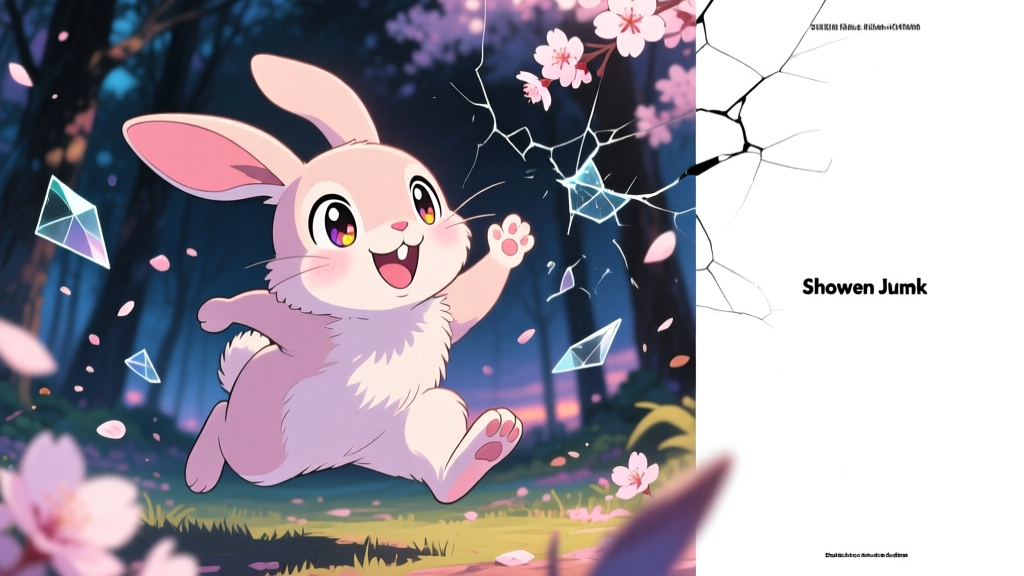
You've seen him before, even if you don't remember the name. A small, powder-pink rabbit with oversized yellow buckteeth, rosy cheeks, and a perpetual expression of wide-eyed innocence. He hops onto screen, waves at the camera, and within ninety seconds he's been pulped by a lawnmower or impaled on a flagpole. The audience laughs. The rabbit dies again. And somehow, you want to watch it happen one more time.
That rabbit is Cuddles, and he's been dying on screen since 1999. As the unofficial mascot of Mondo Media's Happy Tree Friends, Cuddles occupies a strange corner of internet culture: too cute to belong in a gore cartoon, too mangled to belong on a lunchbox. Yet he appears on both. The contradiction is the whole point, and it's worth examining why a character this ridiculous has stuck around for over two decades.
A Rabbit Built to Be Destroyed
The design brief for Cuddles, if you could call it that, was simple: make something so aggressively adorable that watching it get torn apart becomes genuinely funny rather than merely disturbing. Kenn Navarro and Aubrey Ankrum, who co-created Happy Tree Friends for Mondo Media's online platform, leaned hard into the saccharine end of the spectrum. Cuddles is rendered in soft pastel pink — hex #FFB6C1, or something close to it — with the kind of rounded, blob-like body shape that reads as "plush toy" at a glance. His ears are oversized relative to his head. His feet have floppy white bunny slippers baked right into his design, which is the kind of detail that makes sense only in a universe where animals wear their footwear as skin.
His eyes are the real trick. Two enormous black dots, positioned wide on his face, that somehow convey a permanent state of cheerful vacancy. There are no pupils to speak of, no squinting, no expression of thought. Cuddles doesn't think. Cuddles hops forward with the confidence of a creature that has never once anticipated consequences, and the show's entire comedic engine runs on that gap between expectation and outcome.
Warren Graff, the voice actor behind Cuddles, delivers what might be the most minimal vocal performance in animation history. Cuddles doesn't speak — he emits high-pitched giggles, cheerful squeaks, and the occasional startled yelp. In a 2004 interview with Animation World Network, Graff described the recording sessions as "basically me making bunny noises into a microphone while watching storyboard animatics of the character getting dismembered." That's the job. That's the whole job. And it works because the voice performance never breaks the illusion that Cuddles is blissfully unaware of what's about to happen to him.
The Mascot Problem: Why the Cutest Character Dies the Most
Here's an uncomfortable production reality: the mascot always gets the worst material. In a show built on the premise that cute characters suffer spectacularly violent deaths, the cutest character becomes the primary vehicle for the show's signature gag. Cuddles has appeared in over 80 episodes across the series' run — more than any other character — and has died in nearly every single one of them. The survival rate hovers somewhere around 15%, and even those "survivals" usually involve losing a limb or suffering a severe maiming that the next episode quietly resets.
The writers understood something about comedic escalation. The first time you see a pink bunny get sliced in half by a ceiling fan, the shock carries the joke. By the fifth time, the joke has shifted: you're no longer laughing at the violence, you're laughing at the creativity of the violence. How many ways can you kill a cartoon rabbit? The show's answer, across its web series run (1999–2006), its television adaptation on G4 and MTV (2006–2016), and various specials, was: a staggering number. Fans on the Happy Tree Friends Wiki have cataloged over 60 distinct death scenarios for Cuddles alone.
"Cuddles is the anchor. Every episode needs someone the audience instinctively wants to protect, and then we take that away. That tension — between the viewer's sympathy and the character's obliviousness — is where the comedy lives."
— Kenn Navarro, co-creator, paraphrased from a 2006 Mondo Media panel at San Diego Comic-Con
The mascot role extends beyond episode count. Cuddles appears in the show's opening title sequence, waving from behind the Happy Tree Friends logo. He's featured on the official website's splash page. When Mondo Media licensed merchandise in the early 2000s — and there was a surprising amount of it — Cuddles dominated the product lineup. He was the character you saw first, the character you remembered, and the character whose death you anticipated most.
Fifteen Episodes That Define the Character
Trying to pick definitive Cuddles episodes from a catalogue this large is a losing game, but certain installments have become fan touchstones. These are the ones people link to, the ones that show up in "best of" compilations, the ones where the death is inventive enough to override the desensitization that sets in around episode twenty.
"Spin Fun Knowin' Ya" (Season 1, Episode 1)
The episode that started it all for television audiences. Cuddles, along with Toothy and Lumpy, rides a merry-go-round that accelerates beyond safe operating speed. The centrifugal force rids Cuddles of his grip, launching him into a metal support beam. It's notable primarily as an introduction: here is a pink rabbit, here is a merry-go-round, here is what this show does to pink rabbits on merry-go-rounds. The death is almost tame by later standards, but the tonal contract between show and viewer gets established in those first ninety seconds.
"House Warming" (Season 1, Episode 5)
One of the earlier episodes to demonstrate that the writers were willing to extend the suffering. Cuddles visits Handy's newly built treehouse, and a series of construction-related mishaps turns the visit into an extended demolition sequence. The episode runs nearly four minutes — long by web-series standards at the time — and uses the extra runtime to build genuine anticipation. You know something terrible will happen. The question is only what, and the answer involves a nail gun, a loose board, and approximately thirty feet of vertical drop.
"Class Act" (Season 2, Episode 4)
A holiday-themed episode where Cuddles participates in a school play. The setup is deliberately mundane: a rabbit in a school talent show, complete with tiny costume and stage fright. The escalation involves a prop malfunction that turns a theatrical performance into something resembling a woodchipper demonstration. This episode is frequently cited on fan forums as a top-five Cuddles moment, largely because the school-play framing amplifies the contrast between setting and outcome.
"Keepin' it Reel" (Season 2, Episode 7)
Cuddles goes to the movies. The death here is secondary to the setup, which is a loving parody of theater etiquette — talking on phones, crunching popcorn, blocking the screen. The gore, when it arrives, involves a film reel and a projector mechanism in a way that feels almost mechanically plausible, which makes it worse. The Happy Tree Friends Wiki rates this death as a 4 out of 5 on the "Gore Scale," and community comment threads from 2003 still contain debates about whether the physics actually work.
"YouTube Series Premiere: 'You're Kraken Me Up'" (2016)
When Mondo revived the series for YouTube in 2016, Cuddles was front and center. The revival episodes featured updated animation — smoother lines, more saturated colors, slightly more fluid motion — but the core formula remained intact. Cuddles encounters a giant squid, and the resulting sequence borrows from kaiju-film framing: low-angle shots, dramatic scale comparisons, and a death that involves being squeezed like a stress ball. The episode accumulated over 12 million views within its first year, demonstrating that the appetite for cartoon-rabbit violence had not diminished during the show's hiatus.
The Cute-Horror Economy
Cuddles doesn't exist in isolation. He sits at the center of a specific aesthetic formula that Happy Tree Friends essentially pioneered for the web-animation era: the systematic juxtaposition of children's-media visual language with extreme cartoon violence. The show borrows its color palette, character proportions, and background design from the world of preschool television. Soft gradients, simple shapes, bright primary and secondary colors, gentle ambient music. Everything about the production design signals "safe for children," and then a character gets their spine removed through their mouth.
This formula predated the mainstream "cute horror" trend by several years. Before Aggretsuko (2018) paired a red panda with death metal screaming, before Happy Tree Friends, there wasn't a prominent animated property that made this specific contrast its entire identity. The show proved there was an audience — a large one — that found the dissonance between visual sweetness and narrative cruelty inherently funny.
The numbers back this up. By 2005, Happy Tree Friends episodes were pulling in an estimated 15 million downloads per month across various platforms, according to a Mondo Media press release from that year. The show's YouTube channel, launched in 2006, eventually surpassed 3 million subscribers and 2 billion total views. Cuddles, as the most recognizable character, functioned as the primary draw — the thumbnail face, the search result, the algorithm recommendation that pulled new viewers into the ecosystem.
| Metric | Value | Context |
|---|---|---|
| Total episode appearances | 80+ | More than any other HTF character |
| Approximate death count | 60+ | Catalogued by fan wiki contributors |
| Survival rate per appearance | ~15% | Includes partial survivals (maiming) |
| First web episode debut | 1999 | "Spin Fun Knowin' Ya" (web version) |
| Television series premiere | 2006 | G4 network, "Happy Tree Friends" TV series |
| Merchandise product categories | 12+ | Plush, apparel, stickers, figures, stationery |
| YouTube revival premiere | 2016 | New episodes produced for Mondo's YouTube channel |
| Voice actor | Warren Graff | Consistent across all media since 1999 |
Merchandise: The Rabbit You Can Own (Intact)
There's a peculiar irony in selling plush toys of a character whose defining trait is being physically destroyed. Mondo Media leaned into it anyway, and the merchandise line became one of the more successful ancillary revenue streams for a web animation property in the early 2000s. At Hot Topic stores across North America, Cuddles plush toys sat alongside Invader Zim and South Park merchandise, targeting the exact demographic overlap of teenagers who found cartoon violence hilarious.
The product range was broader than most people realize. Beyond the standard 8-inch and 12-inch plush toys, Mondo licensed Cuddles for vinyl figures (produced by Kidrobot in limited editions that now resell for $80–$150 on collector markets), apparel (t-shirts featuring Cuddles in various states of disassembly), stickers, keychains, notebooks, and even a short-lived line of phone charms popular in the Japanese and Korean markets where the show had a surprisingly strong following.
The most commercially successful item was arguably the "mystery pack" series of 2-inch vinyl figures, sold in blind boxes at retailers like Hot Topic and Spencer's. Each pack contained one of twelve possible Cuddles variants — some depicting him intact and cheerful, others showing him mid-demise with removable limbs or detachable head pieces. The "destroyed" variants were rarer by design, creating a collector's incentive structure that Mondo Media borrowed directly from the Japanese gashapon market. According to a 2007 licensing report covered by License! Global Magazine, Happy Tree Friends merchandise generated approximately $10 million in retail revenue at its peak, with Cuddles products accounting for roughly 40% of total sales.
Japanese market penetration deserves specific mention. Happy Tree Friends aired on MTV Japan and gained cult status in the mid-2000s, and Cuddles became a recognizable character in Harajuku fashion-adjacent merchandise shops. The kawaii-guro (cute-grotesque) aesthetic already had roots in Japanese subculture — artists like Takato Yamamoto and the broader ero-guro movement had been exploring similar territory for decades — and Cuddles slotted neatly into that existing cultural appetite. Japanese-exclusive merchandise, including a line of Cuddles-themed stationery and a collaboration with the fashion brand h.NAOTO, never made it to Western markets.
The Fan Community and the Rabbit's Afterlife
Cuddles has outlived the cultural moment that produced him. The original web series ended its first run in 2006. The television adaptation ran until roughly 2016. Mondo Media's output has slowed considerably since its peak, and the animation landscape has shifted toward different platforms, different formats, different sensibilities. Yet Cuddles persists — in fan art, in meme formats, in YouTube recommendation algorithms that keep serving old episodes to new audiences.
The fan community around Happy Tree Friends has a particular texture that reflects the show's demographic sweet spot. The core audience came of age in the early-to-mid 2000s, meaning they're now in their late twenties to late thirties. Fan art on platforms like DeviantArt, Tumblr, and more recently Twitter/X and Pixiv tends toward two poles: sincere attempts to render Cuddles as genuinely cute (stripping away the gore, drawing him in soft lighting with flowers) and increasingly elaborate fan-created death scenarios that outdo the official material in creativity, if not always in taste.
The fan wiki — hosted on Fandom and maintained by a small core of dedicated editors — has documented every death, every appearance, every piece of merchandise with the kind of obsessive granularity usually reserved for Star Trek or Warhammer. The Cuddles page alone runs to several thousand words and includes a death gallery with frame-by-frame screenshots, categorized by method (blunt force, impalement, dismemberment, crushing, burning, drowning, and a catch-all "other" that includes being launched into orbit and being erased from existence by a supernatural entity).
The joke isn't that a cute rabbit dies. The joke is that a cute rabbit dies in a way you didn't see coming — and then hops back in the next episode like nothing happened.Why Cuddles Works When Other Gore Cartoons Don't
There are plenty of animated properties that pair cute characters with violence. Itchy & Scratchy existed as a Simpsons meta-joke decades before Happy Tree Friends. South Park has killed Kenny over a hundred times. Don't Hug Me I'm Scared built an entire franchise on the puppet-horror formula. So what makes Cuddles specifically endure?
Part of it is simplicity. Cuddles has no backstory, no personality beyond cheerfulness, no ongoing narrative arc. He is a blank canvas onto which the viewer projects whatever emotional response the death sequence triggers. You don't mourn Cuddles because there's nothing to mourn — he resets every episode, arriving with the same dopey grin and floppy ears. This is a feature, not a limitation. It means each death is a self-contained gag with no accumulated emotional weight, which keeps the show from ever tipping into genuine darkness.
The other factor is craft. The death sequences in Happy Tree Friends, at their best, are genuine pieces of physical-comedy choreography. The animators — primarily Kenn Navarro in the early seasons, later expanded to a team — treated each death like a Rube Goldberg machine. Object A triggers Action B, which sets off Chain Reaction C, which results in Cuddles being folded into a paper airplane and launched through a plate glass window. The sequence is planned, animated, and timed with the same precision you'd find in a Tom and Jerry short or a Jackie Chan fight scene. The violence is the punchline, but the setup does the real work.
Compare this to something like Happy Tree Friends' imitators — and there were many in the mid-2000s, from Flash-animated web series to mobile games that copied the formula wholesale. Most of them failed because they treated the gore as the product rather than the punchline. Cuddles getting decapitated by a rogue frisbee is funny because of the three minutes of escalating mundane chaos that preceded it. Without the setup, you just have a decapitated cartoon rabbit, which isn't comedy — it's just weird clip art.
Character Relationships: The Rabbit in Context
While Cuddles functions primarily as a solo victim, his interactions with other characters add texture to the series' dynamics. His most consistent pairing is with Flaky, the porcupine whose defining trait is extreme anxiety. In episodes where the two appear together, Flaky's nervousness serves as an audience surrogate — she can sense the danger that Cuddles obliviously walks into, and her attempts to warn him (or flee) create a comedic tension that his solo appearances lack.
His dynamic with Lumpy, the dim-witted moose whose clumsiness causes roughly half the show's disasters, positions Cuddles as the collateral damage in someone else's story. Lumpy doesn't intend to kill Cuddles. Lumpy doesn't intend to do anything. He simply exists in a state of catastrophic ineptitude, and Cuddles — cheerful, trusting, too stupid to run away — ends up in the blast radius every time.
The Toothy pairing is the show's closest approximation to a friendship. Both characters share the same wide-eyed, childlike energy, and episodes featuring them together often begin with the two engaged in innocent activities — playing catch, building a snowman, visiting a carnival — before the environment turns hostile. The comedic formula here relies on dramatic irony: the audience knows that a carnival in Happy Tree Friends is a deathtrap, and watching two characters enjoy it with genuine enthusiasm creates the specific brand of dread that the show perfected.
Legacy and the Broader Animation Landscape
It's difficult to draw a straight line from Happy Tree Friends to any specific contemporary show, but the series' influence on the tone and distribution model of adult animation is underappreciated. The show proved, in 1999, that short-form animated content could build a massive audience through web distribution — years before YouTube existed as a platform. Mondo Media's direct-to-consumer approach, offering episodes for download on their website, anticipated the creator-economy model that now defines independent animation on platforms like Newgrounds, YouTube, and Patreon.
The cute-horror formula that Cuddles embodies has surfaced repeatedly in the decades since. Aggretsuko (Sanrio/Netflix, 2018) channels a similar energy, pairing kawaii character design with existential rage. The Amazing Digital Circus (Gooseworx/GLITCH, 2023) uses bright, child-friendly aesthetics to explore psychological horror, and it pulled in over 100 million views for its pilot episode. Even mainstream properties like The Owl House and Amphibia have incorporated moments of genuine horror within their cute-adjacent visual frameworks, and while those shows have deeper narrative ambitions, the tonal whiplash they exploit is the same one Cuddles pioneered on a Flash-animated website twenty-five years ago.
The Frequently Asked, Occasionally Answered
Is Cuddles a boy or a girl?
Cuddles is male. The character has been voiced by Warren Graff since the series' inception, and all official character materials from Mondo Media refer to Cuddles with male pronouns. The confusion sometimes arises because the character design — pink coloring, long eyelashes in some renderings, general softness — reads as gender-ambiguous to casual viewers.
Has Cuddles ever survived an entire episode without dying or being injured?
Yes, but rarely. Across the show's full catalogue, Cuddles survives without significant injury in roughly 10–15% of his appearances. These episodes typically cast him as a background character or a witness to someone else's catastrophe rather than the primary victim. The episode "See You Later, Elevator" (Season 2) is one example where Cuddles appears but remains largely intact by the end.
Why is Cuddles pink?
The color choice was deliberate: pastel pink registers as the most stereotypically "innocent" and "child-friendly" color in Western visual culture. Making the primary victim pink maximizes the contrast between the character's visual identity and the violence inflicted upon them. In practical production terms, pink also provided strong visual contrast against the show's predominantly green-and-blue forest backgrounds.
Is Happy Tree Friends appropriate for children?
No. Despite the child-friendly character designs and color palette, the show is explicitly intended for adult audiences. The graphic violence, while cartoonish, is not suitable for young children. Mondo Media has included content warnings on their website and DVD releases. The show's TV-MA rating on G4 and MTV reflected this, though the visual style has historically confused parents into thinking it was children's programming.
Where can I watch Cuddles episodes today?
Mondo Media's official YouTube channel hosts the majority of Happy Tree Friends episodes, including both the original web series and the television adaptation. Select episodes and compilations are also available on Mondo's website. Physical DVD collections exist but are out of print — secondhand copies of the "First Blood" and "Second Serving" DVD sets typically sell for $15–$30 on resale markets.
Still Hopping
Twenty-seven years is a long time for a cartoon rabbit to keep dying. The internet that Cuddles debuted on — a place of Flash animations, personal websites, and downloadable QuickTime clips — doesn't exist anymore. The animation industry has been reshaped several times over. Trends that Happy Tree Friends helped start have been absorbed, remixed, and moved past. And yet the pink rabbit persists: in YouTube autoplay queues, in fan-art galleries, in the occasional TikTok clip that introduces him to a generation that wasn't alive when he first got fed into a woodchipper.
Maybe that's the real trick. Not the gore, not the contrast, not the Rube Goldberg death machines — though all of those are part of it. The real trick is that Cuddles is simple. He doesn't demand emotional investment. He doesn't require you to remember last episode's continuity. He shows up, he smiles, something horrific happens, and he's back next week with the same smile and the same floppy ears, ready to do it all again. In a media landscape increasingly defined by serialized narratives, cinematic universes, and lore-heavy worldbuilding, there's something almost radical about a character whose only job is to be cheerful and indestructible — right up until the moment he isn't.