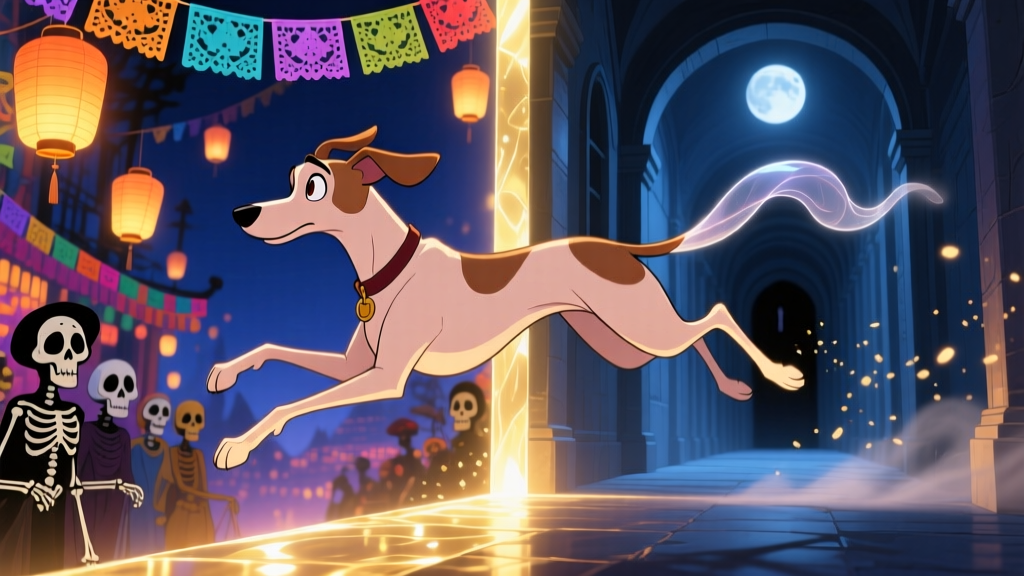
Dante from Coco: The Hairless Dog Who Guided Souls Across Two Worlds
There's a scene early in Coco where a skinny, mostly-hairless dog knocks over a bucket of paint and laps it up like it's the finest pozole in Santa Cecilia. That single moment tells you everything you need to know about Dante — he's reckless, ridiculous, and completely incapable of staying out of trouble. Yet by the film's final act, this same bumbling stray has sprouted glowing wings and become the spiritual compass that saves a boy's life. That arc — from comic-relief nuisance to mythic spirit guide — is the hidden backbone of Pixar's most culturally layered film.
If you've watched Coco even once, Dante is the character who lodges in your memory. Not because he has the best songs (that honor goes to Hector and Ernesto de la Cruz), and not because he drives the plot in the way Miguel or Mama Coco does. Dante sticks with you because he embodies something the film understands at a deep, almost ancestral level: that the creatures we dismiss as ordinary often carry the oldest magic of all.
A Breed Older Than the Pyramids (Almost)
To understand why Pixar chose a Xoloitzcuintli — not a Chihuahua, not a street mutt, not a Dalmatian — you have to go back roughly 3,500 years. The Xolo, as it's commonly shortened, is one of the oldest known dog breeds on the planet. Archaeologists have uncovered ceramic figurines of hairless dogs in Colima tombs dating to 300 BCE, and clay effigies from the broader Mesoamerican corridor stretch even further back. These aren't stylized cartoon dogs. They are meticulous, anatomically accurate representations of an animal that lived alongside humans in pre-Columbian Mexico long before Spanish boots touched the continent.
The breed's full name, Xoloitzcuintli, is a Nahuatl compound. Xolotl refers to the Aztec deity of fire, lightning, and transformation — the dog-headed twin brother of Quetzalcoatl, the feathered serpent god. Itzcuintli simply means "dog." Put them together and you get "Dog of Xolotl," which in Aztec cosmology was no ordinary pet. According to the Florentine Codex, compiled by Bernardino de Sahagún in the 1570s, Xolos were believed to be created by Xolotl himself from a sliver of the Bone of Life, the same mythical material used to fashion humanity. Their purpose was specific and sacred: to guard living humans in this world and then to shepherd their souls through the nine treacherous levels of Mictlan, the Aztec underworld, a journey said to take four years.
"The Xolo was not a symbol of death in Aztec culture — it was a companion through death. The distinction matters enormously, and it's the exact distinction Coco preserves." — National Museum of the American Indian, "Mexico's Legendary Xoloitzcuintli" (2021)
By the mid-twentieth century, the breed had nearly vanished. A 1956 survey by the Federación Canófila Mexicana counted fewer than forty registered Xolos in the entire country. The breed's survival owes a great deal to Norman Pelham Wright, a British diplomat stationed in Mexico who spent decades tracking down surviving specimens in remote villages and lobbying for formal recognition. The Fédération Cynologique Internationale granted full breed recognition in 1965, and the American Kennel Club added the Xolo to its Foundation Stock Service in 2009, with full Miscellaneous Class status arriving in 2012. Today, an estimated 30,000 Xolos exist worldwide — still rare, but no longer on the knife's edge of extinction.
Why "Dante"? The Name Is Not an Accident
Let's address the literary Easter egg that most viewers catch on their second or third watch. Dante the dog shares his name with Dante Alighieri, the fourteenth-century Florentine poet who wrote the Divine Comedy — an epic poem in which the narrator descends through the circles of Hell, climbs the terraces of Purgatory, and ultimately ascends to Paradise, guided at every turn by the Roman poet Virgil. The parallel is deliberate: both Dantes journey into a realm of the dead, and both serve as guides (or in the dog's case, a very enthusiastic and not-always-competent guide) for a living soul navigating an afterlife that operates by unfamiliar rules.
Pixar's creative team, led by director Lee Unkrich and co-director Adrian Molina, confirmed the reference in the film's official companion book, The Art of Coco (Chronicle Books, 2017). The name was chosen early in development as a shorthand for the character's narrative function: a creature who crosses freely between the land of the living and the Land of the Dead, and who — despite his chaotic energy — ultimately proves to be the most reliable ally Miguel has. The fact that Dante Alighieri's guide was named Virgil, and Miguel's guide is named Dante, creates a neat inversion: in Pixar's version, the guide is the Dante figure, while Miguel occupies the role of the pilgrim.
It also doesn't hurt that "Dante" is fun to say, and that a hairless dog sprinting across a bridge of marigold petals while trailing a tongue three sizes too big for his skull is inherently the kind of image that sticks in your brain.
From Paint-Eating Menace to Alebrije: Dante's Transformation
Dante's character arc in Coco follows a specific, almost musical structure. In the film's first act — set entirely in the living world of Santa Cecilia — he is pure physical comedy. He tangles with a chicken. He eats things he shouldn't. His tongue flops out at inopportune moments. Animator Nickolas Rosario, who supervised Dante's movement cycle, has said in interviews that the team studied real Xolos and noticed their tongues are proportionally longer than most breeds, with no lips to contain them. That anatomical quirk became Dante's signature visual gag: his tongue is essentially a character of its own, acting independently and getting the dog into constant trouble.
The pivotal shift happens when Miguel crosses the marigold bridge into the Land of the Dead. Dante, having "died" (the paint incident, as confirmed by the film's production team), is already there — but he's changed. His body has developed luminous, swirling patterns in marigold orange, magenta, and teal. He has grown wings. His eyes glow. He is now an alebrije, a fantastical spirit creature drawn from the Oaxacan folk-art tradition.
What Are Alebrijes, and Why Does Dante Become One?
Alebrijes are brightly colored, chimerical sculptures — part dragon, part bird, part jaguar, part whatever the artist's imagination decides — that originated in the workshop of Pedro Linares López, a Mexico City artisan who began crafting them after a fever dream in 1936. Linares, a skilled piñata maker, hallucinated an entire forest of impossible creatures while battling a high fever, and upon recovering, he began reproducing them in papier-mâché. The tradition was later adopted by Zapotec woodcarvers in Oaxaca, particularly in the villages of Arrazola and San Martín Tilcajete, where artisans carve them from copal wood and paint them in electric, almost psychedelic palettes.
Pixar's decision to make Dante an alebrije was not arbitrary. In the film's internal mythology, an alebrije is a spirit guide — a supernatural companion assigned to help the dead navigate the afterlife. Pepita, the eagle-jaguar creature who serves Imelda, is the other prominent alebrije in the film. But Dante's transformation carries more weight because it is earned. He becomes an alebrije not through magical decree but through loyalty: he follows Miguel across the boundary between worlds simply because that's what his dog does. The transformation is the Land of the Dead's recognition of a bond that already existed. Miguel formally declares Dante his spirit guide in a scene that mirrors the Aztec belief that a warrior's loyal dog would voluntarily accompany them into Mictlan.
The Animation Challenge: Designing a Glow-in-the-Dark Dog
Dante's alebrije form presented a technical headache that the Pixar animation department spent roughly eighteen months solving. In his living-world form, Dante is textured using standard subsurface scattering to mimic the warm, slightly translucent quality of a real Xolo's skin. His color palette is muted: dusty brownish-gray with patches of pink on his ears and belly. The alebrije version required an entirely different approach. The luminous patterns on his body are not painted textures — they are emissive materials, meaning they generate their own light within the render engine. This meant that in every scene where Dante appears in alebrije form, he is literally illuminating the environment around him, casting colored light onto Miguel, onto the marigold bridge, onto the architecture of the Land of the Dead.
The wing design went through over forty iterations before the team settled on the final version. Early concepts gave Dante bat-like membranous wings, which read as sinister. Feathered wings, borrowed from Pepita's design language, made him look too much like a bird. The solution — translucent wings with a skeletal structure that echoes the bone-and-petal aesthetic of the Land of the Dead's architecture — gave him a look that was simultaneously delicate and powerful, like stained glass lit from behind.
| Attribute | Living World (Santa Cecilia) | Alebrije Form (Land of the Dead) |
|---|---|---|
| Body Color | Dusty gray-brown with pink patches | Glowing teal base with orange, magenta, and gold luminous patterns |
| Wings | None | Translucent skeletal wings, emissive glow |
| Eyes | Dark, expressive, slightly derpy | Bright gold, luminous |
| Tongue | Excessively long, constant physical comedy | Still present, still floppy — some things transcend death |
| Movement Style | Clumsy, uncoordinated, slapstick | Graceful flight mixed with residual clumsiness on the ground |
| Narrative Role | Comic relief, loyal companion | Spirit guide, protector, emotional anchor |
Coco's Box Office and the Dante Effect on Xolo Adoptions
Coco premiered in Mexico on October 27, 2017, and in the United States on November 22 of the same year. It grossed over $807 million worldwide against a production budget estimated at $175 million, making it one of Pixar's strongest original-IP performances of the decade. It won two Academy Awards — Best Animated Feature and Best Original Song ("Remember Me") — and received a 97% approval rating on Rotten Tomatoes based on 354 reviews. But the numbers that matter for this article aren't on a spreadsheet. They're in animal shelters and breed registries.
In the months following Coco's release, Xoloitzcuintli breeders and rescue organizations across Mexico and the southwestern United States reported a significant spike in inquiries. The Xoloitzcuintli Club of America saw website traffic increase by roughly 200% between December 2017 and March 2018. In Mexico City, the Xolo rescue organization Xolos y Algo Más told reporters that adoption applications tripled in the first quarter of 2018. This phenomenon — a popular film driving demand for a specific breed — has a complicated history in the dog world. After 101 Dalmatians (1996), Dalmatian surrenders spiked as unprepared owners realized the breed's high energy was not a match for their lifestyles. After Legally Blonde (2001), Chihuahua sales surged, followed by a predictable wave of abandonments.
The Xolo community was, to its credit, prepared. Breeders and rescue groups used the attention as an educational opportunity, publishing guides that emphasized the breed's specific needs: they require early socialization, they are sensitive to cold (hairless varieties need sunscreen and winter clothing), they are intelligent but stubborn, and they bond intensely with one person, which can lead to separation anxiety. The conversation around Dante helped shift public understanding of the Xolo from "weird hairless dog" to "living piece of Mesoamerican heritage that deserves informed ownership."
Collectibles and Merchandise: Owning a Piece of Dante
If you want a physical Dante on your shelf, the market has you covered — though the range and quality vary considerably.
Funko Pop! Figures
Funko released several Dante figures as part of their Coco line. The standard "Dante" Pop! depicts him in his living-world form — brownish-gray, tongue out, mid-skid. The more sought-after variant is the Alebrije Dante, which renders him in his Land of the Dead form with glowing wing patterns. A BoxLunch exclusive glow-in-the-dark version of Alebrije Dante (released in 2022) became one of the more collectible pieces in the line, with aftermarket prices on eBay and Mercari hovering in the $45–$80 range for a mint-in-box figure as of mid-2026. The standard Alebrije Dante Pop! typically retails for around $12–$15 and remains widely available.
Plush and Soft Goods
Disney Store has produced Dante plush toys in multiple sizes, ranging from a 7-inch mini plush (approximately $16) to a 17-inch "life-size" version (approximately $35). The plush designs lean heavily into the living-world Dante — round body, oversized ears, tongue permanently extended — which makes them immediately recognizable and, frankly, ideal for younger fans who are more drawn to the goofy version than the majestic alebrije.
Higher-End Collectibles
For adult collectors, the market is thinner but not empty. A limited-edition Dante statuette produced by EFX Collectibles — hand-painted resin, approximately 12 inches tall, depicting the alebrije form — was released in a run of roughly 1,500 units and now trades on the secondary market between $150 and $250 depending on condition. Hot Toys, known for their hyper-detailed 1/6 scale figures, has not released a Dante-specific product, though their Coco diorama sets include a small Dante figure alongside Miguel.
- Budget pick: Funko Pop! Alebrije Dante — widely available, under $15, great for desk display.
- Best glow factor: BoxLunch exclusive glow-in-the-dark Alebrije Dante — the emissive paint actually mimics the film's luminous alebrije aesthetic surprisingly well.
- Collector's piece: EFX Collectibles resin statuette — limited run, hand-painted, appreciating in value.
- For kids: Disney Store mini plush — durable, huggable, and inexpensive enough that you won't cry when it ends up under a bed.
Dante's Place in the Broader Otaku and Pop Culture Landscape
It's worth examining why a Disney/Pixar character has earned a permanent spot in the otaku consciousness alongside anime and manga characters. Part of it is Coco's reception in Japan, where the film grossed over $46 million — a strong number for a non-franchise Pixar release in a market notoriously resistant to Western animation. Japanese audiences connected with the film's themes of ancestral reverence and the permeability between the living and the dead, concepts that resonate deeply with Shinto and Buddhist traditions surrounding Obon, the festival of the dead. Dante, in this context, reads as a universal archetype: the animal psychopomp, the creature that walks between worlds. Japan has its own rich tradition of such figures — the kitsune who carry messages between the human and spirit realms, the baku who devour nightmares, the tanuki who shape-shift at the crossroads.
In cosplay circles, Dante has become a niche but recognizable choice, particularly during Día de los Muertos events and Halloween conventions. The alebrije form, with its vivid color palette and wing silhouette, translates well to face paint and costume design. A quick search through convention photography from events like Anime Expo, Dragon Con, and Mexico City's massive Día de Muertos parade turns up dozens of Dante interpretations, ranging from simple ear-and-tongue headbands to full-body painted suits with articulated wing rigs. The character's appeal in cosplay is partly practical: unlike most anime characters, Dante doesn't require a wig, and the living-world version can be pulled off with a brown unitard, prosthetic ears, and a very long pink ribbon for the tongue.
The character has also found a second life in fan art communities. On platforms like Pixiv, DeviantArt, and Twitter/X, Dante frequently appears in crossover art — paired with characters from Spirited Away (the spirit-world connection), Yu-Gi-Oh! (the afterlife mythology), and Bleach (the Soul Society). A popular fan-art trope places Dante in the role of spirit guide for characters from other franchises who have died in-canon, essentially giving him a multiversal side hustle. It's the kind of organic, community-driven mythmaking that no marketing department could engineer, and it speaks to the depth of feeling the character provokes.
What Makes Dante Work (When Other Animal Sidekicks Don't)
Disney has a long, sometimes uneven history with animal sidekicks. Mushu from Mulan, Terk from Tarzan, Pascal from Tangled, Sven from Frozen — the studio has produced dozens of them, and the quality ranges wildly from genuinely beloved to painfully annoying. Dante occupies a rare sweet spot: he is funny without being grating, and he is meaningful without being saccharine.
The reason, I think, is that Dante's humor and his emotional significance are not separate features — they are the same feature. His ridiculousness (the tongue, the clumsiness, the inability to sit still) is precisely what makes his transformation into a spirit guide so moving. The film doesn't ask you to believe that a majestic, noble creature would guide souls to the afterlife. It asks you to believe that this particular goofy, paint-eating, chicken-chasing dog would follow a boy he loves into the land of the dead and figure out how to fly along the way. That's a much harder story to tell, and Pixar tells it almost entirely through visual storytelling and body language, with minimal dialogue.
There's also the matter of cultural specificity. Dante is not a generic dog. He is a Xoloitzcuintli, a breed with documented ties to the exact mythology the film explores. When he becomes an alebrije, the transformation isn't a random magical event — it is the cinematic realization of a belief system that existed for thousands of years before a single frame of animation was rendered. That grounding in real cultural material gives Dante a weight that sidekicks invented from whole cloth simply cannot carry. He isn't just Miguel's dog. He is three and a half millennia of Mesoamerican spiritual tradition, wearing a very silly expression and trailing a tongue that belongs on a carpet.
Frequently Asked Questions About Dante from Coco
What breed is Dante from Coco?
Dante is a Xoloitzcuintli (commonly called Xolo), a hairless dog breed native to Mexico with a documented history spanning over 3,500 years. The Xolo is recognized as Mexico's national dog and holds deep significance in Aztec mythology as a guide for souls traveling through Mictlan, the underworld.
Why is the dog named Dante?
The name references Dante Alighieri, the Italian poet who wrote the Divine Comedy, in which the protagonist journeys through Hell, Purgatory, and Heaven with a guide (Virgil). Pixar confirmed in The Art of Coco (2017) that the name was a deliberate parallel: both the literary Dante and the canine Dante serve as guides through the realm of the dead.
How does Dante get to the Land of the Dead?
Early in the film, Dante laps up spilled paint and this is implied to kill him (off-screen). Because he has died, he crosses the marigold bridge into the Land of the Dead, where he undergoes his transformation into an alebrije spirit guide.
What is an alebrije?
An alebrije is a fantastical, brightly colored creature originating from Mexican folk art. The tradition began with Pedro Linares López, a Mexico City artisan who created the first alebrijes after experiencing vivid hallucinations during a fever in 1936. In Coco, alebrijes function as spirit guides who help the dead navigate the afterlife.
Is Dante based on a real dog?
Not a specific individual dog, but Pixar's animation team studied real Xoloitzcuintli dogs extensively during production. They observed the breed's distinctive proportions, movement patterns, and particularly the length of the tongue relative to the jaw — a trait they exaggerated for comedic effect. The film's research trips to Mexico, which included visits to Oaxaca and Michoacán, informed every aspect of Dante's design.
Does Dante come back to the Land of the Living?
Yes. In the film's epilogue, set one year after the main events, Dante is shown living with Miguel's family in Santa Cecilia. He appears in his original living-world form — still hairless, still tongue-out, still chasing chickens — suggesting that his alebrije transformation was specific to his function in the Land of the Dead and does not permanently alter him in the world of the living.
Where can I buy Dante merchandise?
Dante merchandise is available through Disney Store (plush toys, apparel), major retailers like Walmart and Target (Funko Pop! figures, toys), and specialty collectible shops. The glow-in-the-dark Alebrije Dante Funko Pop! (BoxLunch exclusive) is particularly popular with collectors. Secondary market sites like eBay and Mercari carry discontinued and limited-edition pieces.
Sources: The Art of Coco (Chronicle Books, 2017) · National Museum of the American Indian, "Mexico's Legendary Xoloitzcuintli" (2021) · National Geographic, "This Hairless Mexican Dog Has a Storied, Ancient Past" · American Kennel Club Xoloitzcuintli Breed Standard · Xoloitzcuintli Club of America · Florentine Codex, Bernardino de Sahagún (1577)