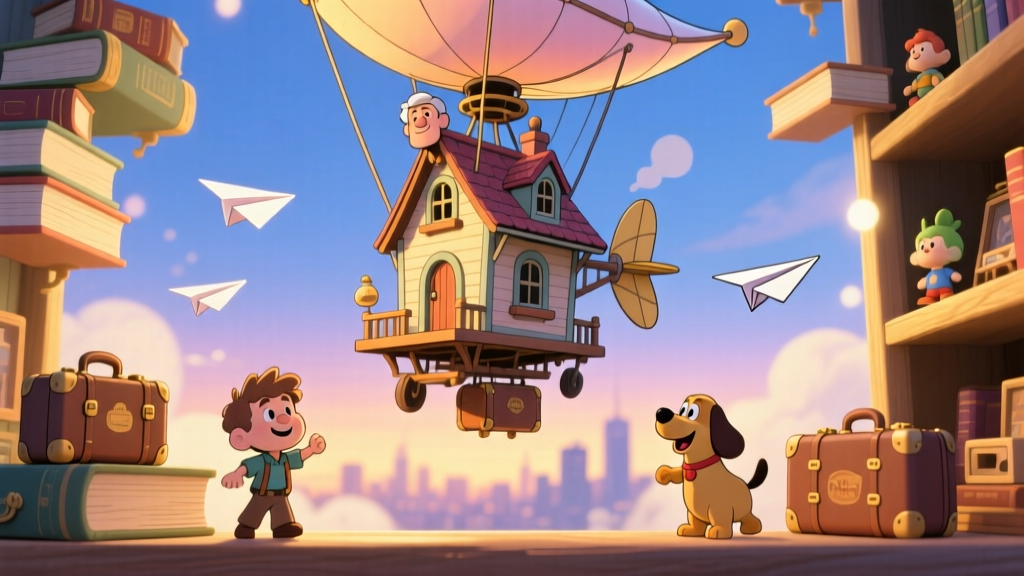
You open the box. Inside, nestled in a molded plastic tray, sits a six-inch slice of Paradise Falls — a tiny Victorian house suspended mid-flight, its chimney trailing a rainbow torrent of balloons, with a squinting old man gripping his walker on the porch and a rotund Wilderness Explorer clinging to the garden hose below. A Golden Retriever with a translation collar stands at the doorstep, mouth open mid-bark. The whole thing weighs about as much as a coffee mug, but it somehow carries the emotional freight of a $735 million animated film inside a footprint smaller than a paperback novel.
That’s the power of the Disney and Pixar Up diorama series — a growing ecosystem of miniature scene collectibles that has quietly become one of the most sought-after display formats in the Pixar collecting world. From Beast Kingdom’s resin D-Stage line to LEGO’s brick-built house set to VeVe’s animated 3D digital dioramas, the diorama format turns individual characters into moments. And for collectors who grew up watching Carl Fredricksen tie his necktie in front of a mirror and fly a bungalow across South America, those moments are worth serious shelf space.
What Makes a Diorama Different From Every Other Figure on Your Shelf
Most collectible figures stand alone. A Funko Pop of Carl Fredricksen is just Carl — bobbleheaded, stylized, context-free. A Nendoroid of Russell gives you a cute, posable kid scout, but he’s floating in a void. Dioramas do something fundamentally different: they reconstruct narrative space. You’re not buying a character. You’re buying a scene.
The diorama format in collectibles traces its modern lineage back to Japanese garage kit culture in the 1980s and ’90s, where modelers built elaborate scene bases for mecha and anime figures. Bandai’s Mobile Suit Gundam diorama kits and Kotobukiya’s scene statuettes established the template: characters anchored to a base that includes environmental elements — terrain, architecture, weather effects, props — that tell a story in a single frozen frame.
When this format migrated to Western pop culture collectibles in the 2010s, Disney and Pixar films were a natural fit. Pixar’s storytelling relies heavily on environmental narrative — the junk-filled wasteland of WALL-E, the coral reef of Finding Nemo, the cluttered antique shop of Coco. Each film builds worlds where the setting is inseparable from the emotional arc. Up is the extreme case: the house itself is the character. It’s Carl’s marriage to Ellie made physical, a rolling metaphor for grief and adventure, and it flies. A standalone figure of Carl without the house is like a portrait of Han Solo without the Millennium Falcon — technically complete, emotionally hollow.
The diorama format solves this by giving you the house, the balloons, the cliff edge, the characters, and the sky all in one sculpted unit. It’s a self-contained scene that doesn’t need context from the viewer. You look at it and you’re immediately back in the movie’s third act, watching Carl choose between saving Russell and saving the house he carried across a continent.
The Physical Diorama Landscape: Beast Kingdom DS-100 and Beyond
Beast Kingdom D-Stage DS-100: The Resin Centerpiece
Beast Kingdom, a Taipei-based collectibles studio founded in 2009, launched its D-Stage line as a 6-to-7-inch scale diorama series focused on Disney and Pixar scenes. Each piece is numbered sequentially in the D-Stage catalog. The Up entry, designated DS-100, marks the 100th release in the line — a milestone number that the studio assigned deliberately to one of Disney-Pixar’s most visually iconic films.
The DS-100 recreates the film’s most recognizable image: Carl’s house in full flight, lifted by its cluster of multicolored balloons, with Paradise Falls visible in the background terrain. The sculpt includes Carl Fredricksen on the porch with his four-pronged walker, Russell hanging from a garden hose attached to the house’s exterior, Dug the Golden Retriever standing at the base, and Kevin the giant tropical bird perched nearby. The base incorporates rocky terrain and a partial cliff face that evokes the tepui formations of Venezuela’s Canaima National Park, which inspired Paradise Falls’ design.
The piece retailed in the $55 to $75 USD range depending on the retailer, with a typical MSRP around $64.99. It’s cast in polystone resin, hand-painted with some factory-applied color gradients on the balloon cluster. Total weight sits around 1.2 pounds — substantial enough to feel premium without requiring reinforced shelving. Production runs are limited but not numbered, meaning Beast Kingdom doesn’t publish a hard cap on units produced, though the studio typically runs D-Stage pieces in batches of 5,000 to 15,000 globally before retiring the mold.
LEGO 43217: The Brick-Built Diorama Alternative
LEGO entered the Up diorama space in 2023 with set 43217, a 598-piece build that recreates Carl’s house with a balloon cluster rendered in translucent and solid-color round plates. The set includes two minifigures — Carl (with his walker accessory and printed torso showing his signature tweed jacket) and Russell (with his Wilderness Explorer sash loaded with printed badge tiles) — plus a brick-built Dug figure.
At $49.99 USD MSRP, the set targets a broader audience than the Beast Kingdom resin piece. The house itself is partially enclosed, showing Carl’s living room interior with his dark red armchair and the shadow box containing Ellie’s Adventure Book. The balloon cluster uses a clever technique: layered round plates in red, orange, yellow, blue, and white, attached to a flexible Technic pin system that allows slight movement. It’s not a static sculpt the way the DS-100 is — it’s an activity, a building experience that takes roughly 90 minutes for an adult builder.
The trade-off is visual precision. LEGO’s minifigure proportions are inherently stylized, and the house reads more as a cartoon of a house than a faithful miniature replica. For collectors who value display impact over the building process, the Beast Kingdom piece wins on pure aesthetics. For those who enjoy the tactile construction and modular flexibility (you can technically remove the balloon cluster and display the house as a grounded structure, mimicking the film’s opening act), the LEGO set offers something the resin diorama can’t.
VeVe Digital Dioramas: The Animated Collectible
In the digital realm, VeVe — the New Zealand-based platform operated by Ecomi — released an Up diorama series as animated 3D digital collectibles. These pieces render scenes from the film as fully three-dimensional dioramas that rotate and animate inside the VeVe mobile app. The digital format allows effects that physical sculpts can’t replicate: balloon strings sway with simulated wind, clouds drift behind the house, and character elements move in looping animations.
VeVe distributed these through their blind box drop system, where collectors purchase at a set price (typically $9.99 to $14.99 USD per blind box) and receive a randomized rarity tier. The series includes multiple scenes and character configurations, with ultra-rare variants featuring different color palettes or animation states. Secondary market pricing on VeVe’s internal marketplace fluctuates based on rarity, with common variants trading near retail and rare or ultra-rare pieces commanding premiums of 3x to 10x the original blind box price.
The Specific Scenes That Matter: Breaking Down the Key Diorama Moments
Not every moment from Up translates well into diorama format. The film’s emotional power lives largely in its opening montage — a wordless 4-minute sequence spanning decades — which is nearly impossible to capture in a single static scene. The diorama collectibles instead gravitate toward three key visual moments:
- The Lift-Off. Carl’s house tearing free from its foundation, balloons erupting upward, garden hose snaking behind it. This is the most reproduced scene across all Up collectible formats. It works because it’s the film’s thesis statement in a single frame: an old man’s refusal to be moved becomes literal flight. The Beast Kingdom DS-100 captures this moment, with the house at a slight upward tilt and the balloon cluster fanning out overhead in a rainbow gradient from warm reds and oranges at the top to cooler blues and purples at the base.
- Paradise Falls Landing. The house perched on the cliff edge above the falls, with Carl and Russell standing at the precipice. This scene appears in several fan-made and artisan diorama builds on platforms like Etsy, where independent creators produce resin and mixed-media pieces at various scales. The appeal is environmental: the lush green cliff, the roaring waterfall, the house tilted at a precarious angle. It’s the adventure payoff.
- The Ellie Badge Ceremony. Russell receiving his Ellie badge from Carl, with Dug and Kevin flanking them. Less commonly produced as a commercial diorama, this scene appears in pin sets and smaller collectible formats. It’s the emotional closer — the moment Carl completes his arc from grief-hardened recluse to chosen family.
The lift-off scene dominates for a reason. When Beast Kingdom’s sculptors designed the DS-100, they angled the house at approximately 15 degrees from horizontal, with the balloon cluster leaning into the implied wind direction. This creates a sense of forward momentum — the house isn’t hovering, it’s going somewhere. The eye follows the balloons upward and to the right, which mirrors the film’s own camera movement during the lift-off sequence. It’s a small compositional choice, but it’s the difference between a diorama that feels alive and one that feels like a taxidermy display.
Comparing the Major Up Diorama Pieces
| Feature | Beast Kingdom DS-100 | LEGO 43217 | VeVe Digital Diorama |
|---|---|---|---|
| Format | Polystone resin, hand-painted | 598-piece brick build | 3D animated digital asset |
| Scale / Size | ~6 inches tall, ~1.2 lbs | ~7 inches built, ~0.9 lbs | App-rendered, scalable |
| Characters Included | Carl, Russell, Dug, Kevin | Carl, Russell, Dug (brick-built) | Varies by blind box variant |
| MSRP | $55–$75 USD | $49.99 USD | $9.99–$14.99 per blind box |
| Scene Depicted | House in flight (lift-off) | House in flight (modular) | Multiple scenes, randomized |
| Secondary Market (2025) | $80–$140 sealed | $55–$80 sealed | Varies by rarity tier |
| Best For | Display-focused collectors | Builders and casual fans | Digital collectors, flippers |
| Secondary market prices estimated from eBay sold listings and VeVe marketplace data, early 2025. Prices fluctuate based on condition, completeness, and regional availability. | |||
Display Value and the Shelf Presence Problem
Here’s something most collectible reviews won’t tell you: the diorama format is a display liability if you don’t plan for it.
A standard action figure or statue stands on a flat circular or rectangular base. It fits on a shelf, sits next to other figures, and generally plays well with neighbors. A diorama doesn’t. The Beast Kingdom DS-100 has an irregular base — the rocky terrain and cliff edge extend beyond what a standard figure shelf accommodates. The balloon cluster rises high enough that it won’t fit on shelves with 8-inch or less vertical clearance. And the visual weight of the piece — that massive rainbow balloon bouquet — dominates everything within a 12-inch radius. Put it next to a Funko Pop and the Funko disappears. Put it next to another diorama and they fight for attention.
Experienced diorama collectors solve this with dedicated display zones. Acrylic risers, typically 3 to 4 inches tall, lift the piece above surrounding figures and give the balloon cluster room to breathe. LED strip lighting mounted above the shelf (5000K to 6500K daylight temperature, which complements the balloon color palette without washing out the hand-painted details) adds depth. Some collectors build custom backdrop panels — a painted sky gradient from pale blue to white, or a printed Paradise Falls panorama — that extend the diorama’s environmental storytelling beyond its physical base.
The display challenge is real, but so is the payoff. A well-lit Up diorama on a clean shelf doesn’t just sit there. It performs. The balloon cluster catches light from multiple angles, casting colored shadows on the shelf surface below. The house, angled upward, draws the eye up and across the room. It’s the kind of piece that stops visitors mid-sentence and pulls them into a two-minute conversation about the movie, their kids, their parents, the first time they saw the opening montage and tried not to cry in a theater full of strangers.
The Broader Pixar Diorama Trend: From Niche Format to Collectible Category
The Up diorama isn’t an isolated product. It’s part of a wider movement in Pixar collectibles that has seen the diorama format grow from a niche modeler’s specialty into a mainstream collectible category over the past five years.
Beast Kingdom’s D-Stage line now encompasses over 100 entries across Disney and Pixar films. The Aladdin piece (DS-075) recreates the magic carpet flight over Agrabah. The Lion King entry (DS-076) places Simba on Pride Rock at sunrise. Each piece follows the same formula: a defining scene from the film, rendered at 6-to-7-inch scale, with environmental base elements that extend the storytelling beyond the characters themselves. The line’s consistency — matching scale, similar base dimensions, coordinated color palettes — encourages collecting across films. A shelf with the Up, Coco, Finding Nemo, and Toy Story D-Stage pieces creates a miniature Pixar anthology, each scene a chapter.
The trend extends beyond Beast Kingdom. Good Smile Company’s Pop Up Parade line has experimented with scene bases for select Pixar characters. Independent artisans on Etsy have built a cottage industry around custom Pixar dioramas, and several titles have proven especially popular in the artisan scene:
- Ratatouille — Gusteau’s restaurant kitchen with Remy on the counter, copper pots hanging from overhead racks, and a tiny cookbook propped open at the ratatouille recipe. Artisan resin casts of this scene typically run $80 to $150 for 1/24 scale.
- Inside Out — The memory orb shelves inside Headquarters, with Joy and Sadness standing among thousands of glowing spheres. This scene benefits from LED integration — fiber optic strands embedded in the orbs create a soft interior glow.
- Coco — The marigold bridge crossing into the Land of the Dead, with Miguel and Dante mid-stride. The most visually complex of the artisan Pixar dioramas, with layered translucent petals and warm amber lighting built into the base.
- Soul — The You Seminar astral plane, with 22 and Joe Gardner on the metaphysical steps. Less commonly produced due to the abstract setting, but the minimalist geometry appeals to collectors who prefer cleaner display aesthetics.
Prices for these artisan pieces range from $40 for simple two-character scenes to $300 or more for complex multi-element builds with LED lighting and hand-painted backgrounds.
The collectibles market broadly has expanded dramatically. According to a GlobeNewsWire market analysis published in April 2026, the global collectibles market is projected to reach $480.75 billion between 2025 and 2033, driven in part by nostalgia-led demand and rising investment appeal among millennial and Gen Z collectors who grew up with Pixar films. The animation-specific segment of the collectibles market has grown proportionally, with licensed Disney-Pixar merchandise commanding premium secondary market pricing compared to equivalent non-Disney collectibles.
“The diorama format works because it sells nostalgia as a complete package. You’re not buying a figure of a character — you’re buying the feeling you had watching that specific scene in the theater. For Pixar films, which are engineered to hit emotional beats with surgical precision, that feeling is the product.”
— Collectible industry analysis, Second-hand Collectibles Market Report, GM Insights, 2025
LEGO has leaned into this trend aggressively. Beyond the Up house, the company released diorama-format sets for Star Wars (the Death Star trash compactor scene, the Dagobah Jedi training sequence), Indiana Jones (the boulder chase), and Back to the Future (the DeLorean time machine with Hill Valley clock tower). Each set follows the same principle: don’t sell the vehicle or the character, sell the scene. The Up House set (43217) was one of LEGO’s most pre-ordered Disney sets of 2023, with multiple retailers reporting sell-out within the first week of availability.
What to Look For Before You Buy
If you’re considering adding an Up diorama to your collection, a few practical notes from the trenches:
Check the paint application on resin pieces. Beast Kingdom’s factory painting is generally solid, but the balloon cluster is where quality control varies. The color gradient from warm to cool tones should be smooth, not banded. If you see hard lines between color zones on the balloons, that’s a sign of rushed production. Some collectors have reported finding paint bleed between adjacent balloons on early DS-100 production runs, though later batches improved significantly.
Verify packaging condition for sealed purchases. The DS-100 ships in a windowed display box with the diorama visible through a clear acetate panel. Shipping damage to these boxes is common — the balloon cluster, which protrudes above the box’s internal foam cradle, is vulnerable to crushing if the outer carton takes a hit. When buying from online retailers, request photos of the actual unit before shipping if possible. For secondary market purchases, check that the internal foam inserts are intact; replacement foam for these boxes is essentially nonexistent.
Consider shelf depth. The DS-100’s base is roughly 5 inches deep at its widest point (the cliff terrain extends backward), and the balloon cluster rises about 6.5 inches from the base. You need a shelf at least 6 inches deep with a minimum of 9 inches vertical clearance. Standard IKEA Billy bookcases (11-inch shelf depth, adjustable shelf height) work well. Kallax cube shelving (15-inch depth) provides even more room but the 13-inch cube width means the diorama sits alone in each compartment, which some collectors find isolating.
For the LEGO set, decide sealed vs. built before you open. Sealed LEGO 43217 boxes hold a modest premium on the secondary market ($55 to $80 versus the $49.99 retail). Once built, the set’s value drops to roughly $30 to $40 as a complete, disassembled lot with instructions and original box. If you’re buying to build and display, that’s fine — you’re paying for the experience. If you’re buying as an investment-grade collectible, keep it sealed and store it flat.
Where the Diorama Format Goes From Here
The trajectory is clear. As the collector demographic skews younger and more digitally native, expect the diorama format to expand into augmented reality. Imagine pointing your phone at the Beast Kingdom DS-100 on your shelf and watching the balloon cluster sway in simulated wind, or seeing Kevin the bird walk across the cliff base through an AR overlay. VeVe’s digital dioramas already hint at this — their animated 3D scenes are essentially AR-ready assets waiting for a hardware ecosystem that can project them into physical space.
On the physical side, artisan and limited-run dioramas are likely to grow as 3D printing and resin casting technology becomes more accessible. Independent creators are already producing Up scenes that major studios won’t touch — the interior of Carl’s living room with Ellie’s murals, the construction site where Carl and Russell first meet, the Spirit of Adventure dirigible interior. These aren’t mass-market products. They’re passion projects from people who watched Up as kids and now have the tools to build the scenes that mattered to them.
And that, maybe, is the whole point. The diorama format works because it mirrors what Up itself is about: taking a story that’s too big for a single object and building a small, contained world that holds all of it. Carl couldn’t carry his whole life with Ellie across a continent. But he could carry the house. A diorama collector can’t carry the entire emotional weight of a film onto a 6-inch shelf. But they can carry the scene that made them feel it.
Frequently Asked Questions
What is the Beast Kingdom DS-100 and is it still available?
The DS-100 is the 100th entry in Beast Kingdom’s D-Stage diorama series, a polystone resin collectible depicting Carl’s flying house with Carl, Russell, Dug, and Kevin. It originally retailed for $55 to $75 USD and shipped globally starting in mid-2022. As of 2025, it’s available on secondary marketplaces like eBay and specialty collectible retailers, with sealed units typically selling for $80 to $140 depending on condition and seller location.
How does the LEGO Up House set compare to the Beast Kingdom diorama?
They serve different purposes. The LEGO 43217 ($49.99, 598 pieces) is a building experience that results in a displayable model — it’s interactive, modular, and aimed at a broader audience including kids aged 9 and up. The Beast Kingdom DS-100 is a finished sculpt meant purely for display, with more detailed paintwork and realistic character proportions. If you enjoy the process of building, the LEGO set delivers. If you want a shelf-ready showpiece, the resin diorama has stronger visual impact.
Are Up diorama collectibles a good investment?
Sealed Beast Kingdom D-Stage pieces have shown moderate appreciation, typically 20% to 80% above MSRP within two to three years of release, depending on production run size and ongoing demand. The Up theme has enduring appeal due to the film’s emotional resonance, which keeps demand steadier than more plot-driven Pixar titles. That said, collectible investment is speculative. Buy what you want to display, and treat any price appreciation as a bonus rather than a guarantee.
What other Pixar films have diorama collectibles?
Beast Kingdom’s D-Stage line covers over 100 Disney and Pixar films, including Toy Story, Coco, Finding Nemo, The Lion King, Aladdin, Beauty and the Beast, and The Incredibles. Independent creators on Etsy and similar platforms produce custom dioramas for virtually any Pixar title, with Ratatouille, Inside Out, and Soul being particularly popular in the artisan scene. LEGO’s diorama-format sets extend to Star Wars, Indiana Jones, and Back to the Future.
How should I display an Up diorama to protect it?
Polystone resin is durable but not indestructible. Keep the DS-100 out of direct sunlight, which can fade the hand-painted balloon colors over 12 to 18 months of sustained UV exposure. A UV-filtering acrylic display case (available from collectible accessory suppliers for $20 to $40) protects against dust and sunlight simultaneously. Clean with a soft, dry brush — compressed air works well for dust between the individual balloon elements. Avoid water or cleaning solvents, which can damage the paint finish on resin surfaces.