When director Peter Sohn first pitched the idea for a world where fire, water, earth, and air coexist as living beings, Pixar's production team faced a challenge unlike anything they'd tackled before. Unlike previous animated films where characters inhabit a world, Elemental demanded that the characters be the world itself. The concept art series that emerged from this production represents one of the most ambitious visual development efforts in Pixar's history, spanning over six years of iterative design, technological innovation, and artistic problem-solving.
The 2023 film grossed approximately $484 million worldwide against a production budget of $200 million, but its true legacy lies in the concept art and production design that pushed the boundaries of what animated characters could be. This is the story of how a team of over 50 effects artists, led by Production Designer Don Shank and VFX Supervisor Sanjay Bakshi, reimagined the fundamental building blocks of nature as sentient beings.
The Foundation: Designing Characters Who Are Their Elements
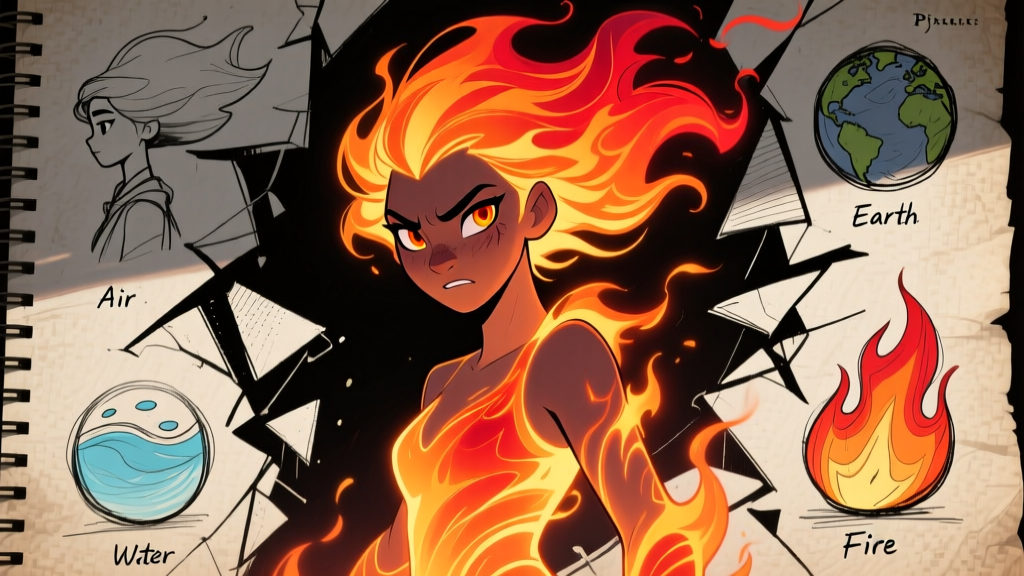
The first rule Peter Sohn established for the design team was deceptively simple: "Ember is fire. She's not something on fire." This distinction became the guiding principle for every piece of concept art produced for the film. Ember Lumen, the fiery protagonist voiced by Leah Lewis, couldn't simply be a humanoid figure with flame effects applied to her surface. She had to be combustion itself, given form and personality through the language of fire.
The early concept sketches, later compiled in The Art of Elemental (Chronicle Books, 2023), show dozens of iterations exploring what a fire person might look like. Some early designs featured visible skeletal structures beneath translucent flame layers. Others experimented with ember-like particles orbiting a central mass. The breakthrough came when the team realized that Ember's emotional states needed to manifest through changes in her flame behavior rather than facial expressions alone.
"We approached the characters as if we were designing forces of nature that had somehow gained consciousness. Every movement, every color shift, had to feel authentic to the element while still being readable as character performance." — Don Shank, Production Designer
Ember's flames shift from transparent yellows when she's calm to deep purples and blues when emotional—a choice rooted in real combustion physics. The concept artists worked closely with the simulation team to ensure that the painted designs could be translated into the volumetric fire simulation that would ultimately appear on screen. This wasn't traditional character design; it was elemental choreography.
Wade Ripple: The Fluid Challenge
If Ember represented the challenge of making fire feel alive, Wade Ripple presented an entirely different problem: how do you design a character who is literally water? The concept art for Wade, voiced by Mamoudou Athie, evolved from early sketches that depicted him as a contained vessel of liquid to the final design where he flows and reforms with every movement.
The design team studied fluid dynamics extensively, analyzing how water behaves when it encounters obstacles, how surface tension creates meniscus curves, and how light refracts through different volumes of liquid. These studies directly informed Wade's silhouette in the concept art—his edges are never static, always suggesting motion even in stillness. His transparency varies based on his emotional state, becoming more opaque when he's feeling vulnerable.
One particularly innovative aspect of Wade's design involved his interaction with his environment. The concept artists developed a visual language showing how water would collect, drip, and flow along surfaces. When Wade leans against a wall in the film, you can see water pooling at the contact point—a detail that emerged directly from the concept art phase and required new simulation tools to implement.
Element City: Architecture as Elemental Expression
Element City, the film's primary setting, represents perhaps the most ambitious piece of world-building in Pixar's history. The concept art series includes extensive explorations of how a city would function when its inhabitants have fundamentally incompatible physical properties. Production Designer Don Shank drew inspiration from canal cities like Venice, the brownstone architecture of New York City, and the terraced gardens of various global metropolises to create something that felt both fantastical and lived-in.
The city is divided into distinct districts, each reflecting the needs and nature of its elemental inhabitants:
| District | Primary Element | Architectural Style | Design Inspiration | Key Visual Features |
|---|---|---|---|---|
| Firetown | Fire | Industrial with heat-resistant materials | Historic furnace districts, kiln architecture | Wide lenses for open spaces, ember-colored lighting, fire-specific furnaces |
| Waterfront District | Water | Canal-based with fluid architecture | Venice, Amsterdam, canal cities | Steadicam-style camera movement, reflective surfaces, flowing waterways |
| Garden District | Earth | Organic, terraced structures | Botanical gardens, hanging gardens | High geometry plant life, soil textures, natural growth patterns |
| Cyclone Stadium Area | Air | Open, wind-sculpted forms | Tornado formations, cloud structures | Swirling movement, volumetric space, transparent boundaries |
The concept art for Firetown, which was the last district to be established in the film's lore, required particular attention to how fire elements would navigate their environment. The artists designed specialized furnaces that serve as both heat sources and social gathering points, reflecting the communal nature of fire culture. The architecture uses materials that can withstand high temperatures while still feeling like a neighborhood rather than an industrial zone.
Cyclone Stadium, the venue for the film's sporting events, exemplifies how the concept artists thought about air element culture. Don Shank designed the structure as a tornado shape with swirling movement patterns that represent the dynamic nature of air. The concept art shows how air characters would interact with vertical spaces, creating natural updrafts and circulation patterns that inform both the architecture and the animation.
The Technology of Elemental Concept Art
What makes the Elemental concept art series particularly fascinating is how it directly informed—and was informed by—technological breakthroughs in animation. The traditional pipeline at Pixar had always separated character design from effects simulation. For Elemental, these disciplines merged in ways that required constant back-and-forth between concept artists and technical directors.
Volumetric Neural Style Transfer
One of the most significant innovations documented in the concept art development was the use of Volumetric Neural Style Transfer (NST) for fire simulation. This technique, detailed in Pixar's SIGGRAPH 2023 technical papers, allowed the team to train a convolutional neural network to apply the aesthetic qualities of concept art directly to dynamic fire simulations.
The concept art for Ember showed specific flame patterns, color gradients, and movement qualities that traditional simulation couldn't achieve while maintaining the performance requirements of a feature film. The NST approach allowed the team to capture the "essence of the painting" and infuse it into the volumetric fire simulation, creating a direct pipeline from concept sketch to final rendered frame.
"I don't want to see patterns in the motion of the fire. It has to feel alive, unpredictable, but still controlled enough to convey character intention." — Sanjay Bakshi, VFX Supervisor
This philosophy drove the concept art process. Artists weren't just designing what Ember looked like; they were designing how she moved. The concept art series includes numerous motion studies showing Ember's flame behavior in different emotional contexts—excited flames that dance upward, sad flames that droop and dim, angry flames that flare aggressively.
Curvenets and Character Rigging
Traditional character animation relies on virtual skeleton rigs—hierarchical bone structures that deform a character's mesh. For Elemental, this approach was abandoned entirely. The concept art team worked alongside technical artists to develop "curvenets," a system where Ember and Wade were animated through curve-based manipulation rather than skeletal deformation.
This decision emerged directly from the concept art phase. Early designs that used traditional rigging made the characters feel stiff and artificial. The concept artists kept pushing for more fluid, organic forms that couldn't be achieved with bones and joints. The solution was a complete rewrite of the character animation pipeline, with over 50 effects artists contributing to what the team describes as "every frame has fire or water simulation."
The key technical innovations that emerged from this production include:
- Volumetric Neural Style Transfer: Machine learning applied to stylize fire simulations based on concept art
- Curvenets: Curve-based character animation replacing traditional skeletal rigs
- Volume Deformation: New approaches to rendering air characters in crowd scenes
- Fluid Dynamics Integration: Real-time water behavior tied to character performance
- Elemental Lighting Systems: Dynamic illumination based on character elemental properties
The Art of Elemental: The Collectible Art Book
Published by Chronicle Books on May 16, 2023, The Art of Elemental (ISBN: 9781797218519) represents the definitive collection of concept art from the film's development. The 176-page hardcover, measuring 9 x 11 inches, features a foreword by Pete Docter and an introduction by director Peter Sohn.
The book is organized chronologically through the film's production, beginning with early character explorations and progressing through environment design, color scripts, and final production art. Key sections include:
- Character Development: Hundreds of sketches showing the evolution of Ember, Wade, and supporting characters from abstract concepts to final designs
- Element Studies: Detailed explorations of how each element behaves, including physics references and artistic interpretations
- Environment Design: Extensive concept art for Element City's districts, showing how architecture reflects elemental culture
- Color Scripts: Full-color visual narratives that establish the emotional palette of each sequence
- Storyboards: Key sequences in storyboard form, showing how concept art translates to cinematic storytelling
The book also includes exclusive interviews with the creative team, providing context for the artistic decisions documented in the concept art. One particularly revealing section shows how the team balanced "physics, logic, and cartoony appeal"—a phrase that appears repeatedly in the production notes and reflects the core tension in designing characters who must feel both elemental and emotionally expressive.
The VeVe Concept Art Series: Digital Collectibles
Beyond the physical art book, Disney and Pixar released a digital concept art series through the VeVe platform, featuring five distinct illustrations that capture key moments and designs from the film's development. This collection offers fans a different way to engage with the concept art, presenting selected pieces in a format that emphasizes their artistic merit outside the context of film production.
The VeVe series includes a bird's-eye view of Element City that showcases the intricate district planning, character studies of Ember and Wade that highlight their elemental nature, and environmental pieces that demonstrate the production design team's attention to cultural detail. Each piece is presented as a collectible that can be rotated and examined, allowing viewers to appreciate the brushwork and design decisions that might be lost in traditional reproduction.
Firetown features prominently in the collection, depicted as a vibrant neighborhood where fire culture thrives. The concept art shows how the district's architecture accommodates its residents' need for heat and flame-friendly materials while maintaining the aesthetic of a lived-in community. These pieces reveal the thought that went into making Element City feel like a place where different elemental cultures could coexist, sometimes in harmony, sometimes in tension.
Earth and Air: The Supporting Elements
While Ember and Wade dominate the narrative, the concept art for earth and air elements reveals equally thoughtful design approaches. Earth characters like Clod, voiced by Wendi McLendon-Covey, presented unique challenges in visual design. These characters are composed of soil, plants, and rock, requiring high geometry counts to render the intricate details of their botanical surfaces.
The concept art for earth elements drew heavily from botanical illustration and geological studies. Artists explored how different plant species might combine to form humanoid shapes, how root systems could function as nervous systems, and how seasonal changes might affect an earth character's appearance. The Garden District of Element City reflects these considerations, with architecture that incorporates living plant structures and soil-based building materials.
Air elements, represented by characters like Gale, required a completely different visual language. Gale, who has "a big personality" according to the film's official materials, is depicted in concept art as a cloud-like form with constantly shifting density. The challenge was making air visible while maintaining its essential transparency. The artists solved this through careful attention to how light interacts with vapor, creating designs that suggest form through atmospheric effects rather than solid boundaries.
Volume Deformation for Air Crowds
One of the technical achievements documented in the concept art development was volume deformation for air crowd scenes. Unlike fire and water characters, which have defined surfaces, air characters exist as volumetric phenomena. The concept art team worked with technical directors to develop visualization methods that could represent air characters in group settings while maintaining their ethereal quality.
This work directly influenced the design of Cyclone Stadium and other spaces where air elements gather. The concept art shows how multiple air characters could occupy the same space without losing their individual identities, a visual challenge that required new approaches to volumetric rendering.
Cultural Themes in the Concept Art
Beyond the technical achievements, the Elemental concept art series is notable for how it embeds cultural commentary into visual design. Director Peter Sohn has spoken about how the film reflects immigrant experiences, and this theme is woven throughout the production design. Firetown, for instance, is depicted as a neighborhood established by fire element immigrants, with architecture that reflects both their homeland traditions and their adaptation to Element City's existing infrastructure.
The concept art shows Firetown as "the last to be established" among Element City's districts, a detail that informs its architectural character. The buildings incorporate elements from fire culture while adapting to the city's broader aesthetic, creating visual tension between assimilation and cultural preservation. This attention to sociological detail elevates the concept art beyond mere visual development into a form of world-building that comments on real-world dynamics.
Similarly, the Waterfront District's canal-based architecture reflects how water elements shaped their environment to suit their needs, while the Garden District shows earth elements integrating their biological nature into urban planning. Each district in the concept art tells a story about how different elemental cultures have negotiated their place in a shared city.
Lighting and Color: The Emotional Language of Elements
The concept art for Elemental pays particular attention to how lighting and color function in a world where characters emit, reflect, or absorb light differently based on their elemental nature. Color and shading art director Jennifer Chang's work, referenced in the film's official materials, established distinct palettes for each element that inform both character design and environmental lighting.
Fire characters emit light, which means they illuminate their surroundings—a consideration that affects every scene they appear in. The concept art shows how Ember's presence changes the color temperature of a room, casting warm orange hues on nearby surfaces. Water characters like Wade refract and reflect light, creating caustic patterns and requiring different lighting approaches. Earth and air characters interact with light in still different ways, creating a complex lighting environment that the concept artists had to visualize before the technical team could implement it.
The color scripts included in The Art of Elemental demonstrate how these lighting considerations shaped the film's emotional arc. Scenes of conflict between elements use clashing color temperatures to heighten tension, while moments of connection find visual harmony through careful color balancing. The concept art established a visual grammar that the lighting team could follow throughout production.
The Legacy of Elemental's Concept Art
The concept art produced for Elemental represents a significant moment in animation history. It documents not just the visual development of a single film, but the evolution of how animated characters can be conceived and realized. The merger of traditional concept art techniques with emerging technologies like neural style transfer points toward a future where the boundary between artistic vision and technical implementation continues to blur.
For artists and animators, the Elemental concept art series offers a masterclass in designing characters who are fundamentally different from anything that has existed before. The iterative process documented in The Art of Elemental shows how a large team can maintain creative coherence while exploring uncharted territory. For fans of the film, the concept art reveals the depth of thought that went into every frame, from the way Ember's flames respond to her emotions to the way Element City's architecture reflects the cultures that built it.
The film's box office performance may have been modest by Pixar standards, but its artistic achievements have secured its place in the studio's legacy. The concept art series, both in the physical book and the VeVe digital collection, ensures that this visual development work will continue to inspire artists and audiences for years to come. In a medium where technological capability often outpaces creative vision, Elemental stands as an example of how art and technology can evolve together, each pushing the other toward new possibilities.