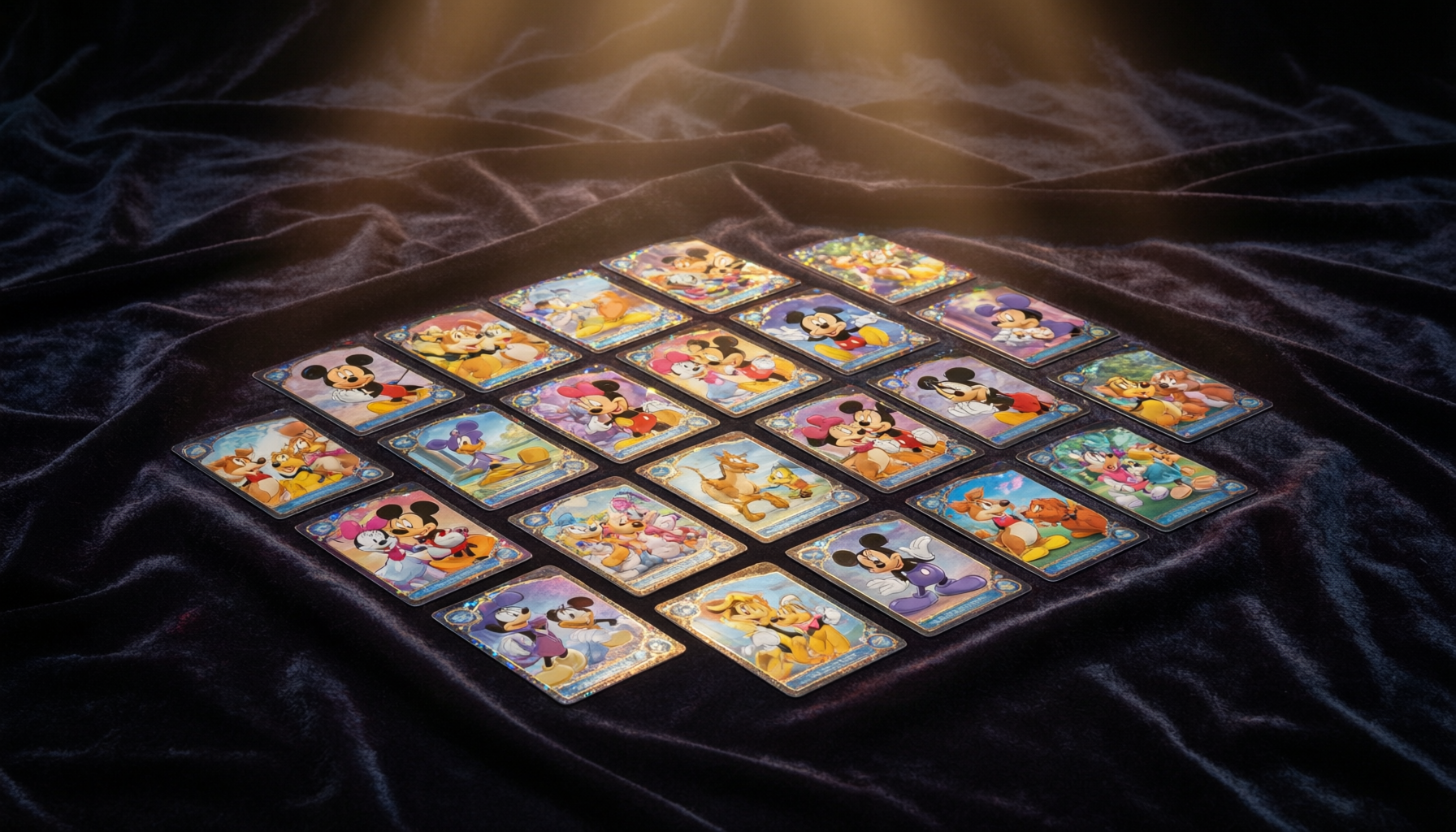
Disney Trading Cards: A Collector's Guide to the Magic
From vintage Mickey Mouse cards to the Lorcana TCG explosion — everything a serious Disney card collector needs to know about sets, rarity, and market values.
Otaku Culture Disney Collecting
Disney trading cards occupy a strange and fascinating corner of the collectibles world. Unlike sports cards, where the market logic is relatively straightforward — rookie cards, graded condition, player performance — Disney cards pull from nearly a century of animated film history, theme park ephemera, and now a full-blown trading card game that shook the industry when it launched in 2023. Whether you're chasing a 1930s Mickey Mouse card worth more than some cars or pulling enchanted foil characters from a Lorcana booster box, the hobby has layers that most people never see coming.
I've been collecting Disney cards on and off for over fifteen years. What started as nostalgia — picking up cheap sets at Disney Parks — turned into something more serious once I realized how deep the vintage market ran. A PSA 10 gem mint card from the 1930s? That's museum-grade Americana. And the modern Lorcana scene has injected a competitive energy into Disney collecting that didn't exist a few years ago. Prices move fast. Rarity windows open and close. If you're going to collect in this space, you need to know what you're looking at.
This guide covers the major Disney trading card sets that matter, the cards that command serious money, the Lorcana phenomenon that rewrote the rules, and practical advice for anyone building a collection today.
The History of Disney Trading Cards
Disney's relationship with trading cards stretches back further than most collectors realize. The earliest Disney cards weren't trading cards in the modern sense — they were premiums, inserts, and promotional items bundled with other products. In the 1930s, companies like National Chicle and Gum Inc. began including Disney character cards in gum packages, capitalizing on the explosive popularity of Mickey Mouse, who debuted in Steamboat Willie in 1928.
These early cards were small, often roughly printed, and treated as disposable by the kids who received them. That's precisely why surviving examples in good condition are so rare today. A 1933 Gum Inc. Mickey Mouse card in PSA 8 or better condition is a genuine museum piece, and prices reflect that reality.
Through the 1950s and 60s, Disney cards appeared in various forms — as Topps inserts, as promotions tied to Disney films, and as standalone sets from regional manufacturers. The 1960s Topps Disney sets, featuring characters from Sleeping Beauty, One Hundred and One Dalmatians, and The Jungle Book, represent some of the most accessible vintage options for collectors today, though high-grade examples still carry premium prices.
The modern era of Disney trading cards arguably began in the 1990s, when InkWorks and later Upper Deck began producing dedicated Disney sets with modern card stock, holographic technology, and limited-edition insert cards. These sets targeted adult collectors directly, and the print runs were often small enough that scarcity was built in from the start.
The Most Valuable Disney Trading Card Sets
Not all Disney card sets are created equal. Some have appreciated dramatically over the past decade, while others remain affordable entry points. Here are the sets that serious collectors watch closely.
1933 Gum Inc. Mickey Mouse
This is the holy grail. The 1933 Gum Inc. set featured Mickey Mouse in various scenes and is widely considered the first true Disney trading card set. Complete sets contain 24 cards, though most surviving collections are incomplete. Individual commons in low grade can be found for $100–$300, but a high-grade Mickey Mouse card from this set — PSA 7 or above — can fetch $5,000 to $15,000 or more at auction. The record prices keep climbing as vintage Disney memorabilia continues to attract serious money from both card collectors and Disney historians.
1956 Topps Disney
Topps produced several Disney-themed sets in the 1950s and 60s, and the 1956 series is among the most collected. Featuring scenes from classic Disney films, these cards are more affordable than the 1930s material but still carry weight with vintage collectors. A PSA 9 example of a key card from this set typically sells in the $200–$800 range, with rarer variations pushing higher.
1998 InkWorks Disney Masterpieces
The InkWorks era represented a shift toward premium collectible cards aimed squarely at adults. The Disney Masterpieces line featured artwork from classic Disney films, with autograph cards and limited-edition sketches from Disney artists as chase cards. The sketch cards in particular — original artwork on card stock — have held and in some cases appreciated significantly. A rare sketch card from a well-known Disney artist can sell for $500–$2,000 depending on the subject and artist.
2003 Upper Deck Disney 100 Years of Magic
Upper Deck brought its sports card expertise to Disney with the 100 Years of Magic celebration sets. These included memorabilia cards featuring actual pieces of Disney theme park artifacts — costume fabric, animation cels, park signage. The memorabilia cards are the draw here, and the rarest versions (particularly those containing animation cel fragments from classic films) command $300–$1,500 on the secondary market. The concept was brilliant: treat Disney history the way sports cards treat game-used jerseys.
Disney Archives Collection (Various Years)
Multiple manufacturers have produced sets under the "Disney Archives" banner, and these tend to hold value well because of their limited print runs and nostalgic subject matter. Cards featuring original concept art, behind-the-scenes photos, and rare promotional materials appeal to a broader collector base than just the trading card community.
Disney Lorcana: The Game That Changed Everything
In August 2023, Ravensburger launched Disney Lorcana, a full trading card game built entirely around Disney characters, locations, and lore. To say it was a success would be an understatement. The first set, The First Chapter, sold out virtually everywhere within days, and secondary market prices for rare cards spiked almost immediately.
Lorcana wasn't the first Disney TCG. Upper Deck's VS System had Disney licenses briefly, and there were various digital card games. But Lorcana was the first physical Disney TCG designed from the ground up to compete with Magic: The Gathering and Pokemon in the hobby space. The production quality is exceptional. The card art — pulling from decades of Disney animation, Pixar films, and the Disney vault — is genuinely stunning on the rare foil variants.
How Lorcana Works
For those unfamiliar with the game mechanics: players build decks of 60 cards featuring Disney characters, items, actions, and locations. The goal is to be the first to collect 20 "lore" points, which are generated by questing with your characters. It's more accessible than Magic but has enough strategic depth to support competitive play. The ink resource system is forgiving — no mana screw — which makes it appealing to casual players while the meta at competitive levels continues to evolve.
The Most Valuable Lorcana Cards
The chase cards in Lorcana are the Enchanted foil variants — alternate-art versions of popular characters with a distinctive shimmer treatment. Here's where the real money lives in the modern Disney card market:
The Elsa — Spirit of Winter Enchanted foil from The First Chapter was the undisputed king of early Lorcana. PSA 10 examples have sold for $1,500–$3,000+ at peak market, though prices have settled somewhat as more copies have been graded. Even raw (ungraded) copies in near-mint condition regularly sell for $400–$800.
Mickey Mouse — Brave Little Tailor Enchanted foil is another heavyweight. The nostalgic appeal of classic Mickey in a rare treatment pushes PSA 10 copies into the $1,000–$2,500 range.
Maleficent — Biding Her Time from Rise of the Floodborn captured attention with its striking alternate art. Enchanted foil versions in top grades consistently sell for $800–$1,800.
What's notable about Lorcana is how the market behaves compared to Pokemon. Disney characters have universal name recognition, which means demand comes from both TCG players and Disney collectors — two audiences that don't typically overlap in the card world. This dual-demand dynamic creates price floors that wouldn't exist for comparable rarity levels in a purely TCG-driven market.
Collector's note: Lorcana's print runs are significantly larger than vintage Disney sets, so long-term appreciation is less certain. The cards that will hold value best are the ones with the strongest character appeal (classic Disney, iconic villains) in the highest grades. Commons and uncommons, even from early sets, are unlikely to appreciate meaningfully.
Lorcana Sets Released So Far
As of this writing, Lorcana has released multiple sets, each expanding the card pool with new characters and mechanics:
- The First Chapter (August 2023) — The debut set. 204 cards. Still holds the highest-value chase cards due to first-mover scarcity.
- Rise of the Floodborn (November 2023) — Introduced new mechanics and expanded the villain roster significantly.
- Into the Inklands (February 2024) — Brought in characters from more recent Disney and Pixar films.
- Ursula's Return (May 2024) — Themed around iconic Disney villains, which drove strong collector interest.
- Azurite Sea (late 2024) — Continued expanding the competitive meta with new archetypes.
Each new set creates a brief window where early pulls can be sold at a premium before supply catches up. Smart collectors buy booster boxes at release and pull their chase cards for grading immediately, then sell duplicates on the secondary market while prices are elevated.
Rare Disney Cards: What Makes Them Valuable
Understanding rarity in Disney trading cards requires looking at several factors that interact in ways specific to this hobby.
Character Popularity
This is the single biggest driver of Disney card values, and it's unique to the character-IP collecting space. A Mickey Mouse card will almost always command more than an equivalent card featuring a secondary character, even if the secondary character card has a lower print run. The Disney brand is so character-centric that demand concentrates on a relatively small group of icons: Mickey, Minnie, Donald, Goofy, the Disney Princesses, and major villains like Maleficent, Ursula, and the Evil Queen.
This means you can sometimes find undervalued cards by looking at lower-print-run cards of less popular characters — they're rare in absolute terms but cheap because demand is thin. Whether that's an opportunity or a trap depends on whether you believe niche Disney characters will develop stronger collector bases over time.
Condition and Grading
As with all trading cards, condition matters enormously. Disney cards are graded by PSA (Professional Sports Authenticator), BGS (Beckett Grading Services), and CGC. PSA remains the dominant grading service for Disney cards, and a PSA 10 Gem Mint designation can multiply a card's value by 5x to 20x compared to an ungraded copy.
For Lorcana cards specifically, grading has become almost essential for high-value cards. The foil treatments on Enchanted cards are beautiful but can show wear, scratches, and edge damage more easily than standard cards. Getting a clean PSA 10 on a foil Lorcana chase card is genuinely difficult, which is why those examples carry such steep premiums.
Print Runs and Serial Numbering
Many modern Disney card sets include serial-numbered cards — versions limited to a specific number of copies, often stamped on the card itself. A card numbered 1/100 will command significantly more than the same design without numbering. Sketch cards (original artwork by artists, one-of-a-kind) sit at the top of this hierarchy, as do autograph cards featuring signatures of Disney voice actors, animators, or Imagineers.
Error Cards and Variations
Error cards — cards with printing mistakes, miscuts, or incorrect information — are a niche within Disney collecting that mirrors the sports card market. When an error is confirmed and the print run is corrected, the original error versions can become highly sought-after. This is still a developing area in Lorcana, where early print runs have already shown some quality control variations that collectors are watching closely.
Most Valuable Disney Trading Cards: Price Reference
The following table represents approximate market values based on recent sales data and graded population reports. Prices fluctuate — treat these as ballpark figures for cards in the grades specified.
| Card / Set | Year | Grade / Condition | Approx. Value |
|---|---|---|---|
| 1933 Gum Inc. Mickey Mouse (High Grade) | 1933 | PSA 8 | $8,000 – $15,000 |
| 1933 Gum Inc. Mickey Mouse (Mid Grade) | 1933 | PSA 5 | $1,500 – $3,500 |
| Elsa — Spirit of Winter (Enchanted Foil) | 2023 | PSA 10 | $1,500 – $3,000 |
| Mickey Mouse — Brave Little Tailor (Enchanted Foil) | 2023 | PSA 10 | $1,000 – $2,500 |
| Maleficent — Biding Her Time (Enchanted Foil) | 2023 | PSA 10 | $800 – $1,800 |
| Disney Masterpieces Sketch Card (Known Artist) | 1998 | Raw / NM | $500 – $2,000 |
| 100 Years of Magic — Animation Cel Memorabilia | 2003 | Raw / NM | $300 – $1,500 |
| 1956 Topps Disney (Key Card) | 1956 | PSA 9 | $200 – $800 |
| Lorcana The First Chapter — Booster Box (Sealed) | 2023 | Factory Sealed | $200 – $500 |
| Donald Duck — 1930s Gum Inc. Premium | 1935 | PSA 6 | $400 – $1,200 |
Collecting Tips: Building a Disney Card Collection That Holds Value
Whether you're starting from scratch or expanding an existing collection, these principles will help you make smarter decisions in the Disney card market.
Buy What You Love, But Know the Market
This sounds contradictory. It isn't. Collecting should be enjoyable — if you don't care about the cards you're holding, you'll lose interest and probably sell at a loss. But ignoring market realities is how people end up with binders full of commons they overpaid for. The sweet spot is building a collection around characters and sets you genuinely appreciate, while being disciplined about condition, rarity, and price.
Grading Is Non-Negotiable for High-Value Cards
If you're spending more than $100 on a single Disney card, get it graded. If you're pulling chase cards from Lorcana packs, submit them to PSA or BGS immediately. The graded population reports also give you valuable information about true rarity — a card might seem common until you check how many PSA 10 examples actually exist.
Sealed Product Is a Legitimate Strategy
Sealed booster boxes of early Lorcana sets, particularly The First Chapter, have already shown strong price appreciation. Sealed product is a different kind of collectible — you're betting that future collectors and players will want to open those boxes, and the shrinking supply will drive prices up. It's a slower play than chasing individual cards, but historically sealed TCG product has been one of the more reliable collectible investments of the past two decades.
Diversify Across Eras
A well-rounded Disney card collection spans multiple eras. Vintage cards (1930s–1960s) provide historical significance and scarcity. Modern premium sets (InkWorks, Upper Deck) offer artistic value and limited print runs. Lorcana provides current market liquidity and competitive play relevance. Having exposure across all three segments protects you against market shifts that might affect one era more than others.
Watch the Disney Release Calendar
New Disney films and anniversaries create demand spikes for related characters. When a live-action remake hits theaters, cards featuring the animated original versions often see temporary price bumps. When Disney celebrates a milestone anniversary (the 100th anniversary in 2023 was massive), commemorative card sets tend to have strong initial sales and can appreciate if print runs are limited. Being aware of these calendar events lets you buy before the demand spike rather than during it.
Storage and Preservation
This should go without saying, but it bears repeating because I've seen too many collections damaged by neglect. Use penny sleeves and top-loaders for any card worth more than a few dollars. Store cards in a cool, dry environment away from direct sunlight. For Lorcana foils specifically, humidity is the enemy — the foil layer can warp and curl if exposed to moisture over time. A dehumidified storage space or silica gel packets in your storage boxes will save you heartbreak later.
Build Relationships with Dealers
The Disney card market is smaller than sports cards or Pokemon, which means personal relationships matter more. Regular dealers at card shows often have Disney material that never makes it online. eBay sellers who specialize in Disneyana can alert you to incoming inventory. And the Lorcana community on Discord and Reddit is active enough that good deals surface regularly if you're engaged and responsive.
The Future of Disney Trading Cards
Disney's IP portfolio is arguably the strongest in entertainment history. Between the classic animation library, Pixar, Marvel, Star Wars (which has its own massive card market), and the continued expansion of Disney+ original content, the well of characters and stories that can be translated into trading cards is essentially bottomless.
Lorcana's success has proven that the market can support a premium Disney TCG, and Ravensburger has signaled a long-term commitment to the product with an aggressive release schedule and organized play infrastructure. Whether Lorcana maintains its current momentum or settles into a niche (albeit profitable) position will depend on competitive balance, continued artistic quality, and whether new sets can excite both players and pure collectors.
For vintage Disney cards, the trajectory seems clear: as Disney memorabilia continues to attract institutional and high-net-worth collector interest, the rarest early cards will keep appreciating. The 1933 Gum Inc. Mickey Mouse cards are already in the territory where they compete with fine art and historical artifacts at auction houses. That trend isn't reversing.
The middle tier — modern premium sets from the 1990s and 2000s — is the most uncertain. Some of these sets had small print runs and will become harder to find in high grades. Others were overproduced and will remain cheap. Discriminating between the two requires doing your homework on print runs, set checklists, and population reports.
Frequently Asked Questions
Are Disney Lorcana cards a good investment?
They can be, but with caveats. Early Lorcana chase cards in top grades (PSA 10) have held value reasonably well, and sealed First Chapter product has appreciated. However, print runs are large by vintage standards, and the long-term value of most individual cards is uncertain. Treat Lorcana collecting as a hobby first, an investment second. The cards most likely to hold value are iconic characters (Mickey, Elsa, Maleficent, Simba) in the highest available grades from the earliest sets.
How do I tell if a vintage Disney card is authentic?
For pre-war cards (1930s–1940s), authentication through a professional grading service like PSA or SGC is strongly recommended. These services examine cards for alterations, trimming, color touch-ups, and other issues that affect both authenticity and grade. Buying raw vintage Disney cards from unknown sellers carries significant risk — reproductions and fakes exist, particularly for the high-value 1933 Gum Inc. Mickey Mouse cards.
What's the difference between Lorcana foil types?
Lorcana has several rarity tiers with different foil treatments. Standard foil cards have a holographic pattern across the entire card surface. Super foil versions have a more pronounced shimmer. Enchanted foil cards feature alternate art with a distinctive enchanted shimmer pattern and are the rarest and most valuable variant. The Enchanted versions are the ones that command premium prices on the secondary market — always check the set symbol and card number to confirm which version you're looking at.
Where is the best place to buy and sell Disney trading cards?
For vintage cards, heritage auction houses (Heritage Auctions, Goldin) handle the highest-value material. For mid-range vintage and modern cards, eBay remains the most liquid marketplace. For Lorcana specifically, TCGPlayer has a robust marketplace, and dedicated Discord servers and Reddit communities (r/Lorcana) facilitate peer-to-peer trades and sales. Local card shows are still excellent for vintage Disney material, where you can inspect condition in person before buying.
Should I open my sealed Lorcana booster boxes or keep them sealed?
This is one of the eternal debates in TCG collecting. Sealed First Chapter boxes have already appreciated beyond their retail price, suggesting that holding sealed product is the more conservative play. Opening boxes gives you a chance at chase cards, but the expected value of a booster box in pulls is typically less than the sealed box price, especially for early sets where sealed premiums are high. If you enjoy the opening experience and accept the financial tradeoff, go for it. If you're optimizing for long-term value, sealed product has the edge historically.
Are there Disney trading cards that aren't related to Lorcana?
Absolutely. The Disney trading card world extends well beyond Lorcana. Vintage sets from the 1930s through 1960s (Gum Inc., Topps, Fleer), the InkWorks premium sets from the 1990s and 2000s, Upper Deck's Disney collections, Disney Archives sets, and various promotional cards from Disney Parks and Disney Store events all exist as distinct collecting categories. Many collectors focus exclusively on pre-Lorcana material and view the TCG as a separate hobby entirely.
How do I get my Disney cards graded?
The three main grading services are PSA (Professional Sports Authenticator), BGS (Beckett Grading Services), and CGC (Certified Guaranty Company). PSA is the most widely recognized for Disney cards and generally produces the highest resale values. You can submit cards directly through their website or through authorized dealers who offer bulk submission rates. Turnaround times vary by service tier — economy submissions take longer but cost significantly less. For cards valued under $500, economy or regular service is usually the right call.
What Disney characters have the most valuable cards?
Mickey Mouse consistently tops the list, both for vintage and modern cards. Among Lorcana characters, Elsa, Maleficent, and classic Mickey variants command the highest prices. For vintage material, Mickey, Donald Duck, and Pinocchio cards tend to be the most valuable. Disney Princess cards (Ariel, Belle, Cinderella) have strong demand from a collector base that extends beyond traditional card collectors into general Disney memorabilia enthusiasts.