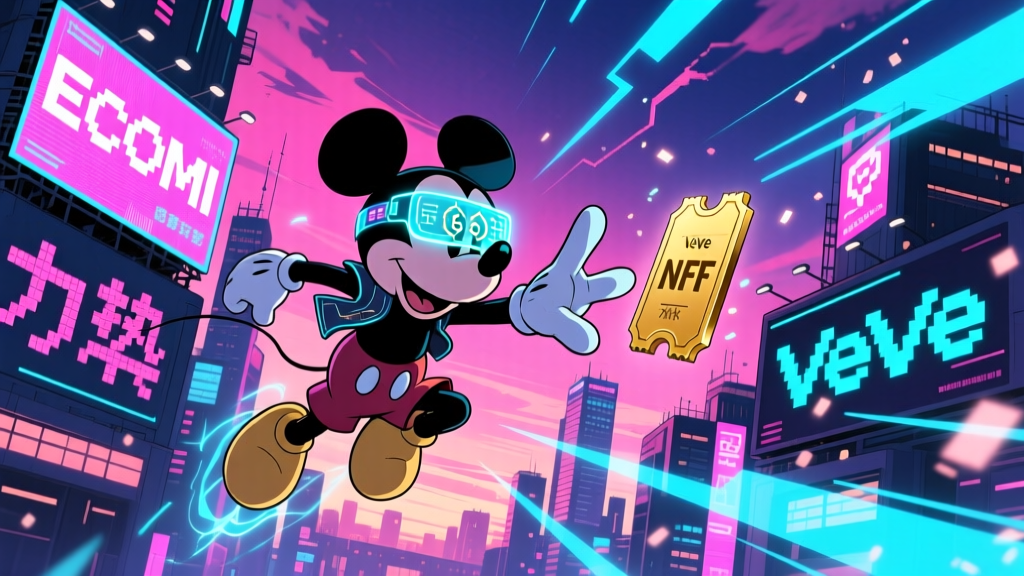
It started with a golden Mickey. In October 2021, ECOMI dropped a set of 3D digital collectibles called "Golden Moments" on their VeVe app. A limited-edition Mickey Mouse statue rendered in shimmering gold, viewable in augmented reality right on your living room table. It sold out in minutes. Resale prices on the secondary market spiked to over 2,000 OMI within days. For a lot of collectors who had never touched a crypto wallet before, that single drop was the moment digital collectibles stopped being a niche curiosity and started feeling like something real.
ECOMI is not a crypto startup that stumbled into pop culture. It is a New Zealand-based technology company that deliberately set out to bridge the gap between licensed entertainment franchises and blockchain-based ownership. The VeVe platform is the result: a mobile-first marketplace where you can buy, sell, display, and trade officially licensed digital collectibles from the biggest names in entertainment. Disney. Marvel. DC Comics. Universal. Sony Pictures. Paramount. Looney Tunes. Sesame Street. Ghostbusters. The roster reads like a who's-who of every fandom you have ever been part of.
What makes the platform interesting is not just the IP roster. It is the execution. VeVe does not ask you to understand blockchain. It does not throw wallet addresses or gas fees in your face. You download an app, browse a storefront, tap "buy," and suddenly you own a limited-edition 3D statue of Spider-Man that you can walk around in augmented reality. The blockchain part happens underneath, quietly, the way a credit card transaction happens underneath a tap at a coffee shop.
The Machine Behind the Curtain: What ECOMI Actually Built
ECOMI was co-founded by David Yu and Janice Taylor, with early involvement from Alfred Kahn, the entertainment licensing veteran who helped build the Teenage Mutant Ninja Turtles brand into a global phenomenon. That licensing pedigree mattered. When ECOMI started approaching studios like Disney and Warner Bros., they were not pitching a half-baked crypto experiment. They had a working product, a growing user base, and a legal framework that respected IP rights.
The VeVe app launched its public beta in early 2021. By mid-2022, it had accumulated over 1.5 million registered users and processed hundreds of millions of dollars in collectible sales. The platform migrated to Immutable X, an Ethereum Layer 2 scaling solution built specifically for NFTs. That move was significant: Immutable X offers gas-free minting and trading, which meant VeVe users could buy and sell collectibles without the transaction fees that plague Ethereum mainnet. For a platform where a $5 collectible sale needs to make economic sense, that mattered enormously.
VeVe by the Numbers (as of 2025 estimates):
- Over 2 million registered users across iOS and Android
- 70+ licensed brand partners
- 200,000+ unique collectible items minted
- Available in 170+ countries
- Secondary market volume exceeding $500 million in cumulative OMI transactions
The technical architecture is worth unpacking. Each VeVe collectible is a non-fungible token minted on Immutable X. Ownership is recorded on-chain, but the user experience is entirely custodial within the app until you decide to export to an external wallet. Collectibles come in several formats: static 3D models you can rotate and zoom, animated scenes with particle effects, and augmented reality experiences that place the object in your physical environment using your phone's camera.
Rarity Tiers and the Scarcity Engine
Every VeVe drop follows a structured rarity system, and this is where the collectibles psychology kicks in hard. Most drops include items across five rarity tiers:
- Common — Widely minted, accessible entry point, typically priced at the floor
- Uncommon — Moderate scarcity, slight price premium on resale
- Rare — Limited supply, meaningful secondary market value
- Ultra Rare — Small mint counts, often chased by serious collectors
- Secret Rare — Extremely limited, sometimes one-of-one variants, can command thousands of OMI
The rarity tier you get is determined at the moment of minting. You buy a blind box at a fixed price, and the blockchain randomly assigns you a rarity. It is the same dopamine loop as pulling physical trading cards from a wax pack, minus the cardboard and the disappointment of finding your eighth common in a row.
The Partnerships That Changed the Game
ECOMI's licensing strategy did not start small and hope to grow. They went straight for the top-tier IP holders, and remarkably, they got yes. Here is a breakdown of the major partnerships and what they have produced:
| Brand Partner | Notable Drops | First Drop Year | Estimated Total Editions |
|---|---|---|---|
| Disney | Golden Moments, Disney Classics, Pixar series, 100 Years of Wonder | 2021 | 500,000+ |
| Marvel | Spider-Man statues, Avengers series, X-Men, Deadpool, Moon Knight | 2021 | 400,000+ |
| DC Comics | Batman, Superman, Wonder Woman, Justice League, The Dark Knight Returns | 2021 | 350,000+ |
| Universal Pictures | Fast & Furious, Jurassic Park, Back to the Future | 2022 | 150,000+ |
| Sony Pictures | Ghostbusters, Spider-Man film series | 2022 | 120,000+ |
| Paramount | Star Trek ships, Mission: Impossible | 2023 | 80,000+ |
| Warner Bros. / Looney Tunes | Bugs Bunny, Daffy Duck, classic Looney Tunes scenes | 2022 | 100,000+ |
| Sesame Street | Elmo, Big Bird, Cookie Monster statues | 2022 | 60,000+ |
The Disney partnership is the anchor. When Disney launched their "100 Years of Wonder" celebration in 2023, VeVe was one of the digital platforms chosen to host officially licensed commemorative collectibles. That is not a small thing. Disney is notoriously protective of its brand licensing, and being selected as a digital partner for a centennial celebration signals a level of institutional trust that most crypto-adjacent companies cannot dream of.
The Marvel drops have been particularly aggressive. The platform released a series of highly detailed Spider-Man statues tied to various comic eras, including a Spider-Man: Into the Spider-Verse inspired piece that sold out within seconds of drop. Marvel's X-Men line has seen multiple waves, with characters like Wolverine, Storm, and Magneto receiving full 3D treatment with AR-capable display modes.
"We didn't want to be a crypto platform that happened to have characters. We wanted to be the best collectibles platform in the world, and blockchain was the technology that made true digital ownership possible." — David Yu, ECOMI co-founder, in a 2022 interview with Decrypt
Drops That Broke the Internet (Briefly)
Certain VeVe drops have become landmark moments in the digital collectibles space. The Marvel's Spider-Man "Covers" drop from 2021 offered digital recreations of iconic Spider-Man comic book covers as 3D collectibles. The drop attracted so much traffic that the VeVe app temporarily crashed under the load. Over 100,000 users were competing for editions that ranged from a few dollars to hundreds on the secondary market.
Then there was DC's Batman "The Dark Knight Returns" series. Based on Frank Miller's legendary 1986 graphic novel, the collection featured scenes rendered in the stark, high-contrast style of the original artwork. The Secret Rare variant of Batman in the armored suit sold for over 8,000 OMI on the secondary market at peak demand, roughly equivalent to several hundred dollars at the time.
The Disney Golden Moment Mickey deserves its own paragraph. This was the drop that put VeVe on the map for mainstream collectors. A shimmering, golden Mickey Mouse statue, meticulously modeled with individual fingers visible on the white gloves, wearing his classic red shorts. Place it in AR on your desk and walk around it, and the light reflections shift realistically. The common variant was affordable. The secret rare? There are collectors who would trade you a small car for it.
Comic-Cover Drops and the Nostalgia Factor
One of VeVe's smartest moves has been its comic-cover series. Rather than creating generic superhero poses, the platform licenses specific iconic comic book covers and recreates them as three-dimensional dioramas. Think of the cover of Amazing Fantasy #15 — Spider-Man's first appearance — but rendered as a fully rotatable 3D scene. You are not just owning a character model. You are owning a piece of comic book history, digitized.
These drops tend to attract a different kind of collector than the typical NFT crowd. These are people who grew up buying long boxes at comic shops, who know the difference between a Frank Miller Batman and a Jim Lee Batman by the line weight alone. VeVe found a way to give that collector demographic something they could not get from Funko Pops or Hot Toys: ownership of the actual cover art, in a format that cannot be counterfeited and does not degrade over time.
The OMI Token: Fuel for the Ecosystem
The OMI token is the native utility token of the VeVe ecosystem. It is an ERC-20 token on Ethereum (with bridging to Immutable X for in-app transactions). OMI serves several functions:
- Purchasing: Collectibles can be priced in OMI on the primary market during drops
- Secondary Market Trading: All peer-to-peer trades within the VeVe marketplace are denominated in OMI
- Staking: Users can stake OMI to earn rewards and gain early access to certain drops
- Governance: OMI holders have voting rights on certain platform decisions and future partnership directions
OMI launched in August 2021 on the Uniswap decentralized exchange. At its all-time high in late 2021, it traded at approximately $0.013 per token, giving it a fully diluted valuation exceeding $1 billion. Like most crypto assets, it experienced significant drawdowns during the 2022 bear market, dropping below $0.001 at its lowest point. The token has since stabilized, with a circulating supply in the tens of billions and a market cap that fluctuates with broader crypto sentiment.
Here is the practical reality of OMI: most VeVe users do not think about it the way crypto traders think about ETH or SOL. For the average collector, OMI is simply the currency inside the app. You buy some with a credit card, you spend it on collectibles, you maybe earn some by selling a duplicate. The tokenomics are complex on paper, but the user-facing experience is deliberately simple. ECOMI designed it that way on purpose, because asking a Marvel fan to understand tokenomics before they can buy a Spider-Man statue is a conversion funnel nobody wants to enter.
OMI Token Quick Facts:
- Token standard: ERC-20 (Ethereum), bridged to Immutable X
- Total supply: 78 billion OMI
- All-time high: ~$0.013 (November 2021)
- Listed on: Uniswap, Gate.io, BitMart, and several smaller exchanges
- Primary use case: In-app purchases and secondary market trading on VeVe
Augmented Reality: The Feature That Separates VeVe From Everything Else
Open the VeVe app and tap on any collectible in your collection. Hit the AR button. Point your phone at a flat surface. A life-size Iron Man helmet materializes on your coffee table. Walk around it. Crouch down and look up at it. The lighting responds to your environment. This is not a screenshot you can take with your phone camera — this is a real-time rendered 3D model anchored to your physical space.
The AR experience is arguably VeVe's most underappreciated feature. In a market where most NFT projects offer a JPEG and a Discord server, VeVe gives you something you can actually interact with in your living room. The rendering quality has improved substantially since launch. Early AR models were somewhat blocky and low-polygon. Current-generation VeVe collectibles feature subsurface scattering on skin, cloth simulation on capes, and particle effects that play out in your real environment.
The Showroom feature takes this further. You can arrange multiple collectibles into curated displays — imagine lining up the entire Avengers roster on your bookshelf, each one in their iconic pose, visible through your phone camera. Some collectors have built elaborate virtual dioramas and shared screenshots and videos on social media, creating a secondary layer of community engagement around the platform.
Display Cases and Virtual Shelves
For collectors who want to display their items without AR, VeVe offers a virtual showroom mode that works on any screen. You arrange your collectibles on customizable virtual shelves, adjust lighting, and share the setup with other users. It is the digital equivalent of a glass display cabinet, minus the dusting.
The showroom feature also introduced a social layer: other VeVe users can browse your collection (or the parts you choose to make public), leave reactions, and initiate trades. It turns collecting from a solitary activity into something with a community pulse. Not quite the same as walking into a comic shop and seeing what someone has on their shelf, but in the digital realm, it is the closest approximation yet.
The Collectibles Market: Where VeVe Fits in the Larger Picture
The global collectibles market was valued at approximately $370 billion in 2023, according to estimates from Allied Market Research. That figure encompasses everything from trading cards and action figures to stamps, coins, and sports memorabilia. Digital collectibles represent a small but rapidly growing segment within that total. A 2024 report by Grand View Research projected the blockchain-based collectibles market specifically to grow at a compound annual rate of roughly 24% through 2030.
VeVe occupies an interesting position in this landscape. It is not competing directly with OpenSea or Magic Eden, which are open marketplaces for any kind of NFT. It is not competing with Topps or Panini, which produce physical trading cards with digital tie-ins. VeVe sits in a lane that is closer to something like a digital-only Sideshow Collectibles or a virtual Hot Toys showroom: premium, officially licensed, brand-forward 3D collectibles with verifiable scarcity.
The comparison to physical premium collectibles is instructive. A Sideshow Collectibles Spider-Man statue costs $250 to $400. It sits on a shelf. It gathers dust. If you want to sell it, you ship it across the country and hope it does not break. A VeVe Spider-Man collectible costs $5 to $50 depending on the drop. You can view it in AR, rotate it, share it, and sell it instantly on the secondary market with zero shipping risk. The trade-off is obvious: you cannot physically hold it. For some collectors, that matters. For a growing number of younger collectors who grew up with digital skins in Fortnite and V-Bucks as pocket money, it does not.
"The next generation of collectors doesn't distinguish between physical and digital ownership the way older generations do. A skin in a game is as real to them as a card in a binder." — 2024 Deloitte Digital Consumer Trends Report
Competitive Landscape and Differentiation
VeVe's closest competitors in the licensed digital collectibles space include NBA Top Shot (Dapper Labs, focused on basketball highlights), NFL All Day (same company, football), and Autograph (Tom Brady's venture, covering multiple sports). But these platforms are primarily sports-focused. In the entertainment and pop culture space, VeVe has very little direct competition at its scale. The licensing moat is enormous — getting Disney, Marvel, and DC to sign off on a platform is not something a startup can replicate in a weekend.
There have been attempts. Various NFT projects have tried to build licensed collectibles around smaller IP holders, and some anime-focused platforms have emerged from Japan and South Korea. But none have assembled the cross-studio, cross-genre licensing portfolio that ECOMI has built. That portfolio is, in many ways, a more durable competitive advantage than any technology they have built. IP licensing agreements are multi-year, legally complex, and relationship-dependent. They cannot be forked.
Challenges and the Road Ahead
VeVe is not without its problems. The secondary market can be volatile. OMI's price fluctuations mean that a collectible worth $20 today might be worth $12 next week in dollar terms, even if its OMI price has not changed. Some collectors have expressed frustration with the blind-box mechanic, which they argue favors wealthy buyers who can purchase large quantities to chase rare variants. ECOMI has responded with "Fair Drop" mechanics that limit per-user purchases on high-demand items, but the tension between accessibility and scarcity-driven excitement is inherent to the collectibles model.
There is also the broader question of what happens to your collection if ECOMI were to shut down. While collectibles exist on Immutable X and can theoretically be exported to external wallets, the AR experience, the showroom, and the marketplace are all proprietary features that live on ECOMI's servers. Own your NFT, yes — but the experience around that NFT is platform-dependent. It is the same problem that plagues every digital ecosystem: you own the file, but not the viewer.
ECOMI has been working on expanding into new verticals. There have been hints of music-related collectibles, fashion brand collaborations, and deeper integration with the broader Immutable X ecosystem to enable cross-platform interoperability. The company has also explored "comic book" format collectibles — digital comics that you own as NFTs, readable within the app, with certain pages or panels available as standalone 3D collectibles.
What the OMI Ecosystem Means for Collectors Right Now
If you are sitting on the fence about VeVe, here is the honest assessment. The platform offers genuinely high-quality 3D models of characters you love, from franchises you have been collecting in physical form for decades. The AR feature is not a gimmick — it is a legitimately cool way to display your collection without needing shelf space. The licensing roster is unmatched in the digital space. The blind-box mechanic is either exciting or infuriating depending on your personality. And the OMI token adds a layer of financial complexity that some collectors enjoy and others tolerate.
For otaku culture enthusiasts specifically, VeVe represents something interesting: the first serious attempt to build a premium digital collectibles platform around the franchises that matter most to fans. Not pixel art generated by an algorithm. Not a monkey JPEG that costs $200,000. Actual, recognizable, beautifully rendered characters from the stories that shaped your childhood and adulthood, in a format that acknowledges how people actually consume and display culture in 2026.
The platform is not perfect. The crypto market is not kind. And the question of whether digital collectibles will ever fully replicate the emotional satisfaction of holding a physical figure in your hand remains open. But ECOMI has built something that, at minimum, takes the idea of digital ownership seriously. They have earned the trust of the most protective IP holders in entertainment. And they have given collectors a new way to engage with the characters they love, in a medium that did not exist five years ago.