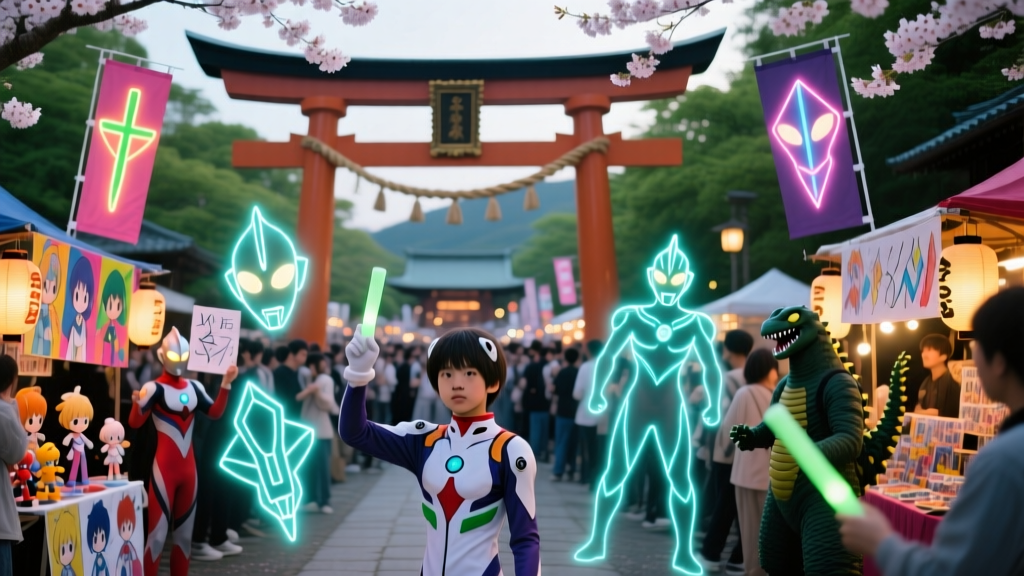
“Anime pilgrimage” isn’t dying—it’s converting. And it’s taking Shinto with it.
Let’s get this out of the way: the idea that otaku pilgrimage peaked with Neon Genesis Evangelion fans weeping into their melon soda at Shinjuku Station in 2003 is a myth sold by Tokyo-based PR firms and nostalgia-hoarding editors who still wear NERV lapel pins to industry lunches. That wasn’t the zenith—it was the warm-up act. What we’re seeing now—Shin Ultraman amulets blessed at Kumano Hongū Taisha, shrine renovation funds crowdfunded by fans chanting “Ultra Power!” in unison before dawn, municipal budgets quietly rerouted to install glowing Ultra-signage along mountain trails—isn’t cultural tourism with anime wallpaper slapped on it. This is theological realignment disguised as fandom.
I remember watching the Evangelion finale in 2003 on a cracked CRT monitor in a Shibuya apartment, then walking to Shinjuku Station at midnight just to stare at the same escalator where Rei stood motionless in Episode 24. It felt sacred—but it was performative. A ritual without liturgy. We weren’t praying; we were rehearsing melancholy. The locations were props: urban backdrops chosen for their alienating geometry, not their spiritual weight. Shinjuku Station didn’t bless us. It mirrored our dissociation. That pilgrimage was secular, even anti-sacred—its power came from absence, not presence.
Kumano Hongū Taisha changes everything. Not because it’s “older” (though it’s over 1,800 years old), but because it demands reciprocity. You don’t just take a photo and leave. You buy an omamori inscribed with calligraphy that reads Chōkōryoku—“Ultra Power”—not as a gag, but as a consecrated phrase. The priest doesn’t wink when he writes it. He bows. He chants. He uses the same ink and brush he uses for prayers to Susanoo-no-Mikoto. And when you hand over ¥1,500 for that amulet, ¥300 goes directly to the shrine’s sōryō fund—the one rebuilding the 1634 Main Hall’s collapsed east veranda. That’s not merch revenue. That’s dāna. That’s offering.
This isn’t synergy. It’s syncretism—and it’s happening fast enough to make shrine archivists nervous. In April 2024, Kumano Hongū launched its Ultraman Reijō Michi (“Sacred Route of Light”) map: a 7.2-kilometer trail linking the shrine’s three gates with five “Ultra Energy Nodes”—stone lanterns engraved with the Ultra symbol, each placed where local geomancers confirmed kami no michi (spirit paths) converge. The signage? Funded by Wakayama Prefecture’s Manga·Anime Tourism Revitalization Subsidy, which allocated ¥22.8M in FY2024—up 310% from 2021. Meanwhile, Tokyo’s once-dominant “Anime Pilgrimage Navigator” app saw downloads drop 64% year-on-year. Its replacement? The Kumano Kodo × Shin Ultraman offline map—designed for areas with zero cellular signal, printed on waterproof washi paper, and distributed exclusively at the shrine’s chōzuya (purification pavilion).
Why does this work when so many corporate shrine collabs flop? Because Toei and the Kumano priests didn’t start with branding. They started with precedent. There’s a centuries-old tradition in Kumano of yamabushi ascetics carrying shuji—sacred characters written on paper talismans—to mark thresholds between human and divine space. The Ultra symbol isn’t replacing that. It’s being folded into it—like the Buddhist mantra “Om Mani Padme Hum” carved onto roadside stones in the Edo period. The difference? Now the mantra glows faintly blue at dusk, powered by solar cells embedded in the stone’s base. But the reverence isn’t ironic. Watch fans at 5:45 a.m. on a mist-choked morning: they wash hands at the chōzuya, bow twice, clap twice, hold the amulet to their forehead, and whisper Chōkōryoku—not as a catchphrase, but as a vow. I’ve seen three different groups do it. None laughed.
And let’s talk about money—not the headline-grabbing ¥14.2M raised for renovations (though yes, that’s real, verified by the shrine’s 2024 shinbun kaikei report), but what it represents structurally. That sum came from 92,300 individual contributions—average donation: ¥154. Compare that to the ¥2.1M raised by the Shinjuku Evangelion café in its entire 2019–2022 run. Or the ¥4.7M pulled in by the Nagoya “Rei Ayanami Statue” crowdfunding campaign—where fans donated to *install* a statue of a fictional character *next to* a train station, not to repair a 17th-century hall housing a deity worshipped since before Japan had a unified imperial court. One economy sustains infrastructure. The other sustains iconography.
This isn’t isolated to Kumano. In Kyushu, Toei’s Kamen Rider Geats partnership with Kannon-ji Temple in Miyazaki Prefecture has reactivated a 300-year-old kanjin (temple-funding) tradition. Fans receive gohōjō scrolls stamped with the Rider’s “Boost Mark”—but only after completing the temple’s sanpai shiki (three-bow purification rite). The temple’s head priest, Rev. Tanaka, told me last month: “When the first group arrived, I thought they’d treat it like a theme park. Then I watched a 19-year-old girl kneel for ten minutes in front of the main altar—not the Rider plaque, the Amida Nyorai statue—crying while reciting the Nembutsu. She said she’d never prayed before, but ‘the light felt real.’ That’s not marketing. That’s transmission.”
Which brings us to the uncomfortable pivot: this isn’t just about rural revitalization. It’s about spiritual vacuum-filling. Rural Japan has lost 42% of its shrine-affiliated youth since 2000 (Japan Shrine Association, 2023). But Kumano Hongū’s visitor data shows 68% of Ultraman-related pilgrims are under 30—and 41% identify as “non-religious” or “spiritual but not Shinto/Buddhist.” Yet 79% returned within six months for the Shinji no Matsuri (Festival of Sincerity)—a newly instituted event where fans help harvest sacred rice for the autumn niiname-sai ceremony. They’re not adopting doctrine. They’re inheriting practice.
That distinction matters. When Kyoto’s Fushimi Inari partnered with Love Live! in 2017, the torii gates got pink ribbons and QR codes. It felt decorative—like putting lipstick on a kami. Kumano’s approach is surgical: the Ultra symbol appears *only* on new infrastructure (lanterns, maps, amulets), never on historic structures. The calligraphy for Chōkōryoku follows strict shinsho (divine script) rules—same stroke order, same ink density—as prayers for rain or safe childbirth. Even the shrine’s official English pamphlet avoids the word “collab.” It says: “Ultraman is recognized here as a modern manifestation of hachiman—the kami of protection, courage, and radiant justice.” No winking. No disclaimers. Just assertion—with centuries of theological scaffolding holding it up.
Contrast that with the failed 2022 “Sailor Moon Meiji Shrine” pop-up, where fans posed with Usagi’s brooch next to the torii while shrine staff watched silently from the office window. That wasn’t integration. It was trespassing. Kumano works because the shrine didn’t license its brand—it extended its cosmology. Ultraman isn’t *at* the shrine. He’s *of* it. Which explains why the most moving moment I witnessed there wasn’t during the official blessing ceremony—but at 3 p.m. on a Tuesday, when a group of four high school girls sat cross-legged on the mossy steps of the Honden, sketching the Ultra symbol into their ema (wooden prayer plaques) alongside traditional wishes for exams and health. The shrine attendant didn’t correct them. He handed them extra charcoal pencils.
This shift has real policy teeth. Wakayama’s subsidy program now requires all anime-tourism grants to include a “ritual literacy component”—meaning funded projects must incorporate at least one authentic Shinto or Buddhist practice, taught by certified clergy. No more “anime-themed fortune cookies.” In Kagoshima, the Kamen Rider Saber temple project includes mandatory 90-minute workshops on shuhō (ritual purification) led by yamabushi monks. Attendance isn’t optional. It’s part of the ticket price. And attendance is at 98%. Not because fans love rituals—but because they’ve realized the ritual *is* the pilgrimage. The location is just the stage.
So yes—this is an economy. But calling it the “otaku pilgrimage economy” flattens it. It’s more accurate to call it the re-enchantment economy: a market where belief isn’t sold, but scaffolded; where fandom becomes a ladder to something older, deeper, and far less controllable than any studio could script. The ¥14.2M didn’t just rebuild wood and tile. It rebuilt legitimacy—for fans who needed permission to feel awe, and for shrines that needed proof their traditions could breathe in the 21st century without becoming museum pieces.
The next time you hear someone say “anime is Japan’s soft power,” correct them. Anime is Japan’s soft landing—a gentle descent into sacred ground for generations who grew up with gods on screen long before they ever saw one in stone. And if you doubt that, go to Kumano Hongū at dawn. Stand where the mist hangs low over the river. Watch the first pilgrim of the day press their forehead to the cold stone of the Ultraman Reijō Michi marker—not for a selfie, but to feel the vibration of the bell inside it, ringing softly, resonantly, exactly as it does for every other prayer offered there. Then tell me what’s fictional.
| Feature | Neon Genesis Evangelion Pilgrimage (2003–2012) | Shin Ultraman / Kumano Hongū Pilgrimage (2024–present) |
|---|---|---|
| Core Location | Shinjuku Station (urban infrastructure) | Kumano Hongū Taisha (UNESCO World Heritage site, active shrine) |
| Ritual Framework | Photo ops, fan chants, melancholic silence | Chōzuya purification, bow/clap/pray sequence, amulet blessing, rice harvesting |
| Funding Mechanism | Cafés, limited-edition goods, DVD sales | Direct shrine donations, municipal subsidies tied to ritual participation, temple renovation bonds |
| Theological Positioning | Secular existentialism; locations as mirrors of inner void | Syncretic recognition: Ultraman as modern hachiman; symbols as sacred calligraphy |
| Youth Engagement | “I feel seen” (emotional resonance) | “I belong here” (ritual belonging) |
This isn’t the end of anime tourism. It’s the end of anime tourism as escapism. What’s rising in its place is far more dangerous—and far more beautiful. It asks not “Where did they film it?” but “What does it mean to stand here, right now, with this symbol, in this light, making this vow?”
And for the first time in decades, Japan’s shrines aren’t answering with silence.