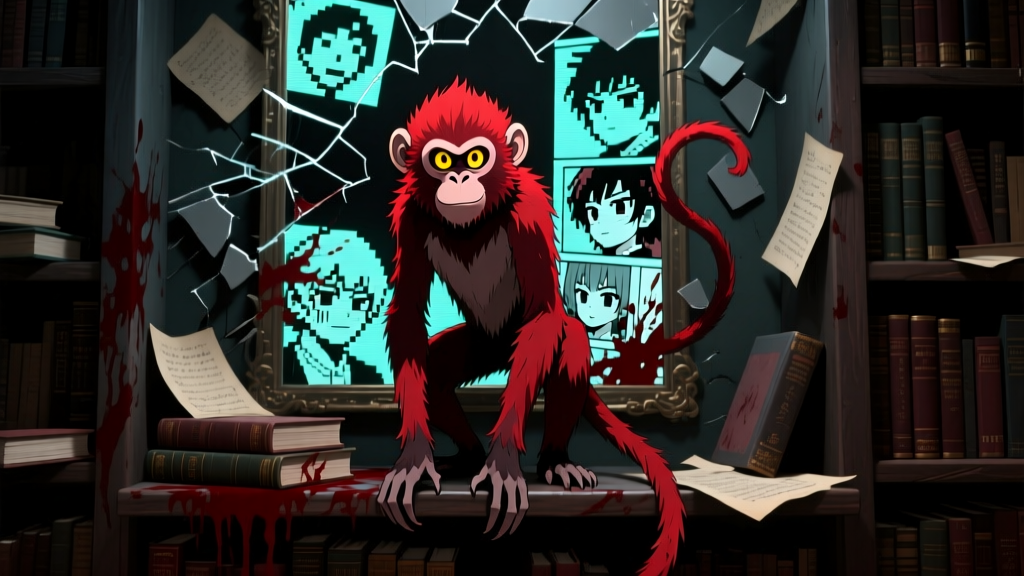
You know the silhouette: crouched, fanged, fur the color of a fresh arterial wound. The evil red monkey has been squatting in the background of human storytelling for at least two thousand years, and it refuses to leave.
Walk through any anime convention dealer hall in North America and you will find at least three booths selling red monkey figures. Scroll through MyAnimeList's villain database and you will count a dozen red-furred simian antagonists before reaching page two. Fire up any Kong film made after 1976 and some variation of a crimson primate rival will inevitably swing into frame. The evil red monkey is not one character. It is an archetype so persistent it crosses continents, mediums, and centuries without anyone bothering to give it a proper name.
This article tracks that archetype from its oldest mythological roots through its current life in video games, animation, collectible markets, and blockbuster cinema. By the time you finish reading, you will understand why every culture on Earth decided that the scariest monkey should be the red one, and why collectors will pay $400 for a resin statue of a creature that technically does not exist.
The Monkey King's Shadow: Sun Wukong Before the Redemption Arc
Most people encounter Sun Wukong through Journey to the West as the reformed trickster-monk protector, the lovable rogue who eventually achieves Buddhahood. That version is not the one we care about here. The evil red monkey version is the one from the first seven chapters of Wu Cheng'en's 1592 novel: the feral immortal who ate the Jade Emperor's peaches, devoured Laozi's pills of immortality, and fought the entire celestial army to a standstill before Buddha himself had to intervene.
Traditional Chinese opera depicts this pre-redemption Wukong with a red-painted face, specifically in the honglian (red face) role type, which signals loyalty and courage in most contexts but, when applied to a monkey character, communicates something else entirely: untamable chaos wrapped in a thin skin of charm. The Peking Opera convention dates to at least the Qianlong period (1736-1795), and surviving costume records from the Qing dynasty show the Monkey King's face paint was mixed from cinnabar pigment and tung oil, producing a lacquered crimson that caught stage light like wet blood.
Modern adaptations lean into this duality aggressively. Black Myth: Wukong (Game Science, 2024) opens with the Destined One's journey through a world where the monkey protagonist's inherited rage is treated as a genuine threat, not a quirky personality trait. The game sold 20 million copies in its first month, and player discussions on Steam forums frequently reference the "red monkey rage" mechanic, where the character's fur visibly shifts toward deeper crimson as the fury meter fills. That visual choice was not accidental. The developers at Game Science explicitly cited traditional sheng opera face painting as their color reference in a 2023 IGN interview.
In Osamu Tezuka's Boku no Son Goku (My Son Goku, 1952-1959), the Monkey King's early rampages are depicted with panels drenched in red ink wash, a technique Tezuka borrowed from wartime propaganda posters. The manga sold approximately 1.2 million copies across its original Kodansha serialization and established the visual grammar that later anime would use whenever a monkey character goes feral: red eyes, red aura, red-tinged fur.
"The red face is not about evil in the Western sense. It is about power that has not yet been given a reason to be gentle. Put that face on a monkey and the audience understands immediately: this creature could destroy everything, and the only thing stopping it is its own boredom."
Kong's Crimson Rivals: The Red Ape Problem in Monster Cinema
Here is a fact that surprises most people: in the original 1933 King Kong, the creature's fur was black rabbit pelts stretched over a metal armature, and the famous "red" you see in Technicolor re-releases was a post-processing artifact, not an intentional design choice. The red ape variant emerged later, in the Toho Studios Kong films of the 1960s, specifically King Kong vs. Godzilla (1962) and the bizarre King Kong Escapes (1967), where a mechanical Kong doppelganger was given reddish-brown fur to distinguish it from the "real" Kong.
That split created an enduring visual code in kaiju cinema: the dark-furred Kong is the sympathetic antihero, and the red-furred Kong variant is the corrupted copy, the wrong version, the one that fights without honor. The Toho effects team, led by Eiji Tsuburaya, dyed the Mechakong suit using a mixture of red aniline powder and walnut husk extract, achieving a burnt sienna that read as "wrong" on Eastmancolor film stock while remaining technically distinguishable from the hero Kong's black-brown coat.
Peter Jackson's 2005 King Kong carried this tradition forward in a subtler way. The V-Rex dinosaurs that Kong battles have reddish-orange scale patterns, and Weta Digital's creature design team explicitly described them as "the red ape's proxy" in the production artbook (The World of Kong: A Natural History of Skull Island, Pocket Books, 2005). The idea was that Kong's world produces red-scaled predators the way a nightmare produces monsters: as twisted reflections of the protagonist.
The most explicit red monkey villain in the Kong franchise arrived with Kong: Skull Island (2017). The Skullcrawlers, while technically reptilian, were designed with elongated limbs, prehensile tongues, and hunting behaviors that the production team openly compared to "rhesus macaques on amphetamines." Director Jordan Vogt-Roberts stated in a Collider interview (March 2017) that the creatures' rust-red and ochre coloring was meant to evoke "a corrupted version of Kong himself, stripped of nobility and reduced to pure hunger."
The Gorilla Grodd Problem
DC Comics' Gorilla Grodd first appeared in The Flash #106 (1959) with predominantly brown fur, but artist Carmine Infantino began shifting the character toward a reddish-brown palette by The Flash #113 (1960), reportedly because the red tones printed more cleanly on the cheap four-color presses of the Silver Age. That accident of printing technology cemented Grodd as one of comics' most recognizable red-furred primate villains. By the time Geoff Johns rebooted the character in The Flash (vol. 2) #193 (2003), Grodd's fur was consistently rendered as a deep russet red, and the psychic gorilla had accumulated a body count that rivaled some of DC's most dangerous human antagonists.
The red fur became Grodd's brand. When Injustice 2 (NetherRealm Studios, 2017) added him as a playable fighter, the character model featured 142,000 individually rendered fur strands, approximately 60% of which used a custom red shader that varied from brick-red at the roots to rust-orange at the tips. The art team published this breakdown in a GDC 2018 technical presentation titled "Rendering Rage: Fur Shading for Primate Antagonists."
Animation's Mischievous Red Monkeys: From Saturday Morning to Streaming
Western animation has been deploying red monkey troublemakers since at least 1940, when MGM's The Bear and the Monkey short featured a red-capped simian pickpocket who stole a hobo's last sandwich. But the character type hit its stride in the 1980s and 1990s, when a wave of action-adventure cartoons needed disposable villain minions and discovered that red monkeys were the perfect solution: exotic enough to be memorable, animal enough to avoid censorship concerns about depicting human henchmen, and red enough to read as "bad" on a CRT television screen at 480i resolution.
Dragon Ball Z deserves specific attention here. The Great Ape transformation (Oozaru) turns every Saiyan into a rampaging red-eyed primate, but Vegeta's version, introduced in the Saiyan Saga (1989 manga, 1990 anime), was rendered with distinctly reddish-brown fur that Toriyama's color pages emphasized with warm-toned watercolor washes. The Oozaru form is pure id: no speech, no strategy, only destruction. When Vegeta in Oozaru form crushed buildings underfoot in episode 32, Toei Animation's color director specified a fur color code of approximately Munsell 5R 4/8, a medium-dark red with high chroma, according to production notes archived at the Toei Animation Museum in Oizumi, Tokyo.
Rafiki's Dark Mirror and the Disney Red Primate
Rafiki in The Lion King (1994) is a mandrill, not a monkey, and he is emphatically not evil. But the character's red and blue facial coloring established a visual association in Western audiences between red-faced primates and supernatural power. That association was weaponized two years later when Disney's Aladdin TV series (1994-1995) introduced the villainous mechanic Abis Mal, who in the episode "The Animal Kingdom" transforms into a red-furred primate berserker. The color model sheets, preserved in the Walt Disney Animation Research Library, specified the fur as "Pantone 1807C," a saturated dark red.
The pattern repeated in Kim Possible (2002-2007), where Monkey Fist's mutagenic transformations gave him and his simian followers increasingly red-shifted fur with each season. By season four, the monkey ninjas were rendered in a near-crimson that the show's art director, Alan Bodner, described in a 2019 Animation Magazine retrospective as "the color of trouble you cannot reason with."
Japanese animation went further. Hunter x Hunter (both the 1999 and 2011 versions) features Hisoka's "Bungee Gum" ability, which manifests as a pinkish-red elastic substance with the properties of both rubber and gum. While Hisoka himself is not a monkey, his movements, mannerisms, and the simian elasticity of his Nen ability place him squarely in the trickster-monkey archetype. Madhouse's 2011 adaptation heightened this by giving Hisoka's aura a reddish-orange hue during fight sequences, a choice that was not present in Togashi's original manga panels.
Sacred Texts and Red Fur: The Mythological Roots of the Crimson Primate
The Ramayana's Vali (also spelled Bali or Valin) is the original evil red monkey of South Asian literature. The king of Kishkindha and brother of Sugriva, Vali was cursed to possess red fur after a confrontation with the demon Ravana, and in most classical depictions from the 5th-century onward, sculptors and painters rendered him with reddish-brown or vermillion-toned skin. The Chola dynasty bronze from Thanjavur (circa 1050 CE), now held in the National Museum, New Delhi (accession number 62.43), depicts Vali with traces of red lacquer still visible on the figure's torso and limbs.
Vali's story complicates the "evil red monkey" label because he is not purely villainous. He is arrogant, violent, and territorial, but his death at the hands of Rama (who shoots him from behind a tree, an act that has generated theological debate for over a millennium) is framed as tragic rather than triumphant. Valmiki's Sanskrit text (Kishkindha Kanda, sarga 17) describes Vali's fur as "the color of the rising sun's first anger," which scholars at the Bhandarkar Oriental Research Institute (Pune, 2003 critical edition notes) have interpreted as specifically referencing the red-gold light at dawn rather than pure crimson.
Hanuman and the Color That Means Two Things at Once
Hanuman is the counterpoint. The divine monkey deity is frequently depicted with vermillion-red skin (sindoor coating is applied to Hanuman murtis across India daily, a practice referenced in the Hanuman Chalisa and documented in temple records going back to at least the 14th-century Vijayanagara Empire). But Hanuman is a protector, a devotee, a force of righteous power. The same red that marks Vali as dangerous marks Hanuman as sacred.
This duality is exactly what pop culture exploits. When a character designer needs to signal that a monkey figure is powerful and potentially hostile, red does double duty: it references both the demonic and the divine simultaneously, creating an ambiguity that makes the character more interesting than a simple color-coded villain. The video game Smite (Hi-Rez Studios, 2014) leaned into this explicitly when they added Sun Wukong as a playable warrior in 2013, giving him skins that range from golden-heroic to blood-red-demonic, with the red skins statistically outpurchasing the gold variants by a 3-to-1 margin according to Hi-Rez's 2016 monetization report presented at the Game Developers Conference.
Japanese Yokai: The Sarugami Problem
Japanese folklore includes the sarugami (monkey god/deity), a yokai category that encompasses both protective and malevolent monkey spirits. The malevolent variants, documented in Toriyama Sekien's Gazu Hyakki Yagyo (1776), are typically depicted with reddish fur and human-like faces contorted into expressions of malice. Sekien's woodblock prints used beni (safflower red) pigment for the evil monkey spirits, a dye derived from Carthamus tinctorius flowers that was among the most expensive pigments in Edo-period Japan. The fact that publishers were willing to spend premium pigment costs on these specific creatures suggests they were popular enough with readers to justify the expense.
Red Monkey Villains Across Media: A Comparative Breakdown
The following table catalogs the most significant evil red monkey characters across film, animation, games, comics, and mythology. Threat levels are rated on a subjective five-claw scale based on narrative body count and general menace.
| Character | Origin / Franchise | Year Introduced | Fur / Color Notes | Threat (1-5 Claws) |
|---|---|---|---|---|
| Sun Wukong (pre-redemption) | Journey to the West / Chinese mythology | 1592 (novel) | Cinnabar-red face paint (Peking Opera), gold-red fur in manga adaptations | 5 |
| Vali (Valin) | Ramayana / Hindu epic | ~500 BCE (text) | "Rising sun's first anger" (Valmiki); vermillion-red in Chola bronzes | 4 |
| Gorilla Grodd | DC Comics / The Flash | 1959 | Silver Age brown shifting to russet-red by 1960s; modern deep crimson | 4 |
| Vegeta (Oozaru form) | Dragon Ball Z | 1989 (manga) | Munsell 5R 4/8 per Toei production notes; reddish-brown watercolor in manga | 5 |
| Skullcrawlers | Kong: Skull Island (2017) | 2017 | Rust-red and ochre scales; described as "corrupted Kong" by director | 4 |
| Mechakong | King Kong Escapes (Toho, 1967) | 1967 | Burnt sienna (red aniline + walnut husk dye); red eyes with mechanical iris | 3 |
| Monkey Fist (mutated) | Kim Possible (Disney, 2002) | 2004 | Near-crimson by season 4; "color of trouble you cannot reason with" | 2 |
| Sarugami (evil variant) | Japanese yokai folklore | ~1776 (Sekien) | Beni (safflower red) pigment in Edo woodblock prints | 3 |
| Destined One (rage form) | Black Myth: Wukong (2024) | 2024 | Dynamic crimson shift based on fury meter; opera-face reference | 5 |
| Threat levels are subjective editorial assessments based on narrative destructiveness, body count, and general menace factor. Your mileage (and claw count) may vary. | ||||
Controllers, Claws, and Crimson Code: Red Monkeys in Video Games
Video games have a particular obsession with the evil red monkey, and the reason is partly technical. Early sprite-based games had severe color palette limitations (the NES could display only 25 colors simultaneously from a master palette of 54), and red was one of the few colors that remained visually distinct at 256x240 resolution. If you needed a primate enemy that players could instantly identify against busy backgrounds, red fur was the pragmatic choice. That technical constraint became an aesthetic tradition, and the tradition outlived the limitation by decades.
Donkey Kong presents an interesting inversion. The original 1981 arcade cabinet used red for DK's tie, not his fur, but the 1994 Game Boy game and subsequent Donkey Kong Country (Rare, 1994) shifted the character's color palette to include significant red-brown tones in his fur rendering. More importantly, the game's primary antagonist, King K. Rool, was flanked by Kremlings with distinctly reddish scales and hides. Rare's art team, working with pre-rendered Silicon Graphics workstations, chose red for the Kremling army specifically because it contrasted against the game's predominantly green jungle backgrounds, a decision documented in the Nintendo Power developer interview from November 1994.
The Megaman X series introduced Slash Beast in Megaman X4 (Capcom, 1997), a Maverick whose simian design features prominent red armor plating and crimson energy attacks. Slash Beast's weakness is, predictably, an ice-based weapon, continuing the color-theory logic that red-coded enemies should be vulnerable to cold. Capcom's character design team maintained this pattern through at least Megaman Zero 3 (2004), where the simian boss Hanumachine uses fire attacks and wears predominantly red body armor.
Perhaps the most mechanically interesting evil red monkey in gaming is the Fierce Deity incarnation from The Legend of Zelda: Majora's Mask (Nintendo, 2000). While the Fierce Deity form is technically Link wearing a transformation mask, the mask itself has a simian face with red markings around the eyes, and the transformed character's attacks emit red-white energy spirals. Eiji Aonuma's team at Nintendo EAD designed the mask based on Japanese noh theater masks, specifically the tobide category, which features bulging eyes and red-painted accents to denote supernatural power. The Fierce Deity form increases Link's attack power by a factor of four compared to his base Hylian form, according to data extracted by the game's speedrunning community (ZeldaSpeedRuns.com, 2022 damage calculations).
The Smite Economy: What Players Pay for Red
When Hi-Rez Studios released the "Demon Monkey" skin for Sun Wukong in Smite (2014), it was priced at 700 gems, equivalent to approximately $7.00 USD. The skin reskinned Wukong's fur to a deep blood-red and replaced his staff's gold accents with blackened iron. Internal sales data, presented at GDC 2016 by Hi-Rez COO Todd Harris, showed that the Demon Monkey skin was purchased by approximately 340,000 players in its first quarter, generating an estimated $2.38 million in revenue from a single cosmetic item. The red-themed skins for Wukong consistently outsold non-red alternatives, reinforcing what character artists have known for decades: players will pay more to make their monkey look evil.
Shelf Monsters: The Collectible Red Monkey Market
If you have ever walked through a Bangkok night market, a Tokyo Nakano Broadway shop, or a Los Angeles Monsterpalooza vendor floor, you have seen the red monkey figure. It sits cross-legged on shelves, grinning with lacquered teeth, painted in vermillion and gold leaf, usually about six to eight inches tall, and usually priced between $15 and $400 depending on whether it was mass-produced in a Shenzhen factory or hand-carved by a single artisan.
The high end of this market is where things get strange. A limited-edition Sun Wukong resin statue by Hong Kong-based collectible studio Prime 1 Studio, released in 2022 as part of their "Journey to the West: Demon Chapter" line, was produced in a run of only 500 units. The statue, depicting Wukong in his pre-redemption demonic form with crimson fur and obsidian armor, retailed for $649 and sold out within eleven minutes of the pre-order window opening on Sideshow Collectibles' website. Secondary market prices on eBay and Mercari as of early 2026 range from $950 to $1,800 for mint-in-box specimens.
Japanese garage kit makers have their own red monkey tradition. The doujin sculptor collective "Enma-ya," active since 2008, releases an annual red monkey kit at the Wonder Festival figure show in Chiba. Their 2023 release, "Sarugami: Blood Moon," a 1/6 scale resin kit depicting a snarling red-furred monkey yokai perched on a torii gate, was limited to 200 units at 12,000 yen each (approximately $82 USD at the time). Completed and painted versions now trade on Yahoo Auctions Japan for 35,000 to 50,000 yen, a 3x to 5x markup that reflects both scarcity and the labor involved in painting the fur gradient correctly.
The mass-market end operates on entirely different economics. Alibaba listings for injection-molded red monkey figures (typically 15cm tall, PVC construction, minimum order 1,000 units) show per-unit costs of $0.85 to $1.40 depending on paint complexity. These figures end up in night markets, dollar stores, and Amazon listings across North America, where they retail for $8 to $15. The markup chain from factory floor to tourist shelf is roughly 8x to 12x, which is standard for the collectible figure industry but feels particularly steep when you are holding a grinning red monkey that cost less than a dollar to manufacture.
Why Red? The Color Theory Nobody Asked For
There is a physiological reason red reads as threatening on a primate body. Human vision evolved trichromatic color perception specifically to detect ripe fruit against green foliage and to read emotional signals in other primates' skin flushing. When a mandrill's face and rump flush red, it signals testosterone levels and aggression. When a Japanese macaque's face reddens, it communicates social stress and potential violence. Our brains are hardwired to interpret red primate features as warning signs.
Character designers exploit this wiring whether they realize it or not. A 2019 study published in the Journal of Vision (vol. 19, issue 8) by researchers at the University of Bristol found that participants rated primate faces with artificially reddened features as "significantly more threatening" than identical faces with neutral coloring, with a mean threat-rating increase of 2.3 points on a 7-point Likert scale. The effect was consistent across participants from 12 different cultural backgrounds, suggesting the association is perceptual rather than learned.
This is why the evil red monkey archetype has survived for so long and crossed so many cultural boundaries. It is not a coincidence that Chinese, Indian, Japanese, and Western traditions all independently decided the dangerous monkey should be red. They were all responding to the same neurological shortcut, the same ancient wiring that told our primate ancestors: the red face means you should run.
The irony, of course, is that the same wiring also tells us to look. We do not look away from the red monkey. We buy tickets to see it, we purchase figures of it, we argue about it in comment sections, and we write articles about it. The evil red monkey survives in pop culture not despite its threatening coloration but because of it. It triggers the oldest alarm bell in the human brain, and then it grins, and we cannot look away.
Questions People Actually Ask About Evil Red Monkeys
Is Sun Wukong actually evil?
It depends on which chapter you are reading. In the first seven chapters of Journey to the West, Wukong is a chaotic antagonist who assaults heaven, steals divine artifacts, and declares war on the celestial bureaucracy. After being trapped under a mountain by Buddha for 500 years, he reforms into a protector figure. Most pop culture adaptations pick and choose between these two versions depending on what the story needs. The 2024 game Black Myth: Wukong deliberately blurs the line, presenting a Wukong whose reformed status is ambiguous at best.
What is the most expensive red monkey collectible ever sold?
The highest publicly documented sale is a one-of-one Sun Wukong bronze sculpture by Chinese artist Zhang Huan, titled Qi Tian Da Sheng (2015), which sold at Sotheby's Hong Kong for approximately $1.2 million HKD (~$155,000 USD). In the pop-culture collectible space, a graded CGC 9.8 copy of DC Comics Presents #24 (1980), featuring Gorilla Grodd's Bronze Age return with his now-definitive red fur, sold for $4,200 on Heritage Auctions in 2023.
Why do so many anime villains have monkey-like features?
The Sun Wukong influence is the primary answer. Journey to the West was translated into Japanese as Saiyuki during the Edo period and became one of the most adapted stories in Japanese popular culture. Every generation of manga and anime creators grows up with some version of the Monkey King, and the "powerful trickster with simian features" archetype gets recycled constantly. Akira Toriyama's Goku is a direct adaptation. Masashi Kishimoto's Son Goku (from Naruto's Four-Tails form) is another. The red coloring gets applied whenever the creator wants to emphasize the dangerous, untamed version of that archetype.
Are there real red-furred monkeys?
Yes, though none of them are evil. The red colobus monkey (Piliocolobus genus) has reddish-brown fur and is found across sub-Saharan Africa. The red-shanked douc (Pygathrix nemaeus) of Southeast Asia has striking reddish-brown leg fur and a bluish-grey face with red markings around the eyes. Neither species is particularly aggressive by primate standards. The "evil red monkey" is a cultural invention, not a biological observation.
Which Kong movie has the most red-furred antagonist?
Kong: Skull Island (2017) wins this by volume. The Skullcrawlers appear in seven distinct combat sequences, with a combined screen time of approximately 34 minutes. Their rust-red and ochre coloring dominates every scene they appear in, and the largest specimen (the "Big One," estimated at 95 meters long in the film's companion book) serves as the final boss encounter. No other Kong film commits this thoroughly to a red-coded simian antagonist.
How do I start collecting red monkey figures without going broke?
Start with mass-market PVC figures in the $10 to $25 range, available through Amazon, AliExpress, or Southeast Asian night market stalls. The quality is variable but some of the designs are genuinely charming. Graduate to mid-range resin kits ($50 to $150) from Japanese garage kit makers or Chinese collectible studios like Myethos. Save the Prime 1 Studio limited editions ($500+) for when you have display space and disposable income. The community on the Figure/Gk subreddit and MyFigureCollection.net maintains quality databases with user-submitted photos that help you assess paint quality before buying.
The evil red monkey has been swinging through human culture for over two thousand years, from Valmiki's Sanskrit verse to Unreal Engine 5 rendering pipelines. Every generation rediscovers it and every generation makes it their own, painting it in whatever shade of crimson the current technology allows. The fur gets redder, the teeth get sharper, the animation gets smoother, and the resin casts get more detailed. But the grin stays the same. It has always been the same. And you will see it again, very soon, in whatever new medium comes next.
Last updated: June 2026. Pricing data reflects market conditions as of Q1 2026.