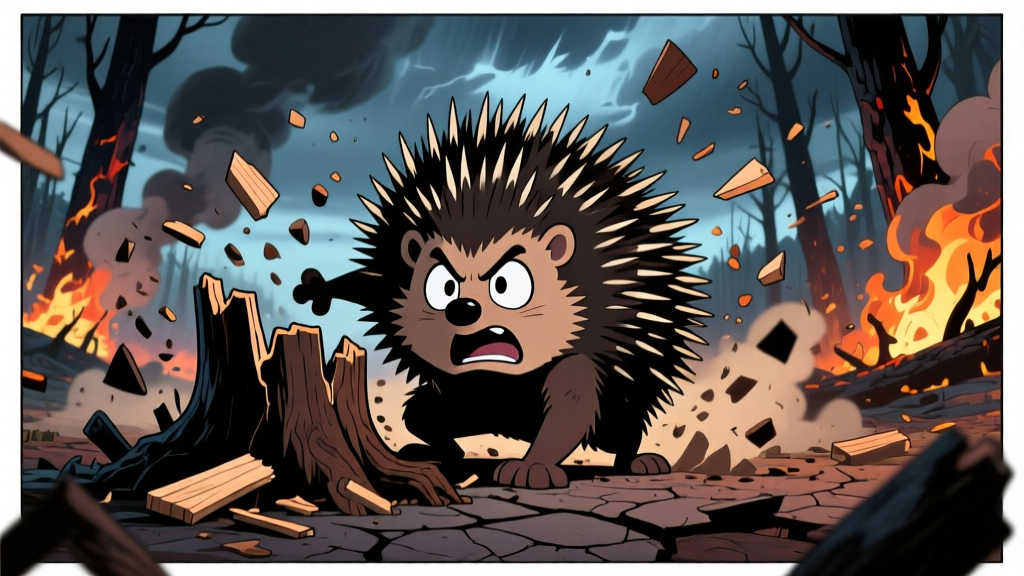
Picture this: a small, lavender-colored porcupine stands frozen at the edge of a diving board. Below, the water sparkles. Behind her, a cheerful bear waves encouragingly. Every instinct in her body screams don't do it. She trembles. She sweats. She takes one cautious step forward — and then her quills puncture the inflatable pool a friend is floating in. Chaos. Blood. The familiar ukulele jingle plays over the credits. That's Flaky in a nutshell, and that's why millions of people refuse to stop watching.
Happy Tree Friends is the animated show that shouldn't work. Cute woodland creatures. Grotesque, Rube Goldberg-style deaths. Almost no dialogue. It sounds like a stunt — and it started as one, back when the internet was young and Flash animation was king. Yet over 25 years later, characters like Flaky still show up on t-shirts, collectible shelves, and in the comment sections of Reddit threads with thousands of upvotes. Something about this show, and this particular porcupine, stuck.
This article is about why. We're going to walk through Flaky's history, her personality, the episodes that made her a fan favorite, the voice actresses who gave her a sound, the merchandise that keeps her visible, and the broader cult phenomenon that Happy Tree Friends became. If you've ever laughed at a cartoon animal getting decapitated by a ceiling fan and then felt vaguely bad about it — you're in the right place.
A Cartoon That Shouldn't Have Worked
Happy Tree Friends was born in 1999, the brainchild of Rhode Montijo, Kenn Navarro, and Aubrey Ankrum. The trio was working at Mondo Media, a San Francisco-based animation studio known for edgy Flash content. The pitch was simple: adorable characters in horrific situations. Montijo sketched a yellow rabbit — what would become Cuddles — getting mangled, and the concept clicked immediately.
The first shorts dropped on MondoMedia.com in December 1999. Each episode ran about 60 to 90 seconds. The format was rigid: introduce a cheerful scenario, escalate it through misunderstanding or bad luck, and end with at least one character dying in an absurdly elaborate way. No dialogue beyond gibberish vocalizations. No continuity. Just setup, punchline, carnage.
By 2001, Happy Tree Friends was pulling roughly 15 million views per month — a staggering number for pre-YouTube web animation. The show ran for 4 web seasons and 91 internet episodes before getting picked up by G4 for a television adaptation in 2006. The TV series, Happy Tree Friends and Friends, produced 39 half-hour episodes and introduced longer story arcs, guest animators, and slightly more ambitious production values.
The show's longevity surprised everyone involved. Mondo Media co-founder John Evershed noted in a 2008 interview with Animation World Network that Happy Tree Friends was originally expected to be a short-run project. Instead, it became the studio's longest-running and most recognizable property, outlasting dozens of other Flash-era series that have since been forgotten entirely.
Meet Flaky: The Porcupine Who Expected the Worst
Flaky is a porcupine — specifically, a small, lavender-bodied creature with a distinctive spray of quills on her back. Her design is clean and immediately recognizable: round body, oversized eyes that communicate perpetual anxiety, and those quills, which are as much a character trait as a visual marker. She's one of the original cast members, appearing in the earliest web episodes alongside Cuddles, Giggles, Toothy, and Lumpy.
Her defining characteristic is fear. Not just ordinary caution — Flaky operates at a level of paranoia that borders on the philosophical. She approaches every situation as though it's a trap. Swimming pools are drowning hazards. Baseball games are projectile disasters. Birthday parties involve candles, which means fire, which means death. And in the universe of Happy Tree Friends, she's not wrong. She's just the only character self-aware enough to recognize the pattern.
That's the central irony that makes Flaky work as a character: her paranoia is entirely justified. In a world where a loose thread can unravel into a woodchipper accident, being cautious isn't neurotic — it's rational. The comedy comes from the fact that despite being right about everything, her attempts to avoid danger often cause the very disasters she feared. She backs away from a lawnmower and falls into a thresher. She runs from a bee and straight into a bear trap. The universe punishes her for knowing too much.
"Flaky works because she's the audience surrogate. We all know something terrible is about to happen — she's the only character who acknowledges it. That makes her suffering funnier and more tragic than anyone else's." — Rhode Montijo, co-creator (paraphrased from Mondo Media behind-the-scenes commentary, 2004)
The Quill Problem
Flaky's quills deserve their own section because they function as both a personality device and a plot mechanism. In multiple episodes, her quills puncture, pierce, or impale — usually other characters, sometimes herself. They pop balloons, deflate inflatables, and turn ordinary interactions into minefields. In one episode, a character hugs her and gets perforated. In another, her quills act as accidental weapons during a panicked retreat.
The quills also create a subtle social dynamic. Flaky isn't antisocial — she wants to participate. She shows up at gatherings, tries to join games, and occasionally attempts to be brave. But her physical nature makes her dangerous to be around, which amplifies her isolation. It's a surprisingly layered character concept for a show where a moose regularly gets his antlers stuck in doorways.
Episodes That Made Flaky a Fan Favorite
With over 130 episodes across web and television, Flaky appeared in dozens of stories. But a handful of episodes cemented her reputation as one of the show's most compelling characters. These are the ones fans bring up in forum threads, the ones that get clipped and shared on social media, the ones that demonstrate what made Flaky different from the rest of the cast.
"The Wrong Side of the Tracks" (TV Series, 2006)
Flaky rides a roller coaster. That's the premise. She's terrified before it starts, terrified during, and — in classic HTF fashion — the ride goes catastrophically wrong. What makes this episode stand out is the extended buildup. Unlike most episodes where death arrives suddenly, here we spend several minutes watching Flaky's anxiety escalate in real time. Her facial expressions, her body language, the way she grips the safety bar — it's some of the most expressive character animation in the entire series. The payoff, when it comes, is both predictable and somehow worse than expected.
"Dentist's Office" (Web Series, 2000)
Flaky needs dental work. She's already terrified. The dentist — played by Lumpy, whose incompetence is a recurring gag — makes everything worse. This episode works because it taps into a universal fear and then escalates it to absurd extremes. Flaky's pre-appointment jitters are genuinely relatable. The dental disaster that follows is anything but.
"From Hero to Eternity" (TV Series, 2006)
This is one of the rare episodes where Flaky gets to be brave. Faced with a crisis, she overcomes her fear and attempts a rescue. It almost works. Almost. The episode is beloved because it plays with audience expectations — for a brief, shining moment, you think Flaky might actually get a win. She doesn't. But the attempt itself is what makes the episode stick in memory. It humanizes her in a way that pure suffering never could.
"Take a Hike" (TV Series, 2007)
A camping trip goes wrong. Multiple characters are involved, but Flaky's thread is the most tense. She spots danger early — a precarious cliff edge, a loose boulder — and tries to warn the others. They ignore her. The disasters play out exactly as she predicted. This episode nails the "Cassandra complex" aspect of Flaky's character: she sees the future, nobody listens, and she's punished for being right.
"A Hole Lotta Love" (Web Series, 2003)
Flaky tries to make friends at a construction site. Her quills cause a series of accidents involving cement, scaffolding, and a very unfortunate pigeon. It's a compact episode — under two minutes — but it packs in more gags per second than almost anything else in the catalog. The pacing is relentless, and Flaky's reactions sell every single beat.
Flaky by the Numbers
- First appearance: "Spin Fun Knowin' Ya" (1999)
- Total episode appearances: 60+ across web and TV series
- Death count: Approximately 18 on-screen deaths (varies by source)
- Kill count: Roughly 12 accidental kills of other characters
- Species: Porcupine (Erethizon dorsatum-inspired design)
- Primary voice: Nica Lorber (2001–present)
The Voices Behind the Quills
Happy Tree Friends characters don't speak in traditional dialogue. Their vocalizations are a mix of squeaks, gasps, whimpers, giggles, and screams — an expressive gibberish that conveys emotion without requiring translation. This made the voice work both simpler and harder than conventional animation. The voice actors had to communicate personality through tone and texture alone.
Flaky's voice has been performed by several actresses over the years, but the most significant contributor is Nica Lorber, who took over the role around 2001 and voiced Flaky through the majority of the web series and the entire TV run. Lorber's performance is defined by a specific quality: a tremulous, breathy anxiety that makes Flaky sound perpetually on the verge of tears. Her screams are distinctive — high-pitched, wavering, and layered with a sense of resigned inevitability that no other character in the show possesses.
Before Lorber, the role was handled by various Mondo Media staff in the earliest episodes, when voice credits were informal and roles were shared. Ellen Connell voiced Flaky in several early episodes, establishing the character's nervous vocal register. Sarah Castel also contributed voice work during a transitional period. But it was Lorber who defined the character's sound, and fans of the show associate Flaky's voice almost exclusively with her performance.
The voice direction for Flaky required a specific technique: Lorber would record multiple takes of the same vocalization at different intensities, and the sound editors would layer them to create the final track. A single scream in a finished episode might be a composite of three or four recordings, blended to achieve the right balance of terror and pathos. It's more craft than most people realize for a show about cartoon animals getting dismembered.
Collectibles and Merchandise: Flaky Beyond the Screen
Happy Tree Friends has been a merchandising staple since the early 2000s. The show's simple character designs translate perfectly to physical products — clean lines, bold colors, instantly recognizable silhouettes. Flaky, with her distinctive quills and lavender coloring, is one of the most popular characters in the merchandise lineup, consistently ranking in the top five alongside Cuddles and Lumpy in fan merchandise polls.
| Category | Price Range (USD) | Availability | Notable Examples |
|---|---|---|---|
| Plush Toys | $12 – $35 | Online retailers, conventions | Giantmicrobes HTF plush line (2008–2012) |
| Vinyl Figures | $8 – $60 | Specialty shops, secondary market | Kidrobot HTF vinyl series (2007) |
| Apparel | $18 – $45 | Hot Topic, online stores | Graphic tees with "Don't Panic" Flaky design |
| Digital Collectibles (VeVe) | $5 – $200+ | VeVe app, secondary NFT market | VeVe HTF animated statue drops (2022–2024) |
| Stickers & Pins | $3 – $12 | Conventions, Etsy, online shops | Enamel pin sets featuring Flaky expressions |
| DVD / Blu-ray Box Sets | $20 – $80 | Secondary market, collectors | Complete TV series box set (2008, now out of print) |
| * Prices reflect typical retail or secondary market values as of mid-2025. Rare or out-of-print items may command significantly higher prices. | |||
The VeVe collectibles platform has become a notable channel for Happy Tree Friends merchandise in recent years. VeVe, a digital collectibles app launched by Ecomi, partnered with various animation properties to release virtual figurines and animated statues. The HTF drops included several characters, with Flaky appearing in at least two release waves. These digital collectibles range from common editions priced at a few dollars to ultra-rare variants that trade for hundreds on the secondary market. Whether you consider them art or speculation is a separate conversation — but the fact that a 25-year-old Flash cartoon has a presence in the digital collectibles space says something about its staying power.
Physical merchandise has always been the core of HTF's commercial presence. Hot Topic carried Happy Tree Friends apparel in the mid-2000s, during the show's peak TV popularity. Kidrobot released a vinyl figure series in 2007 that included a Flaky figure — now out of production and sought after by collectors. The plush toy market was handled by several manufacturers over the years, with the Giantmicrobes collaboration being the most distinctive (they made HTF characters look like actual plush microbes, which was either genius or deeply unsettling depending on your perspective).
Fan Culture and the Cult That Won't Die
Here's what fascinates media analysts about Happy Tree Friends: it has no business still being relevant. The show hasn't produced new episodes since roughly 2016. Its original distribution platform — Flash-based web animation — literally ceased to exist when Adobe killed Flash Player in December 2020. The cultural moment that made HTF famous — the early 2000s internet — is now ancient history by digital standards. And yet.
The r/happytreefriends subreddit maintains an active community of over 70,000 members as of 2025. Fan art gets posted daily. Episode discussions generate hundreds of comments. New fans — people who weren't alive when the show premiered — discover the series through YouTube compilations and social media clips, and they latch on with the same intensity as the original audience.
Flaky occupies a specific niche within this fandom. She's not the most popular character — that title usually goes to Lumpy, the dim-witted moose whose stupidity causes more deaths than any other character, or Cuddles, the show's de facto mascot. But Flaky is consistently cited as the most relatable character. Fan surveys on the HTF wiki regularly rank her in the top three for "character you most identify with." The appeal is straightforward: in a world that seems designed to destroy you, being anxious isn't a flaw — it's a survival strategy.
The cosplay community has also kept Flaky visible. Her design translates well to costume work: the lavender coloring can be achieved with face paint and a wig, and the quills can be crafted from foam or felt. She's a common sight at anime conventions and horror-themed pop culture events, where HTF's blend of cute and grotesque fits naturally alongside properties like Invader Zim and Coraline.
Fan Content That Rivals the Original
The HTF fan art community is unusually productive. DeviantArt, which hosted much of the early fan content, still has thousands of Flaky-themed artworks archived. More recently, platforms like Twitter/X, Instagram, and TikTok have become the primary venues for fan creations. Animated tributes to Flaky — often in styles that mimic the original Mondo Media aesthetic — regularly accumulate tens of thousands of views. Some fan animators have produced shorts that rival the quality of the official episodes, a clear signal of how accessible the HTF visual style is to independent creators.
Fan fiction involving Flaky tends to explore a theme that the original show only touched on obliquely: what it would actually feel like to live in the HTF universe. Stories on Archive of Our Own and FanFiction.net imagine Flaky's internal monologue, her relationships with other characters, and her attempts to develop coping strategies for a world that kills her repeatedly. Some of these are genuinely well-crafted, and they point to something interesting about the show's legacy: it created characters compelling enough that people want to explore them beyond the confines of two-minute death gags.
How Flaky Stacks Up Against the Cast
| Character | Species | Personality Core | Death Frequency | Kill Frequency | Fan Role |
|---|---|---|---|---|---|
| Flaky | Porcupine | Anxious, cautious, paranoid | Moderate | Moderate (accidental) | Audience surrogate, relatable underdog |
| Cuddles | Rabbit | Cheerful, naive, trusting | Very High | Low | Mascot, most frequent victim |
| Lumpy | Moose | Dim-witted, well-meaning | High | Very High | Primary antagonist (unintentional) |
| Giggles | Chipmunk | Sweet, friendly, social | High | Low | Emotional anchor, fan favorite |
| Toothy | Beaver | Goofy, clumsy, eager | High | Moderate | Comic relief, frequent partner to Cuddles |
| Handy | Beaver | Capable, confident, practical | Moderate | Moderate | The "competent" one (ironically) |
| Flippy | Bear | Friendly, then violent (PTSD trigger) | Moderate | Very High (as soldier persona) | Dark horse favorite, meme icon |
| * Death and kill frequencies are qualitative estimates based on aggregate episode data from the HTF Wiki and fan databases. | |||||
The table above illustrates something important about how the HTF cast functions as an ensemble. Each character occupies a specific narrative role. Cuddles is the eternal victim. Lumpy is the unwitting destroyer. Flippy is the wildcard. And Flaky is the one who sees it all coming but can't stop it. These roles create a combinatorial system — any two characters paired together generate a predictable but entertaining dynamic, which is why the show was able to produce over 130 episodes with essentially the same formula.
Flaky's role as the "aware" character gives her episodes an extra dimension that other characters lack. When Cuddles dies, it's tragicomic — he never saw it coming. When Flaky dies, it's something closer to genuine tragedy — she did see it coming, she tried to prevent it, and it happened anyway. That distinction might seem trivial in a comedy about cartoon violence, but it's the reason Flaky has a dedicated fanbase while most other HTF characters are just "the one who dies a lot."
The Dark Comedy Formula: Why Cute Horror Sticks
Happy Tree Friends didn't invent the "cute characters in horrible situations" genre — that tradition goes back at least to Itchy & Scratchy on The Simpsons, and arguably to older traditions of slapstick and Grand Guignol theater. But HTF perfected a specific version of the formula for the internet age: short, punchy, shareable, and just transgressive enough to feel like something you shouldn't be watching at work.
The academic term for this appeal is "benign violation" — a concept from humor research (McGraw & Warren, 2010) that describes comedy arising from something that seems wrong or threatening but is simultaneously perceived as safe. Cartoon violence against cartoon animals triggers the violation response (it looks like suffering), but the obvious artificiality of the animation and the exaggerated sound effects signal that nothing real is being harmed. The brain resolves the conflict by laughing.
Flaky amplifies this effect because her fear response mirrors the audience's. When she screams, we feel a micro-version of that alarm. When the disaster turns out to be cartoonishly absurd rather than genuinely horrifying, the release is proportionally greater. She functions as an emotional amplifier — her anxiety makes the setup feel more tense, which makes the payoff feel more cathartic. Remove Flaky from the cast and the show still works, but it loses its most effective tension-building mechanism.
This is also why HTF has endured while dozens of imitators faded. The show understood that shock value alone has a half-life. The first time you see a cartoon rabbit get shredded by a helicopter blade, it's startling. The tenth time, it's expected. What keeps you watching past the tenth time is character — the personalities, the dynamics, the small variations in how familiar scenarios play out. Flaky, more than any other character, provided that emotional anchor. You weren't just watching a death scene. You were watching Flaky's worst day, again.
Common Questions About Flaky and Happy Tree Friends
Is Flaky from Happy Tree Friends a boy or a girl?
Flaky's gender was intentionally ambiguous in the early web series. However, the TV series and most official materials from 2006 onward refer to Flaky with female pronouns. The HTF wiki and fan community generally treat Flaky as female, though some long-time fans still debate the point based on early episode inconsistencies.
How many episodes of Happy Tree Friends feature Flaky?
Flaky appears in over 60 episodes across both the web series and television series. She's one of the most frequently featured characters in the cast, appearing in roughly half of all produced episodes. Her exact appearance count varies depending on how you classify cameo appearances versus full storylines.
Is Happy Tree Friends still making new episodes?
No new official episodes have been produced since approximately 2016. Mondo Media shifted focus to other projects, and the Flash animation ecosystem that originally supported the show no longer exists. However, the complete catalog remains available on YouTube, where individual episodes continue to accumulate millions of views. There has been no official announcement of a revival, though the creators have occasionally teased the possibility in interviews.
Where can I buy Flaky merchandise?
Physical merchandise like plush toys, vinyl figures, and apparel can be found on secondary markets like eBay and Mercari, at anime and pop culture conventions, and through independent sellers on Etsy. Digital collectibles have appeared on the VeVe platform. Official Mondo Media merchandise was previously sold through their online store, though availability fluctuates.
What makes Flaky different from other Happy Tree Friends characters?
Flaky's distinguishing trait is self-awareness. While other characters blunder into danger obliviously, Flaky anticipates disaster and tries to avoid it — usually failing. This makes her the closest thing the show has to an audience surrogate. She knows the rules of the universe she lives in, and her suffering comes not from ignorance but from powerlessness. That emotional dynamic gives her episodes a layer that most other characters lack.
Why is Happy Tree Friends rated TV-MA if it's a cartoon?
Despite its cartoon aesthetic and lack of dialogue, Happy Tree Friends contains graphic (albeit stylized) violence, including dismemberment, impalement, decapitation, and other forms of bodily harm depicted in detail. The TV series was rated TV-MA for these reasons. The show was never intended for children, despite its visual similarity to children's programming — which is precisely the point of the comedy.
What are VeVe collectibles and do they include Happy Tree Friends?
VeVe is a digital collectibles platform created by Ecomi that offers virtual figurines and animated statues from licensed properties. Happy Tree Friends has been featured in VeVe drops, including characters like Flaky, available as limited-edition digital statues. Collectors can display these in virtual showrooms within the VeVe app. Secondary market trading of these collectibles occurs through NFT-based ownership transfers.
The Porcupine Who Taught Us to Expect the Worst
There's a moment in the episode "Keepin' it Reel" where Flaky sits in a movie theater, watching a horror film. She's terrified. She covers her eyes. She peeks through her fingers. The other characters around her are having a perfectly normal time. Then something in the real world mirrors the movie, and the theater becomes a death trap. Flaky, who was already on edge, is the only one who reacts fast enough to try to escape.
She doesn't make it. She never does. But that moment — the covering of the eyes, the peeking, the desperate hope that maybe this time it'll be okay — that's the entire show compressed into a single gesture. It's why Flaky matters in a series that's ostensibly about creative ways to kill cartoon animals. She represents the part of us that knows the world is dangerous but keeps showing up anyway. She's brave in the only way available to her: she tries, even though she knows the odds.
Happy Tree Friends will probably never return with new episodes. The Flash era is over. The creators have moved on to other projects — Navarro worked on various animation properties, Montijo shifted toward independent projects, and Mondo Media pivoted to different content formats. But the catalog lives on. The YouTube channel still has subscribers discovering episodes for the first time. The subreddit still posts. And somewhere, at a convention you haven't heard of, someone is wearing a lavender t-shirt with a porcupine on it, and another person across the room recognizes it, and they smile at each other like they share a secret.
Flaky would hate that. She'd assume the person across the room was about to cause some kind of disaster. And honestly? Given the track record, she'd probably be right.