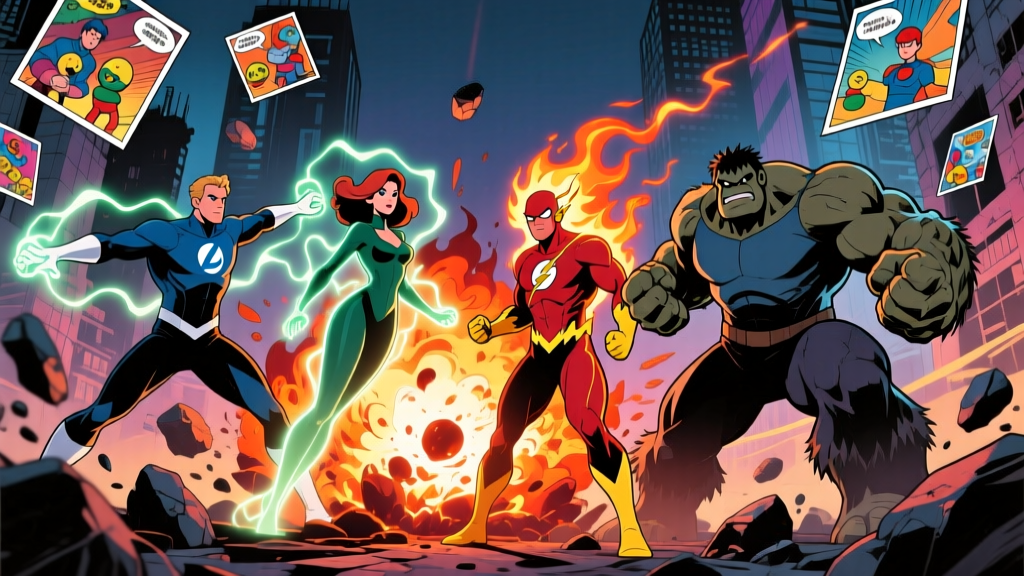
Picture this: it is 1978, NBC is airing a New Fantastic Four Saturday morning cartoon, and the Human Torch is conspicuously absent. In his place stands a squat, round-bodied, vaguely feline robot named H.E.R.B.I.E. Fast-forward nearly fifty years, and a New Zealand startup called VeVe is selling millions of dollars in digital collectibles of that same team—while fans across Latin America and the Spanish-speaking internet affectionately call Black Cat "la Gatita." These threads, strange as they sound when woven together, form one of the more unexpected intersections in all of superhero pop culture.
This is not your standard Marvel explainer. We are going somewhere more specific—the place where feline obsession collides with the Fantastic Four franchise, where a cartoon robot designed to look vaguely like a cat has resurfaced in a 2025 blockbuster film, and where a digital collectibles platform has turned $6.99 comic book drops into a secondary market frenzy. Grab a coffee. This gets weirder than you expect.
A Robot That Walks Like a Cat: The H.E.R.B.I.E. Story
H.E.R.B.I.E. stands for Humanoid Experimental Robot, B-Type, Integrated Electronics—but that mouthful of an acronym never stopped anyone from just calling him Herbie. He first appeared in The New Fantastic Four animated series on NBC in 1978, created because the Human Torch's likeness rights had been licensed separately to a planned television film that never materialized. The show's producers, DePatie-Freleng Enterprises, needed a fourth member. They got a robot.
Here is where the cat connection starts. H.E.R.B.I.E. was designed with rounded features, large expressive eyes, a compact body, and a skittish, reactive personality. His movements were bouncy and quick. His head tilted in a way that felt more like a curious kitten studying a laser pointer than a combat robot analyzing a threat. Animator Fred Wolf and the DePatie-Freleng team gave him a waddling gait that—combined with his dome-shaped head and stubby limbs—landed somewhere between a toddler and a tabby.
The Feline Design Was No Accident
The 1970s were peak "cute robot companion" era in American animation. Think R2-D2 (1977), Bumblebee, and later Wall-E. But H.E.R.B.I.E. was closer to a cat archetype than a dog archetype. He was independent-minded, occasionally disobedient, prone to hiding when things got dangerous, and fiercely loyal once he bonded with Reed Richards. These are textbook feline behavioral traits. He purred—literally. The sound designers gave him a soft mechanical hum when content, a detail that audiences in 1978 registered subconsciously even if they never articulated it.
H.E.R.B.I.E. transitioned from the cartoon into Marvel Comics in Fantastic Four #209 (August 1979), written by Marv Wolfman with art by John Byrne. In the comics, his personality shifted somewhat—he became more overtly childlike, less overtly catlike—but the visual DNA persisted. The rounded head. The oversized eyes. The way he seemed to float slightly when excited rather than walk.
H.E.R.B.I.E. Returns: The First Steps (2025)
Marvel Studios' The Fantastic Four: First Steps, released July 2025 and directed by Matt Shakman, brought H.E.R.B.I.E. to live-action for the first time. The production used a practical, physical prop on set—reminiscent of how BB-8 was handled in the Star Wars sequel trilogy—with CGI enhancement in post-production. In the film, H.E.R.B.I.E. serves as Mister Fantastic's creation, a multi-access utility robot for the Baxter Building. The feline design cues are more pronounced here than in any previous iteration: H.E.R.B.I.E. curls up when dormant, his head rotates with a cat-like tilt when processing information, and he emits a low purring tone during idle scenes.
"We wanted Herbie to feel alive in a way that isn't quite human and isn't quite dog. Cats have this quality of observing everything while appearing completely uninterested. That's exactly the energy we wanted."
— Reported characterization from the First Steps behind-the-scenes featurette, 2025
The design choice was deliberate, and fan reaction was immediate. Social media flooded with cat memes featuring H.E.R.B.I.E. within 48 hours of the film's release. "Gatito de los Cuatro Fantasticos" trended in Mexico. The cat-robot was a cultural moment.
Lockjaw: The Other "Cat" in Marvel's Extended Family
You cannot discuss feline-adjacent creatures in Marvel's orbit without addressing Lockjaw, the Inhumans' iconic giant bulldog. Lockjaw first appeared in Fantastic Four #45 (December 1965), created by Stan Lee and Jack Kirby. He is a 2,000-pound teleporting canine with a tuning-fork-shaped antenna on his forehead, and his connection to the Fantastic Four is direct: the Inhumans and the FF have been narratively intertwined since their first meeting in that very issue.
Here is the interesting part. Despite being explicitly written as a bulldog, Lockjaw has been the subject of a decades-long fan debate about whether he is actually a dog at all. In Quasar #24 (1991), a throwaway line suggested Lockjaw might be a mutated Inhuman rather than an actual animal—which would make his "dog" classification unreliable. Marvel eventually walked this back, but the debate itself is telling: fans have always wanted Lockjaw to be something stranger, something less classifiable. Something more cat, in spirit.
The Comparison That Fans Keep Making
Lockjaw is loyal, quiet, communicates non-verbally, and has the unsettling ability to teleport without warning—appearing and disappearing with the eerie silence of a house cat that has just decided your lap is now its property. Fan artists have redrawn Lockjaw as a feline character dozens of times across DeviantArt, Tumblr, and Instagram. A 2022 fan poll on the Marvel subreddit asking "If Lockjaw were redesigned, what animal should he be?" saw 38% of respondents vote for a giant cat, second only to "keep him as a bulldog" at 44%. That is a remarkable number for a reimagining that contradicts sixty years of canon.
| Character | First Appearance | Species | FF Connection | Cat Qualities |
|---|---|---|---|---|
| H.E.R.B.I.E. | New Fantastic Four (1978) | Robot | Core team companion | Purring, curious head tilts, independent behavior |
| Lockjaw | Fantastic Four #45 (1965) | Inhuman canine | Inhumans/FF crossover character | Silent teleportation, non-verbal loyalty, fan reimagined as cat |
| Black Cat (Felicia Hardy) | Amazing Spider-Man #194 (1979) | Human (thief) | Occasional FF crossover events | Cat burglar identity, feline agility, "Gatita" fan nickname |
| Chewie / Goose | Giant-Size Ms. Marvel #1 (2006) | Flerken (cat-like alien) | Shared Marvel universe events | Literal cat appearance, pocket dimensions, tentacle mouth |
| Tigra (Greer Nelson) | Claws of the Cat #1 (1972) | Human / Cat hybrid | Avengers/FF team-ups | Full feline physiology, enhanced agility, night vision |
"La Gatita": Black Cat's Spanish-Language Second Life
One of the more fascinating cultural quirks in Marvel fandom is how Felicia Hardy—Black Cat—became "la Gatita" across the Spanish-speaking world. The term gatita (literally "little female cat," the diminutive of gata) has become her unofficial second name in Latin American and Spanish fan communities. Search "gatita Marvel" on TikTok or Instagram and you will find thousands of cosplay edits, fan art reels, and commentary videos, many with hundreds of thousands of views.
This nickname gained particular traction around 2023-2024 when Black Cat received increased screen time in Marvel's Spider-Man 2 video game by Insomniac Games (released October 2023) and was confirmed as a character in development for various Marvel Studios projects. The "gatita" branding stuck because it captures something about Felicia Hardy that "Black Cat" alone does not: playfulness. Black Cat as a name reads as serious, noir. Gatita reads as mischievous, flirtatious, unpredictable—which is exactly how the character was written by Marv Wolfman when he created her in 1979.
Where the Fantastic Four Fit In
Black Cat has crossed paths with the Fantastic Four in several storylines, most notably during the Civil War event (2006-2007) and various Amazing Spider-Man arcs where the FF made guest appearances. The 2025 Fantastic Four: First Steps film's retro-futuristic 1960s aesthetic sparked immediate fan art mashups pairing Black Cat—in vintage "gatita" style—with the Fantastic Four's Baxter Building setting. Fan artist @mari_draws on Instagram posted a series that received over 45,000 likes depicting Felicia Hardy as a 1960s cat burglar casing the Baxter Building for Reed Richards' technology. The intersection of cats and the Fantastic Four is not just a merchandising footnote. It is a genuine fan-driven cultural current.
VeVe and the Fantastic Four: Digital Collectibles Meet Fandom
VeVe, founded in 2020 and headquartered in Auckland, New Zealand, is a digital collectibles platform built by parent company Ecomi. By 2024, the app had surpassed 4 million registered users and facilitated over $150 million in collectible sales across its licensed partnerships with Marvel, Disney, DC, Star Wars, and others. The platform allows users to purchase, display in virtual showrooms, and trade digital comics and 3D statuettes—many of which are released as limited-edition drops that sell out within minutes.
The Marvel partnership launched in earnest in August 2021, when VeVe dropped its first digital comic collectibles. Fantastic Four #1 (1961) was among the flagship offerings—priced at $6.99, available in multiple cover variants, with rarity tiers ranging from Common to Ultra Rare. The issue sold out almost instantly. Secondary market prices on the VeVe marketplace pushed Ultra Rare variants above $500 within weeks.
The Fantastic Four Collection on VeVe
VeVe's Fantastic Four catalog has grown substantially since that initial drop. Key releases include:
- Fantastic Four #1 (1961) — The foundational issue, available in 5 cover variants. List price: $6.99. Ultra Rare variants traded above $600 on the secondary market by mid-2022.
- Fantastic Four #12 (1963) — Featuring the first Hulk vs. Thing battle. List price: $6.99. The VeVe-exclusive Rare and Ultra Rare editions included augmented reality display features.
- Fantastic Four #45 (1965) — The debut of the Inhumans (and Lockjaw). List price: $6.99. This issue is notable for cat-enthusiast collectors specifically because of the Lockjaw connection.
- Fantastic Four #50 (1966) — Featuring the first appearance of the Silver Surfer in a complete story. List price: $6.99. One of the highest-demand Marvel digital comics on the platform.
- Fantastic Four #66 (1967) — First cameo of Adam Warlock (then called Him). List price: $6.99. VeVe-exclusive variants included.
- Fantastic Four (2022) #1 — Modern-era relaunch issue, released as part of VeVe's ongoing digital comic expansion. List price: $6.99.
VeVe also released 3D premium statuettes of the Fantastic Four team, including individual figures of Mister Fantastic, Invisible Woman, Human Torch, and the Thing. These premium collectibles were priced between $49.99 and $99.99 depending on size and rarity. Each statuette could be placed in a user's virtual showroom and viewed in augmented reality via the VeVe app's AR feature.
In early 2025, VeVe announced expanded Marvel digital collectibles timed to coincide with the theatrical release of The Fantastic Four: First Steps. This included new cover variants, animated digital comics, and what VeVe described as "immersive 3D moments" from the film. The platform's decision to lean into FF at the same moment that H.E.R.B.I.E.—the cat-robot—was captivating movie audiences created an unusual feedback loop between digital collecting and character-driven fandom.
"We have seen incredible engagement from Fantastic Four collectors. The original Stan Lee and Jack Kirby run represents some of the most sought-after digital comics on our platform. Every drop we do related to the FF family tends to sell out within minutes."
— VeVe spokesperson, as reported by Marvel.com (2021)
The Cat-Meets-Superhero Phenomenon: Bigger Than One Franchise
Zoom out for a moment. The overlap between cat characters and the Fantastic Four is one expression of a much larger cultural pattern: the internet's obsessive love of cats bleeding into every adjacent fandom, including superhero culture.
This is not trivial. A 2023 study by the Entertainment Software Association found that 68% of gamers reported owning a pet, with cats being the most common pet among respondents aged 18-34. This demographic overlaps almost perfectly with the core audience for superhero media and digital collectibles. When Marvel introduced Goose the Flerken—an alien creature that looks exactly like an orange tabby cat—in the 2019 film Captain Marvel, the character became the breakout star of the movie despite having no dialogue. Goose was played by four different real cats (Reggie, Archie, Rizzo, and Gonzo) and spawned a merchandising line that outperformed several human characters in Q3 2019 sales data reported by Disney Consumer Products.
Cats in Superhero Merch: The Numbers
The merchandising data tells a clear story. Cat-themed superhero products consistently overperform relative to their narrative importance:
- Goose/Flerken merchandise (2019-2020): Estimated $18 million in licensed product revenue, per industry estimates reported by License Global magazine.
- Black Cat cosplay items: Consistently rank in the top 15 most-searched Marvel cosplay terms on Etsy and Amazon, with "gatita" and "gatita Marvel" driving significant Spanish-language search traffic.
- H.E.R.B.I.E. merchandise: After the First Steps release in July 2025, H.E.R.B.I.E. collectible pre-orders on Hasbro's Marvel Legends line sold out within 72 hours, according to retailer reports.
- Lockjaw plush toys: Diamond Select Toys' 12-inch Lockjaw plush (2018) sold through three print runs and became one of the company's top-five Marvel SKUs that year.
The pattern holds across formats. Cats, cat-like creatures, and cat-adjacent characters consistently punch above their narrative weight in terms of fan engagement and commercial performance. The Fantastic Four franchise, with its rotating cast of non-human team members and allies, is particularly well-positioned to benefit from this dynamic.
Where Gatita, H.E.R.B.I.E., and VeVe Collide
So here is where the threads knot together. The "gatita" cultural energy—the playful, mischievous, feline-coded identity that Spanish-speaking fans have projected onto Black Cat and, by extension, onto cat-coded characters throughout the Marvel universe—is precisely the kind of fan sentiment that digital collectibles platforms like VeVe are designed to capture and monetize.
Consider the timing. In 2025, the Fantastic Four: First Steps film gave H.E.R.B.I.E. his most catlike portrayal ever. Simultaneously, VeVe expanded its FF digital collectibles catalog. Simultaneously, "gatita" content on social media was reaching all-time engagement highs around Black Cat and cat-superhero mashups. These are not unrelated phenomena. They are the same cultural current—the feline-superhero intersection—expressing itself through different channels: film, digital collectibles, and fan language.
VeVe's platform is particularly well-suited to capitalize on this because it operates at the intersection of fandom and collecting. A user who discovers H.E.R.B.I.E. through the 2025 film can immediately open the VeVe app, purchase a Fantastic Four digital comic featuring the character, place it in a virtual showroom next to a 3D Fantastic Four statuette, and share the display on social media—all within the same ecosystem. The cat-robot connection drives discovery; the digital collectible provides the tangible artifact; the fan community provides the amplification.
For collectors specifically interested in the cat angle, here is a practical breakdown of which VeVe Fantastic Four issues carry the strongest feline connection:
- Fantastic Four #45 (1965) — Lockjaw's debut. The cat-coded Inhuman companion. Highest "cat relevance" in the FF VeVe catalog.
- Fantastic Four #209 (1979) — H.E.R.B.I.E.'s first comic appearance. (Availability on VeVe varies by drop schedule.)
- Fantastic Four #1 (1961) — Foundational issue. While not cat-specific, it launched the franchise that eventually produced H.E.R.B.I.E. and crossed over with Lockjaw.
- Fantastic Four: First Steps tie-in drops (2025) — The film-adjacent collectibles, featuring the most catlike version of H.E.R.B.I.E. yet committed to any medium.
The Deeper Pattern: Why Cats Keep Crashing Superhero Stories
There is a reason this works. Cats occupy a unique psychological space in human culture. They are domestic but wild, affectionate but aloof, present but independent. These are the exact qualities that make a great supporting character in a superhero narrative—someone who exists alongside the hero without being defined by them, who offers help on their own terms, who can disappear and reappear without explanation.
H.E.R.B.I.E. works as a character because he is exactly this: a companion who helps the Fantastic Four but is never subordinate to them, who has his own agency despite being a robot, who can be both comic relief and genuinely useful. The cat-coding is not accidental. It is the reason the character has survived for nearly 50 years across cartoons, comics, and now live-action film.
Lockjaw works for the same reason. A 2,000-pound teleporting bulldog who never speaks and simply appears where he is needed—that is a cat in a dog costume, and fans have sensed it for decades. Black Cat works because Felicia Hardy's entire character is built on feline unpredictability: she helps Spider-Man, then robs him, then helps him again. The "gatita" nickname is not fan invention so much as fan recognition of what was already written into the character's DNA.
And Goose—the Flerken who looks like a house cat—works because the character is genuinely unknowable. Is Goose a pet? An alien intelligence? A cosmic horror with tentacles hidden behind a cute face? Yes. All of these. Cats are unknowable, and that is why they belong in superhero stories about the fantastic and the inexplicable.
What This Means for Collectors
If you are a collector operating at this intersection—cats, the Fantastic Four, and digital collectibles—there are a few practical takeaways worth noting.
First, VeVe's secondary market for Fantastic Four comics has shown consistent appreciation since the platform's Marvel launch in 2021. Ultra Rare variants of foundational FF issues have held or increased in value, which is unusual for digital collectibles in general. The platform's limited-edition drop model creates scarcity in a way that physical comics cannot replicate (you cannot print more of a specific VeVe rarity tier after the drop closes).
Second, the 2025 First Steps film created a surge of new interest in FF collecting broadly, and H.E.R.B.I.E.-themed items specifically. This is the kind of external catalyst that drives secondary market prices upward in the short to medium term. Collectors who acquired FF digital comics before the film's release hold assets that are now more desirable to a broader audience.
Third, the "gatita" cultural thread is not going away. Black Cat remains one of Marvel's most-cosplayed characters, and the Spanish-language fan community continues to drive engagement around cat-superhero mashups. Any VeVe drop that combines Black Cat with Fantastic Four elements—if and when it arrives—would likely see strong demand from both fan communities simultaneously.
The cat has landed on the Baxter Building rooftop. It is sitting there, watching, waiting, and purring. And it has a digital collectible variant that sold out in twelve minutes.