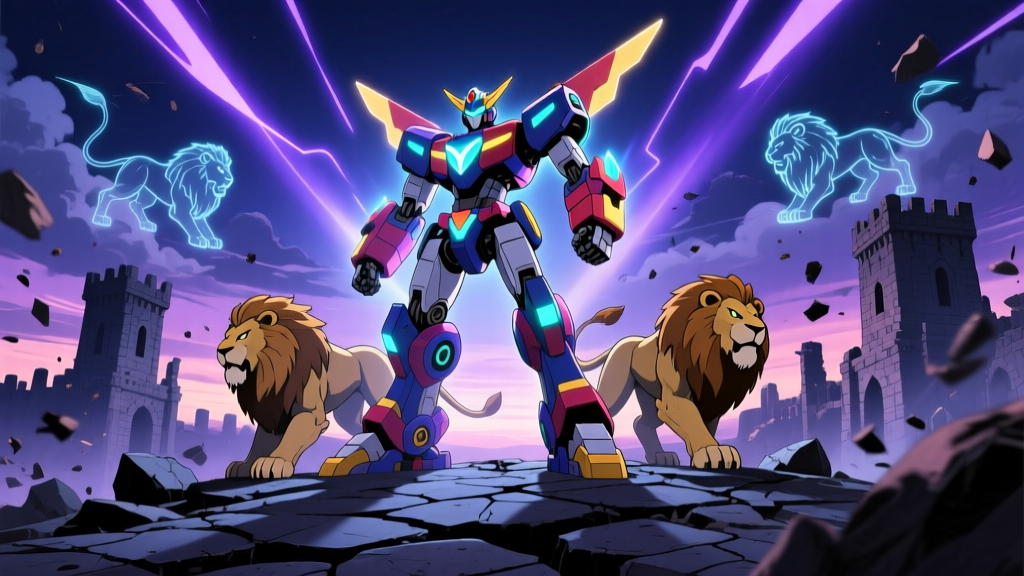
Picture this: five mechanical lions roaring through the vacuum of space, trailing energy contrails as they lock together limb by limb, plate by plate, until a hundred-meter-tall humanoid stands ready to swing a blazing sword at a Galra warship. The sequence lasts maybe forty-five seconds on screen, but it carries the weight of a franchise that stretches back to 1984. When Voltron: Legendary Defender premiered on Netflix in June 2016, it had to do something few reboots manage successfully — honor a beloved property while rebuilding it from the chassis up for a generation raised on Attack on Titan and Pacific Rim.
The voltron legendary defender robot wasn't just a nostalgia play. It was a full mechanical and artistic reinterpretation handled by one of the most respected animation studios working in television, and the results changed how Western audiences think about combining mecha on screen. This is the deep breakdown of that machine — the lions, the forming choreography, the collectibles it spawned, and the ripple it sent through the genre.
Five Lions, Five Design Philosophies
Any conversation about the Voltron Legendary Defender robot starts with the lions. Production designer Joaquim Dos Santos and the team at Studio Mir gave each lion a silhouette distinct enough to identify in a single frame, even at wide battle-zoom. That sounds basic, but it's a harder problem than it appears — the original 1984 Beast King GoLion designs (by Takuo Suzuki for Toei Animation) used nearly identical body proportions across all five lions, differentiated mainly by color.
Black Lion got the sleekest profile of the group, with a narrow muzzle, swept-back mane plating, and a torso-to-leg ratio that telegraphed speed. It formed the torso and head of Voltron, which meant its cockpit sat in the chest cavity — a deliberate choice to make the "heart" of the team literally the heart of the robot. Red Lion became bulkier, wider through the shoulders, and served as the right arm. Its cockpit was positioned in what would be the elbow joint, giving Keith a first-person view down the length of the fist he was controlling.
Green Lion was the most radical departure from the classic design. Studio Mir gave it a distinctively feline, almost panther-like stance with digitigrade hind legs. It formed the right leg. Yellow Lion, the heaviest of the five, was redesigned with a bulldog-like stockiness and a broader jaw, becoming the left leg. Blue Lion kept the most recognizable profile from the original series — long neck, regal bearing — and formed the left arm.
Color Coding and Visual Readability
The color palette was pulled from the original five — black, red, green, yellow, blue — but Studio Mir shifted the saturation and added metallic panel-lining detail that didn't exist in the cel-animated 80s versions. The lions' armor plating got a gunmetal undercoat visible at the joints, which made the forming sequence read as mechanical assembly rather than a magical transformation. Each lion's eyes glowed in its respective color when activated, a small touch that paid off enormously in dark-scene cinematography.
"We wanted the lions to feel like actual machines that pilots climbed into, not toys that clicked together. Every seam, every panel gap was drawn to sell the idea that this thing weighs thousands of tons." — Joaquim Dos Santos, co-executive producer, in a 2017 interview with Animation Magazine
The Forming Sequence: Forty-Five Seconds That Cost a Fortune
Here's where Studio Mir flexed hardest. The forming sequence in Legendary Defender wasn't a recycled stock shot — it was re-animated from multiple angles across the first two seasons, with each iteration adding new mechanical details. The camera follows the lions in a continuous tracking shot: Blue and Yellow fold into the legs first, Red and Green lock on as arms, and Black rises from the center to form the torso and head. The entire process was choreographed to feel physically plausible, with each piece sliding, rotating, and clicking into place with mechanical precision.
The sequence ran roughly 45 seconds in Season 1, but by Season 3 it had been trimmed and refined as the team's animation pipeline matured. Studio Mir reportedly spent 3–4 weeks per forming sequence in early episodes, compared to roughly 1 week for standard battle animation. That cost differential explains why later seasons used abbreviated versions — the budget needed to go toward the increasingly complex mecha battles against Haggar's robeasts and Lotor's Sincline ship.
Sword Activation and the Bayard System
One of the smartest mechanical additions was the Bayard system — each paladin carried a personal weapon that doubled as the activation key for Voltron's weapons. When all five Bayards were inserted into the cockpit console, the blazing sword materialized from the chest plate. This wasn't in the original series, where the sword just... appeared. The Bayard mechanic added a ritual element to the fights: before Voltron could go all-out, every pilot had to commit. It's a small narrative device, but it gave the forming sequence an emotional payoff beyond the visual spectacle.
The blazing sword itself got a redesign. The original 1984 version was a simple broadsword with a cross-guard. Legendary Defender gave it a segmented blade that unfolded from the chest housing, with energy running along channels in the metal. When fully charged, the blade glowed with a blue-white light that became one of the show's most recognizable visual signatures.
From GoLion to Legendary Defender: What Changed in 32 Years
Understanding the Voltron Legendary Defender robot means understanding what it replaced. The 1984 Voltron: Defender of the Universe was assembled by World Events Productions from two separate Japanese anime: Beast King GoLion (the lion Voltron) and Dairugger XV (the vehicle Voltron). The animation was produced by Toei, and the combining sequences were relatively simple — stock footage reused across dozens of episodes with minimal variation.
By contrast, Legendary Defender was produced as a single unified show from the start, animated entirely by Studio Mir in Seoul. The studio had already built its reputation on The Legend of Korra (2012–2014), where they demonstrated an ability to handle complex choreography and elemental effects at television budgets. Voltron was their biggest contract to date: 78 episodes across eight seasons, released between June 2016 and December 2018.
| Design Element | 1984 GoLion / Classic Voltron | 2016 Legendary Defender |
|---|---|---|
| Animation Studio | Toei Animation (Tokyo) | Studio Mir (Seoul) |
| Number of Lions | 5 (identical proportions) | 5 (distinct silhouettes per lion) |
| Forming Sequence | Stock footage, ~12 seconds | Custom-animated, ~45 seconds (S1) |
| Armor Detail | Flat color blocks, minimal line work | Gunmetal undercoat, panel-lining, joint seams |
| Sword Design | Static broadsword, appears from nowhere | Segmented blade, unfolds from chest housing |
| Weapon Activation | No in-universe mechanic | Bayard system (pilot-committed activation) |
| Height (in-universe) | Never consistently stated | Approximately 100 meters (per show bible) |
| Cockpit Location | Inside Black Lion's head | Inside Black Lion's chest cavity |
| Total Episodes | 124 (combined from two anime) | 78 (8 seasons, Netflix) |
The differences go deeper than surface cosmetics. The classic Voltron rarely showed battle damage — the toy-friendly aesthetic demanded a pristine robot. Legendary Defender regularly depicted Voltron getting torn apart: losing limbs mid-fight, leaking what appeared to be coolant or hydraulic fluid, and in one memorable Season 6 sequence, having the Green Lion's leg sheared off entirely by a Galra dreadnought's beam weapon. The damage was always repaired between episodes, but showing it at all was a statement: this machine fights, and fighting has costs.
Studio Mir's Animation Pipeline: How They Pulled It Off
Studio Mir's process for the mecha sequences combined traditional 2D animation with digital compositing techniques borrowed from film VFX. The lions and Voltron were drawn by hand in Toon Boom Harmony, but the energy effects — the forming contrails, the sword glow, the shield projections — were composited as separate layers using particle systems in After Effects.
This layered approach allowed the team to reuse mechanical drawings while swapping out energy effects per scene, which was critical given the show's production schedule. A typical episode required roughly 12,000–15,000 individual drawings, with mecha-heavy episodes pushing toward 18,000. For context, a standard TV anime episode in Japan averages around 4,000–5,000 drawings. Studio Mir was producing at roughly three times the density of a typical anime episode, and they were doing it for a Western streaming schedule that demanded all episodes drop simultaneously.
The Season 7 Redesign
When the team's lion (Green) was temporarily lost in the Season 6 finale, the show introduced a replacement configuration: the Atlas configuration, with a new lion called the "Green Lion II" or sometimes referred to by fans as the "Atlas Lion." This redesign gave Voltron a noticeably different silhouette — broader shoulders, a different head crest, and a new color accent on the right leg. It was a risky move from a branding perspective, since the five-lion silhouette was arguably the show's most marketable image. But it paid off narratively: the audience felt the absence of the original team configuration, and the reformed Voltron carried visible evidence of loss.
Collectible Figures: From Mass-Market Toys to Premium Displays
The merchandising around the Voltron Legendary Defender robot followed a trajectory that mirrors the show itself — starting accessible and getting progressively more detailed and expensive.
Playmates Toys (2016–2018)
Playmates held the master toy license for the show's initial run. Their flagship product was the 15-inch forming Voltron set: five individual lions that physically combined into the robot. Retail price hovered around $59.99 for the complete set. The engineering was legitimate — each lion had its own molded plastic body with spring-loaded joints, and the combining mechanism used a peg-and-slot system that was sturdy enough for actual play. The trade-off was aesthetic: the combined Voltron looked blocky and simplified compared to the on-screen design, with proportions that skewed toward the classic 1984 toy rather than the sleek Studio Mir version.
Playmates also released die-cast metal replicas, deluxe light-up versions, and a "Super Voltron" set that included additional armor attachments. Total SKU count for the Voltron Legendary Defender toy line exceeded 40 individual products by the end of 2018.
Premium Collectibles: Diamond Select and Beyond
For the collector market, Diamond Select Toys produced a 10-inch "Gallery" figure that much more closely matched the show's actual proportions. Priced at approximately $79.99, it featured die-cast joints, a display stand, and paint applications that replicated the panel-lining detail. This is the figure most serious Voltron collectors point to as the definitive Legendary Defender representation.
After the show concluded in 2018, the secondary market for these figures spiked. A sealed Playmates 15-inch forming set that retailed for $59.99 routinely sold for $180–$250 on eBay by 2021. The Diamond Select Gallery figure appreciated more modestly, landing in the $120–$150 range for mint-in-box specimens.
- Playmates 15" Forming Set — $59.99 retail / $180–250 secondary (2021–2025)
- Diamond Select Gallery Figure — $79.99 retail / $120–150 secondary
- Playmates Die-Cast Collection — $24.99 per lion / $90–130 full set secondary
- Super Voltron Deluxe Set — $89.99 retail / $200–300 secondary
Impact on the Mecha Genre: A Western Studio's Argument with Tradition
Here's the part that's easy to overstate, so let me be precise. Legendary Defender did not reinvent combining mecha. That credit still belongs to the Japanese studios that developed the genre across the 1970s and 80s — Getter Robo (1974) pioneered the concept of combining machines, and GoLion itself was a direct product of that tradition. What Legendary Defender did was demonstrate that a Western-produced show, animated by a Korean studio, could handle mecha choreography at a level that satisfied hardcore fans while also building a new audience that had never heard of GoLion.
The show's success on Netflix — it consistently ranked in the platform's top 10 animated shows during each season's debut week, according to data reported by Variety in 2017 — helped greenlight a wave of mecha-adjacent Western productions. Voltron proved there was an audience, and that audience was more demographically diverse than the genre's traditional base. Internal Netflix viewership data, partially disclosed at the 2018 Animation Is Film festival, indicated that roughly 38% of Legendary Defender's audience was female — a number significantly higher than the industry assumption for mecha properties, which typically skewed 70–80% male.
What the Show Got Right About Combining Mecha
The show's approach to the combining mechanic offered three lessons that subsequent productions clearly absorbed:
- Make the combination a character moment, not just a power-up. The forming sequence in Legendary Defender required all five paladins to be in sync — emotionally, not just physically. When the team was fractured (as in the Season 2 arc where Keith and Shiro's conflict destabilized the bond), Voltron physically failed to form completely. The robot reflected the team's state, which is a trick borrowed from Neon Genesis Evangelion but applied to a much broader audience.
- Show damage. As discussed earlier, the willingness to depict Voltron taking hits, losing parts, and getting repaired made the robot feel like a real machine rather than an invincible icon. This directly influenced the approach in Pacific Rim: The Black (2021), where the Jaegers show accumulated wear across episodes.
- Keep the individual units interesting. Each lion fought independently before combining, which meant the show could stage compelling mecha combat even when the full Voltron formation wasn't available. This modular approach to mecha storytelling has since appeared in SSSS.Dynazenon (2021) and Gundam: The Witch from Mercury (2022), where individual mobile suits carry narrative weight outside of any combining mechanic.
The Studio Mir Factor
It's worth noting how unusual the production arrangement was. Studio Mir, founded in 2010 by Jae-Myung Yu, had worked primarily as a service animation studio before The Legend of Korra. With Voltron, they were essentially the co-creative partner — Dos Santos and co-showrunner Lauren Montgomery gave the studio enormous latitude in mechanical design and action choreography. The studio's Seoul team included mecha specialists who had grown up on Gundam and Macross, which gave the fight sequences an authenticity that Western-only productions typically lacked.
By the time the show wrapped its 78th episode in December 2018, Studio Mir had produced over 1.2 million individual animation drawings for the series. The mecha sequences alone accounted for an estimated 300,000 of those frames. That volume of hand-drawn mechanical animation is comparable to what Sunrise produced for a full Gundam television series — except Studio Mir did it at a fraction of the per-episode budget, leveraging Korean animation industry efficiencies that Japanese studios couldn't match.
The Voltron That Almost Was: Scrapped Concepts
Early in development, the design team explored a version of the forming sequence where the lions didn't just fold into a humanoid — they partially merged, with lion heads remaining visible at the shoulders and hips of the combined robot. This "hybrid" design was ultimately rejected because it made the silhouette too busy and complicated the toy engineering. Concept art for this version surfaced in the Voltron: Legendary Defender — The Art and Design book published by Insight Editions in 2019.
Another abandoned concept gave each lion a unique weapon system that carried over into the combined form: Red Lion's claws would become Voltron's gauntlets with extended blades, Yellow Lion's tail would form a whip attachment, and so on. This idea was scaled back to just the Bayard-activated sword and shield, likely because managing five separate weapon transformations per episode would have blown the animation budget.
Why It Still Resonates
Eight years after its premiere, the Voltron Legendary Defender robot holds a specific place in the mecha landscape. It's not the most mechanically complex combining robot ever designed — that title probably still goes to something from the Super Sentai toy engineering labs. It's not the most philosophically ambitious mecha either — Evangelion and RahXephon own that territory.
What it is, arguably, is the most successfully accessible combining mecha property produced outside Japan. It took a concept that most Western viewers associated with fuzzy childhood memories and 1980s toy commercials, and rebuilt it as a machine with weight, consequence, and visual grammar that respected the genre's roots while speaking a contemporary animation language. The lions still roar. The sword still ignites. And forty-five seconds of hand-drawn lions folding into a robot still hits different, even when you've seen it a hundred times.
Common Questions About the Voltron Legendary Defender Robot
Who animated the Voltron mecha sequences in Legendary Defender?
Studio Mir, based in Seoul, South Korea, handled all animation for the series, including the mecha sequences. The studio was founded by Jae-Myung Yu in 2010 and had previously worked on The Legend of Korra. The mecha sequences were drawn in Toon Boom Harmony with energy effects composited in After Effects.
How tall is Voltron in Legendary Defender?
The show's internal production bible listed Voltron at approximately 100 meters tall in the combined formation. The individual lions were roughly 25–30 meters in length. For comparison, a typical Gundam mobile suit is 18 meters, which makes the Legendary Defender Voltron over five times taller than a standard Gundam unit.
What is the Bayard system in Voltron: Legendary Defender?
The Bayard is a personal weapon carried by each paladin that also serves as an activation key for Voltron's combined weapons. When all five Bayards are inserted into the cockpit console, the blazing sword (and later, the shield) materializes. This system was created specifically for Legendary Defender and did not exist in the original 1984 series.
How many episodes and seasons did Voltron: Legendary Defender run?
The series ran for 78 episodes across 8 seasons, premiering on Netflix in June 2016 and concluding in December 2018. The show was produced by World Events Productions and DreamWorks Animation Television, with animation by Studio Mir.
Are the Legendary Defender Voltron figures worth collecting?
The Playmates 15-inch forming set and the Diamond Select Gallery figure are the two most sought-after pieces. Secondary market prices have appreciated since the show ended: the Playmates forming set sells for $180–$250 sealed, while the Diamond Select Gallery figure goes for $120–$150. For serious mecha collectors, the Diamond Select piece is generally considered the more accurate screen representation.
What makes the Legendary Defender forming sequence different from the 1984 original?
The original GoLion-based forming sequence was roughly 12 seconds of recycled stock footage reused across many episodes. Legendary Defender re-animated the sequence from multiple angles with evolving mechanical detail, running approximately 45 seconds in early seasons. The sequence was also custom-animated for specific episodes to reflect story context — for instance, damaged or incomplete formations during team conflict arcs.