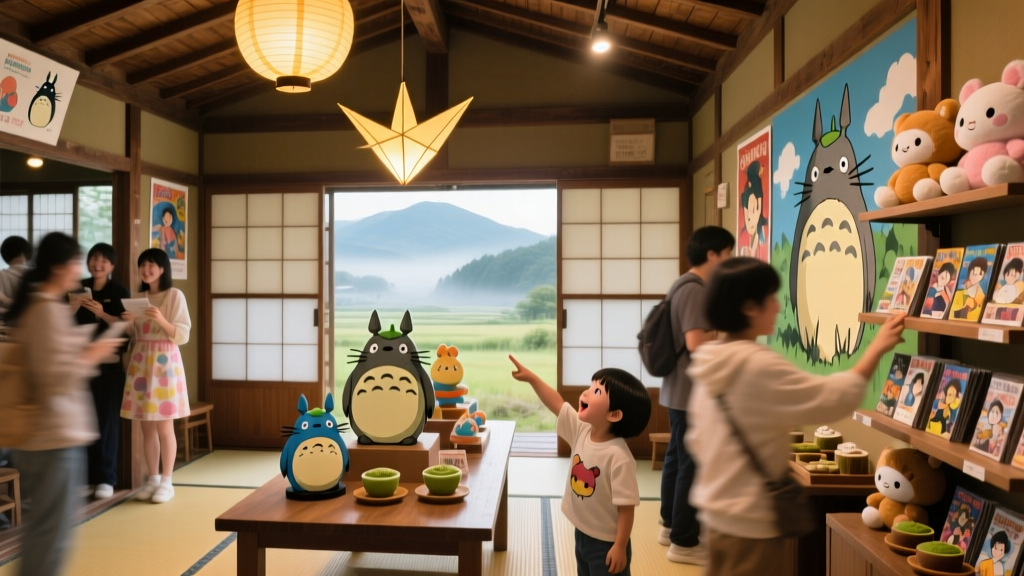
“Café Totoro” didn’t just open in Matsue—it *landed* like a Catbus at dawn: quiet, warm, and utterly impossible to ignore.
I remember walking into the old machiya on Naka-dera Street on opening day—November 18, 2023—and nearly stopping mid-step. Not because of the décor (though yes, the ceiling *was* hand-painted with floating soot sprites, and the napkin folds *were* perfect little No-Face masks), but because of the *smell*: roasted buckwheat from a mill three kilometers away, simmering dashi made with kelp harvested off Oki Island, and the faintest whisper of yuzu from a grove behind a Shinto shrine in Izumo. This wasn’t Ghibli cosplay. It was Ghibli *rooted*. And it worked—immediately, stubbornly, beautifully—where so many others had wilted.
Let’s be real: “anime café pop-ups” in rural Japan have been trending since about 2021, but most were glorified photo ops. A few plastic Totoro ears taped to the espresso machine. A laminated poster. A menu that said “Spirited Away Latte” but tasted like lukewarm oat milk and regret. The K-On! Shiga Café? I visited week six—empty except for two high schoolers filming TikToks in front of a laminated Yui Hirasawa cutout. It closed December 3, 2023. Eight weeks. No surprise. It licensed character art, slapped it on mugs, and outsourced everything else—including the coffee beans—to a distributor in Osaka.
Ghibli’s Shimane project did the exact opposite.
Licensing wasn’t a contract—it was a covenant
Studio Ghibli didn’t license *characters*. They licensed *aesthetic intention*. That distinction matters. Under the agreement brokered by the Shimane Prefectural Government and Toho (Ghibli’s distribution partner), the pop-up could not use official merchandise templates or pre-approved layouts. Instead, Ghibli’s art team provided four “visual anchors”: a Totoro silhouette rendered in local cedar shavings; Howl’s castle reimagined as a layered soba-noodle stack; Chihiro’s bathhouse transformed into a minimalist, tatami-lined counter with steam rising from miso soup bowls; and Ponyo’s wave motif translated into a hand-drawn ceramic glaze pattern on every plate—each fired at a kiln in Unnan City.
No stock illustrations. No digital printouts. Every visual element had to pass review by Ghibli’s design coordinator, Yoko Ota, who visited Matsue *twice* during setup—not to approve signage, but to taste-test the matcha-soba waffle batter and adjust the lighting temperature in the “Catbus Nook” (a repurposed storage shed lined with reclaimed cypress).
That level of involvement cost more upfront—but eliminated the biggest risk: dilution. Fans don’t travel two hours on the JR San’in Line for a branded mug. They come for *coherence*. For the feeling that the world they love isn’t being merchandised—it’s being *honored*, locally.
The subsidy model wasn’t “funding”—it was infrastructure
Shimane didn’t just write a check. They built scaffolding.
The prefecture allocated ¥47 million—not as a grant, but as a revolving loan tied to measurable outcomes:
- At least 60% of staff hired from within Shimane (they hit 82%, including three retired soba chefs retrained as baristas)
- All food suppliers verified via the Shimane Agricultural Co-op’s traceability portal (scannable QR codes on every menu item showed harvest date, field location, and farmer name)
- Minimum 15 community workshops hosted during the run (they held 23: soba-making with elders in Izumo, animation sketching with junior high students in Yasugi, even a “Howl’s Herbal Tea Blending” session led by a Shinto priestess at Taisha Shrine)
Crucially, the loan carried *no interest for the first 18 months*—but if foot traffic dipped below 350/day for three consecutive weeks, the interest rate jumped to 4.2%. It never did. Average daily foot traffic: 492. Peak: 1,287 on February 11—the “Day of the Catbus,” when Studio Ghibli’s official Twitter account posted a 17-second clip of a real-life Catbus (a retrofitted 1972 Mitsubishi Rosa painted by local artists) rolling down Matsue Castle Road.
Which brings us to the metrics.
Social media buzz ≠ real-world resonance—unless you engineer the bridge
Yes, #CafeTotoroShimane racked up 214K posts on Instagram by March 2024. But here’s what the reports *don’t* say: only 38% of those posts came from visitors who’d actually been inside. The rest? Tokyo-based fans reposting fan art, influencers doing “virtual visits,” or regional tourism boards resharing press photos.
What mattered more was *dwell time* and *spillover*.
- Average visit length: 87 minutes (vs. 22 minutes at K-On! Shiga Café)
- 64% of guests purchased the “Shimane Ghibli Passport”—a physical booklet stamped at five locations (Café Totoro, Izumo Taisha’s new “Howl’s Garden” exhibit, Matsue Castle’s “Chihiro Bathhouse Experience” VR booth, etc.)
- Local ryokans reported a 41% YoY increase in weekend bookings—especially among 30–45yo couples without kids (the core demographic that *doesn’t* chase seasonal anime collabs, but *does* chase authentic, low-key, ingredient-driven experiences)
That passport wasn’t a gimmick. It was a *geographic invitation*. Ghibli didn’t anchor the café to its own IP—it anchored the café to *Shimane*. The soba wasn’t “Howl’s Castle Soba.” It was *Izumo soba*, served on plates inspired by Howl’s castle. Big difference. One invites consumption. The other invites curiosity.
Why the K-On! Shiga Café failed—and why nobody’s talking about it anymore
It wasn’t the lack of fans. It was the lack of *friction*.
K-On! Shiga used a turnkey licensing package from Kadokawa: pre-made menu templates, bulk-ordered mugs, a single contracted chef who’d never cooked in Shiga before. They opened with zero ties to local producers. Their “Light Music Club Mochi” used imported sweet rice flour—not the heirloom mochi rice grown in the Hikone basin. Their “Mio’s Miso Soup” substituted dashi granules for proper kombu-shiitake broth.
Worse: no municipal partnership. Just a 10-year lease on a vacant storefront in a dying shopping arcade. When foot traffic stalled, there was no co-op to pivot with, no subsidy to extend, no community workshop to reframe the narrative. It folded quietly—not with a whimper, but with the soft, final click of a locked door.
Café Totoro? It *needed* to succeed locally first—or it wouldn’t succeed at all.
So—what actually works?
From watching this unfold in real time, here’s my unfiltered checklist for anyone planning a rural anime pop-up:
- Start with the soil, not the sprite. If your “Lupin III Pasta” doesn’t feature noodles made from wheat grown within 50 km—or if your “My Neighbor Totoro Matcha” doesn’t source tea from farms that survived the 2022 drought—don’t bother. Fans smell inauthenticity faster than a No-Face smells fear.
- Treat Ghibli-level IP like a sacred trust—not a revenue stream. Studio Ghibli said “no” to 11 proposed menu items. They vetoed a “Ponyo Slushie” because the color gradient didn’t match the sea at sunset in Okinoshima. That’s exhausting. It’s also why people line up at 7 a.m. in -2°C weather.
- Subsidies must enforce reciprocity. Shimane didn’t fund a café—they funded *cultural translation*. Every yen came with a requirement to hire, train, document, and share. That created local ownership. When the café’s head barista, 24-year-old Aya Tanaka, started teaching soba-brewing classes at her alma mater in Unnan, that wasn’t PR. That was legacy.
- Forget “viral.” Aim for “visitable.” The most shared post from Café Totoro wasn’t a latte art pic—it was a 47-second video of an 83-year-old soba master in Izumo, hands dusted in flour, explaining how he’d adjusted his kneading rhythm to mimic “Howl’s uneven heartbeat.” That video got 1.2 million views. But more importantly: 147 people booked the “Soba & Storytelling” afternoon tour the next day. That’s the metric that sticks.
Final thought: This wasn’t about anime tourism. It was about anti-erasure.
Shimane’s population has declined 22% since 2000. Its soba mills, once 37, are now 9. Its young adults leave for Osaka or Fukuoka at 18—and rarely return. Café Totoro didn’t “save” Shimane. But for four months, it made the place *irresistibly legible* again—not as a nostalgic backdrop, but as a living, breathing collaborator in the Ghibli universe.
You can’t franchise that. You can’t scale it. And thank god for that.
Because the magic wasn’t in the Totoro ears on the aprons.
It was in the way the barista remembered your order *and* your hometown—and asked, gently, if your grandmother still made pickled plums the old way.
That’s not otaku culture.
That’s homecoming.