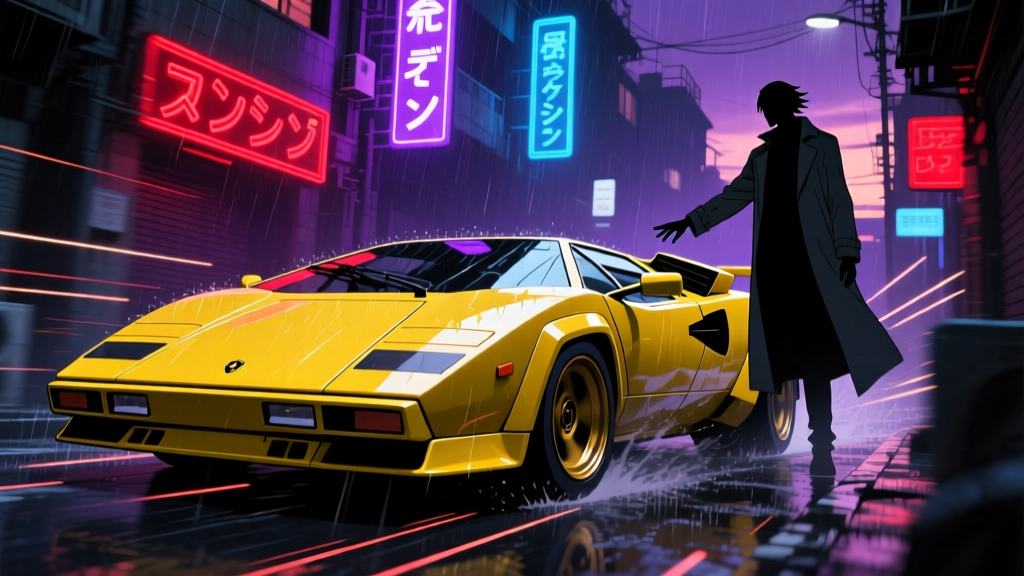
The tunnel is dark. The engine note is not. A 3.9-liter V12, mounted transversely behind the driver, howls at 7,000 rpm as a wedge-shaped silhouette punches through alpine blackness at 160 km/h. Matt Monro sings "On Days Like These" over the soundtrack. The car is orange — Arancio, in Lamborghini's ledger — but in the cultural memory of everyone who has ever watched Peter Collinson's The Italian Job (1969), the color reads differently. It reads yellow. It reads giallo.
There is a reason for this misremembering. Giallo Miura — the specific Lamborghini factory paint code 244.9100, offered between 1971 and 1973 — is arguably the most iconic yellow ever applied to a production automobile. It is also, by linguistic accident or design, the exact same word Italians use for an entire genre of stylish, violent, color-obsessed thriller films. This article lives at that intersection: where a mid-engine Sant'Agata supercar meets the blood-red leather seats and lurid yellow posters of Mario Bava and Dario Argento.
The Car That Invented the Supercar
Before the Miura, fast cars had their engines in front. That was simply how things were done. The Miura's engineering team — Gian Paolo Dallara, Paolo Stanzani, and test driver Bob Wallace — took Ferruccio Lamborghini's 3.9-liter V12, designed by Giotto Bizzarrini, and laid it sideways behind the cockpit. Marcello Gandini, just 27 years old at Carrozzeria Bertone, wrapped it in a body so low and sensual that the Geneva Motor Show crowd in March 1966 reportedly fell silent when the curtain lifted.
The P400 produced 350 horsepower. The revised P400 S, introduced in 1969, pushed that to 370 hp. By the time the SV arrived in 1971 with wider Campagnaro wheels, revised suspension geometry, and 385 hp on tap, the Miura could reach a verified top speed of 300 km/h — roughly 186 mph. For context, the contemporary Ferrari 365 GTB/4 "Daytona" topped out at 280 km/h. The Miura was simply in a category of one.
Total production across all three variants remained deliberately scarce. Lamborghini built just 763 examples between 1966 and 1973: 275 of the original P400, 338 P400 S models, and only 150 SVs. The SV, with its flared fenders and deleted "eyelash" headlamp surrounds, is today the most coveted — and the variant most frequently finished in Giallo Miura at the factory.
"Giallo Miura is not just a color. It's a declaration. The car is already the loudest thing on any road in the world — the yellow simply makes sure nobody can pretend otherwise."
— Valentino Balboni, Lamborghini test driver, quoted in Octane Magazine, Issue 184 (2019)
A Tunnel, a Wreck, and Fifty Years of Mystery
The opening sequence of The Italian Job runs just under four minutes, but it has done more for the Miura's mythology than any brochure ever printed. Rossano Brazzi, playing a thief named Beckermann, threads a 1968 Miura P400 — chassis number #3586, finished in Arancio — through the Colle del Gran San Bernardo tunnel on the Swiss-Italian border. Two Alfa Romeo Giulias appear. The chase escalates. A bulldozer blocks the exit. The Miura is crushed flat against a rock face. It is one of the most expensive car kills in cinema history.
What happened to chassis #3586 after filming became one of the great unresolved questions in automotive archaeology. The wreckage was reportedly sold to a scrapyard in Turin. For nearly half a century, its fate was unknown. Then, in 2019, Lamborghini's in-house heritage division — Polo Storico — located and authenticated the surviving chassis. The car had passed through several private collections in Italy, its identity obscured by a subsequent repaint and rebody. Lamborghini issued a formal certificate of authenticity, and the car was exhibited at the Museo Lamborghini in Sant'Agata Bolognese.
The scene remains culturally radioactive. The 2003 remake with Mark Wahlberg used Mini Coopers instead, which is one reason petrolheads tend to mention the original with a particular kind of reverence — the 1969 film understood that a Lamborghini is not a prop. It is a co-star.
Giallo the Genre, Giallo the Color, Giallo the Car
The word giallo means "yellow" in Italian. Its secondary meaning — a lurid, stylized murder thriller — comes from the yellow-spined pulp crime novels published by Mondadori starting in 1929. By the 1960s, when filmmakers like Mario Bava began translating those stories to the screen, giallo had become a full cinematic genre: black-gloved killers, elaborate set-piece murders, operatic scores by Ennio Morricone or Goblin, and a color palette so saturated it practically vibrates off the celluloid.
The visual grammar of giallo cinema is built on the same primary colors that Lamborghini used to sell its cars. Bava's Blood and Black Lace (1964) opens in a fashion house drenched in red, blue, and — naturally — yellow light. Dario Argento's Suspiria (1977) uses a Technicolor palette so aggressive it makes the violence look like a Renaissance painting. The yellow in these films is never incidental. It signals danger, luxury, and moral ambiguity simultaneously.
A Giallo Miura parked outside a Milanese palazzo in 1972 would have looked like it drove straight off the set of a Sergio Martino thriller. The coincidence is not entirely a coincidence. Both the car and the genre emerged from the same post-economic-miracle Italian culture — a society flush with new money, obsessed with design, and increasingly fascinated by the dark side of glamour. Ferruccio Lamborghini, a tractor manufacturer who decided to build sports cars out of spite toward Enzo Ferrari, was living the same narrative excess that gialli thrived on. The aesthetic overlap is structural, not superficial.
Where the Miura Actually Appears in Giallo Films
Beyond The Italian Job — technically a British heist caper, but shot on Italian soil with Italian hardware — the Miura turns up in several films that brush against or fully inhabit the giallo tradition. In The Cat o' Nine Tails (1971), Argento's second feature, a Miura is visible in a parking structure during a key surveillance scene. The car appears briefly in Luciano Ercoli's Death Walks on High Heels (1971) as the vehicle of a wealthy industrialist suspect. Sergio Martino's All the Colors of the Dark (1972) — whose very title could be a Lamborghini brochure — features a yellow Miura in a Rome piazza sequence that plays like an extended automotive fetish shot.
These are not starring roles. But they establish a pattern: in 1970s Italian genre cinema, a yellow Miura communicated a specific character type — wealthy, morally compromised, probably hiding something in the trunk. It was a shorthand that directors and production designers understood instinctively.
The Money: What a Miura Costs When the Credits Stop Rolling
If the Miura's cinema career made it iconic, its auction record has made it untouchable. A 1972 Miura P400 SV, previously owned by Dare to Dream collector Miles Collier, sold for $4.9 million at a 2022 RM Sotheby's auction in New York. That record was eclipsed in 2024 when a low-mileage SV — reportedly showing fewer than 7,000 original kilometers — crossed the block at a Canadian auction for $6.7 million (USD equivalent), making it the most expensive Lamborghini ever sold at public auction.
The appreciation curve is steep even by classic car standards. According to Hagerty's valuation data, a concours-condition Miura SV that would have fetched $300,000 in 2008 commanded an average of $2.4 million by 2024 — an eight-fold increase in sixteen years, dramatically outperforming the S&P 500 over the same period. The P400 S, once the neglected middle child, now routinely clears $1.2 million at major auctions.
Even the wrecked Miura from The Italian Job, or rather the certified surviving chassis #3586 authenticated by Polo Storico, carries an estimated value exceeding $2 million — a car whose primary historical significance is that it was once filmed being destroyed. The irony would probably amuse Ferruccio.
Scale Models and Diecast: Owning the Legend at 1:18
For collectors who cannot liquidate a retirement fund, the Miura exists in miniature — and the diecast market for this car is surprisingly deep. AUTOart's 1:18 Miura SV, available in Giallo Miura, is widely considered the benchmark. The Premium Collection version includes photo-etched details, a removable rear clamshell revealing the transverse V12, and correctly scaled Campagnaro wheels. It retails between $280 and $360, and secondary-market prices for discontinued colorways have climbed past $500.
The table below maps out the major diecast options currently available or recently in production:
| Manufacturer | Scale | Variant | Giallo Available | Approx. Price (USD) |
|---|---|---|---|---|
| AUTOart (Premium) | 1:18 | P400 SV | Yes | $280–$360 |
| Kyosho | 1:18 | P400 S | Limited | $180–$240 |
| Amalgam Collection | 1:8 | P400 S / SV | Yes (bespoke) | $6,500–$9,800 |
| Minichamps | 1:43 | P400 / P400 S | Yes | $60–$95 |
| CMC | 1:18 | P400 (Geneva prototype) | Rare | $450–$650 |
| Tarmac Works | 1:64 | P400 SV | Yes | $25–$40 |
| Prices reflect 2025–2026 retail and secondary-market data. Amalgam models are hand-built to order; pricing varies by specification. | ||||
For collectors who want a single shelf piece that captures the giallo aesthetic, the AUTOart 1:18 in Giallo Miura is the pragmatic choice: detailed enough to photograph well, sized to dominate a display case, and priced within reach of a serious hobbyist budget. The Amalgam 1:8 is a different conversation entirely — it weighs over 8 kilograms, requires months of lead time, and is purchased by people who probably already own a real Miura.
The Yellow That Outlived the Decade
Lamborghini stopped offering Giallo Miura as a standard factory color after the SV's production run ended in 1973. The shade was replaced by Giallo Flay (Fly Yellow), which leaned slightly greener, and later by Giallo Orion, which was brighter and more metallic. None of them quite matched the deep, warm, almost amber quality of the original Giallo Miura — a color that seemed calibrated specifically for the golden hour light of an Italian afternoon.
Lamborghini's Polo Storico division now offers factory-correct Giallo Miura paint formulations for certified restoration projects. The process involves cross-referencing original Bertone paint codes (maintained in Lamborghini's Sant'Agata archive) with modern PPG waterborne basecoat systems. A full respray in the correct Giallo Miura, performed by a Lamborghini-certified body shop, currently costs between $25,000 and $40,000 — a figure that would have purchased roughly one-tenth of a new Miura P400 in 1968, when the car's list price was $19,900 (approximately $175,000 in 2026 dollars, adjusted for inflation via the Bureau of Labor Statistics CPI calculator).
The color has also migrated beyond Lamborghini. "Giallo Miura" is now a shorthand in automotive design culture — a reference point that Ferrari's Giallo Modena, Porsche's Speed Yellow, and even Dodge's Go Mango all orbit around without quite replicating. When Lamborghini revived the name for a one-off Miura Concept at the 2006 Los Angeles Auto Show, the car was finished — naturally — in a reinterpreted Giallo Miura with a satin clear coat that gave it the look of a freshly poured limoncello.
Collector Questions, Answered
The questions that come up most often in Miura communities, auction house Q&As, and diecast forums.
Is a Giallo Miura more valuable than other colorways?
Generally, yes. Among Lamborghini collectors, Giallo Miura and Verde Miura (the signature green) command a 10–15% premium over more common colors like Bianco (white) or Blu (blue) at equivalent condition levels, according to Hagerty's 2024 model-year valuation report. Arancio (orange) sits in a similar premium bracket. The rarest original colors — Grigio Metallizzato (metallic gray) and Marrone Miura (a deep leather brown) — sometimes exceed even Giallo at auction, simply because fewer survive.
How do I verify an original Giallo Miura paint finish?
Lamborghini Polo Storico maintains the original Bertone build sheets, which record the factory-delivered color for every chassis. A car's paint code should match the data plate on the chassis bulkhead (typically located in the front trunk area). The original Giallo Miura code is 244.9100. A reputable restorer or the Polo Storico team can perform a cross-reference. For diecast models, AUTOart's premium line uses factory-matched paint codes supplied directly by Lamborghini's licensing department.
What's the difference between Giallo Miura and Giallo Flay?
Giallo Miura (1971–1973) is warmer and deeper, with a slight amber undertone that reads as "golden" in natural light. Giallo Flay, introduced as a replacement in the Countach era, leans brighter and slightly more green-chartreuse. The two colors look similar in photographs but are distinctly different in person. Placing a Giallo Miura AUTOart model next to a Giallo Flay Countach model on the same shelf makes the difference immediately visible.
Which giallo films should I watch for the full aesthetic experience?
Start with Bava's Blood and Black Lace (1964) — the ur-text of the genre and a masterclass in color-as-narrative. Move to Argento's The Bird with the Crystal Plumage (1970), which codified the visual tropes. Then Martino's Torso (1973) and Ercoli's Death Walks at Midnight (1972) for the full early-70s Italian production design immersion. By the time you reach Suspiria (1977), you'll understand why Lamborghini and giallo cinema feel like they share a designer — because in a sense, they did: the same Milanese creative class that shaped Bertone's coachwork also furnished the sets of Cinecitta's thriller boom.
Are there any Miura diecast models specifically tied to The Italian Job?
Minichamps released a limited-edition 1:43 "Italian Job" Miura in Arancio, replicating chassis #3586 with movie-accurate details including the correct Italian registration plate. It was produced in a run of approximately 1,008 units and now trades on the secondary market for $120–$180, roughly double its original retail. Hot Wheels also produced a "The Italian Job" Miura in their premium entertainment line, though it leans more toward toy than collectible. Neither is finished in Giallo Miura — the film car was Arancio — but displaying one alongside a Giallo AUTOart SV creates a genuinely compelling diorama.
The Frame Closes
Back to that tunnel. The Miura enters darkness at speed, its V12 howling, headlights cutting through alpine granite. Four minutes later it is scrap metal — a narrative device consumed by the story it was built to tell. But fifty-seven years later, the car is more alive than the scene that killed it. Chassis #3586 sits in a museum. AUTOart's miniature version sits on shelves from Tokyo to Toronto. And the color — that specific, warm, amber-yellow that Lamborghini mixed in a Sant'Agata paint booth half a century ago — still looks like it belongs in a Sergio Martino frame, parked outside a villa where someone is about to be murdered in spectacular style.
That is what "giallo miura" means, in the end. It is not just a paint code or a genre tag. It is the place where Italian engineering and Italian cinema converge on a single frequency — both obsessed with beauty, both willing to be excessive, both convinced that style is not decoration but substance. The Miura was always a thriller. The yellow just made it official.