From the bridge where Gwen Stacy died to the multiverse chaos of No Way Home, the Green Goblin and Spider-Man share something no other Marvel villain-hero pair can claim: a hatred that is genuinely, suffocatingly personal.
June 1973. A woman falls off a bridge. A man in a green mask laughs. And comic books stop being disposable entertainment for a generation of readers who will never quite get over what they just witnessed on the page.
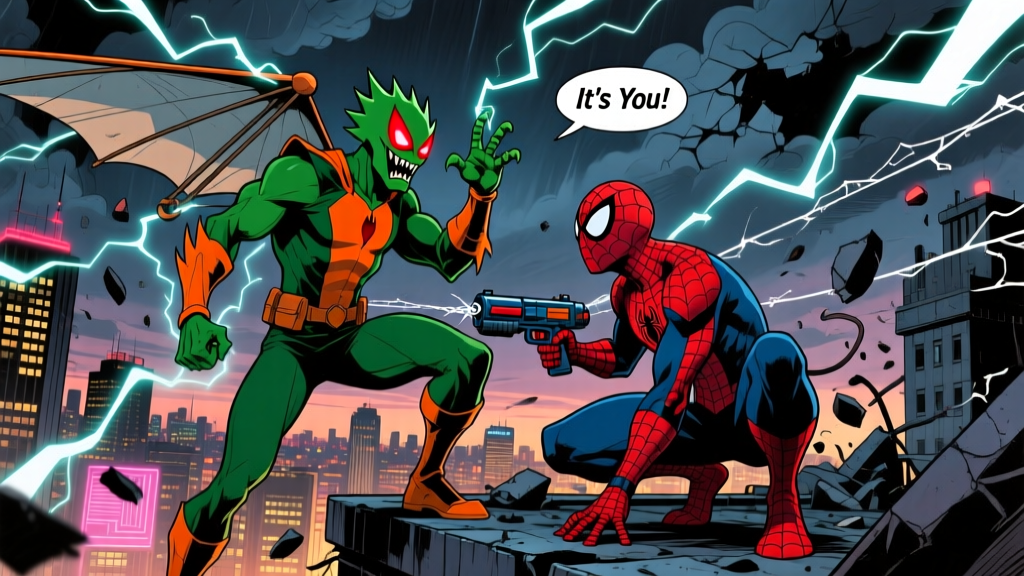
The Green Goblin whispering "It's you" to Spider-Man is not just a comic book moment. It is the moment. The one that every subsequent Marvel villain-hero relationship gets measured against, usually unfavorably. Doctor Doom and Reed Richards have intellectual rivalry. Magneto and Xavier have ideological tension. The Joker and Batman — yes, we are crossing universes for a second — have chaotic symmetry. But none of them have what Norman Osborn and Peter Parker have, which is the specific, nauseating intimacy of a villain who knows exactly who the hero is, knows exactly who the hero loves, and has decided to dismantle that love piece by piece while wearing a Halloween mask and cackling like the world is his personal comedy show.
This article is going to trace the full arc of that rivalry. The comic book issues that started it. The identity reveals that redefined it. The film performances that translated it for audiences who had never touched a floppy comic. And the reason — the actual structural, narrative reason — why this particular villain-hero pairing hits harder than anything else Marvel has produced in sixty-plus years of publishing.
The Night Gwen Stacy Died — Amazing Spider-Man #121-122
Gerry Conway wrote it. Gil Kane penciled it. John Romita Sr. inked it. Roy Thomas edited it. And nobody — not Conway, not Kane, not Thomas in his wildest editorial fever dream — expected the backlash that followed.
Amazing Spider-Man #121, cover-dated June 1973, opens with the Green Goblin kidnapping Gwen Stacy and dragging her to the top of the George Washington Bridge. The confrontation that follows is not particularly long by modern standards. Spider-Man arrives. The Goblin throws Gwen off the bridge. Spider-Man shoots a web to catch her. He pulls her up. She is already dead.
The Snap Heard Around the World
The cause of death has been debated by fans for over fifty years, but the original creative intent was clear in the art: the "snap" lettering appears next to Gwen's neck as the web catches her. Conway's position, stated in multiple interviews including a 2017 conversation with Comic Book Resources, was that the whiplash from Spider-Man's webbing breaking her fall at that speed snapped her neck. Spider-Man killed the woman he loved by trying to save her. That is not a villain victory. That is a tragedy where the hero's own power becomes the instrument of his worst nightmare.
Issue #122, published the following month, is where the "It's you" energy crystallizes. Spider-Man, consumed by rage, hunts the Green Goblin across New York City with the explicit intent to kill him. This is not the quipping, acrobatic Spider-Man readers had grown up with. This is a man who has lost the person who mattered most to him and has decided that the legal system is insufficient. He corners the Goblin. He beats him. And in the final moments, the Goblin's glider — attempting to impale Spider-Man from behind — kills Norman Osborn instead.
Two deaths in two issues. The girlfriend and the villain, both gone. And Spider-Man is left standing in the wreckage, having saved nobody, having lost everything, in a story that ends not with a triumphant pose on a rooftop but with a man staring at his hands and wondering if he is the problem.
The sales numbers told the story before the letters page did. Amazing Spider-Man #121 sold approximately 329,000 copies on the newsstand, making it one of the highest-selling issues of the entire Bronze Age. The letters that poured in over the following months were not the usual "great fight scene" fan mail. They were angry. They were grieving. Multiple readers wrote that they had thrown the comic across the room. At least one letter, published in a later issue, came from a reader who said Conway should be fired. Stan Lee himself reportedly received phone calls from distraught fans. The age of disposable superhero storytelling was over, whether the industry was ready for it or not.
Unmasking the Goblin — Every Identity Reveal That Mattered
The Green Goblin's identity was one of the most guarded secrets in Silver Age comics, and the way Marvel handled its reveals across different eras says a lot about how superhero storytelling evolved from mystery-box gimmickry to character-driven drama.
Amazing Spider-Man #39 (August 1966) — The Original Reveal
Stan Lee and Steve Ditko had been building toward this for nearly two years of Green Goblin appearances where the villain's identity was unknown even to the creative team. Ditko reportedly wanted the Goblin to be a nobody — a random criminal — because he believed that making the villain someone Peter knew would feel contrived. Lee disagreed. Ditko left the book. John Romita Sr. took over art duties. And in ASM #39, the Green Goblin is revealed to be Norman Osborn, the father of Peter Parker's best friend Harry Osborn. The reveal retroactively turned every previous Goblin appearance into dramatic irony: Peter had been fighting his best friend's dad the entire time, and Harry had been introducing them at dinner parties without knowing either of their secrets. This single editorial decision — Lee overruling Ditko — created the foundation for fifty years of Spider-Man mythology.
Spider-Man (2002) — Raimi's Slow Burn
Sam Raimi's first Spider-Man film made a deliberate choice: the audience knows Norman Osborn is the Green Goblin from roughly the midpoint onward, but Peter Parker does not learn the truth until the final act. The dramatic tension is not "who is the Goblin?" but "what will Peter do when he finds out?" Willem Dafoe's Norman Osborn is a man splitting apart in real-time, and the scene where Peter discovers the Goblin lair and pieces together the identity is played with horror-film restraint — a camera pan, a realization, and a silence that stretches until it becomes unbearable. Raimi understood something that many comic book filmmakers miss: the reveal is not for the audience. The audience already knows. The reveal is for Peter, and watching a twenty-year-old man process the fact that his mentor-figure has been trying to murder him is where the actual emotional weight lives.
No Way Home (2021) — The Mask Comes Off in Public
Jon Watts' Spider-Man: No Way Home did something no previous Spider-Man film had done: it put Norman Osborn and Peter Parker in a room together, without masks, without costumes, and let them talk. The scene at Aunt May's apartment where Norman arrives confused, vulnerable, and seemingly free of the Goblin persona is the most uncomfortable sequence in the entire MCU Spider-Man trilogy, because the audience knows what Peter does not — that the Goblin is not gone, he is just waiting. When the personality switch happens in that same apartment, Dafoe's face changes in a way that no amount of CGI could replicate. The smile widens. The eyes go flat. And "It's you" stops being a line of dialogue and becomes a weapon.
The Clone Saga and Beyond — When Marvel Could Not Leave It Alone
The 1990s Clone Saga complicated the Goblin mythology by retroactively suggesting that the "Norman Osborn" who died in ASM #122 had been replaced by a clone, and that the real Norman had been alive and manipulating events from the shadows for years. This retcon, introduced across multiple tie-in issues in 1996, is one of the most controversial editorial decisions in Marvel history. Some fans accepted it as a way to bring back Marvel's greatest villain. Others considered it a betrayal of the original story's stakes — if Norman Osborn can just come back from the dead, then his death in ASM #122 meant nothing, and Spider-Man's grief was pointless. Marvel has never fully resolved this tension. Norman keeps returning, keeps getting defeated, keeps coming back. The cycle has repeated so many times that the Goblin's death has lost all narrative weight, which is its own kind of tragedy.
Willem Dafoe and the Performance That Refused to Stay Dead
There is a version of this article where we discuss every actor who has played the Green Goblin across animation, video games, and film. That is not this article. This section exists because Willem Dafoe's portrayal of Norman Osborn is not just the best Green Goblin performance ever committed to screen — it is one of the finest villain performances in the history of superhero cinema, and the reason has almost nothing to do with the green mask.
Dafoe first played Norman Osborn in Sam Raimi's Spider-Man (2002). The film grossed $821 million worldwide and launched the modern superhero blockbuster era alongside X-Men (2000), but Dafoe's performance was divisive at the time. Some critics found his Norman too sympathetic, too human for a comic book villain. Others found the Goblin persona too theatrical, too over-the-top compared to the grounded Norman scenes. Roger Ebert, in his review published May 3, 2002, called Dafoe "effective" but noted the film's inability to reconcile its two halves — the quiet family drama and the CGI spectacle.
Twenty years later, nobody is talking about the CGI. Everyone is talking about Dafoe's face.
"I liked the idea that Norman is not evil. He's sick. There's a difference. An evil person chooses cruelty. A sick person is consumed by it. When the Goblin takes over, Norman is in there somewhere, watching himself do things he cannot stop. That's not a villain. That's a hostage situation." — Willem Dafoe, interview with Variety, December 2021
Spider-Man: No Way Home gave Dafoe the canvas that the 2002 film could not. Without the constraints of a franchise origin story, without needing to establish the character from scratch, Dafoe was free to play Norman Osborn as a man haunted by a version of himself he cannot control. The apartment scene is the centerpiece. Norman arrives at May's door disoriented, frightened, speaking in fragments. He tells Peter about the serum, about what it did to his mind, about the other personality that lives inside him. And for approximately eight minutes of screen time, the audience believes him. Peter believes him. May believes him. The Goblin is gone.
Then Dafoe smiles.
That smile — the one where the corners of his mouth stretch too wide and his eyes go dead and his voice drops half an octave — is the single most effective practical effect in the entire MCU. No prosthetic. No CGI face replacement. No motion capture. Just a sixty-six-year-old actor who has been doing this for four decades deciding that the scariest thing a villain can do is stop pretending to be human. The "It's you" line lands because of what comes before it: eight minutes of vulnerability that made the betrayal sting. Dafoe made you believe Norman was gone so that the Goblin's return would hurt. That is not a special effect. That is acting.
The fight that follows — Goblin versus three Spider-Men across a construction site and a apartment building — is spectacular in the way superhero fights are supposed to be. But the moment everyone remembers is not a punch or a web-swing or a pumpkin bomb explosion. It is the final confrontation on the Statue of Liberty scaffold, where Tom Holland's Peter, having watched the Goblin kill Aunt May, picks up the Goblin's own glider and prepares to drive it through Norman's chest. Andrew Garfield's Peter stops him. Not with force. With a look. And a shake of the head. The Green Goblin did something that Thanos never managed: he almost turned Spider-Man into a killer. That is the stakes of this rivalry. Not the fate of the universe. The soul of one man.
Why This War Hits Different — Marvel's Most Personal Rivalry
Marvel has dozens of iconic villain-hero pairings. Most of them fall into one of three categories: ideological opposites (Xavier and Magneto), mirror images (Daredevil and Bullseye), or power asymmetries (the Hulk and the Abomination). The Green Goblin and Spider-Man do not fit neatly into any of those boxes, and that is precisely what makes the rivalry feel more human than anything else in the Marvel catalog.
Norman Osborn is not Peter Parker's ideological opposite. They do not represent competing philosophies about how the world should work. Norman is not a dark mirror of Peter in the way Killmonger is a dark mirror of T'Challa — a man with the same goal pursued through different methods. Norman does not want what Peter wants. Norman wants to watch Peter suffer, and the reason he wants that is not philosophical. It is personal. It is petty. It is the rage of a man who blames a teenager for the collapse of his own life and has decided that the most productive use of his genius-level intellect and billions of dollars of military technology is to make that teenager's existence a living hell.
That pettiness is what elevates the rivalry above every other pairing in Marvel. Doctor Doom does not hate Reed Richards because Reed ruined his life. Doom hates Richards because Richards represents an intellectual challenge that Doom cannot tolerate. Magneto does not hate Xavier because Xavier wronged him personally. Magneto hates Xavier because Xavier's dream is, in Magneto's assessment, naively optimistic in a world that has proven itself hostile to mutants at every turn. These are grand, operatic hatreds built on ideas. The Green Goblin's hatred of Spider-Man is built on something smaller and more devastating: the knowledge that Peter Parker is a kid, that Peter Parker loved Norman like a father, and that Norman is going to use that love as a weapon anyway.
The "It's you" moment works because it collapses the distance between the mask and the man. When the Goblin says "It's you," he is not expressing surprise. He is expressing satisfaction. He already knew. He has known for a while. And the pleasure he takes in saying it — in watching Peter realize that the man he considered a second father has been studying him, cataloguing his weaknesses, and planning to use everyone Peter loves against him — is the most chilling thing in the Spider-Man mythos. Not because of the green skin or the pumpkin bombs. Because of how ordinary the cruelty is. How human. How real.
The Harry Factor
No discussion of the Goblin-Parker rivalry is complete without Harry Osborn. Peter's best friend. Norman's son. The person who connects them both and pays the price for it. Harry's descent into the second Green Goblin persona — driven by grief over his father's death and a chemically-induced belief that Peter murdered him — adds a layer to the rivalry that no other Marvel villain pairing possesses: collateral damage to someone both men loved. Peter lost Gwen to Norman. Harry lost his father to the conflict between Norman and Peter. And then Harry lost himself trying to avenge a man whose death he did not fully understand. The Osborn family is Marvel's most compelling tragedy not because of supervillainy but because of how thoroughly the supervillainy destroys the people who had nothing to do with choosing it.
Every Green Goblin Across Media — How They Compare
The Green Goblin has appeared in seven major Spider-Man adaptations across film, animation, and video games since 1967. Not every version lands with the same force. Here is how they stack up against each other on the metrics that actually matter for this character.
| Portrayal | Menace | Emotional Depth | Personal Stakes | Legacy Impact | Overall |
|---|---|---|---|---|---|
| Comics (616 Main, Lee/Romita/Conway) | 9 | 9 | 10 | 10 | 9.5 |
| Willem Dafoe (Raimi Trilogy + NWH) | 10 | 10 | 9 | 10 | 9.7 |
| 1967 Animated Series | 5 | 3 | 4 | 5 | 4.3 |
| Spectacular Spider-Man (2008 Animated) | 8 | 8 | 9 | 7 | 8.0 |
| Ultimate Spider-Man (Animated, 2012) | 6 | 5 | 6 | 5 | 5.5 |
| Spider-Man PS4/PS5 (Yuri Lowenthal) | 9 | 8 | 9 | 8 | 8.5 |
| Spider-Man: The Animated Series (1994) | 7 | 7 | 8 | 7 | 7.3 |
Dafoe edges out the original comics for overall impact, which might seem like heresy to long-time readers. Here is the reasoning: the comics built the mythology, and nothing replaces the visceral shock of reading ASM #121 for the first time in 1973. But Dafoe's performance across four films spanning twenty years has done something the comics never quite achieved — it made the Goblin's internal war visible. You can watch Norman Osborn fight the Goblin inside his own body, in real time, on Dafoe's face. Comics can imply that struggle through thought balloons and narration boxes. Film can show it in the tightening of a jaw muscle. And Dafoe, who has been playing morally complex characters since Platoon in 1986, knows exactly how to weaponize a micro-expression.
The Insomniac games deserve a separate mention. Yuri Lowenthal's Peter Parker and the game's version of Norman Osborn create a dynamic that borrows heavily from the comics but adds the dimension of player agency. When the Goblin attacks in Marvel's Spider-Man 2 (2023), the player is not watching Peter suffer — the player is making Peter fight, and every failed dodge and missed combo makes the Goblin feel more dangerous in a way that passive media cannot replicate. The game sold over 2.5 million copies in its first 24 hours, and the Goblin storyline was cited in virtually every major review as the emotional anchor of the experience.
The "It's You" Formula — What Other Villain-Hero Pairs Can Learn
Strip away the pumpkin bombs and the glider and the green skin, and the "It's you" moment between the Green Goblin and Spider-Man works because of three structural elements that most Marvel rivalries are missing.
First: pre-existing emotional investment. Peter and Norman knew each other before the masks came into play. Norman was Harry's father. Peter was Harry's best friend. They had dinners together. They had conversations that had nothing to do with superheroism. This means the betrayal has a foundation. You cannot betray someone you have no relationship with, and most Marvel villain-hero pairings skip this step entirely. Ultron does not know Tony Stark as a person. Thanos does not know the Avengers individually. Even Killmonger, who is T'Challa's cousin, grew up separated from Wakanda and therefore has no personal history with T'Challa as an individual. The Goblin-Spider-Man rivalry works because the masks are layered on top of a relationship that already existed, and every punch lands harder because both combatants know exactly who is behind the mask.
Second: asymmetric stakes. The Green Goblin does not want to conquer the world or destroy the universe or impose a political ideology. He wants to hurt one specific person as badly as possible. That is a smaller goal than most supervillain motivations, and that smallness is what makes it terrifying. You can reason with a villain who wants to rule the world, because ruling the world requires infrastructure and infrastructure requires negotiation. You cannot reason with a villain whose only objective is your personal misery. There is no compromise position. There is no deal to be struck. The Goblin's agenda is purely, irrationally, obsessively focused on making Peter Parker's life worse, and that single-mindedness gives every encounter a weight that cosmic-scale threats lack.
Third: the villain knows the hero's secret. This is the element that most adaptations misunderstand. The "It's you" line only works because the Goblin already knows Peter is Spider-Man. The dramatic power is not in the revelation itself — it is in the Goblin's enjoyment of the revelation. He is savoring it. He is telling Peter, "I have had this information for longer than you think, and I have been using it to plan your destruction while you went about your life not knowing." That violation — the sense that your enemy has been watching you, studying you, cataloguing the people you love — is a form of intimacy that no other Marvel villain replicates. The closest analogue is Bullseye's knowledge of Daredevil's identity, but even that lacks the paternal dimension that makes the Goblin-Parker dynamic so sickening.
The Design — Green Skin, Purple Hood, and the Pumpkin That Should Not Work
The Green Goblin's visual design is objectively ridiculous. Green skin. A purple tunic that looks like a medieval jester's outfit. Yellow pouches strapped to a bandolier. And pumpkin-shaped explosives, because nothing says "I am a serious threat" like seasonal produce reimagined as military ordnance. Steve Ditko designed the character in Amazing Spider-Man #14 (July 1964), and even by Silver Age standards — an era where villains wore yellow spandex and called themselves "The Thinker" — the Goblin was a lot.
And yet the design works. It works because the absurdity is the point. The Goblin is not supposed to look intimidating in the way that Venom or Thanos look intimidating. The Goblin is supposed to look unhinged. The green skin suggests chemical exposure and physical degradation. The purple and gold color scheme suggests someone who has lost the ability to distinguish between theatrical and practical. The pumpkin bombs suggest a mind that finds humor in destruction, which is arguably more frightening than a villain who takes themselves seriously. A man who blows up a building while wearing a Halloween costume is a man who has completely abandoned the social contract, and that abandonment is visible in every element of his design.
The Raimi films made the smart choice of separating the costume from the man. In the 2002 film, the Green Goblin armor is a military prototype — a functional exoskeleton with a built-in glider. The mask is a rigid faceplate, not skin. This grounded the design in a plausible military context while preserving the iconic silhouette. No Way Home went further, ditching the costume almost entirely for the third act and letting Dafoe fight in a torn purple shirt with no mask at all. The message was clear: the costume was never what made the Goblin scary. The man was.
Comic book artists have taken wildly different approaches to the Goblin's look across the decades. Romita Sr.'s original design was relatively clean — bright green skin, simple purple tunic, a pointed hood that evoked a medieval fool. Todd McFarlane's 1990s redesign bulked the character up, gave him more pronounced musculature, and sharpened the facial features into something more overtly monstrous. Mark Bagley's Ultimate Goblin went full horror, replacing the costume with a biological transformation — Norman Osborn's body literally mutating into a demonic, green-skinned creature with bat-like ears and fangs. Each redesign tells you something about the era that produced it: the Silver Age Goblin is a prankster gone wrong, the 90s Goblin is a steroid nightmare, and the Ultimate Goblin is a body-horror monster. The version that lands hardest depends entirely on what kind of fear you find most effective.
Questions Fans Keep Asking About the "It's You" Moment
Did the Green Goblin actually say "It's you" in the original comics?
Not in those exact words. The phrase "It's you" as an iconic Green Goblin line comes primarily from the Raimi film trilogy and was amplified by No Way Home, where Dafoe delivers it with deliberate weight. In the original Lee/Romita comics, Norman's unmasking scene in ASM #39 uses dialogue like "Yes, Peter — it's me!" rather than the reversed "It's you" from Spider-Man's perspective. The "It's you" phrasing became culturally associated with the Goblin-Spider-Man dynamic through film, fan discourse, and meme culture over the 2000s and 2010s. It captures the emotional core of the reveal — the recognition, the betrayal, the collapsing of two worlds — more efficiently than any single comic book line ever did.
Why did Gwen Stacy have to die? Could the story have worked another way?
Gerry Conway has explained in numerous interviews that the editorial goal was to remove Gwen Stacy from the comic so that Mary Jane Watson could become Peter's primary love interest. The decision was controversial within the Marvel offices — Roy Thomas reportedly resisted it before eventually agreeing that the dramatic impact would justify the loss. Could the story have worked without killing Gwen? Probably not with the same force. The "Night Gwen Stacy Died" is remembered because it broke the unwritten rule that love interests in superhero comics were safe. If the Goblin had merely kidnapped her and Spider-Man rescued her, the story would be forgettable. The permanence of death is what gave the narrative its lasting power, and every subsequent attempt to bring Gwen back (clones, alternate universes, retcons) has only reinforced the original story's impact by contrast.
Is Willem Dafoe's Green Goblin the best Marvel villain ever on screen?
Among live-action Marvel villains, Dafoe's Norman Osborn has a legitimate claim to the top spot alongside Heath Ledger's Joker (DC, but worth the comparison). Josh Brolin's Thanos has more screen time and more narrative significance across the MCU, but Thanos operates on an abstract, cosmic level that makes him hard to relate to as a person. Dafoe's Goblin is intimate. He sits in your living room. He talks to your aunt. He smiles at you with Norman's face before trying to kill you with Norman's hands. That intimacy creates a kind of fear that CGI armies and infinity gauntlets cannot replicate. The fact that Dafoe returned to the role twenty years later and somehow improved on it is proof of both the actor's skill and the character's durability.
How many times has the Green Goblin "died" and come back?
Norman Osborn has died and returned at least six times in main Marvel continuity, depending on how generously you count "death." The original death in ASM #122 (1973) was the only one that stuck for a meaningful period — roughly 23 years before the Clone Saga retconned it in 1996. Since then, Norman has been "killed" or presumed dead in Dark Reign tie-ins, the Superior Spider-Man run, and various event crossovers, only to return each time. The diminishing returns are real. Each resurrection weakens the stakes of the previous death, which is an ongoing problem for every long-running comic book villain. The Raimi films handled this better by letting Norman die once and stay dead within that continuity, which is why Dafoe's return in No Way Home worked — it pulled him from an alternate universe rather than resurrecting him within the same timeline.
What makes the Green Goblin different from the Joker?
The comparison comes up constantly, and the surface similarities are real: both are the hero's arch-nemesis, both use a grotesque visual design, both kill someone the hero loves (Gwen Stacy / Jason Todd, depending on which version of the Joker you are discussing), and both have a theatrical streak that borders on performance art. The fundamental difference is motivation. The Joker, at his best, is an agent of chaos with no personal agenda against Batman beyond the philosophical belief that Batman's moral code is a joke waiting to be exposed. The Green Goblin's hatred of Spider-Man is intensely, suffocatingly personal. Norman does not want to prove a point about society. Norman wants Peter Parker to hurt the way Norman hurts, and he will burn the world down to achieve that. The Joker is scary because he is unpredictable. The Goblin is scary because he is predictable — he will always come for the people Peter loves, every single time, without exception, and he will enjoy it.
Was the Green Goblin always meant to be Norman Osborn?
No. This is one of the most well-documented creative disputes in comic book history. Steve Ditko, who co-created the character and drew his earliest appearances, intended the Green Goblin to be a nobody — a random criminal whose identity would not connect to Peter Parker's personal life. Ditko's philosophical commitment to Objectivism led him to believe that making the villain a stranger was more realistic and morally honest than relying on coincidental personal connections. Stan Lee disagreed, believing that the dramatic payoff of a personal connection would be stronger. Ditko left the title after ASM #38, and Lee immediately revealed the Goblin as Norman Osborn in ASM #39 with John Romita Sr. on art. Whether Ditko's version would have worked as well is one of the great unanswerable questions in comics, but Lee's instinct to make it personal clearly won the historical argument.
The Rivalry That Will Not End (And Should Not)
Marvel will keep bringing the Green Goblin back. They will recast him in future film reboots. They will relaunch the comic with new creative teams who promise to "redefine" the character for a modern audience. They will sell variant covers where the Goblin wears a different costume or operates in a different era. None of this will diminish what Lee, Romita, and Conway built in 1966 and 1973, and none of it will replace what Dafoe added to the mythology in 2002 and 2021.
The "It's you" moment between the Green Goblin and Spider-Man endures because it is about something that does not age. It is not about a specific superpower or a specific technology or a specific political moment. It is about the moment when someone who trusted another person discovers that the trust was weaponized. It is about a father figure who turns out to be a monster. It is about a young man who realizes that the world is more cruel than he believed, and that the cruelty came from someone he invited into his life voluntarily. That is not a superhero story. That is a human story wearing a green mask and riding a bat-shaped glider, and it will hit just as hard fifty years from now as it did in 1973.
Norman Osborn knew Peter Parker. That is the whole thing. That is the engine that drives every confrontation, every threat, every pumpkin bomb through a bedroom window. He knew the boy, and he chose to destroy him anyway, and the "It's you" line is the sound of a villain taking pleasure in the fact that his victim finally understands what has been happening to him all along.
Some rivalries are built on ideology. Some are built on power. This one is built on the quiet, devastating knowledge that the person who hurt you the most was someone you once called family.
Goblin or Green? Which Version Broke You the Most?
Was it the snap of Gwen's neck in ASM #121? Dafoe's smile in the apartment? The Clone Saga retcon that made you question everything? Every Spider-Man fan has a specific Goblin moment that lives rent-free in their head. Tell us yours — cite the issue, the scene, the exact panel — and we will build a ranked list of the most devastating Green Goblin moments in Marvel history.
Drop your pick below. Bonus points if you can name the issue number without looking it up.