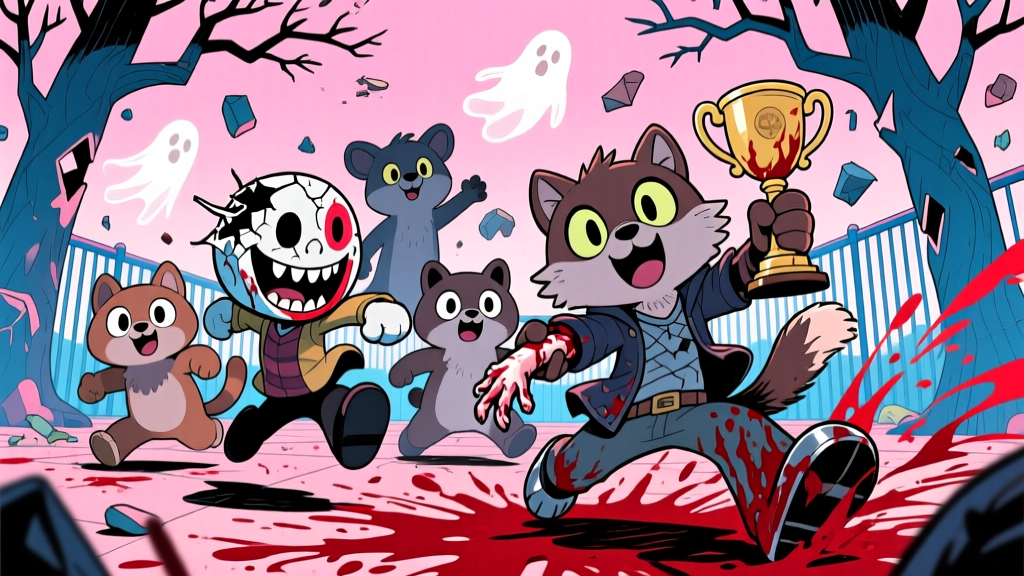
Picture this: a yellow rabbit named Cuddles hops through a sun-dappled forest, pink bow bouncing, eyes sparkling with childlike wonder. He reaches for a butterfly. His hand touches a spinning saw blade. Chaos ensues. This is Happy Tree Friends, the Flash-animated web series that spent the early 2000s traumatizing anyone who accidentally clicked the wrong link on Newgrounds.
But here's something most people never realized about HTF. Beyond the 100+ web episodes, beyond the DVDs that flew off Hot Topic shelves, beyond the merchandise empire that once made the show a $4 million annual licensing machine — there exists a quieter, stranger corner of the franchise. The comics. Official webcomics published on mondomedia.com. A Japanese art book that sells for $200 on eBay. Digital collectibles that dropped in 2023 and crashed secondary markets. And a fan community that has produced more HTF comic pages than the official studio ever did.
This is the story of how the cutest ultra-violent characters in animation history made the leap to print — and why collectors still hunt for issues that technically shouldn't exist.
The Birth of a Blood-Soaked Comic Strip
When Happy Tree Friends premiered on December 24, 1999 (yes, Christmas Eve — because Mondo Media had a sense of humor about ruining holidays), nobody expected it to become a cultural phenomenon. Creators Rhode Montijo, Kenn Navarro, and Aubrey Ankrum had pitched the show to Mondo Media as a simple concept: cute characters in horrific situations. The pilot featured Cuddles in what would become the franchise's signature formula — innocence meets industrial machinery.
The early web episodes spread like wildfire through email chains and forum embeds. By 2002, HTF was pulling 15 million monthly views, a staggering number for pre-YouTube internet. The show got banned in schools across Russia, Germany, and parts of the United States. Parents groups issued formal complaints. YouTube eventually used HTF characters in their early content policy demonstrations — the same characters they'd later flag for violating those same policies.
With that kind of notoriety, Mondo Media knew the brand needed to expand beyond Flash animation. DVDs were the obvious first step. But comics? That was a different beast entirely.
The First Comic: "Don't Worry, Bee Happy"
The first official HTF comic wasn't some grand launch event. It appeared on the HappyTreeFriends.com website sometime around 2004-2005, sandwiched between episode guides and merchandise links. Titled "Don't Worry, Bee Happy", it was a simple strip that did exactly what the show did — introduced a cheerful scenario, then dismantled it with surgical precision.
According to the Happy Tree Friends Wiki, this strip holds a unique distinction: it was the first HTF content explicitly designed as a comic rather than a storyboard or animation frame. The creators realized something important with this experiment. Static panels actually enhanced the shock value. When you can't rely on motion and sound to sell the gore, the artwork itself has to do the heavy lifting. Every splash of red becomes deliberate. Every expression frozen mid-scream hits harder than any animation frame.
"The challenge with HTF comics is the same challenge we face with every piece of merchandise — how do you make something cute that's also deeply disturbing? The comic format actually makes it worse, because you're staring at the aftermath. There's no animation to distract you."
The Official Webcomic Series: Every Strip Catalogued
Over the next several years, Mondo Media published a modest but memorable run of official webcomics. These weren't traditional comic books you'd find in a shop. They were digital strips hosted on the official website, typically 4-8 panels, designed to complement the web episodes rather than replace them. Think of them as bonus content — the same way a DVD might include deleted scenes.
Here's the complete known catalogue of official HTF webcomics:
| Title | Featured Characters | Notable Details |
|---|---|---|
| Don't Worry, Bee Happy | Various | First official HTF comic; bee-related mishap |
| Hit of the Party | Cuddles, Lumpy | Baseball bat incident; classic Cuddles death |
| Drop Me a Line | Various | Fishing-themed; featured on TV Tropes |
| The Choke's on You | Various | Choking hazard scenario; dark humor title |
| Going Overboard | Arcade characters | Released March 2008; tied to arcade games |
| Hot Potato | Various | Explosive premise; cross-promoted with episodes |
| School Fight | School setting cast | Multi-part mini-series; one of the longest strips |
| HTF Comics #1 & #2 | Ensemble cast | Numbered issues; most traditional comic format |
The total official output is modest — somewhere between 8 and 12 published strips, depending on how you count the multi-part series. For comparison, a typical monthly Marvel comic puts out 80+ pages per title per year. HTF's entire official comic catalogue probably fits in a single issue of Amazing Spider-Man.
But quantity was never the point. These strips existed to keep fans engaged between episode releases, to give the website fresh content, and to test whether the HTF brand could work in static visual form. The answer, it turned out, was a resounding yes — just not in the way anyone expected.
KA-POW!: When HTF Went Full Action Comic (Without Actually Being a Comic)
In September 2008, Mondo Media launched KA-POW!, a spin-off action series that shifted HTF's tone from slapstick horror to genuine genre parody. The premise was simple: take three of the show's most popular characters — Flippy (the PTSD-afflicted war veteran bear), Buddhist Monkey (the martial arts-practicing primate), and Splendid (the Superman parody squirrel) — and give them their own dedicated action episodes.
KA-POW! wasn't technically a comic. It was animated Flash content, released as a separate series from the main HTF episodes. But its visual language was pure comic book storytelling. Speed lines. Impact frames. Panel-like compositions that froze mid-action. The Splendid's SSSSSuper Squad episodes in particular looked like Jack Kirby pages filtered through a pastel nightmare.
The KA-POW! Episode Guide
- W.A.R. Journal: Operation — first strike / second strike (Flippy's war flashbacks, two-part episode)
- Splendid's SSSSSuper Squad (three episodes: "Helping Hands," "A Little Piece of Mind," "Mirror, Mirror")
- Buddhist Monkey episodes ("Three Courses of Death," "Books of Fury," "Enter the Garden")
- Mole in the City (The Mole's spy thriller arc)
Animation World Network reported at the time that KA-POW! was designed to expand the HTF audience beyond the core web series. "The new episodes in the series revolve around Flippy, Buddhist Monkey, and Splendid," the network announced in September 2008, positioning it as a way to give fan-favorite characters deeper storylines.
For comic fans, KA-POW! represented something else entirely. It proved that HTF's visual vocabulary — big eyes, round bodies, primary colors — could adapt to genre storytelling. Flippy's war flashbacks played like Apocalypse Now reimagined by a Care Bears artist. Splendid's episodes were direct Superman parodies with the gore dialed to eleven. If Mondo Media had ever decided to publish actual KA-POW! comic books, the blueprint was already there.
They never did. But fans took the hint and ran with it.
Japan's Obsession: The Art Book That Collectors Kill For
Here's a fact that surprises most Western HTF fans: Happy Tree Friends was massive in Japan. Not niche-internet-famous. Actually, legitimately, mainstream popular. The show aired on Japanese television. Merchandise was sold in regular retail stores. And in the mid-2000s, a Japanese publisher called Tohan Kikaku released the Happy Tree Friends Official Setting Material Illustration Art Works book — a comprehensive production art book that has become one of the most sought-after HTF collectibles in existence.
The art book includes:
- Full character design sheets for every major character (Cuddles, Giggles, Toothy, Lumpy, Flippy, Petunia, Handy, Nutty, and more)
- Episode storyboards and animation frame breakdowns
- Official illustration galleries with commentary from the creators
- Setting material — the forest environments, props, and background designs
- A section on the "Happy Tree High" (HTH) spin-off concept art
Current market value? The Japanese edition sells for $150-$250 USD on eBay and HobbySearch, depending on condition. A limited edition version (print run of 111 copies, according to collector community reports) has changed hands for even more. The book is printed entirely in Japanese, which hasn't stopped English-speaking collectors from hunting it down.
This art book matters in the context of HTF comics because it represents the closest the franchise ever came to traditional print publishing. The character sheets, the storyboards, the sequential art breakdowns — these are the building blocks of comic book production. The Japanese market recognized something that the Western market largely missed: HTF's visual design is inherently comic-friendly. The bold outlines, the expressive faces, the clean color palettes — strip away the animation and you have comic panels ready to print.
The Japan Magazine: Official Book Magazine (Japan Limited)
Alongside the art book, Mondo Media and their Japanese partners released the Happy Tree Friends Official Book Magazine Japan Limited edition. This magazine-format publication included series information, character profiles, episode guides, and exclusive illustrations. It functioned as both a promotional tool and a collector's item, bridging the gap between HTF's web-native origins and Japan's print-obsessed otaku culture.
The magazine included early concept art that showed how different HTF could have looked. Original character designs for Cuddles had him with sharper features and more angular eyes. Lumpy was originally green (he's now iconic in light blue). These design evolution pages are the kind of content that comic book publishers routinely include in art books and variant editions — proof that Mondo Media understood the collector market even if they never fully entered it.
The Fan Comic Explosion: Where HTF Print Culture Actually Lives
If you want to understand HTF comics in 2026, forget the official strips. The real action is in the fan community, which has produced a staggering volume of HTF comic content across DeviantArt, WEBTOON, Pixiv, and independent sites.
DeviantArt alone hosts thousands of HTF-related artworks, with a significant percentage being sequential comic pages. Artists like TigerMcFlurry have built entire fan comic series — multi-chapter narratives featuring HTF characters in scenarios the official show would never touch. These aren't quick gag strips. They're long-form stories with character development, plot arcs, and production values that rival independent comic publishers.
The fan comic scene operates on several tiers:
- Single-panel gags: Quick death scenarios in the official style. These are the most common, essentially replicating the show's formula in static form.
- Multi-page strips: 4-12 page stories with actual narratives. Often parody other franchises using HTF characters — imagine Cuddles in a My Hero Academia crossover where his quirk is "accidentally dying."
- Full fan comic series: Ongoing narratives with original characters designed in the HTF art style. The Happy Tree Friends Fanon Wiki documents dozens of these, complete with character bios and episode guides.
- HTF x other franchises: Crossover comics that drop HTF characters into entirely different universes. Flippy in war comics. Splendid in actual superhero stories. Buddhist Monkey in martial arts manga parodies.
WEBTOON hosts a series called "short comics about HTF" that has accumulated a steady readership. Pixiv, Japan's dominant art platform, has a dedicated HTF tag with comic content that reflects the show's enduring popularity in Asia. The fan community doesn't just consume HTF — it actively expands the universe in ways Mondo Media never could.
The HTF fan comic community is one of the oldest active fandoms in internet animation. People who discovered the show on Newgrounds in 2002 are still drawing these characters in 2026. That's a 24-year creative pipeline — longer than most professional comic book runs.
VeVe Digital Collectibles: HTF Enters the NFT Era (Sort Of)
In 2023, VeVe — the digital collectibles platform backed by Marvel, DC, and Disney — released Happy Tree Friends Series 1. These weren't comics in the traditional sense, but they represented HTF's most significant push into the collectibles market since the Hot Topic merchandise boom of the mid-2000s.
The Series 1 drop included digital figurines of the core cast: Cuddles, Giggles, Toothy, Lumpy, Flippy (both normal and "Fliqpy" variants), Petunia, Handy, and Nutty. Each figure came rendered in 3D, viewable in augmented reality through the VeVe app. Priced at approximately $9.99 per figure, they sold out quickly — then immediately appeared on secondary markets at inflated prices.
Series 2 followed, expanding the character roster and introducing digital mural collectibles — essentially large-format digital artwork featuring HTF scenes, priced at $2.99 per mural. VeVe's Facebook promotion described the characters exactly right: "Adorable? Yes. Ultra-violent? YES."
The VeVe collectibles matter for the comic conversation because they sit alongside Marvel and DC figures on the same platform. HTF characters share digital shelf space with Spider-Man, Batman, and Mickey Mouse. For a franchise that started as a Flash animation on a small studio's website, that's a remarkable trajectory. The collectibles also demonstrated that HTF's character designs translate beautifully to 3D — another medium where the franchise hadn't previously existed in a significant way.
VeVe HTF Collectibles Breakdown
| Series | Content Type | Price | Characters / Items |
|---|---|---|---|
| Series 1 | 3D Digital Figurines | ~$9.99 each | Cuddles, Giggles, Toothy, Lumpy, Flippy/Fliqpy, Petunia, Handy, Nutty |
| Series 2 | 3D Figurines + Murals | $2.99-$9.99 | Expanded cast + digital mural artwork |
Why HTF Comics Work: The Visual Paradox
There's a reason HTF translates so well to static art, and it comes down to one principle that every comic book artist understands: contrast sells the punchline.
In animation, HTF uses motion and sound to build tension before the gore. The cheerful music, the bouncing walk cycles, the innocent giggling — all of it primes you for the payoff when a log splitter turns Cuddles into confetti. The animation does half the work.
In a comic panel, you lose all of that. No music. No movement. Just a single frozen image that has to convey both the innocence and the violence simultaneously. This forces the artist to lean harder into the visual paradox — the pink bow next to the arterial spray, the smiling eyes above a jaw that's been separated from its skull. The static format makes the horror more intimate. You can look away from an animation. A comic panel just sits there, daring you to keep staring.
This is why HTF fan comics thrive while many other animated franchises struggle in print. The show's visual language was designed for this kind of contrast. Rhode Montijo's original character designs use bold outlines, limited color palettes, and exaggerated expressions — all hallmarks of effective comic art. Strip away the Flash animation and you're left with characters that look like they were born in a comic panel.
The Art Style That Launched a Thousand Fan Pages
The HTF art style occupies a specific niche that comic artists find irresistible to replicate. It sits at the intersection of:
- Sanrio-level simplicity: Round bodies, dot eyes, minimal features. Easy to draw, easy to recognize.
- Horror-comedy precision: The art style is designed to make gore look almost cartoonish — bright red blood, clean wound lines, expressive reactions.
- Character modularity: Each character has a distinct silhouette and color scheme, making ensemble panels readable at a glance.
- Emotional range: Despite the simple designs, the characters convey a wide emotional spectrum — something comic artists need for storytelling.
Collecting HTF Comics: What Actually Exists (and What It Costs)
For collectors looking to own physical HTF comic-adjacent material, the landscape is limited but specific. Here's what's actually out there:
- Official webcomic prints: The original webcomics were digital-only, but some fans have produced high-quality printed versions. These exist in the grey area of fan-made physical media.
- HTF Official Art Book (Japan): $150-$250 on the secondary market. The closest thing to a professional HTF print publication.
- HTF Official Book Magazine (Japan Limited): Magazine-format publication with exclusive content. Pricing varies widely; rare in good condition.
- VeVe Digital Collectibles: Not physical, but blockchain-verified digital ownership. Series 1 and 2 both available through the VeVe marketplace.
- DVD booklets and inserts: HTF DVD releases included comic-style booklets with episode guides and character art. Often overlooked by collectors.
- Convention exclusives: Mondo Media occasionally distributed HTF prints and mini-comics at conventions like San Diego Comic-Con. These are extremely rare.
The Missing Marvel Deal: What Almost Was
Let's address the elephant in the room. For years, rumors circulated in the HTF community about potential comic book deals with major publishers. The logic seemed sound — HTF had the brand recognition, the cult following, and the visual style that comic publishers love. Marvel had been licensing unexpected properties for years (remember Marvel Super Heroes vs. Street Fighter?). IDW had built an empire on licensed comics (Sonic the Hedgehog, Transformers, My Little Pony).
But the deal never materialized, and the reasons are practical rather than creative. HTF's content is fundamentally incompatible with the Comics Code Authority's legacy standards that still influence mainstream comic retail. A Cuddles death scene that plays as dark comedy in a 90-second Flash animation becomes a content rating nightmare when stretched across a 22-page comic issue. Retailers who stock Spider-Man aren't going to carry a book where the main character gets blended in the first panel.
Additionally, Mondo Media's business model was built on direct-to-fan distribution — web content, DVD sales, merchandise licensing. Traditional comic publishing requires a completely different infrastructure: the Diamond Distribution monopoly, monthly release schedules, variant cover strategies, and direct market relationships. For a web-native brand, that overhead didn't make financial sense when the webcomics could be published for free and drive traffic back to the merchandise store.
The gap between what HTF comics could have been and what they actually became is one of those interesting what-ifs in animation history. A professionally published HTF comic series — with proper creative teams, variant covers, and collector numbering — would have been a fascinating artifact. Instead, the franchise took a different path: web-native, fan-driven, and digitally distributed.
Where HTF Comics Stand in 2026
The Happy Tree Friends franchise is in an interesting place. Mondo Media's official output has slowed considerably since the show's peak years, but the fan community remains active. New fan comics still appear on DeviantArt and WEBTOON. The VeVe collectibles proved there's still commercial appetite for the brand. And the Japanese art book continues to appreciate in value as physical copies become scarcer.
For anyone interested in HTF comics today, the entry points are clear:
- Start with the official webcomics — archived on the HTF wiki and still accessible through web archives. They're short, they're violent, and they capture the show's spirit perfectly.
- Explore the fan comic community — DeviantArt's HTF tag, the Happy Tree Friends Fanon Wiki, and WEBTOON's HTF series. The quality varies wildly, but the best work rivals professional independent comics.
- Watch KA-POW! — Not technically a comic, but the closest the franchise came to comic-book-style storytelling in animated form.
- Hunt for the Japanese art book — If you have the budget and the patience, this is the crown jewel of HTF print media.
- Check out VeVe collectibles — The digital figurines and murals represent HTF's newest visual medium, and they're still available on the platform.
Frequently Asked Questions
Did Happy Tree Friends ever have an official Marvel or IDW comic series?
No. Despite persistent rumors in the fan community, Happy Tree Friends was never published by Marvel Comics, IDW Publishing, Dark Horse, or any other traditional comic book publisher. All official HTF comics were published as digital webcomics on the official HappyTreeFriends.com website by Mondo Media. The franchise's ultra-violent content and web-native distribution model made traditional comic publishing impractical.
How many official HTF comics were published?
Approximately 8-12 official webcomic strips were published between roughly 2004 and 2008. Key titles include "Don't Worry, Bee Happy" (the first), "Hit of the Party," "Drop Me a Line," "The Choke's on You," "Going Overboard" (March 2008), "Hot Potato," "School Fight," and the numbered "HTF Comics #1 & #2." Exact counts vary because some were multi-part strips.
What is KA-POW! and is it a comic?
KA-POW! is an animated Flash spin-off series launched in September 2008 by Mondo Media. It's not a comic — it's animated content featuring Flippy, Buddhist Monkey, and Splendid in action-oriented episodes. However, its visual style heavily references comic book storytelling, with speed lines, impact frames, and panel-like compositions. It's the closest HTF came to comic-book-style narrative.
Where can I buy the Happy Tree Friends Japanese art book?
The Happy Tree Friends Official Setting Material Illustration Art Works book (published by Tohan Kikaku) is available on secondary markets including eBay and Japanese collectibles site HobbySearch. Expect to pay $150-$250 USD depending on condition. A limited edition version (reportedly 111 copies) commands higher prices. The book is printed entirely in Japanese.
Are the VeVe Happy Tree Friends collectibles still available?
Yes. VeVe released Happy Tree Friends Series 1 (3D figurines of core characters, approximately $9.99 each) and Series 2 (expanded cast plus digital murals, $2.99-$9.99) in 2023-2024. Both series are available through the VeVe app and marketplace, though some items may only be available on the secondary market within the platform.
Where is the best place to find HTF fan comics?
DeviantArt has the largest collection of HTF fan comics (search the "happytreefriends" tag). WEBTOON hosts ongoing HTF comic series. Pixiv has Japanese-language HTF comic content. The Happy Tree Friends Fanon Wiki on Fandom documents fan-created comic series with character bios and episode guides. The r/happytreefriends subreddit also occasionally features fan comic content.
Why didn't HTF become a traditional comic book series?
Several practical reasons: (1) HTF's extreme gore content would have faced distribution challenges in mainstream comic retail. (2) Mondo Media's direct-to-fan business model (web content + merchandise + DVDs) didn't require traditional comic publishing infrastructure. (3) The Diamond Distribution monopoly in comics adds overhead that web-native brands can avoid. (4) Free webcomics drove traffic to the merchandise store more effectively than a $3.99 monthly comic would have.
Happy Tree Friends © Mondo Media. All character names and properties are trademarks of their respective owners. This article is for informational and editorial purposes only.
SenpaiSite | Otaku Culture | June 2026