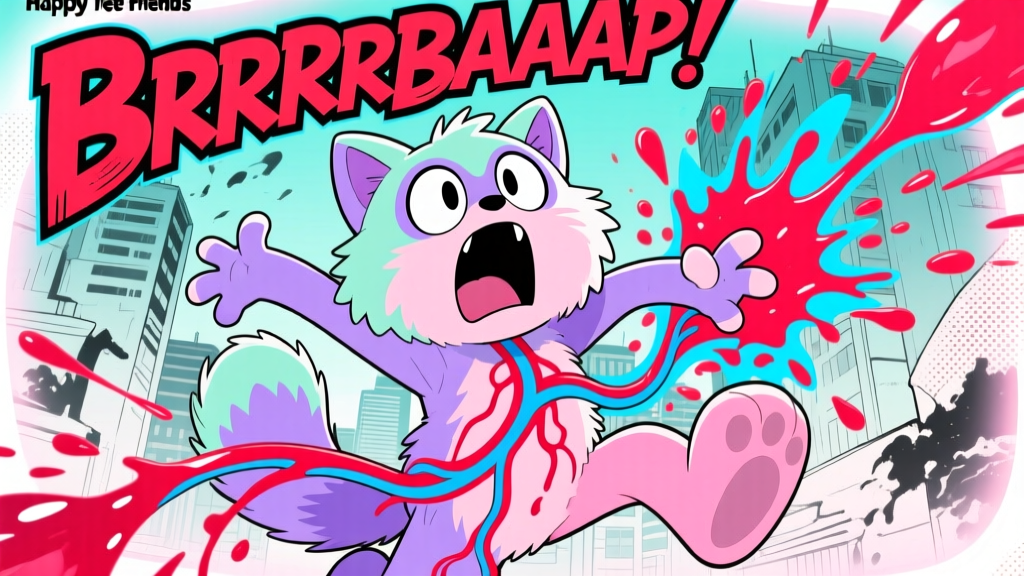
Picture this: a sky-blue rabbit with oversized buck teeth and rosy cheeks skips through a meadow rendered in candy-colored Flash animation. Daisies bob. Butterflies flutter. Then a lawnmower blade catches the rabbit at the waist and the screen floods with anatomically enthusiastic amounts of blood. That six-second whiplash — from Sanrio sweetness to Grand Guignol — is the entire creative thesis of Happy Tree Friends, a web cartoon that spent over two decades proving the internet would watch anything if the art style was cute enough.
For anyone hunting for happy tree friends pictures, the search results tell a bizarre story. You get birthday-party-worthy fan art nestled between screenshots of cartoon animals being dismembered in Technicolor. That dissonance was never accidental. It was the whole point, baked into every pixel from the very first episode.
A Three-Panel Pitch That Became a Web Culture Earthquake
The origin story reads like a bet made at 2 a.m. in a college dorm. In 1999, three Rhode Island School of Design graduates — Rhode Montijo, Kenn Navarro, and Aubrey Ankrum — created a short cartoon called "Banjo Frenzy" featuring a purple bear murdering three adorable woodland creatures. The pitch was dead simple: characters designed like they belonged on a preschool lunchbox, killed in ways that would make a Saw director wince.
They uploaded it to their personal website. At the time, this was still unusual. YouTube did not exist. Newgrounds was the dominant platform for Flash animation, and the trio posted there as well. Within weeks, "Banjo Frenzy" had been viewed hundreds of thousands of times — a staggering number for pre-broadband internet. Mondo Media, a San Francisco-based digital entertainment company, signed the creators and commissioned a full series.
The first official episode, "Spin Fun Knowin' Ya", premiered on Mondo's website in December 1999. It featured four characters on a merry-go-round. By the end, every single one was dead — impaled, decapitated, or launched into a jet engine. The art style was already locked in: thick black outlines, flat pastel fills, exaggerated facial expressions borrowed from rubber-hose animation, and a color palette that looked like a Lisa Frank folder had a baby with a splatter-paint canvas.
"We designed them to be as innocent-looking as possible. The bigger the eyes, the funnier it is when they get ripped out." — Kenn Navarro, co-creator, interview with Wired (2008)
The Art Style: Lisa Frank Meets Lucio Fulci
If you stripped away the gore, Happy Tree Friends would look like a line of merchandise aimed at toddlers. The character design follows a rigid visual grammar that the team established early and barely deviated from across 69 web episodes and 39 TV episodes:
- Body proportions: Heads are roughly 50-60% of total body height. Eyes consume a third of the face. Limbs are stubby and cylindrical, with no visible joints unless a scene requires one to snap.
- Line work: Consistent 3-4 pixel black outlines at standard resolution, giving every character a sticker-like silhouette. No shading gradients — fills are flat and saturated.
- Color palette: Each character is anchored to a single dominant hue (Cuddles is yellow, Giggles is pink, Lumpy is light blue) with one or two accent colors. Backgrounds push saturation even higher, creating a world that feels chemically cheerful.
- Expression system: Two default states — "happy" (crescent eyes, open smile) and "dead" (X eyes, tongue out, blood pooling). The comedy lives in the microsecond transition between them.
- Blood and viscera: Rendered in a bright, almost neon crimson (#CC0000 range) that clashes deliberately with the pastel surroundings. The gore is detailed — exposed organs, severed limbs, eyeballs on stalks — but maintains the same flat-fill, outlined aesthetic. It looks like a coloring book illustrated by a medical student.
This consistency was strategic. When you are producing short Flash animations on a small team's budget, a locked-down style guide means any animator on staff can draw any character without the audience noticing a shift. It also made the characters instantly recognizable at thumbnail size — a crucial advantage years before algorithms started recommending content based on visual similarity.
The Cast: Five Faces You Cannot Unsee
Over the show's run, the roster ballooned to roughly two dozen recurring characters. But five of them became the visual pillars — the ones who show up in almost every piece of promotional art, merchandise, and fan content.
Cuddles the Rabbit
Yellow fur, pink nose, perpetually raised arms as if asking to be held. Cuddles is the de facto mascot and holds the dubious record for the most on-screen deaths in the franchise — over 42 confirmed kills across all media. His design is the simplest in the cast, which makes him the easiest to draw and the most fun to destroy. Fan artists have rendered Cuddles in virtually every art style imaginable, from studio Ghibli watercolor to hyperrealistic oil painting. He is the Hello Kitty of splatter animation.
Flippy the Bear
A green bear in a military beret and dog tags. Flippy's visual gimmick is his dual-personality trigger: whenever he hears a sound that reminds him of combat (a popping balloon, a cracking twig, a doorbell), his eyes shift from warm dots to narrow white slits, and the background palette swaps from pastel to olive-drab military tones. This visual transformation — taking roughly eight frames of animation — became one of the show's most iconic and memed sequences. Cosplayers spend more time on Flippy's eye-swap contact lenses than on any other part of the costume.
Petunia the Raccoon
Blue fur, a pink bow, and a visible obsession with cleanliness (she is frequently shown scrubbing, organizing, or sanitizing). Petunia's design leans the hardest into the "cute merchandise" aesthetic — she looks like a plush toy you would win at a carnival. Her deaths tend to involve household appliances and cleaning chemicals, which gives them a darkly domestic quality. She is also one of the few characters whose eyes are drawn with visible pupils (small black dots inside the white), lending her a slightly more "aware" expression than the others.
Lumpy the Moose
Light blue, impossibly tall, with antlers that seem to have their own gravitational field. Lumpy is the tallest character in the cast and is drawn with a noticeably different proportion — his head is smaller relative to his body, making him look almost human in silhouette. He is also the show's designated idiot: his visual gags often involve him failing to notice obvious dangers (a lit stick of dynamite, an open manhole, a running chainsaw). His antlers, which span nearly twice his shoulder width, are frequently the instrument of someone else's demise.
Giggles the Chipmunk
Pink with a red bow, Giggles is one of the few female-coded characters in the main cast. Her design is deliberately the most "generic cute" — round face, dot eyes, tiny hands — which the animators exploited by giving her some of the most drawn-out, elaborate death sequences. The contrast between her squeaky giggle sound effect and the visual of her being slowly crushed by a log became a recurring comedic formula. She appears in the show's opening title card alongside Cuddles, cementing her status as a co-mascot.
| Character | Species | Dominant Color | Visual Signature | Approx. On-Screen Deaths |
|---|---|---|---|---|
| Cuddles | Rabbit | Yellow (#FFD700) | Buck teeth, pink nose, raised arms | 42+ |
| Flippy | Bear | Green (#4A7C59) | Military beret, eye-color shift | 18+ |
| Petunia | Raccoon | Blue (#6BA3D6) | Pink bow, visible pupils | 24+ |
| Lumpy | Moose | Light Blue (#87CEEB) | Oversized antlers, tall frame | 31+ |
| Giggles | Chipmunk | Pink (#FFB6C1) | Red bow, round face | 29+ |
Web Animation Before YouTube: Pioneering the Format
It is easy to forget how radical Happy Tree Friends was in 1999. Streaming video was a novelty — RealPlayer was the dominant format, and buffering a 90-second clip could take five minutes on a 56k modem. The creators chose Macromedia Flash (now Adobe Animate) because it produced vector-based animations that were tiny in file size. A typical two-minute episode was under 2 megabytes, making it downloadable even on dial-up connections.
This technical decision shaped the art style as much as any creative choice. Flash's vector tools naturally produce clean lines and flat fills — exactly the aesthetic that became the show's signature. Gradient shading was possible but file-size-expensive, so the team avoided it. Frame-by-frame animation was labor-intensive in Flash, so the animators relied on tweening (software-interpolated movement between keyframes), giving the characters a slightly mechanical, puppet-like motion that audiences found charming rather than stiff.
By 2003, the show was pulling in over 15 million views per month on Mondo Media's website. This was before YouTube (founded 2005), before Vimeo (2004), before social media embedding. People were sharing Happy Tree Friends links on forums, via email chains, and through early social networks like Friendster and LiveJournal. The show proved that original animated content could find a massive audience online without a TV network, a studio deal, or a broadcast license.
When G4 TV picked up the series for a television run in September 2006, the episodes were reformatted for standard-definition broadcast. The Flash files were upscaled, and some scenes were re-animated at a higher frame rate. But the core visual language — flat colors, thick outlines, pastel-and-gore palette — remained unchanged. It aired alongside South Park and The Soup, and its TV-MA rating confused channel-surfers who expected a children's show based on the character designs.
The Numbers That Mattered: Happy Tree Friends reached 15 million monthly web views by 2003, accumulated over 300 million total streams by 2008, and was available in 42 countries through television distribution deals. The YouTube channel, launched after the platform matured, currently holds over 1.2 million subscribers and individual episode clips regularly surpass 10 million views.
The Cute-Gore Formula: Why the Visual Whiplash Works
The comedy of Happy Tree Friends rests on a single visual principle: expectation violation through art style mismatch. Cognitive psychology research on humor (notably the incongruity-resolution theory outlined by Suls, 1972) suggests that laughter occurs when the brain detects a pattern violation and then rapidly resolves it. HTF weaponizes this by loading the visual channel with contradictory information.
The art style primes you for innocence. Rounded shapes, saturated pastels, and oversized eyes trigger the same caregiving responses that baby animals and infant product design exploit — what Konrad Lorenz called Kindchenschema in his 1943 ethology work. Your brain categorizes these characters as "safe, cute, non-threatening." Then the violence hits, and that categorization shatters. The resolution — "oh, this is a cartoon, it is fake, it is supposed to be funny" — arrives quickly, and the gap between the initial shock and the resolution is where the laugh lives.
This formula is not unique to HTF. Itchy & Scratchy from The Simpsons used a similar conceit. So does Happy Tree Friends' spiritual successor in the YouTube era, Salad Fingers. But HTF committed to the bit harder and longer than anyone else. Every single episode follows the same structural template: cheerful setup, accidental escalation, catastrophic violence, cheerful ending card. The audience knows exactly what will happen. The pleasure is in the how — the increasingly inventive Rube Goldberg machines of doom.
Memorable Visual Moments: The Frames That Burned Into Retinas
Across nearly two decades of production, certain frames became etched into the collective memory of the fandom — the images that surface in "remember this?" threads and reaction GIF libraries.
- "House Warming" (2000): Petunia's treehouse catch-and-release sequence, where a simple home improvement project escalates into a nail-gun massacre. The freeze-frame of Petunia with twelve nails embedded in her skull, eyes still smiling, became one of the most widely shared images in early internet humor.
- "Flippy's Flip" episodes: Any scene where Flippy's eye transformation triggers. The visual shift — warm brown irises snapping to predatory white slits over a half-second dissolve — was so effective it became a reaction GIF template used far outside the HTF community.
- "Classy Kringle" (2003 Christmas special): A 12-minute holiday episode that features, among other things, a candy cane used as an impalement device and a Christmas tree that functions as an accidental woodchipper. The color palette juxtaposes traditional holiday reds and greens with arterial spray, making it the most visually festive atrocity in the catalog.
- "From Hero to Eternity" (2004): The superhero parody where Lumpy's stretching power is used to create a slingshot that launches Cuddles into a building. The impact frame — a yellow smear on a skyscraper window while Lumpy waves cheerfully — is peak HTF visual comedy.
- The TV series opener (2006): A reimagined title sequence with higher production values, featuring all main characters in a cheerful parade that systematically kills each one in time with a bouncy ukulele soundtrack. The sequence was storyboarded by Kenn Navarro himself and remains the most polished piece of animation the franchise ever produced.
Fan Art, Cosplay, and the Merchandising Paradox
Happy Tree Friends occupies a strange space in merchandise culture. The character designs are so inherently toy-friendly that fans demanded plushies, pins, and apparel almost immediately — and then felt deeply conflicted about buying a stuffed animal of a character they had watched get dismembered forty times.
Mondo Media and later licensing partners obliged. Official merchandise has included:
- Plush toys (Cuddles, Flippy, and Giggles in 8-inch and 14-inch variants)
- Enamel pin sets featuring characters in both "alive" and "dead" poses
- T-shirts with designs like "I survived Happy Tree Friends" alongside a blood-splattered Cuddles
- A limited-run board game where players compete to die in the most creative way
- Sticker sheets that include both happy and mangled versions of each character
The fan art scene is where things get truly expansive. Search platforms like DeviantArt, Pixiv, and Tumblr host tens of thousands of HTF fan pieces. The art spans every conceivable style — chibi crossovers, dark fantasy reinterpretations, pixel art tributes, and "what if" redesigns that reimagine the characters in other animation house styles (Studio Trigger HTF, Pixar HTF, Laika stop-motion HTF).
A particularly popular fan art subgenre involves "character swap" art, where artists redraw the characters in the visual style of other franchises: Happy Tree Friends as My Little Pony characters, as Pokémon, as Undertale sprites, or as Studio Ghibli creatures. These pieces often preserve the core HTF gore element, creating art where a Ghibli-styled Cuddles is being devoured by a soot sprite — somehow both soothing and horrifying simultaneously.
Cosplay peaked around 2008-2014, when HTF was at maximum cultural saturation. Flippy remains the most popular cosplay choice because the military costume is relatively straightforward to assemble and the eye-color transformation can be achieved with double-sided contact lenses (one side brown, one side white). Convention photos of Flippy cosplayers doing the "thousand-yard stare" became a minor meme in their own right.
Legacy: What the Pictures Left Behind
Happy Tree Friends stopped regular production around 2016, though the YouTube channel continues to accumulate views and occasional compilation uploads surface. The show's visual DNA, however, is everywhere in modern internet animation. You can see it in:
- Don't Hug Me I'm Scared (2011-2016): The British puppet series that uses the same cute-to-horrific pipeline, though with physical puppets instead of Flash.
- Lackadaisy and other indie web animations that adopted the "clean vector art, dark subject matter" approach.
- The Amazing Digital Circus (2023-present): GL Productions' indie web series carries forward the tradition of bright, toy-like character designs in existentially unsettling scenarios.
- TikTok horror animation: The current wave of short-form animators on TikTok and Instagram Reels who pair kawaii character art with disturbing narratives owes a direct debt to HTF's formula.
The show proved that art style is a delivery mechanism for tone, and that the sharper the contrast between visual packaging and narrative content, the more memorable the result. Every piece of Happy Tree Friends fan art, every screenshot, every GIF that circulates online is proof that the formula still resonates.
If you grew up watching these characters die and somehow kept coming back — and millions did — then you already understand why the pictures matter. They are postcards from the moment the internet realized that animation did not need a network, a budget, or permission to reach millions of people. All it needed was a rabbit with big eyes and a really, really bad day.
What art program was Happy Tree Friends animated in?
The original web series was animated in Macromedia Flash (later Adobe Flash, now Adobe Animate). The vector-based workflow kept file sizes small enough for dial-up-era streaming. Later TV episodes used a combination of Flash and After Effects for compositing and effects work.
Who designed the original Happy Tree Friends characters?
The core character designs were created by Rhode Montijo, one of the three co-creators. Montijo's background in illustration and children's book art heavily influenced the show's deceptively innocent visual style. Aubrey Ankrum and Kenn Navarro contributed to character development and animation direction.
Why does Happy Tree Friends look so much like children's merchandise?
Deliberately. The creators designed the characters to mimic the visual language of children's products — rounded shapes, pastel colors, oversized eyes, minimal detail — specifically to maximize the comedic impact of the violent content. The more innocent the design, the sharper the contrast when the gore starts.
Where can I find high-quality Happy Tree Friends pictures and screenshots?
The official Happy Tree Friends YouTube channel maintains episode uploads and stills. Fan wikis like the HTF Wiki (Fandom) maintain screenshot archives organized by episode and character. DeviantArt and Pixiv host extensive fan art galleries. For GIF captures, Tenor and Giphy have substantial HTF libraries.
Is Happy Tree Friends still being produced?
Regular production of new episodes ended around 2016. However, Mondo Media has occasionally released compilation videos and the existing catalog remains available on YouTube and various streaming platforms. The franchise retains an active fan community that continues to produce art, animation tributes, and fan episodes.