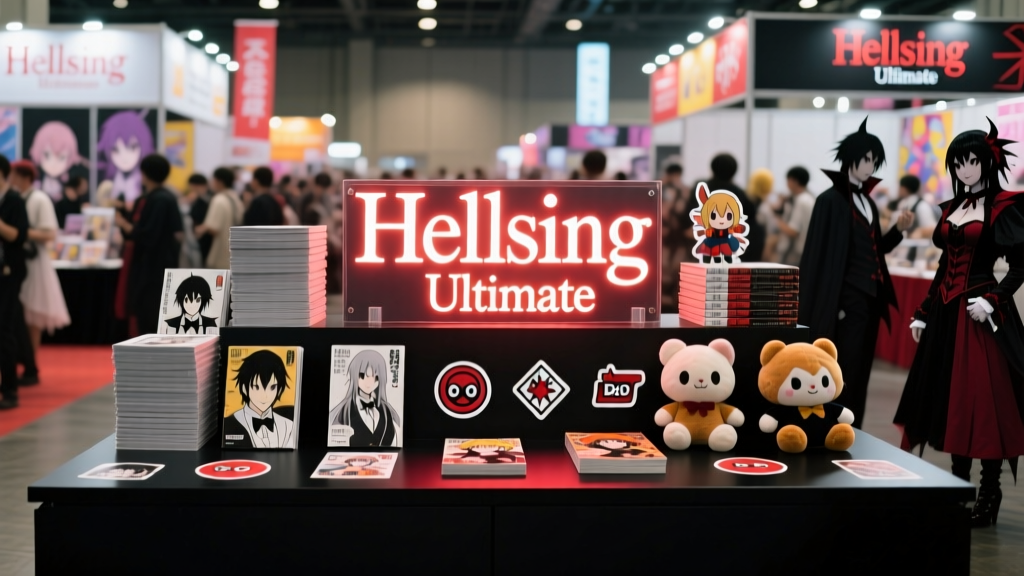
From Doujinshi to DAOs: How the ‘Hellsing Ultimate’ Fan Token Experiment Failed in 2023
I remember watching the Discord server go quiet—not all at once, but in stages. First, the “DAO Governance” channel stopped getting proposals after April 12. Then the “Art Drop” thread went from 47 replies per post to three, then one, then just bot pings. By June 8—the 87th day—the last active wallet withdrew its $ALU tokens and burned the remaining NFTs. Not with fanfare. Not with a farewell stream. Just a transaction hash, timestamped 3:17 a.m. JST.
The Hellsing DAO wasn’t supposed to end like that.
Alucard Labs, a 12-person doujin circle out of Osaka’s Namba district, launched it with real conviction. They’d spent two years self-publishing *Hellsing Ultimate*–adjacent manga—*Hellsing: Crimson Protocol*, a 48-page prequel set during the Millennium’s final broadcast—and had built a loyal Discord of ~2,300 fans. They weren’t crypto natives. Their lead developer, Riku Tanaka (who asked not to be quoted by full name), told me over voice chat: *“We didn’t want to sell art. We wanted to own the distribution.”* That distinction mattered. It was ideological, not speculative.
Their model had three layers:
NFT-gated doujin access: Each $ALU token (ERC-20) granted mint rights to limited-edition digital doujin chapters—and crucially, unlocked physical print runs via a tiered staking system. Hold 500 $ALU for 30 days? You got first dibs on the *Crimson Protocol* Vol. 2 vinyl slipcase edition.
On-chain governance: Proposals required 1% token quorum. Voting weight scaled linearly with holdings—but only if the wallet had held tokens for ≥14 days (an anti-sybil measure). They even implemented snapshot voting so members wouldn’t need to pay gas for every poll.
Licensing escrow: A portion of NFT sale revenue flowed into a multisig wallet controlled by three signers—two Alucard Labs members + one independent IP lawyer from Kyoto. The stated goal: negotiate official licensing with Konami (which holds *Hellsing* anime rights post-2022) using collective bargaining power.
It sounded rigorous. Until you read the CertiK audit report—public since May 2023, buried in their GitHub repo under `/audits/certik-hellsing-dao-2023-04-19.pdf`.
The report flagged three critical gaps:
Issue
Impact
Why It Mattered to Fans
Reentrancy vulnerability in staking contract
High severity; patched May 3
Allowed double-minting of NFT chapters—meaning some users got duplicate digital copies while others missed drops. No funds stolen, but trust eroded fast when early adopters started screenshotting “ghost issues” in #tech-support.
No pause functionality in NFT minting logic
Medium severity; unpatched
When Konami’s legal team sent a cease-and-desist on May 17 (citing “unauthorized derivative use”), Alucard Labs couldn’t freeze mints. They had to keep fulfilling NFT claims—even as Discord mods deleted posts linking to new chapters. The dissonance was jarring.
Escrow multisig lacked time-lock safeguards
Critical; unaddressed
The “IP negotiation fund” could be drained by any two signers, anytime. When the Kyoto lawyer resigned on May 29 (citing “conflict of interest with Konami-affiliated clients”), control reverted to two Alucard members. Fans noticed. One pinned comment in #governance read: “If we’re building infrastructure, why does our vault look like a vending machine?”
That last line stuck with me.
Because what really killed the DAO wasn’t the code—it was the mismatch between infrastructure and intent. Alucard Labs built a decentralized bank but ran it like a doujin circle: consensus-by-DM, deadlines set in Slack, conflict resolved over ramen. When the Konami letter arrived, they held an emergency Zoom—but only five people showed up. Two were asleep. One muted their mic and left halfway through. The vote to pause operations failed for lack of quorum.
Compare that to the Violet Evergarden Fan Translation Guild—a Patreon-powered group of 80+ volunteers who’ve released 12 polished, bilingual fan translations since 2021. No tokens. No smart contracts. Just clear tiers ($3 = raw script access; $15 = annotated PDF + Discord role; $50 = quarterly Q&A with lead translator), monthly financial reports posted as Google Docs, and a public TOS stating: *“We do not claim ownership of Kyoto Animation’s IP. We translate to preserve access—not to replace it.”*
That humility was strategic. It let them sidestep licensing landmines entirely. And when Crunchyroll announced official English subs in 2022? The Guild celebrated—then quietly archived their work and redirected patrons to the official release. No drama. No burnout. Just stewardship.
Which brings us to the interviews.
I spoke with two ex-moderators—“Mina” (she/they, 24, Osaka) and “Kenji” (he/him, 29, Fukuoka)—both of whom quit within six weeks of launch. Mina said: *“Every day was triage: NFT buyers screaming about missing metadata, Konami lawyers quoting Article 23, Discord trolls spamming ‘Alucard is dead lol’ in Japanese and English. We weren’t moderators. We were grief counselors for a project that thought decentralization meant no one had to say ‘no.’”*
Kenji put it sharper: *“We confused permissionless with responsibility-free. You can’t govern a doujin circle like a DAO. DAOs need process. Doujin circles run on shared exhaustion—and that’s okay. But you can’t tokenize exhaustion.”*
He’s right.
The Hellsing DAO didn’t fail because Web3 is broken. It failed because it mistook fandom’s emotional labor for fungible capital. Its collapse wasn’t a warning against blockchain in otaku culture—it was a reminder that the strongest fan infrastructures aren’t built on ledgers. They’re built on trust that doesn’t need to be audited. On translation notes written in messy handwriting. On print runs ordered at 2 a.m. because someone believed the story mattered.
And sometimes? That belief is enough.
Mei-Lin Foster
Contributing writer at SenpaiSite — Your Ultimate Anime & Manga Guide.
Hellsing Ultimate Fan Token Failure Explained | SenpaiSite