SenpaiSite · Otaku Culture · Star Wars
Imperial Guard Star Wars: The Crimson Sentinels Who Guarded the Galaxy's Greatest Tyrant
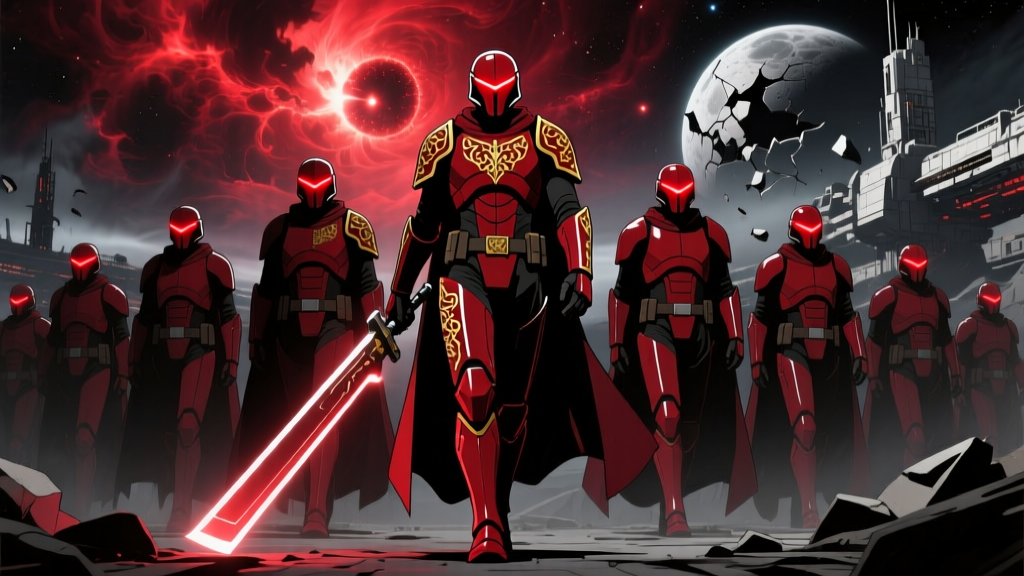
Faceless. Nameless. Lethal. The Emperor's Royal Guard stood motionless in crimson robes while an empire rose and burned around them. Here is everything we know about Palpatine's most unsettling creation.
Every Star Wars fan remembers the first time they saw them. Two figures in floor-length crimson robes, faces completely hidden behind featureless red helmets, standing absolutely still on either side of Emperor Palpatine's throne. No dialogue. No movement. No personality whatsoever. And somehow, they were terrifying.
The Emperor's Royal Guard — sometimes called the Imperial Guard, sometimes the Red Guard, and occasionally the Emperor's Shadow Guard depending on which era and which sourcebook you are reading — represents one of the most visually striking and deliberately mysterious design choices in the entire Star Wars franchise. George Lucas and his costume department created a figure that communicates absolute authoritarian control without uttering a single line of dialogue.
This article digs into every corner of what makes the Imperial Guard compelling: their in-universe origins and training, the real-world design philosophy behind those crimson robes, their weapons and combat capabilities, every significant appearance across films, television, comics, novels, and games, and a rundown of the collectibles market that has sprung up around them. Whether you are a casual viewer who always wondered who those red guys were or a deep-lore enthusiast looking for a comprehensive reference, this is the guide.
Origins and Purpose: Why Palpatine Needed Crimson Ghosts
The Emperor's Royal Guard was established shortly after Palpatine consolidated power and transformed the Galactic Republic into the Galactic Empire. Before the Empire, the Supreme Chancellor relied on the Senate Guard and, during the Clone Wars, clone troopers for personal protection. But Palpatine understood something that went beyond practical security needs: theater.
A dictator does not need bodyguards who look like regular soldiers. Stormtroopers are effective for crowd control and military operations, but they look like mass-produced infantry. They communicate expendability. Palpatine wanted something different for his personal chambers — figures that projected exclusivity, fanaticism, and the kind of disciplined menace that made visitors think twice about reaching for a weapon.
The Royal Guard was the answer. They were deliberately designed to erase individual identity. The helmets concealed every facial feature. The robes hid body type, gender, and any distinguishing marks. A guard on duty was not a person. They were an extension of the Emperor's will — silent, unmoving, and unquestionably loyal. In the Legends continuity, Palpatine went so far as to require that guards never speak while on duty, never remove their helmets in the presence of anyone other than the Emperor himself, and never acknowledge the existence of other guards by name.
This was not paranoia for its own sake. Palpatine had survived countless assassination attempts as Chancellor and understood that the most dangerous threats came from people who got close to him. A faceless, anonymous guard corps that rotated frequently and answered only to him was a practical countermeasure wrapped in authoritarian aesthetics.
Training on Yinchorr: The Crucible That Forged the Guard
In the Legends continuity — which remains the richest source of Imperial Guard lore — candidates for the Royal Guard were drawn from the most elite units of the Imperial Military. Stormtrooper sergeants, Imperial Intelligence operatives, and special forces veterans were handpicked based on combat performance records, psychological profiles, and an unwavering loyalty assessment that bordered on brainwashing.
These candidates were sent to Yinchorr, the homeworld of the Yinchorri species and a planet with an environment so hostile that simply surviving on its surface constituted a significant portion of the training. Yinchorr featured extreme temperatures, toxic atmospheric pockets, predatory wildlife, and terrain that shifted between jagged rock formations and unstable marshland. The Imperial training facility there was less a school and more a survival gauntlet.
The training program lasted roughly two standard years and covered unarmed combat (a hybrid system drawing from multiple martial traditions across the galaxy), blaster proficiency, force pike mastery, close-quarters protection tactics, and assassination countermeasures. Candidates trained in full armor from day one, learning to fight with the restricted peripheral vision and limited mobility that the iconic helmet imposed. Dropout rates were staggering — according to the Star Wars: The Complete Visual Dictionary, fewer than one in ten candidates completed the program.
In canon, the details are thinner but the broad strokes remain consistent. The Royal Guard were among the most individually capable soldiers in the Imperial hierarchy. Their training emphasized loyalty above survival, which is why in Return of the Jedi, they stand motionless while the Death II's throne room literally collapses around them during the Battle of Endor.
Armor, Weapons, and Equipment
The visual design of the Imperial Guard is one of the most recognizable silhouettes in Star Wars, and every element of their kit was purpose-built.
The Crimson Robes
The outer layer is a heavy crimson robe that extends from the high collar to the floor. The fabric is thick enough to provide minor protection against slashing attacks and environmental hazards, and its deep red color is deliberately chosen to evoke blood, fire, and imperial authority. The robes also serve a practical concealment function — body armor, comlinks, and secondary weapons are hidden beneath the fabric, making it impossible for an observer to assess what a guard is carrying.
The Helmet
The helmet is a smooth, featureless dome with a narrow visor slit that provides a restricted forward field of view. This was a deliberate trade-off: the guard sacrifices peripheral vision in exchange for an intimidating, inhuman appearance. The helmet includes a built-in comlink, atmospheric filtration for operation in toxic environments, and a heads-up display in later canon iterations. In Legends, some variants included polarized lenses that could filter flashbangs and other optical countermeasures.
Body Armor
Beneath the robes, guards wore fitted plastoid body armor similar in material composition to stormtrooper armor but tailored for greater flexibility. The armor covered the torso, shoulders, forearms, and shins, providing protection against blaster bolts at moderate range and most melee strikes. The armor was lighter than standard stormtrooper issue — the Royal Guard's role was precision protection, not frontline warfare, so mobility mattered more than maximum coverage.
Weapons Loadout
The signature weapon of the Royal Guard is the force pike — a long, vibro-edged polearm that can be wielded two-handed for powerful thrusting and sweeping attacks. Force pikes are effective against both armored and unarmored opponents, can block lightsaber strikes for brief periods thanks to their cortosis-weave variants, and look imposing when held at attention. The pike is the weapon most associated with the guard and the one you see in virtually every appearance.
Secondary armament includes a heavy blaster pistol (typically an S-5 or equivalent) holstered beneath the robes, and in Legends, certain guards were trained with electrostaffs, blaster rifles, and even lightsabers. The lightsaber-equipped guards are a deep-cut Legends concept — Palpatine kept a small cadre of Royal Guards who had received rudimentary lightsaber training, not as true Force wielders but as a last-resort countermeasure against Jedi assassination attempts. These guards carried short-bladed lightsabers hidden within their robes.
Every Appearance Across Star Wars Media
The Imperial Guard has appeared across virtually every medium Star Wars has touched. Here is a comprehensive breakdown of their most significant appearances, organized by category.
| Medium | Title | Year | Role & Notes |
|---|---|---|---|
| Film | Return of the Jedi | 1983 | First appearance. Two guards flank Palpatine's throne on the Death Star II. They do not speak or fight but their presence defines the visual language of imperial power. |
| Film | Revenge of the Sith | 2005 | Blue-robed Senate Guard variant visible during Palpatine's transition to Emperor. Establishes the visual lineage from Republic to Empire. |
| TV | The Clone Wars | 2008–2020 | Red Guard appear in multiple episodes protecting Chancellor Palpatine. The "Crisis on Naboo" arc features a guard sacrificing himself, establishing fanatical loyalty early. |
| TV | Star Wars Rebels | 2014–2018 | Royal Guard appear in Emperor-themed sequences. The show's stylized animation captures the crimson robes with striking visual impact. |
| Film | The Rise of Skywalker | 2019 | Royal Guard flank the resurrected Palpatine on Exegol. Crimson robes against dark stone — the visual language returns full circle. |
| Comics | Crimson Empire series | 1997–1999 | Legends. The definitive Imperial Guard story. Kir Kanos vs. Carnor Jax — a civil war between former guards. Essential reading for any Guard enthusiast. |
| Novels | Tarkin by James Luceno | 2014 | Canon. Explores the early days of the Royal Guard and their relationship with the Emperor's inner circle. |
| Games | Jedi: Fallen Order / Survivor | 2019 / 2023 | Purge Troopers share visual DNA with the Royal Guard. Boss encounters on Imperial installations feature guard variants as elite enemies. |
| Games | Star Wars: Battlefront II | 2017 | Royal Guard appear as elite NPC enemies on Emperor-themed maps. High health, force pike attacks, and aggressive AI behavior. |
| Comics | Darth Vader (2017 Marvel run) | 2017–2018 | Canon. Royal Guard appear in multiple issues as Palpatine's personal enforcers. Vader's interactions with the guard hint at mutual, silent hostility. |
Notable Guards: The Few Who Had Names
Kir Kanos
Legends · Crimson Empire series
The closest thing the Imperial Guard has to a protagonist. Kir Kanos is one of the last surviving Royal Guards after the Battle of Endor and the death of Palpatine. When a faction of former guards led by Carnor Jax attempts to seize control of the Imperial Remnant, Kanos takes it upon himself to hunt them down. He is disciplined, lethal, and driven by a code of loyalty that outlasted the Empire itself. Kanos is the character who proved that a faceless guard in crimson armor could carry an entire comic series — and he did it convincingly.
Carnor Jax
Legends · Crimson Empire series
The villain of Crimson Empire and arguably the most ambitious Imperial Guard in Star Wars history. Carnor Jax was a Royal Guard who trained alongside Kir Kanos and was equally skilled. After Palpatine's death, Jax gathered other surviving guards and plotted to establish himself as a new Imperial leader. He was manipulative, ruthless, and backed by a faction of the Imperial military that saw a guard-turned-warlord as a useful figurehead. His eventual confrontation with Kanos is one of the best-penciled fight sequences in Dark Horse Comics' Star Wars run.
Emperor's Shadow Guard
Legends · The Force Unleashed series
A specialized subset of the Royal Guard equipped with force-resistant armor and trained to counter Force-sensitive attackers. The Shadow Guard appeared primarily in The Force Unleashed video games as elite enemies who could resist Force pushes, telekinetic grabs, and even brief lightsaber contact. They represented Palpatine's contingency planning — a guard unit specifically designed to fight Jedi. In gameplay terms, they were among the toughest non-boss enemies in the franchise.
Lieutenant Charbel
Canon · Various reference materials
One of the few named Royal Guard officers in current canon. Charbel appears in reference materials and background lore as a senior member of the guard who served during the height of the Empire. His significance lies primarily in being one of the rare instances where the franchise acknowledged that individual people existed beneath those helmets.
Real-World Design: How a Costume Department Created an Icon
The Imperial Guard costume was designed for Return of the Jedi by the Lucasfilm wardrobe department under the supervision of Aggie Guerard Rodgers and Nilo Rodis-Jamero, who handled much of the concept art for the film's new characters. The design brief was straightforward: create a figure that looked like a ceremonial guard for a galactic emperor, something between a Vatican Swiss Guard and a futuristic samurai.
The result was a masterclass in visual storytelling. The crimson color was chosen for its association with blood, power, and danger — it is the most attention-grabbing color in the human visual spectrum, and in a throne room filled with dark grey and black Imperial architecture, a pair of bright red figures creates an instant focal point. The floor-length robes eliminate any visible body language, which makes the guards read as objects rather than people. The featureless helmet is perhaps the single most effective design element: it denies the audience any emotional connection, which is exactly the point. You cannot empathize with someone whose face you cannot see.
The practical construction of the costume for the 1983 film was relatively straightforward by modern standards. The helmet was a fiberglass shell with a tinted visor, the robes were dyed cotton-polyester blend, and the force pikes were aluminum rods with resin tips. The actors inside the costumes — including stunt performer Richard Oldfield and others who were never publicly credited for the role — had limited visibility and restricted arm movement, which inadvertently contributed to the stiff, rigid posture that became the guard's signature stance.
The design proved so effective that it has remained virtually unchanged across four decades of Star Wars media. Minor updates in The Rise of Skywalker added subtle texture to the helmet and slightly richer fabric for the robes, but the silhouette is identical to what appeared in 1983. That is a testament to how well the original design solved its core problem: making a silent, motionless background figure feel like a threat.
Legends vs. Canon: What Changed and What Survived
When Disney acquired Lucasfilm in 2012 and restructured the Star Wars expanded universe into the non-canon "Legends" category, the Imperial Guard lost a significant amount of backstory. The Crimson Empire comics, the detailed training lore from sourcebooks like The Essential Guide to Warfare, and the Shadow Guard's expanded role in The Force Unleashed were all reclassified as Legends material.
What survived the transition into canon was the visual identity and the core concept. The Royal Guard still exist in current Star Wars canon. They appear in The Clone Wars animated series (which bridged the pre-canon and post-canon eras), in Rebels, in The Rise of Skywalker, and in various Marvel comics. The novel Tarkin by James Luceno provided some canon-compliant backstory, and reference books like Star Wars: The Rise of Skywalker Visual Dictionary confirmed that the training pipeline and the loyalty protocols remained consistent with the Legends version in broad terms.
The gap that canon has yet to fill is the post-Endor story. Crimson Empire gave the Imperial Guard a narrative arc that extended beyond Palpatine's death — guards struggling with identity and purpose after the figure they were sworn to protect no longer existed. That is a rich story premise, and it remains unexplored in current canon. Given the franchise's tendency to revisit its most visually iconic elements, it would not be surprising to see a Crimson Empire-inspired story emerge in a future Disney+ series or comic run.
Combat Capabilities: How Dangerous Were They Really?
This is where fan debate gets heated. The Imperial Guard never received a major on-screen combat sequence in the films. In Return of the Jedi, they stand still while chaos erupts around them, and at least one is killed by falling debris during the throne room's destruction. This has led some viewers to assume the guards are ceremonial — all costume, no combat capability.
That assumption is wrong, and the expanded material makes it clear. In The Clone Wars, a Royal Guard throws himself in front of a bomb meant for Palpatine during the "Crisis on Naboo" arc, surviving the blast through sheer armor resilience and physical conditioning. In the Crimson Empire comics, Kir Kanos and Carnor Jax engage in lightsaber-level melee combat using force pikes and demonstrate reflexes, strength, and tactical thinking that rival most Jedi depicted in the prequels.
The Star Wars: The Force Unleashed games took this further with the Shadow Guard, who could actively resist Force powers and engage Starkiller — a character whose power level borders on absurd — in sustained combat. These enemies required the player to use advanced combos and Force abilities to defeat, making them functionally equivalent to mini-bosses.
In the current canon, the most telling detail comes from the Darth Vader Marvel comics, where Royal Guards are shown responding to threats with speed and precision that suggest their motionless throne-room posture is a deliberate choice, not a limitation. When activated, they move fast. The stillness is discipline, not inability.
Collectibles: Building a Crimson Collection
The Imperial Guard occupies a unique niche in the Star Wars collectibles market. They are not the most popular character — that territory belongs to Vader, Mandalorian, and the usual suspects — but they have a dedicated collector base that keeps demand steady and prices relatively stable. Here is a breakdown of the most notable collectible lines.
Hasbro Black Series (6-Inch)
Hasbro released an Emperor's Royal Guard figure in The Black Series line that quickly became a fan favorite. The figure includes the crimson robes (fabric, not molded plastic), a force pike, and a blaster pistol accessory. The helmet sculpt is accurate to the Return of the Jedi design, and the articulation allows for both the iconic standing pose and more dynamic combat stances. Secondary market prices for the Black Series Royal Guard typically range from $35 to $65 depending on condition and packaging, making it one of the more affordable entries for new collectors.
Sideshow Collectibles & Hot Toys (12-Inch / Premium)
Sideshow Collectibles produced a premium 12-inch Emperor's Royal Guard statue that is widely considered the definitive collectible representation. The piece features real fabric robes, a detailed helmet with weathering effects, a display base modeled after the Death Star throne room floor, and interchangeable hand grips for the force pike. Original retail was approximately $220, and secondary market prices for mint-in-box examples have climbed to $350–$500. Hot Toys has not released a standalone Royal Guard figure as of this writing, though fan demand has been vocal and persistent.
Funko Pop! Vinyl
The Funko Pop! Emperor's Royal Guard is a simplified but recognizable take on the character, featuring the characteristic oversized head in the smooth red helmet. It is a common figure in the Star Wars Pop! lineup and typically retails for $10–$15, making it the most accessible entry point for casual fans. Convention-exclusive variants with metallic or chase finishes command modest premiums of $25–$40.
LEGO
LEGO has included Royal Guard minifigures in several sets over the years, most notably in the Death Star and Emperor's Throne Room playsets. The minifigure features a printed red torso with robe detailing and a solid red helmet piece. Individual Royal Guard minifigures sell for $8–$20 on the secondary market depending on the set they originated from and whether accessories (force pike) are included.
Vintage Kenner (1983–1984)
The original Kenner Emperor's Royal Guard action figure from the Return of the Jedi line is a collector's item in its own right. Carded examples in good condition sell for $80–$200, and the figure is recognizable by its simplified sculpt and fabric cape attachment. The vintage figure lacks the articulation and detail of modern releases but carries significant nostalgia value for collectors who grew up with the original trilogy toys.
Why the Imperial Guard Still Matters
Strip away the lore, the collectibles, and the expanded universe comics, and the Imperial Guard's significance comes down to a single design truth: the most effective symbol of authoritarian power is not a weapon or a fortress. It is a human being who has surrendered their identity so completely that they have become furniture.
The Royal Guard do not negotiate. They do not question. They do not react. They stand. And in standing, they communicate everything Palpatine wanted his visitors to feel — that resistance is futile, that the Emperor's authority is absolute, and that the people protecting him have given up every part of themselves to serve that authority. That is a more effective intimidation tactic than any Star Destroyer or Death Star superlaser.
The franchise recognizes this. That is why the Royal Guard keeps coming back, in every era, across every medium. They are too visually powerful and too conceptually resonant to leave on the shelf. Whether the next generation encounters them in a Disney+ series, a new comic run, or a next-generation video game, those crimson robes and featureless helmets will still be doing exactly what they were designed to do in 1983: standing still, saying nothing, and making everyone in the room feel watched.
Frequently Asked Questions
What is the official name for the Emperor's red guards in Star Wars?
The most widely used official designation is the Emperor's Royal Guard. They are also referred to as the Imperial Guard, the Red Guard, and in certain Legends materials as the Emperor's Shadow Guard (a specialized subset). In current canon, "Royal Guard" is the standard term used across films, television, and reference materials.
Can the Imperial Guard actually fight, or are they just ceremonial?
They can fight, and they are exceptionally skilled. The stillness seen in the films is a product of extreme discipline, not a lack of combat ability. In expanded media including The Clone Wars, the Crimson Empire comics, and The Force Unleashed games, Royal Guards engage in sustained combat against elite opponents and demonstrate capabilities that rival or exceed most special forces units in the Star Wars galaxy.
Were the Imperial Guard Force-sensitive?
In canon, no. The Royal Guard are non-Force-sensitive soldiers. In Legends, there were rumors and references to a small number of guards who received rudimentary lightsaber training as a countermeasure against Jedi assassins, but they were not true Force wielders. Their effectiveness came from physical training, specialized equipment, and fanatical loyalty rather than any connection to the Force.
What is the story of Crimson Empire and why is it important?
Crimson Empire is a Legends comic series published by Dark Horse Comics in 1997–1998. It follows Kir Kanos, one of the last surviving Royal Guards after Palpatine's death, as he hunts down Carnor Jax, a fellow guard who has turned traitor and is trying to seize power within the Imperial Remnant. The series is important because it gave the Imperial Guard their only sustained narrative arc, transforming them from anonymous background figures into characters with depth, motivation, and internal conflict. It remains one of the most critically acclaimed Star Wars comic series ever published.
What happened to the Royal Guard after Palpatine died?
In canon, this has not been fully explored. Some guards were killed during the Battle of Endor when the Death Star II was destroyed. In Legends, the Crimson Empire comics showed that surviving guards splintered into factions — some remained loyal to the memory of the Emperor, while others, led by Carnor Jax, pursued their own political ambitions. The canonical fate of the post-Endor Royal Guard remains an open question that future Star Wars content may address.
Who played the Imperial Guard in Return of the Jedi?
The Royal Guard in Return of the Jedi were portrayed by uncredited stunt performers and extras. The specific actors inside the crimson costumes have never been officially credited in Lucasfilm materials, which is somewhat fitting given that the characters were designed to be completely anonymous. Several fan research projects have attempted to identify the performers, but definitive confirmation remains elusive.
What weapon does the Imperial Guard carry?
The primary and signature weapon is the force pike — a long polearm with a vibro-edged tip capable of cutting through most materials. They also carry a heavy blaster pistol concealed beneath their robes. In Legends, specialized variants were equipped with electrostaffs, blaster rifles, and in rare cases short-bladed lightsabers for anti-Jedi operations.
Is there a difference between the Royal Guard and the Praetorian Guard?
Yes. The Emperor's Royal Guard served Palpatine during the Galactic Empire (original trilogy era). The Elite Praetorian Guard served Supreme Leader Snoke during the First Order era (sequel trilogy). They share visual DNA — both wear full-body armor and feature-concealing helmets — but the Praetorian Guard use a different color scheme (crimson with gold accents), different weapons (including bisento, double-bladed swords, and electro-chain whips), and were designed for a different political context. Think of the Praetorian Guard as the First Order's evolution of the Royal Guard concept.
The Emperor's Watch Continues
From a 1983 costume built with fiberglass and dyed cotton to a multi-decade expanded universe spanning comics, novels, games, and animated series — the Imperial Guard has earned its place as one of Star Wars' most enduring visual icons. They never asked for screen time. They never needed it.