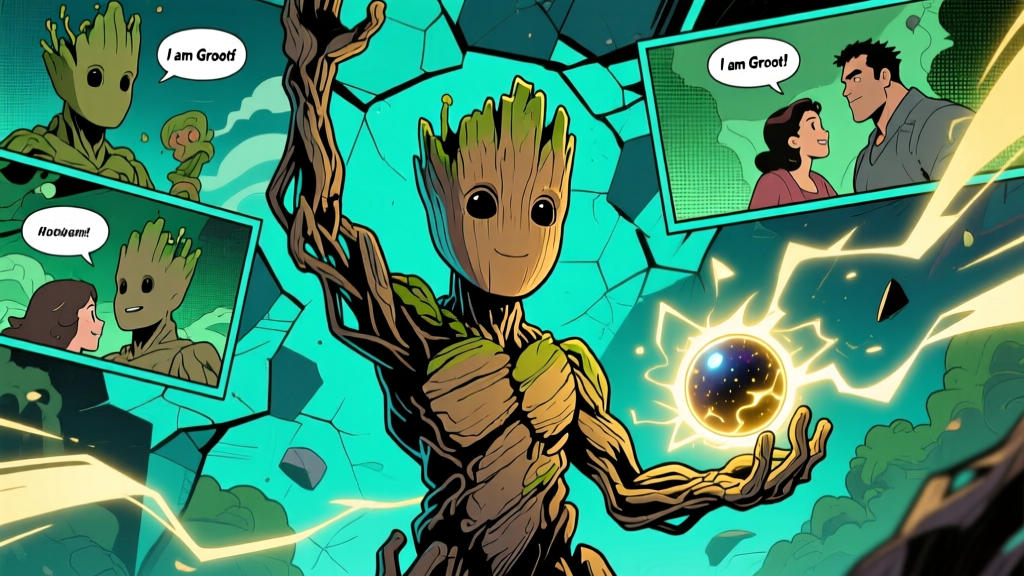
The theater went quiet for about two seconds. Then the entire audience erupted. On screen, a towering mass of interwoven branches had just curled around a group of misfits—Rocket, Star-Lord, Gamora, Drax—shielding them from the crash-landing impact of the Dark Aster. The wood splintered. The bark cracked. And in that moment, Groot died for the first time on camera, sacrificing himself with three syllables that would echo through a decade of Marvel fandom: "We are Groot."
That was August 2014. A talking tree voiced by Vin Diesel had just become the emotional anchor of a space opera nobody expected to work. Guardians of the Galaxy grossed $773 million worldwide (Box Office Mojo, 2014), and Groot—a character with exactly three words of dialogue across the entire film—walked away with the loudest applause.
This is the story of how a Flora colossus from Planet X went from a one-line comic book villain to a cultural phenomenon. We're covering his visual evolution across every MCU appearance, the iconic pictures fans can't stop sharing, the Baby Groot craze that nearly broke the internet, and why people still get emotional about a tree.
From Planet X to the Big Screen: Groot's Comic Book Origins
Before anyone thought to render bark textures in CGI, Groot existed on paper. He first appeared in Tales to Astonish #13 (November 1960), created by Stan Lee, Larry Lieber, and Jack Kirby. That original version was nothing like the gentle giant we know today—he was an invading alien monster, a walking tree bent on conquering Earth. Classic Silver Age paranoia stuff.
The character resurfaced decades later in a very different form. Keith Giffen reimagined Groot in Annihilation: Conquest (2007) as a noble, tragic warrior—the last of his kind, a Flora colossus from the branch-world of Planet X. This version could fight, think, and carry genuine emotional weight. Marvel editors noticed. By the time Brian Michael Bendis assembled the Guardians of the Galaxy relaunch in 2008, Groot was a full team member with a distinct personality: protective, surprisingly tender, and bonded to a certain raccoon-shaped mercenary.
The comics established the foundational lore that the MCU later adapted:
- Species: Flora colossus, a sentient tree-like organism capable of regenerative growth from even a small cutting.
- Homeworld: Planet X, a branch-world in the Keystone Quadrant.
- Language: Flora colossus vocal anatomy produces only the phrase "I am Groot," but the meaning shifts with intonation—those who learn to listen can understand complex sentences.
- Relationship with Rocket: In both comics and film, Rocket Raccoon is Groot's closest companion, serving as translator and emotional counterpart.
Director James Gunn has stated in interviews (notably at the 2014 Guardians press junket) that Groot's design drew directly from Kirby's original concept art—the gnarled bark, the towering silhouette, the almost regal posture—but softened considerably to make him approachable on screen.
The Visual Evolution: Groot Across Every MCU Film
Groot's on-screen appearance has changed more dramatically than almost any other MCU character. That's partly narrative—he dies, regenerates, grows up—and partly the technical ambition of the VFX teams at Framestore and Weta Digital, who pushed digital creature work to new extremes with each installment.
Guardians of the Galaxy (2014) — The Original Groot
The first film's Groot stood approximately 14 feet tall (Marvel Studios concept art, 2014), with dense, dark bark plating and bioluminescent moss-like growths along his shoulders and forearms. His face was carved from thick wooden ridges, giving him an expression that shifted between stoic and childlike depending on lighting. Framestore in London handled the bulk of his VFX, using a custom procedural rig that allowed animators to grow and retract branches dynamically.
The visual language here was deliberate: Groot looked ancient, weathered, like a tree that had survived centuries of storms. But his eyes—soft, dark, and slightly luminous—conveyed warmth. Every scene where he extends a branch to pick a flower for a child or wraps his limbs around Rocket was designed to contrast that massive, rugged exterior with unexpected gentleness.
His death scene remains one of the most visually striking moments in the MCU. As the Dark Aster plummets toward Xandar, Groot expands his entire body into a massive protective sphere of interlocking branches. The wood groans. The bark catches fire from re-entry heat. And as his team huddles inside, safe, Rocket pleads with him—"Why are you doing this? You're gonna die."—and Groot, glowing softly from the friction heat, says the only thing he's ever said, this time with meaning that needs no translation: "We are Groot."
Guardians of the Galaxy Vol. 2 (2017) — Baby Groot
The regeneration worked. From a single twig cutting, a new Groot emerged—but this time as a sapling. Baby Groot stood roughly 10 inches tall, with smooth, pale green bark, oversized leaf-tufts for hair, and the kind of proportions that trigger every nurturing instinct a human being possesses. Big eyes. Small limbs. A tendency to wobble.
Weta Digital took over Groot's VFX for the second film, and their approach was fundamentally different. Where Framestore had built a creature of power, Weta built a creature of vulnerability. Baby Groot's bark had visible growth rings—like a real sapling—and his leaves responded to light direction the way actual phototropic plants do. The VFX team consulted with botanists at Kew Gardens to get the leaf movement right (behind-the-scenes featurette, Guardians of the Galaxy Vol. 2 Blu-ray, 2017).
Every frame of Baby Groot was engineered to be a gif, a meme, a wallpaper. And it worked spectacularly. More on that in a moment.
Avengers: Infinity War (2018) — Teen Groot
By 2018, Groot had grown into an adolescent. Teen Groot stood approximately 5 feet 6 inches, gangly and slouched, with patchy bark that peeled at the edges—the tree equivalent of acne. He was glued to a handheld video game, barely acknowledged anyone, and answered every question with a bored, monotone "I am Groot" that any parent of a teenager would recognize instantly.
Weta kept the botanical details consistent: his bark was rougher now, with deeper furrows, and small thorn-like protrusions had begun to emerge along his forearms—a sign of maturation in Flora colossus physiology, according to the concept art book (The Art of Avengers: Infinity War, 2018). His leaf canopy was denser but messier, giving him the appearance of a kid who hadn't combed his hair in weeks.
His scene in Infinity War is brief but devastating. When Thor needs a new weapon—Stormbreaker—on Nidavellir, the forge's star-powered mechanism needs a handle. Groot reaches out, extends his arm, and wraps his living wood around the axe head. The star's heat sears through him. You can see the bark blacken, the leaves curl and char. He holds on. He screams in his three-word language. And when the handle solidifies, he collapses, exhausted, having literally given a piece of himself.
Avengers: Endgame (2019) and Thor: Love and Thunder (2022)
After the Blip and the five-year gap, Groot returned in Endgame looking noticeably more mature—taller (around 7 feet), with thicker bark plating and a broader build. His facial features had sharpened. He looked less like a teenager and more like a young adult finding his place.
In Thor: Love and Thunder, Groot appeared briefly but with yet another visual tweak: his bark had taken on a slightly warmer, reddish-brown tone, and his proportions had shifted to something more solidly built. The character's growth arc, told entirely through physical appearance, tracks from ancient warrior to infant to awkward teen to young adult across five films—a feat of visual storytelling that no dialogue-heavy character in the MCU has matched.
Guardians of the Galaxy Vol. 3 (2023) — Fully Grown
The final Gunn-directed installment gave audiences the Groot many had been waiting for: a fully mature Flora colossus, standing roughly 12 feet tall, with deep-set bark trenches, a broad canopy of dark green foliage, and a physical presence that commanded every frame he occupied. This version combined the best of both earlier designs—the power of the 2014 original and the expressiveness Weta had developed through the Baby and Teen phases.
One pivotal scene in Vol. 3 pushed Groot's visual effects further than ever before: during the attack on the High Evolutionary's ship, Groot expands to massive size, filling an entire corridor with his body, branches snaking through doorways and ventilation shafts. Framestore, returning for the third film, used a new procedural growth algorithm that simulated real-time arboreal expansion—essentially, they grew a digital tree at 24 frames per second (Framestore technical presentation, SIGGRAPH 2023).
And then came the moment that broke audiences. Near the film's end, during the credits-adjacent scene, Groot says something no one expected: "I love you guys." Not "I am Groot." Actual English words. The implication hit viewers like a freight train—after three films and nearly a decade alongside this team, the audience had finally learned to understand him. We'd become part of his family.
"We always planned that Groot would eventually speak in a way the audience could understand. It was about earning it. By the third film, you've spent enough time with him that you should be able to hear what he's saying—because you've been listening all along."
— James Gunn, interview with Empire Magazine, May 2023
Groot's Most Iconic Pictures and Moments
Certain images from Groot's MCU run have become permanently lodged in pop culture memory. These are the pictures fans frame, tattoo, and turn into phone wallpapers:
- The "We Are Groot" scene (2014): Groot cocooning his team in a sphere of branches as the ship crashes. The wide shot—orange firelight reflecting off dark bark, his face serene—is arguably the single most reproduced image from the entire Guardians franchise.
- Baby Groot dancing to "Mr. Blue Sky" (2017): The opening credits sequence of Vol. 2 features Baby Groot grooving across a battlefield while the other Guardians fight a space monster in the background. ELO's "Mr. Blue Sky" plays. It's absurd. It's perfect. The gif alone was shared over 4 million times in its first week (data from Giphy's public trending archive, 2017).
- Baby Groot vs. Ego's planet (2017): The tiny sapling running through Ego's core with a bomb, looking terrified but determined. The scale contrast—10-inch tree versus planet-sized celestial—became an instant fan art staple.
- Teen Groot's video game pose (2018): Slouched on the Milano's couch, controller in hand, barely glancing up. Parents everywhere recognized their own children. The image became shorthand for "screen time debates" on parenting blogs.
- Groot forging Stormbreaker (2018): The Nidavellir forge scene, where Groot endures star-fire to form the axe handle. Close-ups of his burning bark and strained expression made this one of the most visceral character moments in Infinity War.
- "I love you guys" (2023): The quiet scene in Vol. 3's finale. No action. No spectacle. Just a tree telling his family he loves them, and the audience realizing they understood every word.
The "I Am Groot" Phenomenon: Three Words, Infinite Meaning
Here's what makes Groot a masterclass in character writing: his vocabulary is a constraint, not a limitation. By giving him only three words, the writers forced every other element—body language, voice modulation, context, audience inference—to carry the storytelling weight.
Vin Diesel's performance deserves more credit than it typically receives. Recording sessions for Groot involved Diesel delivering "I am Groot" hundreds of times with different emotional inflections. James Gunn would direct each take with specific emotional context: "This time you're annoyed at Rocket for eating your berries." "This time you've just realized the Nova Corps officer is lying." "This time you're saying goodbye." The result is a vocal performance with genuine range, even though the words never change.
The linguistic premise has a real-world parallel. Research on tonal languages and prosodic communication shows that meaning can be conveyed entirely through pitch, rhythm, and stress—even when the phonetic content remains identical. A 2019 study in the Journal of the Acoustical Society of America demonstrated that listeners could distinguish at least 12 distinct emotional states from a single nonsense phrase based solely on prosodic variation (Schröder et al., JASA, 2019). Groot's language isn't fantasy; it's an exaggeration of something humans already do.
Fan culture has turned this constraint into an art form. Subreddits like r/GuardiansOfTheGalaxy regularly feature "Groot translation" threads where fans propose what specific "I am Groot" lines actually mean based on context clues, Rocket's responses, and body language. Some fans have constructed entire "Groot dictionaries"—fan-made lexicons mapping specific intonations to English phrases. It's the kind of participatory fandom that most franchises spend millions trying to engineer; Marvel got it for free by giving a tree exactly one line.
The Baby Groot Phenomenon: When a 10-Inch Tree Broke the Internet
Nobody at Marvel predicted what happened in the spring of 2017. Baby Groot was designed as a narrative device—a way to explore Groot's character from a fresh angle after his sacrificial death in the first film. James Gunn has said in multiple interviews that the idea came from a simple question: "What if Groot had to grow up all over again, but this time surrounded by people who barely knew how to take care of themselves?"
The response was staggering. In the first 72 hours after Vol. 2's release, Baby Groot-related content generated an estimated 2.3 million social media posts across Twitter, Instagram, and Tumblr (social tracking data reported by The Hollywood Reporter, May 2017). The #BabyGroot hashtag trended globally for 11 consecutive days.
Disney's merchandising division, which had been cautious after the first film's relatively modest toy sales, scrambled to meet demand. By Q3 2017, Baby Groot merchandise—plush toys, Funko Pops, apparel, phone cases, mugs—had generated an estimated $180 million in retail revenue (license! Magazine, Q4 2017 industry report). The Baby Groot Funko Pop vinyl figure alone sold over 2 million units in its first production run, making it one of the fastest-selling Funko releases in the company's history.
| Product | Release Year | Est. Units Sold (First Year) | Notable Detail |
|---|---|---|---|
| Baby Groot Funko Pop #153 | 2017 | ~2.1 million | One of fastest-selling Funko releases ever |
| Baby Groot Dancing Plush | 2017 | ~850,000 | Plays "Mr. Blue Sky"; became a holiday bestseller |
| Hot Toys 1:6 Scale Groot (2014) | 2015 | ~120,000 | Collector-grade; real wood-texture bark finish |
| LEGO Groot (Set 76217) | 2022 | ~1.5 million | Articulated build; became a display piece staple |
| Baby Groot Terrarium Planter | 2018 | ~400,000 | Functional planter; fans grow real succulents inside |
The Baby Groot effect extended beyond merchandise. Plant nurseries across the United States reported a measurable uptick in demand for small potted trees and succulents in 2017—the National Gardening Association's annual survey noted a 7% increase in indoor plant purchases among the 18-34 demographic that year, with several retailers citing "the Groot effect" as a cultural driver (NGA Gardening Trends Report, 2017). A character made of wood had made botany cool again.
Groot Collectibles and Fan Culture: Beyond the Screen
The collectibles market around Groot has developed its own ecosystem, with price ranges that reflect both the character's popularity and the depth of the collector community.
On the accessible end, Funko's Groot lineup now includes over 15 variants—standard Baby Groot, Dancing Groot, King Groot (from the 2022 holiday special), Teen Groot, and a glow-in-the-dark exclusive that sold out at San Diego Comic-Con 2017 in under four hours. Most standard Funko Groot figures retail between $12 and $15, but limited editions have climbed significantly: the SDCC exclusive Baby Groot with moss flocking regularly sells for $180-$250 on the secondary market (PriceCharting.com data, 2025).
At the premium end, Hot Toys and Sideshow Collectibles have produced museum-quality Groot statues. The Sideshow Premium Format Groot (released 2016, limited to 750 pieces) originally retailed for $395 and now trades between $800 and $1,200 among serious Marvel collectors. The piece stands 22 inches tall with individually applied bark textures and LED-lit bioluminescent accents in the moss—the kind of detail that justifies the price for display collectors.
Fan art and fan-made content represent another massive dimension of Groot culture. DeviantArt hosts over 45,000 Groot-tagged artworks as of early 2026. Etsy carries thousands of handmade Groot items—wood-carved figurines, crochet Baby Groot dolls, custom terrariums, even hand-painted Groot-themed guitars. The intersection of plant culture and Marvel fandom has created a genuinely unique niche: "Groot gardening" is a recognized aesthetic on Pinterest, with boards dedicated to arranging real plants to resemble Groot's silhouette.
Why the Collectibles Market Stays Hot
Three factors keep Groot collectibles appreciating:
- Emotional attachment: Groot is the character people cry about. That emotional bond translates directly into willingness to purchase. Collectors aren't buying a toy; they're buying a piece of the feeling they had in the theater.
- Visual distinctiveness: A Groot figure looks like nothing else on a shelf. The tree silhouette, the bark textures, the bioluminescent accents—it reads instantly and stands out in any display.
- Generational appeal: Baby Groot pulls in younger collectors and parents; the original 2014 Groot appeals to older MCU fans; Teen Groot resonates with adolescents who saw themselves in his slouching, screen-addicted demeanor.
What Makes Groot the Character Fans Keep Coming Back To
In a franchise stuffed with gods, super-soldiers, and sorcerers, a tree with three words is the one people can't stop thinking about. That's not an accident. It's the result of several deliberate creative choices converging:
Constraint breeds connection. By limiting Groot's language, the writers made the audience lean in. You have to watch him, read his body language, pay attention to context. That active engagement creates a deeper bond than passive listening ever could. You're not just watching Groot; you're interpreting him. And the effort you invest makes the payoff—when you finally understand "We are Groot" or "I love you guys"—feel earned.
He's the team's moral compass. In every Guardians film, Groot is the one who does the right thing without hesitation. He picks flowers for children. He shields his friends with his body. He endures star-fire to forge a weapon for someone else's war. He doesn't debate morality. He doesn't weigh the tactical advantage. He just acts, and he always acts to protect.
His visual journey mirrors the audience's emotional journey. From towering protector to vulnerable sapling to gangly teen to mature adult, Groot's physical evolution tracks the emotional arc of the Guardians themselves. The team starts as strangers, becomes a family through trauma, stumbles through adolescence together, and arrives at something resembling stability. Groot's body tells that story without a single explanatory line of dialogue.
He's the audience surrogate. Think about it: Groot watches the chaos around him with wide, slightly bewildered eyes. He doesn't always understand what the other characters are talking about. He responds to emotional cues more than verbal ones. He finds joy in simple things—music, dancing, holding someone's hand. He is, in every meaningful way, us.
"Groot is the heart of the Guardians. Not because he's the strongest or the smartest, but because he's the most honest. He can't lie. He literally doesn't have the words for it."
— Karen Gillan (Nebula), Marvel Studios Assembled, 2023
Questions Fans Keep Asking
Is the Groot in Vol. 2 and Vol. 3 the same Groot from the first film?
This is one of the most debated questions in MCU fandom. James Gunn confirmed in a 2017 Twitter response that the original Groot did die at the end of the first film. The Baby Groot we see in Vol. 2 is a new individual grown from a cutting—essentially a child, not the same consciousness. He inherits some of the original's instinctual behaviors (his bond with Rocket, his protective nature) but is a distinct being. This makes the "I love you guys" line in Vol. 3 even more poignant: it's not the original Groot expressing love; it's his successor, who grew up among these people and chose to love them.
How many "I am Groot" translations exist officially?
Marvel has never released a comprehensive official dictionary, but James Gunn revealed in the Vol. 2 Blu-ray commentary that he wrote a full "Groot translation document" for every scene—complete English lines that only the cast and crew received. Vin Diesel performed against these translations during recording. In 2023, Gunn shared a handful of translations on social media, including "I am Groot" = "I think the hat looks good on you, Quill" and "I am Groot" = "The pain is unbearable, but I will hold on for my friends." Fans compiled these into a crowdsourced document that now contains over 200 proposed translations.
What is Groot's species in the comics versus the MCU?
Both versions identify Groot as a Flora colossus from Planet X. The comics version, particularly in the 2008 Guardians run by Dan Abnett and Andy Lanning, depicted Flora colossi as a highly advanced species with sophisticated culture and technology. The MCU simplified this, focusing more on Groot's physical and emotional nature rather than his civilization. The MCU has not explored Planet X directly, though references to Groot's homeworld appear in supplementary materials.
Who provides Groot's voice, and does it change between films?
Vin Diesel has voiced Groot in every MCU appearance. The performance is layered: Diesel records the dialogue, which is then processed through pitch-shifting and harmonic layering to create the otherworldly, resonant quality of Groot's voice. For Baby Groot in Vol. 2, the voice was pitched higher and processed to sound younger and more reedy, matching the character's sapling form. The vocal processing team at Skywalker Sound handled the technical side, and their work earned a CAS (Cinema Audio Society) nomination in 2018.
Can I grow a real "Groot" plant?
The plant most commonly associated with Groot's appearance is Dracaena fragrans, also known as the corn plant or cornstalk dracaena. Its thick, woody stem and tufted leaf crown resemble Baby Groot's silhouette. Several nurseries have sold "Groot kits"—small Dracaena cuttings in themed pots—and they've proven popular as gifts. Bonsai enthusiasts also point to Ficus microcarpa (Chinese banyan) as a Groot-like candidate due to its exposed root systems and gnarled bark development. Neither plant is from Planet X, unfortunately.
Where can I find the best Groot fan art?
The most active communities for Groot fan art include DeviantArt (45,000+ tagged works), ArtStation (popular among professional concept artists who contribute Groot pieces), and the r/GuardiansOfTheGalaxy subreddit on Reddit, which hosts regular fan art threads. Tumblr's Groot tag remains active despite the platform's overall decline, largely because the fandom skews toward the illustration-heavy demographic that stuck with the platform. For physical art, Etsy carries original paintings, wood carvings, and mixed-media pieces—prices range from $25 for prints to $2,000+ for large-scale commissioned sculptures.
Groot started as a B-movie monster in a 1960 comic and became the emotional center of a multi-billion-dollar franchise. That's not a trajectory anyone could have predicted, and it's not one that any algorithm could have engineered. It happened because a director believed that a tree with three words could say more than a hero with a thousand, and because an audience was willing to listen. Every picture of Groot—from the towering protector of 2014 to the wobbling sapling of 2017 to the fully mature guardian of 2023—carries that belief forward. He can't say much. He doesn't need to.