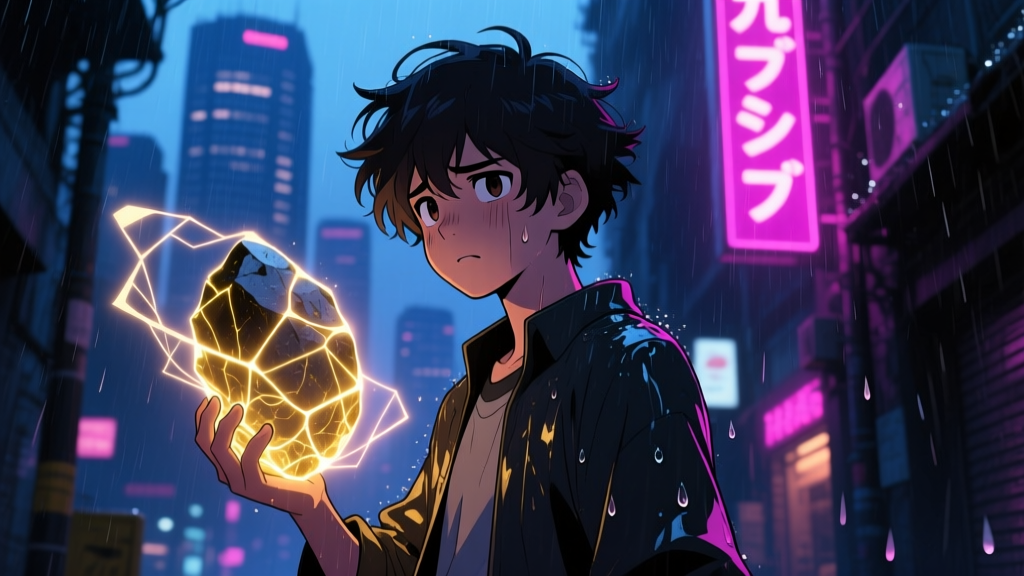
Picture this: you're fifteen, your biggest worry is whether you'll make it to first period without tripping in the hallway, and then you find a fist-sized chunk of alien crystal pulsing with blue light in a drainage ditch. You touch it. It bonds with you. Now you're the sole defender of two civilizations, and the thing under your bed is real and it wants to eat you.
That's Tuesday for Jim Lake Jr.
DreamWorks' Trollhunters, the animated series created by Guillermo del Toro and showrun by the Hageman brothers, dropped on Netflix in December 2016 and quietly became one of the most emotionally ambitious pieces of serialized animation aimed at a younger demographic. At the center of it all was Jim — not a chosen-one archetype in the traditional sense, but a kid who grabbed a rock because his best friend dared him to, and then had to figure out what "being worthy" actually meant when the consequences stopped being metaphorical.
This is a deep look at Jim Lake Jr. across the entire Tales of Arcadia saga — the character, the voice behind him, the armor, the relationships, and why a teenage boy from a fictional California suburb still resonates years after the franchise wrapped.
The Amulet Chose a Nobody — And That Was the Whole Point
The Daylight Amulet wasn't supposed to pick Jim. That's the part most people forget. Merlin designed it to bond with a troll — the strongest, bravest, most troll-ish troll in the pile. Kanjigar the Courageous held it before Bular killed him, and the expectation was always that another troll would take up the mantle. Draal, Kanjigar's own son, fully assumed it was his birthright.
Instead, the Amulet rolled out of a canal pipe and landed at the feet of a lanky sophomore from Arcadia Oaks High who got picked on, lived alone with his overworked mom, and cooked elaborate meals as a coping mechanism because his dad walked out.
The show's writers made a deliberate structural choice here. Jim isn't special because of bloodline or prophecy. The Amulet, according to the lore established in Part 1, responds to whoever picks it up first after a vacancy. Jim happened to be there. Toby Domzalski, his best friend — voiced by Charlie Saxton — was standing three feet away. If Toby had bent down a second faster, the entire franchise would have been about a chubby kid with a bike helmet fighting goblins. The randomness is the point. Heroism, Trollhunters argues, isn't about who you are before the call. It's about what you do after you stop being able to say no.
Jim's initial reaction wasn't noble acceptance. It was terror. He ran. He tried to give the Amulet back. In Episode 4 ("Gnome Your Enemy"), he literally attempts to lose a fight against Bular so the Amulet will leave him. This isn't the behavior of a traditional shounen protagonist screaming about becoming the best. This is a kid processing trauma in real time, and the show gives him space to be afraid without treating that fear as a character flaw to overcome in one episode.
Armor That Actually Changed — Not Just Power Creep for the Sake of It
One thing Trollhunters does better than most animated action series is treat Jim's armor as a narrative barometer rather than a stat upgrade. Every redesign maps to a psychological shift in the character, not just a bigger sword.
Part 1: The Default Plate — Borrowed and Ill-Fitting
When Jim first summons the Armor of Daylight in the pilot, it's clearly designed for a troll's proportions. The shoulders are too wide. The gauntlets are loose. The helmet — with its distinctive forward-swept horns and the Amulet set into the chest plate — looks like a kid wearing his dad's suit. The color palette is gunmetal silver with deep blue energy lines tracing the joints, and the Sword of Daylight is a straightforward broadsword that glows warm gold when charged.
This is intentional visual storytelling. Jim is wearing someone else's legacy. Kanjigar wore this same armor for centuries. It doesn't fit because Jim hasn't earned the right to reshape it yet. The show reinforces this every time Jim trips over his own feet or the helmet slips during a fight. He's cosplaying a hero, not being one.
Part 2–3: The Eclipse Armor and the Shift Toward Something Personal
By the back half of the series, after Jim has survived Gunmar's possession, the Darklands, and the near-destruction of everything he cares about, the armor starts adapting to him rather than the other way around. The silhouette tightens. The horns reshape into something more angular and aggressive. The energy lines shift from blue to a deeper, almost violet tone during moments of extreme stress — a visual callback to the Killahead Bridge battle and the darkness Jim carried out of Gunmar's mind control.
The Eclipse Armor, which appears when Jim temporarily wields both Daylight and the Night Amulet (Shadowbreaker), is the franchise's most visually striking design: black plating with gold fissures and blue energy bleeding through the cracks. It looks like something forged in a place where light and dark stopped being opposites and started being co-dependents. Jim wears it for roughly four episodes across Part 3, and it's telling that the show never lets him get comfortable in it. The Eclipse Armor is power at a cost — it's eating him alive, and the design makes that visible.
Rise of the Titans: The Final Form
In the 2021 film Trollhunters: Rise of the Titans, Jim's armor reaches its final iteration — fully integrated, custom-fitted, with a streamlined silhouette that finally looks like it belongs to him. The horns are shorter and swept back. The chest plate now has the Amulet fully recessed rather than protruding. It's the armor of someone who stopped fighting the role and started inhabiting it. The film's animation budget was noticeably higher than the series, and the armor's detail work — individual plate articulation, energy flow patterns that respond to movement — reflects that upgrade.
| Era | Armor Design | Sword | Narrative Meaning |
|---|---|---|---|
| Part 1 (Ep 1–13) | Standard Daylight plate, oversized, silver with blue lines | Broadsword, gold glow | Wearing someone else's legacy |
| Part 1 (Ep 14–26) | Slightly better fit, minor cosmetic damage and repair | Broadsword, brighter charge | Starting to grow into the role |
| Part 2 (Ep 27–39) | Tighter silhouette, darker energy tones post-Gunmar | Reforged after shattering | Trauma reshaping the vessel |
| Part 3 — Eclipse | Eclipse Armor: black plate, gold fissures, blue bleed | Daylight + Shadowbreaker dual | Power at personal cost |
| Rise of the Titans | Final form: streamlined, custom-fit, recessed Amulet | Redesigned Daylight blade | Acceptance and mastery |
Blinky, Claire, and the People Who Kept Jim Human
You can't talk about Jim Lake without talking about the two beings who anchored him — one a six-eyed troll scholar with four arms and a library obsession, the other a teenage girl from his high school who turned out to be more dangerous than most of the villains.
Blinky: The Father Jim Didn't Know He Needed
Blinkous "Blinky" Galadrigal, voiced by Kelsey Grammer, is nominally Jim's mentor. In practice, he's the first stable adult male in Jim's life. The show never hammers this parallel with a sledgehammer — it's quieter than that. Jim's father left when Jim was young (the exact circumstances are left deliberately vague until later seasons reveal Steve Palchuk's dad as the more visible deadbeat in Arcadia). Barbara Lake, Jim's mother, voiced by Amy Landecker, works constantly and loves her son fiercely, but she's stretched thin. Blinky fills a gap neither of them knew existed.
The training montages between Jim and Blinky in Part 1 are some of the show's warmest material. Blinky's approach to teaching is pure academic enthusiasm — he assigns reading, lectures about troll history, and treats combat preparation like a university syllabus. Jim tolerates this because Blinky is the first teacher who's ever treated him like he's capable of understanding hard things. The scene in Episode 11 ("Recipe for Disaster") where Blinky cooks troll food for Jim and Jim cooks human food for Blinky isn't a throwaway gag. It's two lonely people building a family ritual around a dinner table.
By Part 3, Blinky's relationship with Jim shifts from mentor-student to something closer to equals-in-arms. The moment in "In the Hall of the Troll King" where Blinky defers to Jim's tactical judgment during the Eternal Night crisis — that's the show telling you, without words, that the student has surpassed the teacher. Grammer's voice performance in that scene carries a specific kind of pride: the pride of a parent watching their kid fly solo for the first time.
Claire Nuñez: A Love Story That Didn't Suck
Romance in animated shows aimed at teens is usually a disaster. Love triangles, forced drama, character development that evaporates the moment someone needs to be rescued. Trollhunters mostly dodged these traps with Claire Nuñez, voiced by Lexi Medrano.
Claire starts as a classmate — the smart, slightly intimidating girl Jim has a crush on. What makes their relationship work is that Claire has her own arc completely independent of Jim. She becomes the wielder of the Shadow Staff, a weapon with its own dark sentience, and her struggle to control it runs parallel to Jim's struggle with the Amulet. They're not in the same story; they're in adjacent stories that happen to overlap.
The show's best Claire-and-Jim moment might be in Part 2's "Grand Theft Otto," where Claire uses the Shadow Staff to open a portal to the Darklands to rescue Jim's friends. She's not doing it for Jim. She's doing it because those are also her friends, and she has the power to help. Jim watches her do something terrifying and competent, and his reaction isn't "my girlfriend is so cool" — it's genuine, slightly awed respect. That distinction matters. The show treats Claire's power as hers, not an extension of Jim's.
By the end of Part 3, their relationship has weathered possession, dimensional separation, and the kind of stress that breaks adults. The show doesn't give them a saccharine ending. It gives them something better: mutual survival with respect intact.
"Jim doesn't protect Claire because she can't protect herself. He fights alongside her because she's already proven she can hold her own. That's a rare thing in a kids' show." — Animation analysis by Rebecca Silverman, Anime News Network (2018)
Anton Yelchin's Voice — And the Silence That Follow
You cannot discuss Jim Lake Jr. without discussing the person who gave him a voice, and the fact that this discussion is also an elegy.
Anton Yelchin recorded the bulk of Jim's dialogue for Trollhunters Part 1 across multiple sessions throughout 2015 and early 2016. Yelchin was 26–27 during recording — barely older than the character he was playing, which gave Jim's voice a genuine adolescent texture. Not the polished, adult-woman-voicing-a-boy sound common in anime dubs, but an actual young man's voice cracking slightly on the high notes and dropping into natural warmth during quiet scenes.
Yelchin died on June 19, 2016, in a freak accident when his Jeep Grand Cherokee rolled backward on a steep driveway in Studio City, pinning him against a brick mailbox. He was 27. Trollhunters had not yet premiered. The show's December 23, 2016 launch on Netflix became, unintentionally, one of Yelchin's final public performances.
The production team had enough recorded material to complete Part 1 and portions of Part 2. For later episodes and subsequent seasons, additional voice work was handled through a combination of unused Yelchin recordings and, ultimately, Emile Hirsch taking over the role for Rise of the Titans in 2021. Hirsch, a friend of Yelchin's, approached the role with visible restraint — his Jim is slightly lower, slightly more measured, making no attempt to impersonate Yelchin while still honoring the character's established cadence.
The dedication card at the end of Trollhunters Part 1 reads simply: "For Anton." The show's creators, Guillermo del Toro and the Hageman brothers, have spoken in interviews about how Yelchin brought an earnestness to Jim that surprised them — a willingness to be vulnerable in a role that could easily have been played as one-note action hero bravado.
"Anton understood that Jim's strength was his uncertainty. He played the fear as honestly as the courage. That's why kids connected." — Guillermo del Toro, interview with Collider (2017)
Listening to Yelchin's Jim across the first season, you can hear the choices he made. The way Jim's voice goes up half an octave when he's lying to his mom. The flat, controlled tone he uses when giving orders to trolls who are centuries older than him — a kid imitating confidence until it becomes real. In the scene where Jim first puts on the armor and sees himself in the reflection of a canal wall, Yelchin lets out a breath that's half laugh, half panic attack. It's a tiny, specific human moment in a show about magical rock people, and it works because the actor understood that the fantasy only lands if the human part is honest.
Across the Arcadia-Verse — Jim in 3Below, Wizards, and the Film
The Tales of Arcadia franchise expanded beyond Trollhunters into three interconnected series: Trollhunters (2016–2018, 52 episodes across 3 parts), 3Below (2018–2019, 26 episodes), Wizards (2020, 10 episodes), and the concluding film Trollhunters: Rise of the Titans (2021). Jim appears in all of them, though his role shifts significantly.
In 3Below, which follows alien royals Aja and Krel Tarron hiding in Arcadia, Jim exists mostly as a background presence — a classmate, a known figure in the town. The crossover moments are subtle: Jim and Toby appear in crowd scenes, and there's a blink-and-you'll-miss-it reference to "the kid with the glowing amulet" that confirms the two shows share a continuity. This restraint was smart. 3Below had its own protagonists to develop, and dragging Jim into the spotlight would have undercut Aja and Krel's stories.
Wizards, the Douxie Casperan-focused miniseries, gave Jim a more substantial role. Set partly in the medieval past, the series explores the origins of the Trollhunter mantle through Kanjigar, and Jim appears in the modern-day framing sequences. The show draws explicit parallels between Jim and Kanjigar — both were unexpected choices, both carried the weight of a role they didn't seek, and both found that the armor never quite fits until you stop trying to fill someone else's shape.
Rise of the Titans serves as the franchise's endpoint, and it makes a controversial narrative choice with Jim. Without spoiling every beat, the film puts Jim through a level of sacrifice that goes beyond what the television series ever demanded. The final confrontation with the Arcane Order requires Jim to make a choice that redefines what "being the Trollhunter" means — and the film is brave enough to let that choice have permanent consequences.
| Series | Episodes | Years | Jim's Role |
|---|---|---|---|
| Trollhunters | 52 (3 parts) | 2016–2018 | Protagonist |
| 3Below | 26 (2 parts) | 2018–2019 | Background / Cameo |
| Wizards | 10 | 2020 | Supporting character |
| Rise of the Titans | Film (104 min) | 2021 | Protagonist (finale) |
Why Jim Lake Still Matters — The Character's Legacy in Animation
Strip away the fantasy trappings — the trolls, the magic amulets, the underground civilizations — and Jim Lake Jr. is a story about a kid who learned that responsibility isn't something you're born ready for. You pick it up because it's in front of you and nobody else is reaching for it.
This resonated. Trollhunters became one of Netflix's most-watched animated originals in its debut window, with Nielsen reporting 22 million viewers in its first three weeks (a staggering number for a new animated IP with no theatrical release). The show won two Daytime Emmy Awards — Outstanding Writing in an Animated Program and Outstanding Directing in an Animated Program — in 2017, and was nominated for an Annie Award for Best Animated Television/Broadcast Production for Children.
Jim's impact on the landscape of animated protagonists is harder to quantify but visible in the work that followed. The uncertain, emotionally grounded teen hero became more common in Western animation after Trollhunters proved it could hold an audience. Shows like The Dragon Prince (Netflix, 2018), Kipo and the Age of Wonderbeasts (Netflix, 2020), and even Avatar: The Last Airbender's spiritual successors carried forward the idea that young protagonists could be complex without being cynical.
What sets Jim apart from the crowd, though, is the specificity of his ordinariness. He's not a prince in disguise. He's not the reincarnation of a god. He's not secretly powerful. He's a kid from a broken home in a forgettable suburb who makes good food and rides his bike everywhere and happened to be in the wrong drainage ditch at the right time. The franchise spends 88+ episodes and a feature film arguing that this is enough — that being ordinary doesn't disqualify you from doing extraordinary things. It just makes the cost higher and the fear more real.
For the otaku community specifically, Jim occupies a unique space between Western animation and anime sensibilities. Trollhunters drew heavily from shounen and mecha traditions — the transformation sequence, the escalating power forms, the mentor figure, the tournament arcs (the "Gumm-Gumm" challenge in Part 2 is straight out of the shounen playbook). Jim himself reads like a deconstructed shounen lead: the kid who would normally get a power-up montage instead gets a panic attack and a therapy session with a four-armed troll who quotes Merlin at him.
The Phrase Everyone Remembers
"For the glory of Merlin, Daylight is mine to command."
Jim speaks this incantation to summon his armor, and it became the show's signature line — the equivalent of a henshin call in tokusatsu or a Bankai declaration in Bleach. Yelchin delivered it with a specific cadence: reverent on "Merlin," emphatic on "Daylight," almost breathless on "command," as if the words themselves were a physical effort. The line appears in nearly every episode of Part 1, slightly less frequently in Parts 2 and 3 as Jim's summoning becomes more instinctual and less ritualistic.
In Rise of the Titans, the final time Jim speaks the incantation, the delivery is different. Slower. Quieter. Not because the power has diminished — because the boy who first said those words in a panic in a drainage ditch is gone, and the person who replaced him knows exactly what the words cost.
Frequently Asked Questions
Was Jim Lake always meant to be human?
Yes. Guillermo del Toro and the Hageman brothers designed the concept around a human holding a troll artifact from the earliest development stages. The contrast between a fragile, mortal teenager and an ancient, immortal civilization was the show's foundational creative tension. Early concept art from 2014, later shared by del Toro on social media, shows Jim in a rougher armor design that leaned more heavily into medieval knight aesthetics before the production settled on the final streamlined look.
How old is Jim Lake Jr.?
Jim is 15 years old at the start of Trollhunters Part 1 and 16 by the events of Part 3 and Rise of the Titans. The franchise's timeline spans roughly 18 months of in-universe time from the pilot to the film's conclusion. He's a sophomore at Arcadia Oaks High School, later a junior.
Why did Emile Hirsch replace Anton Yelchin as Jim's voice?
Anton Yelchin passed away in June 2016, before Trollhunters premiered. He had completed recording for Part 1 and portions of Part 2. For Rise of the Titans (2021), the production brought in Emile Hirsch — a close friend of Yelchin's — to voice Jim. Hirsch intentionally did not attempt a direct imitation, instead offering a performance that honored the character's emotional continuity while acknowledging the passage of time.
Does Jim end up with Claire at the end of the series?
Without spoiling every detail of Rise of the Titans, Jim and Claire's relationship remains one of the franchise's most enduring emotional threads. The film makes narrative choices that complicate a simple "do they end up together" answer, but the show consistently treats their bond — romantic and otherwise — as genuine and earned. The franchise prioritizes emotional honesty over tidy resolution.
Is Jim Lake considered a strong protagonist compared to other animated heroes?
Among Western animated protagonists of the 2010s, Jim is widely regarded as one of the more emotionally nuanced teen leads. Unlike many "chosen one" characters, Jim's power never scales beyond his humanity — he remains physically outmatched by most trolls throughout the series, and his victories rely on tactical thinking, emotional intelligence, and stubbornness rather than raw strength. This approach influenced subsequent animated series and earned the character comparisons to a more grounded, Western take on the shounen protagonist archetype.
What does "Jim Lake" as a name mean in context?
The name "Jim Lake" is almost certainly a deliberate play on "daylight" — the Amulet he wields. Jim's mother, Barbara Lake, also shares the surname. Whether the show's creators intended this as a subtle linguistic connection or it's a happy coincidence has never been officially confirmed, but the fandom has noted the parallel since Part 1. Jim's full name — Jim Lake Junior — also echoes the show's theme of legacy: he's a junior in every sense, inheriting a role, a name, and expectations that aren't originally his.
Sources: DreamWorks Animation Television production notes (2016–2018); Netflix viewership data via Nielsen (January 2017); Daytime Emmy Awards records (2017); Annie Awards nomination archive (ASIFA-Hollywood, 2017); Guillermo del Toro interview with Collider.com (January 2017); Anton Yelchin memorial coverage, The Hollywood Reporter (June 2016); Rebecca Silverman animation analysis, Anime News Network (2018).
#JimLakeJr #Trollhunters #TalesOfArcadia #AntonYelchin #DreamWorks #OtakuCulture #GuillermoDelToro