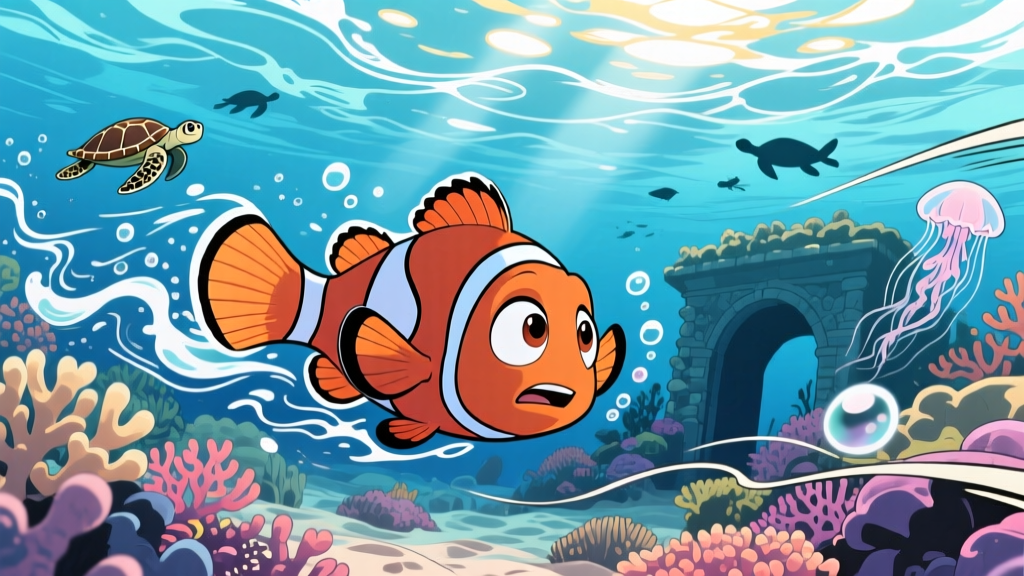
A clownfish with a small fin vanishes into the blue. His father — neurotic, terrified, hopelessly out of his depth — crosses an entire ocean to find him. That premise, stripped to its bones, sounds like a Pixar pitch that could have flopped. Instead, Finding Nemo (2003) became the highest-grossing animated film of its era, spawned a billion-dollar sequel, colonized a theme park at Epcot, generated a multi-season television series, and moved enough merchandise to stock a small country's worth of aquariums. The finding nemo series is not just a pair of movies. It is a franchise that rewired how studios think about animated IP — and two decades later, fans still have not stopped swimming.
The Drop-Off That Started It All: Finding Nemo (2003)
Andrew Stanton had been at Pixar since the studio's earliest days, contributing story work to Toy Story and directing segments of A Bug's Life. But Finding Nemo was different. The idea came partly from a childhood memory — Stanton's father once took him to a tide pool and told him not to touch anything — and partly from watching his own son play at a park, that parental tension between protection and freedom. The Great Barrier Reef became the canvas for a story about letting go.
The plot is deceptively simple. Marlin (Albert Brooks), a clownfish living in a sea anemone on the Great Barrier Reef, loses his son Nemo to a scuba diver. Nemo ends up in a dentist's office aquarium in Sydney Harbour. Marlin sets off across the open ocean, paired with Dory (Ellen DeGeneres), a blue tang with short-term memory loss. Along the way they encounter sharks, jellyfish, sea turtles, and a whale — while Nemo, inside the tank, engineers his own escape plan with a ragtag group of aquarium fish.
What elevated the film beyond a simple adventure was its emotional architecture. Marlin's journey is not really about finding his son. It is about confronting the terror that drove him to be overprotective in the first place. Dory, comic on the surface, carries a quiet sadness — she cannot remember who she is, and no one has ever stayed with her long enough to find out. That layering of humor over genuine pathos became a Pixar signature, and Finding Nemo was the film that perfected it.
The numbers told the story. Finding Nemo grossed $871 million worldwide on a $94 million production budget, making it the highest-grossing film of 2003 and, at that time, the second-highest-grossing animated film ever. It won the Academy Award for Best Animated Feature at the 76th Academy Awards (2004), beating out The Triplets of Belleville and Brother Bear. It also earned a nomination for Best Original Score (Thomas Newman), and it held the record for the best-selling DVD in history — over 40 million copies sold by 2006, according to the Digital Entertainment Group. Rotten Tomatoes gives it a 99% approval rating based on 265 reviews.
"I was trying to find something that was universal to all parents — that fear of not being able to protect your kid. The ocean is the perfect metaphor for that. It's beautiful, and it will kill you."
Thirteen Years Later: Finding Dory Crashes the Box Office
Sequels at Pixar were once rare enough to feel like events. Toy Story 2 (1999) had been a miracle; Toy Story 3 (2010) was a cultural moment. So when Finding Dory was announced for a 2016 release, thirteen years after the original, the question was whether audiences still cared about a forgetful blue tang fish.
They did. Finding Dory opened to $135 million domestically in its first weekend — the biggest animated opening in North American history at that point, surpassing Minions (2015). It went on to earn $1.029 billion worldwide against a reported $200 million budget, becoming only the fourth animated film to cross the billion-dollar mark. Andrew Stanton returned to direct, this time with co-director Angus MacLane.
The story flips the original's structure. Where Nemo was lost and Marlin searched, now Dory is the one searching — for her parents, Jenny (Diane Keaton) and Charlie (Eugene Levy), whom she was separated from as a fry. Fragments of memory lead her to the Marine Life Institute in Morro Bay, California, a rehabilitation-and-release facility that functions as a sort of fish hospital. Marlin and Nemo follow, and the film becomes a heist story as much as a reunion story — Dory recruiting Hank the septopus (Ed O'Neill), Destiny the whale shark (Kaitlin Olson), and Bailey the beluga whale to navigate the facility's pipes, tanks, and quarantine zones.
Critics were warm but measured. Finding Dory holds a 94% on Rotten Tomatoes (based on 338 reviews) and a 77 on Metacritic, compared to the original's near-perfect scores. The common note was that the sequel lacked the original's emotional surprise — Dory's sadness was no longer a revelation — but compensated with richer world-building and some of Pixar's most technically accomplished animation. The underwater caustics, the octopus rigging for Hank (who required a completely new animation system), and the crowd simulation for the Marine Life Institute visitors pushed Pixar's render farm to its limits.
Finding Nemo vs. Finding Dory: A Side-by-Side Breakdown
| Metric | Finding Nemo (2003) | Finding Dory (2016) |
|---|---|---|
| Director | Andrew Stanton, Lee Unkrich | Andrew Stanton, Angus MacLane |
| Production Budget | $94 million | $200 million |
| Worldwide Gross | $871 million | $1.029 billion |
| Opening Weekend (Domestic) | $70.3 million | $135.1 million |
| Rotten Tomatoes | 99% (265 reviews) | 94% (338 reviews) |
| Metacritic Score | 90 | 77 |
| Academy Awards | Best Animated Feature (won) | No nominations |
| Runtime | 100 minutes | 97 minutes |
The Reef's Who's Who: Characters That Refuse to Be Forgotten
One of the franchise's quiet achievements is its character density. Between two films, a TV series, theme park appearances, and endless merchandise, the Finding Nemo universe has built a roster that rivals most long-running anime for sheer personality count.
The Core Trio
Marlin — voiced by Albert Brooks across both films and the series. A clownfish (Amphiprion ocellaris) whose entire personality is shaped by trauma: he lost his mate Coral and all but one of their eggs to a barracuda attack. His overprotectiveness of Nemo is not a character flaw to be corrected but a grief response the story asks us to understand. Brooks brings a specific energy — fast-talking, anxious, self-aware enough to know he is being unreasonable but unable to stop.
Nemo — voiced by Alexander Gould in the first film, Hayden Rolence in the sequel. Nemo's smaller right fin (referred to in-film as his "lucky fin") was a deliberate choice by the filmmakers to give him a visible vulnerability without making it the plot's central problem. He is resourceful, stubborn, and — crucially — the one who ultimately saves himself from the dentist's tank.
Dory — Ellen DeGeneres in every appearance. The character was originally written as male; DeGeneres was cast after Stanton heard her change topics mid-sentence on her talk show and realized she was performing short-term memory loss in real time. Dory's condition (anterograde amnesia, in clinical terms) is treated with a lightness that never becomes mockery. In Finding Dory, her parents teach her to use shells as breadcrumb trails — a workaround, not a cure — and that specificity is what makes the emotional payoff land.
The Tank Gang (Finding Nemo)
The dentist's aquarium in Sydney Harbour houses one of Pixar's best ensemble casts. Gill (Willem Dafoe), a Moorish idol with a scarred face and a history of failed escape attempts, serves as Nemo's mentor inside the tank. Bloat (Brad Garrett) is a pufferfish who inflates at the slightest provocation. Gurgle (Austin Pendleton), a royal gramma, is obsessed with cleanliness. Peach (Allison Janney) is a starfish permanently stuck to the tank glass. Bubbles (Stephen Root) is a yellow tang fixated on the treasure chest's air bubbles. Deb (and her reflection "Flo," both voiced by Vicki Lewis) is a black-and-white humbug damselfish who believes her reflection is her sister. And Jacques (Bruce Spence), a cleaner shrimp, speaks in a French accent and compulsively cleans everything.
The Open Ocean Cast
Bruce (Barry Humphries) is a great white shark who has sworn off eating fish and runs a support group ("Fish are friends, not food"). Anchor (Eric Bana) and Chum (Bruce Spence) are his hammerhead and mako shark friends. Crush (Andrew Stanton himself) is a 150-year-old sea turtle who surfs the East Australian Current and speaks like a California surfer — one of the film's most quotable characters. Squirt, Crush's son, mirrors Nemo's relationship with Marlin from the other side: a young creature whose parent trusts him completely. Nigel (Geoffrey Rush) is a brown pelican who acts as the bridge between the ocean world and the dentist's office.
Finding Dory Additions
Hank (Ed O'Neill) is the breakout addition — a seven-armed octopus (he lost a tentacle, hence "septopus") who can camouflage, squeeze through gaps, and walk on land. Pixar built an entirely new procedural animation system to handle his body mechanics; a single shot of Hank moving could take six months to render. Destiny (Kaitlin Olson) is a nearsighted whale shark who keeps bumping into walls. Bailey is a beluga whale who has convinced himself his echolocation is broken. And Fluke and Rudder (Idris Elba and Dominic West) are a pair of California sea lions who guard their rock with aggressive territorial pride — comic relief that somehow works every time.
Under the Sea at Epcot: The Seas with Nemo & Friends
Disney did not wait long to turn the franchise into a physical experience. The Seas with Nemo & Friends opened on January 24, 2007, at Epcot's The Seas pavilion in Future World, replacing the original The Seas dark ride that had operated since 1986. The attraction reuses the pavilion's existing Omnimover ride system — the same clamshell-shaped vehicles from the original — but overlays the aquarium windows with projected animated characters using a technique Disney calls "Sea-cabs" (sea-calibrated animated back-projection).
The ride lasts approximately six minutes. Riders board the clamshell vehicles and descend beneath the surface, where projected versions of Marlin, Nemo, and Dory swim alongside the real fish in the 5.7-million-gallon aquarium. The projected characters interact with the live environment — Dory bumps into a real sea turtle, Nemo hides behind actual coral. At one point, Bruce the shark appears on projection and the vehicle "shakes" as he charges, a simple vibration effect that sells the moment better than any screen could.
The pavilion also houses Turtle Talk with Crush, a live interactive show where a puppeteer-controlled Crush (projected onto a screen behind a window into the aquarium) improvises conversations with audience members in real time. The show opened in 2004, before the ride itself was rethemed, and it remains one of Epcot's most popular attractions because of its unpredictability. Crush responds to specific questions from kids (and adults), and no two shows are identical. The puppeteer uses a real-time animation rig that translates their facial expressions and voice into Crush's movements — a technique borrowed from Disney's Who Wants to Be a Millionaire: Play It! technology.
In 2023, as part of Epcot's ongoing transformation, the pavilion received updated projections and lighting, though the core ride experience remained unchanged. Attendance data is not publicly broken out by individual Epcot attractions, but The Seas pavilion consistently ranks among the park's top five most-visited installations, according to TouringPlans crowd-tracking estimates.
Saturday Morning Reef: The Animated Series
Finding Nemo: Reef School — sometimes listed simply as Finding Nemo — was a series of animated shorts produced by Pixar for Disney Channel and Disney Junior. The shorts ran from 2012 to 2016, spanning approximately three seasons and 55 episodes (each running 3–5 minutes). A separate series, Finding Nemo: Adventures in Fish School, produced 3-minute episodes distributed through Disney's digital platforms.
The shorts focus on Nemo, Dory, and their reef friends in slice-of-life scenarios — Nemo's first day at Mr. Ray's school, Dory misplacing something (repeatedly), Pearl the flapjack octopus squirting ink at the wrong moment, and Sheldon the seahorse getting stuck in things. The voice cast was recast for the series (Albert Brooks and Ellen DeGeneres did not reprise their roles), which is standard practice for Disney's TV adaptations of theatrical properties.
The series occupies a specific niche in the Finding Nemo franchise ecosystem. It is not prestige animation — the production values are noticeably lower than the films, with simpler lighting and less detailed environments — but it serves the function of keeping the characters visible between theatrical releases. For a generation of children who saw Finding Nemo on home video and Finding Dory in theaters, the shorts bridged the thirteen-year gap and maintained brand recognition. Disney Junior's internal metrics, as reported in a 2015 Kidscreen industry report, showed that Finding Nemo shorts consistently ranked in the top ten most-requested properties among the 2–5 demographic.
The shorts were never going to match the films. That was not the point. The point was to keep Nemo and Dory in the rotation — on screens, in living rooms, in the minds of kids who would eventually drag their parents to the theater for Finding Dory.
From Plush to Premium: Collectibles Across Both Films
The Finding Nemo franchise is a merchandising juggernaut, though Disney has been strategically inconsistent about how aggressively it pushes the IP. The first film's merchandise wave (2003–2006) was massive and immediate. Mattel and Jakks Pacific produced action figures, playsets, and bath toys. Ty Inc. released Beanie Babies of Nemo, Dory, Bruce, Crush, and the Tank Gang — the Nemo Beanie Baby alone became one of the company's top sellers in 2003, with secondary market prices briefly reaching $40–60 before mass reprints collapsed the value.
The Finding Dory merchandise cycle (2015–2017) was larger in scope but more disciplined in execution. Disney had learned from over-saturating the market with Cars 2 merchandise that underperformed. For Finding Dory, the product lineup emphasized three tiers:
- Mass market — Mattel figures, Jakks Pacific playsets, Hasbro's "Tank Zone" line, and LEGO's single Finding Dory set (the Submarine Explorer, set 10723, released in 2016 with 92 pieces)
- Mid-range collectibles — Funko Pop! figures (Nemo, Dory, Bruce, Crush, Hank, and a limited-edition "Glow in the Dark" Dory exclusive at Hot Topic), Loungefly mini-backpacks, and Bioworld apparel
- Premium/collector — Sideshow Collectibles produced a limited-run "Dory in Flight" polystone statue (edition of 500, retail $285). Disney also released a Vinylmation series featuring Finding Nemo characters, with the 5-inch Dory figure commanding resale prices above $120 on eBay as of 2025
Trading pins deserve a separate mention. Disney pin trading is its own subculture, and Finding Nemo pins have been a consistent presence since 2003. The "Nemo and Friends" hidden Mickey pin set (2004, set of 8) remains one of the more sought-after early-2000s sets among pin traders, with complete mint sets selling for $150–200. Limited-release pins from D23 Expo events — particularly the 2015 "Finding Dory Preview" pin, given only to D23 Gold Members — have traded for $80–100 on secondary markets.
Apparel has been a steady earner. The "Just Keep Swimming" graphic tee has been reissued by Disney in various designs since 2004, appearing in collaborations with Uniqlo (2017, Japan-exclusive UT line), H&M (2019, global kids' collection), and Zara (2022, limited capsule). According to Disney's annual licensing disclosures, the Finding Nemo/Dory IP generated an estimated $2.1 billion in cumulative merchandise revenue between 2003 and 2020, a figure that includes toys, apparel, home goods, publishing, and digital content.
Notable Collectibles Quick Reference
| Item | Year | Original Retail | Resale Range (2025) |
|---|---|---|---|
| Ty Beanie Baby — Nemo | 2003 | $5.99 | $8–15 |
| LEGO Submarine Explorer (10723) | 2016 | $9.99 | $25–40 (sealed) |
| Funko Pop! Glow-in-Dark Dory | 2016 | $10.99 | $35–55 |
| Sideshow "Dory in Flight" Statue | 2017 | $285.00 | $300–450 |
| Disney Pin "Nemo & Friends" Set | 2004 | $24.95 | $150–200 (complete) |
| Vinylmation 5" Dory | 2014 | $29.95 | $100–140 |
Beyond the Screen: The Franchise in Fan Culture
The Finding Nemo franchise occupies a specific space in otaku and collector culture that differs from most Disney/Pixar properties. Unlike Star Wars or Frozen, which generate massive fan-fiction and cosplay ecosystems, Finding Nemo fandom clusters around three specific activities: aquarium keeping, pin trading, and animation craft appreciation.
The aquarium connection is the most culturally significant. After Finding Nemo released in 2003, demand for clownfish as pets spiked by an estimated 40%, according to a 2006 study published in the journal Conservation Biology (Raghuram et al.). The irony was not lost on marine biologists — a film about rescuing a fish from captivity was driving demand for captive fish. The "Nemo Effect" became shorthand in conservation circles for the unintended consequences of media on wildlife demand. Fortunately, clownfish are among the few saltwater species that breed readily in captivity, which limited the pressure on wild reef populations. The sequel repeated the pattern: blue tang sales increased noticeably in 2016, though blue tangs cannot be commercially bred and must be wild-caught, prompting renewed concern from organizations like the Marine Aquarium Council.
On the animation craft side, Finding Nemo holds a particular place among animators and VFX professionals. The original film's water simulation was groundbreaking — Pixar developed new techniques for caustic lighting, subsurface scattering on fish skin, and procedural current motion that are still referenced in animation courses. The film's technical achievement papers, presented at SIGGRAPH 2003, became required reading in graduate-level computer graphics programs. Finding Dory pushed further: Hank the octopus alone required a custom rig with over 350 individual control points and a procedural suckers-on-surfaces algorithm that took two years to develop.
Among anime and otaku communities, Finding Nemo gets respect as craft. It regularly appears on curated lists of "animated films that hold up" alongside Studio Ghibli titles. On MyAnimeList, Finding Nemo holds a user rating of 8.10/10 from over 180,000 users — a score that places it in the top 500 animated titles on a platform dominated by Japanese anime. That crossover appeal — a Western CGI film earning credibility in a community built around hand-drawn Japanese animation — is rare, and it speaks to the storytelling fundamentals that transcend style and origin.
The Finding Nemo Series — Questions Fans Actually Ask
Is there a Finding Nemo 3 in development?
As of mid-2026, Pixar has not announced a third Finding Nemo film. Andrew Stanton has said in interviews that he considers Dory's story complete and that he has no active plans to return to the franchise. Pixar's current slate through 2028 includes original projects and a Toy Story 5, but no Finding Nemo sequel. That said, the franchise's billion-dollar performance makes it unlikely to stay dormant forever — Disney's IP strategy has never been one to leave billion-dollar franchises on the shelf indefinitely.
What species is Dory, and can she actually have memory loss?
Dory is a blue tang (Paracanthurus hepatus), a surgeonfish native to Indo-Pacific reefs. Her depicted condition — anterograde amnesia, the inability to form new long-term memories — is a real neurological condition in humans, typically caused by hippocampal damage. Fish do not have hippocampi in the mammalian sense, so the condition as portrayed is a creative liberty. That said, the filmmakers consulted with marine biologists at the Monterey Bay Aquarium during production of both films to ensure that fish behavior (schooling, cleaning symbiosis, current riding) was grounded in real biology, even where the emotional storytelling took liberties.
Is the Tank Gang still at the dentist's office in Finding Dory?
Yes — in a post-credits scene from Finding Dory, the Tank Gang is shown still inside their plastic bags (from the escape at the end of the first film), bobbing in the ocean off the California coast. Gill remarks, "Now what?" It is a darkly comic gag — they have been floating in bags for over a year — and it doubles as a sequel hook that has not yet been followed up on.
Where can I ride The Seas with Nemo & Friends?
The attraction operates daily at Epcot, inside The Seas pavilion in the World Nature neighborhood (formerly Future World) at Walt Disney World Resort in Bay Lake, Florida. No Genie+ reservation is required — it is a standby-only attraction. The adjacent Turtle Talk with Crush show runs on a separate queue. Both are included with standard Epcot admission.
Which Finding Nemo collectibles are actually worth buying?
For long-term value retention, the Sideshow Collectibles polystone statues (limited editions) and sealed Disney pin trading sets have shown the most consistent appreciation. Funko Pop! exclusives (particularly the Glow-in-the-Dark Dory) hold moderate value. Mass-market items like Beanie Babies and standard Mattel figures have limited resale potential due to high production volumes. The safest bet for collectors: buy sealed, keep receipts, and prioritize items with confirmed limited production runs.
The reef keeps growing. Whether it is a kid pressing their face against the glass at Epcot, a collector tracking down a 2004 pin set, or someone rewatching Marlin's opening monologue and getting wrecked for the dozenth time — the Finding Nemo series has a way of pulling people back under. P. Sherman, 42 Wallaby Way, Sydney. Some addresses you never forget.